

Telescope Advisor Logo Telescope Advisor
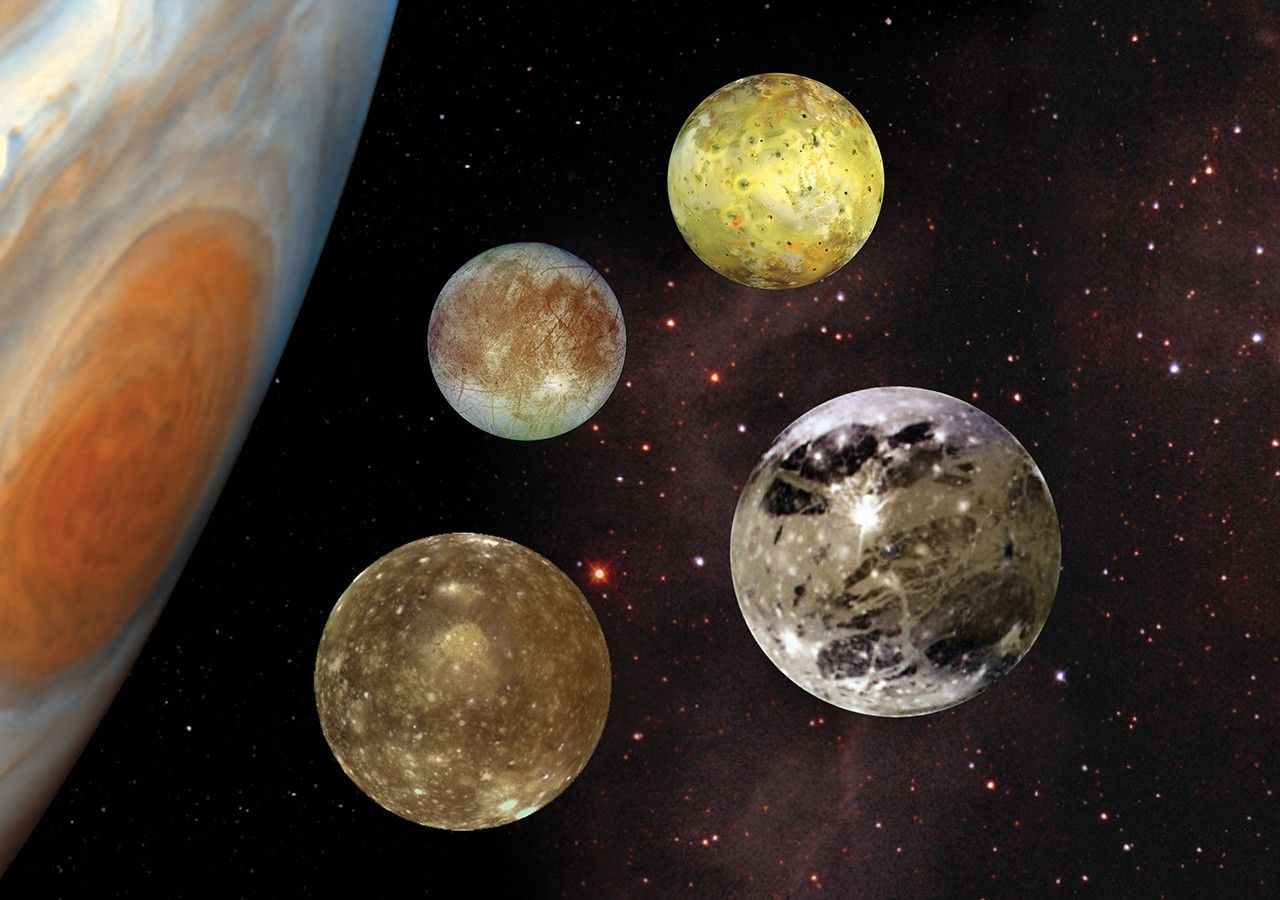
Jupiter with its four Galilean moons — Io, Europa, Ganymede, and Callisto — arranged in a family portrait captured by NASA's Cassini spacecraft, with the Great Red Spot visible on the planet's surface

Observing Guide · Jupiter · Planetary Science

Jupiter's Moons: How to See Io, Europa, Ganymede, and Callisto Through a Telescope

Jupiter's four largest moons — Io, Europa, Ganymede, and Callisto — are among the most rewarding and accessible objects in the solar system for amateur telescope owners. Discovered by Galileo Galilei in 1610, these four worlds orbit Jupiter in a celestial dance that changes night by night, offering observers a front-row seat to the dynamic nature of our solar system. This guide covers everything you need to observe them, identify them, and understand the unique character of each moon.

Brightest moonGanymede (mag 4.6)
Min. equipmentBinoculars (7×50+)
Best seasonAny — Jupiter visible ~8 months/year
Total moons95 known — 4 visible
By Elena Reyes Published: Updated: Reviewed & approved by Juhi Sahni, Senior Editor Editorial Standards
Elena Reyes — Senior Science Editor

Elena Reyes

Senior Science Editor

Covers NASA missions, space science discoveries, and astronomical events for Telescope Advisor. Translates complex astrophysical research into practical insights for backyard observers. Based in the San Francisco Bay Area.

The Four Galilean Moons: A Miniature Solar System

When Galileo Galilei turned his primitive telescope toward Jupiter on January 7, 1610, he noticed three small "stars" lined up near the planet. Over the following nights, he realised they were not fixed stars but bodies orbiting Jupiter — the first clear evidence that not everything in the heavens revolved around Earth. This discovery shattered the geocentric model of the universe and laid the foundation for modern astronomy.

Today, we know Jupiter has at least 95 confirmed moons, but the four Galilean satellites — Io, Europa, Ganymede, and Callisto — remain the only ones visible to amateur observers. Each is a world unto itself: Io is the most volcanically active body in the solar system; Europa harbours a global subsurface ocean that may contain alien life; Ganymede is the largest moon in the solar system, bigger than Mercury; and Callisto is a heavily cratered time capsule of the early solar system. Together, they form a miniature solar system that changes appearance every single night.

Through even a modest telescope, the four moons appear as bright points of light arranged in a line across Jupiter's equatorial plane. Their positions shift nightly as they orbit the planet — Io completes a full orbit in just 1.8 days, while Callisto takes 16.7 days. This constant motion means every observing session offers a unique configuration.

The Four Galilean Moons Compared

Moon Magnitude Diameter Orbit Period Distance from Jupiter Best Viewed
Io 5.0 3,643 km 1.8 days 422,000 km 4-inch+ scope (shows colour)
Europa 5.3 3,122 km 3.6 days 671,000 km 8-inch+ (shows surface brightness variations)
Ganymede 4.6 5,268 km 7.2 days 1,070,000 km Visible in binoculars; 6-inch+ shows disc
Callisto 5.6 4,821 km 16.7 days 1,883,000 km Visible in binoculars; farthest from Jupiter

Ganymede, at magnitude 4.6, is the brightest and easiest to spot — it would be easily visible to the naked eye from a dark site if Jupiter's glare did not overwhelm it. All four moons are visible in 10×50 binoculars when Jupiter is well-placed in the sky, appearing as tiny stars in a row. Through a 4-inch telescope at 100×, the moons resolve into tiny discs, and under good conditions, subtle colour differences become apparent — Io appears slightly yellow-orange from its sulphur volcanoes, while Europa and Ganymede show a grey-white hue.

How to Identify Each Moon

Identifying which moon is which requires either an astronomy app (like Stellarium, SkySafari, or the free NASA/JPL Eyes on the Solar System web app) or a bit of knowledge about their orbital patterns. Here are the key identification strategies:

Use an App or Online Tool

The easiest method: apps like Stellarium Mobile, SkySafari, or the free website Sky & Telescope's Jupiter's Moons Javascript utility show a real-time diagram of the moon positions. Compare what you see at the eyepiece with the diagram to instantly identify each moon.

Track Orbital Motion

If you observe on consecutive nights, you can identify moons by their motion. Io moves fastest — its position changes noticeably after just an hour of observing. Ganymede and Callisto move more slowly and stay farther from Jupiter. Europa moves at an intermediate pace. If a moon disappears behind Jupiter or crosses in front of it, the timing of that event confirms its identity.

By Distance from Jupiter

Callisto is always the farthest from Jupiter due to its wide orbit — it appears well separated from the other three. Ganymede is the next farthest out. Io and Europa orbit closer to Jupiter and can sometimes be hidden in the planet's glare when they cross in front or behind. If you see a moon very close to Jupiter, it is almost certainly Io or Europa.

What Equipment Do You Need?

One of the joys of observing Jupiter's moons is that almost any optical instrument will reveal them. Here is what you can expect at different equipment levels:

Binoculars (7×50 or 10×50)

The four moons appear as tiny points of light in a straight line. Use a tripod or steady your arms against a solid object. Ganymede and Callisto are easiest; Io and Europa can be harder to spot when close to Jupiter's glare. Binoculars will not show any surface detail on the moons, but you can track their positions night to night.

Small Telescope (3–4 inch / 76–100mm)

At 75–100×, all four moons are clearly visible and show tiny discs. Io's slight orange tint becomes detectable on nights of good seeing. You can observe moon shadows crossing Jupiter's face during shadow transits — Io's shadow is the easiest to spot as a tiny black dot moving across the planet's cloud tops. Occultations (moons passing behind Jupiter) and eclipses (moons passing through Jupiter's shadow) are visible as the moon fades and reappears.

Moderate Telescope (6–8 inch / 150–200mm)

At 150–200×, the moons show distinct discs and surface brightness variations. Ganymede appears as a tiny grey disc with brighter polar caps (ice). Callisto shows a darker, more uniform disc. Io and Europa appear as small but distinct discs. Shadow transits become more dramatic — Ganymede's shadow is large and dark, while Europa's is smaller but still clearly visible. On exceptional nights, you can observe two shadows simultaneously crossing Jupiter — a rare but spectacular sight.

Special Events: Shadow Transits, Occultations, and Eclipses

Beyond simply seeing the four moons, amateur astronomers can witness a range of dynamic events as the moons interact with Jupiter. These events occur predictably and can be timed using free online calculators from the Sky & Telescope Jupiter Moons Calculator or the NASA/JPL Horizons System.

Shadow Transits

When a moon passes between the Sun and Jupiter, its shadow falls on Jupiter's cloud tops. Through a telescope, this appears as a tiny black dot moving across the planet's face — one of the most exciting sights in amateur astronomy. Io's shadow is the darkest and easiest to see. Ganymede's shadow is larger but slightly softer-edged. Transit times are predictable to within minutes and can be looked up online.

Occultations

When a moon passes behind Jupiter (as seen from Earth), it disappears from view. Occultations can happen gradually as the moon slides behind the planet's limb, or abruptly if the moon passes directly behind. Watching a moon vanish and later reappear on the other side is a satisfying observation.

Eclipses

When a moon passes through Jupiter's shadow, it dims or disappears entirely. Unlike an occultation, the moon does not physically go behind Jupiter — it simply fades as it enters the planet's shadow cone. Io experiences this every 1.8 days, and its reappearance from eclipse (when it suddenly brightens) is a dramatic sight best observed at high power.

A Closer Look at Each Moon

Io — The Volcanic World

Io is the innermost of the Galilean moons and the most volcanically active body in the solar system, with over 400 active volcanoes. Its surface is covered in sulphur compounds, giving it a distinctive yellow-orange hue that can be detected through an 8-inch telescope on nights of excellent seeing. Io's volcanic activity is driven by tidal heating — Jupiter's immense gravity constantly flexes the moon as it orbits, generating enormous internal friction that melts its interior. The moon's orbit period of just 1.8 days means its position changes noticeably in a single observing session — you can watch it move relative to Jupiter in as little as 30 minutes.

Europa — The Ocean Moon

Europa is perhaps the most scientifically compelling moon in the solar system. Beneath its smooth, icy crust — the smoothest surface of any solid body in the solar system — lies a global saltwater ocean estimated to be 60–150 km deep, containing more than twice the volume of all Earth's oceans combined. This ocean is kept liquid by tidal heating, and NASA's Europa Clipper mission (arriving 2030) will investigate its potential habitability. Through a telescope, Europa appears as a bright, white disc — the brightest of the four moons due to its highly reflective ice surface. It is the second closest moon to Jupiter and shows less colour variation than Io or Ganymede.

Ganymede — The Largest Moon in the Solar System

Ganymede is a true giant — at 5,268 km in diameter, it is larger than the planet Mercury and the ninth-largest object in the solar system (bigger than Pluto, Eris, and all the other dwarf planets combined). It is the only moon in the solar system with its own internally generated magnetic field, likely produced by a liquid iron-nickel core. Through a 6-inch telescope under good conditions, Ganymede appears as a distinct grey disc, and careful observers may notice subtle brightness variations between its darker, older regions and its brighter, icy polar caps. Ganymede's orbit period of 7.2 days makes it ideal for multi-night tracking.

Callisto — The Ancient Time Capsule

Callisto is the outermost of the Galilean moons and the most heavily cratered object in the solar system. Its surface is ancient — approximately 4 billion years old — and records the violent history of the early solar system. Unlike the other three moons, Callisto shows no evidence of volcanic or tectonic activity; it has been geologically dead for most of its history. Through a telescope, Callisto appears slightly dimmer than the other moons and can be identified by its greater separation from Jupiter — it orbits nearly twice as far as Ganymede. The moon's dark, uniform surface makes it look greyer than Ganymede, and it shows the least colour variation of the four.

Frequently Asked Questions

Can you see Jupiter's moons with binoculars?

Yes. 7×50 or 10×50 binoculars will easily show all four Galilean moons as points of light in a line on either side of Jupiter. A tripod helps steady the view.

Which is the brightest of Jupiter's moons?

Ganymede is the brightest at magnitude 4.6, followed by Io (5.0), Europa (5.3), and Callisto (5.6). Ganymede would be visible to the naked eye from a dark site if Jupiter's glare did not overwhelm it.

Why do Jupiter's moons change position every night?

Each moon orbits Jupiter at a different speed — Io takes 1.8 days, Europa 3.6 days, Ganymede 7.2 days, and Callisto 16.7 days. Their relative positions shift constantly, creating a different configuration every night.

What is a shadow transit on Jupiter?

A shadow transit occurs when one of Jupiter's moons passes between the Sun and Jupiter, casting a shadow onto the planet's cloud tops. Through a telescope, this appears as a tiny black dot moving slowly across Jupiter's surface — one of the most dramatic sights in amateur astronomy.

What size telescope do I need to see detail on Jupiter's moons?

An 8-inch (200mm) telescope at 150–200× can show Ganymede as a small disc with brighter polar caps. Io's orange tint becomes visible under good conditions. For detailed surface features, a 10–12 inch scope and excellent seeing are required.

How many moons does Jupiter have?

As of 2026, Jupiter has 95 confirmed moons. The four largest — Io, Europa, Ganymede, and Callisto — are the only ones visible with amateur telescopes. The remaining 91 are much smaller and fainter, ranging from 1 km to 250 km in diameter.