Every Stage of Star Formation in One Image
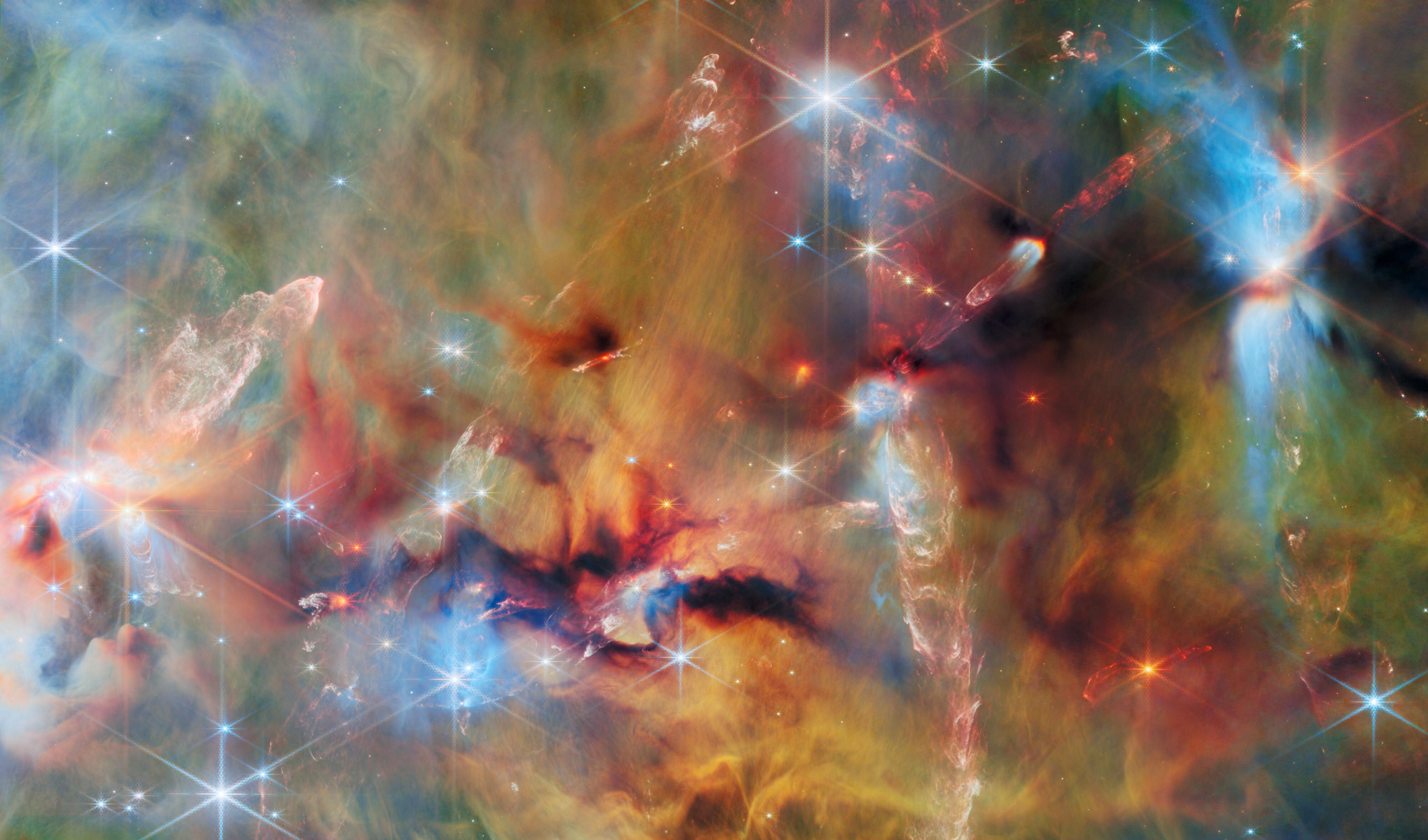
One of the most remarkable aspects of this Webb image is that it captures the full sequence of star formation within a single panoramic frame. Here is what astronomers can identify at different locations across the field.
Stage 1: Dense Cores and Pre-Stellar Clumps
The darkest regions in the image — the opaque brown and black globules — are pre-stellar cores: dense knots of gas and dust that have not yet begun to collapse under their own gravity. These are the seeds of future stars. In visible light, they appear completely black because the dust is so thick that it absorbs all background starlight. Webb's infrared vision pierces through some of this dust, revealing the subtle temperature gradients within these cores that signal the earliest stages of gravitational collapse.
Stage 2: Embedded Protostars (Class 0 and Class I)
At the heart of many of the bright, complex structures in the image are protostars — stars in the process of being born. These objects are still deeply embedded in their natal cocoons of gas and dust. They are not directly visible even to Webb; instead, astronomers detect them by the bright outflows and jets they produce. As gas falls onto the protostar from a surrounding circumstellar disc, the immense gravitational energy is converted into heat, powering the protostar's glow and driving powerful bipolar jets from its poles. These jets create glowing shockwaves (the sharp, bright ridges visible in the image) as they slam into the surrounding molecular cloud at hundreds of kilometres per second.
Stage 3: Protoplanetary Discs (Class II)
As the protostar accumulates mass and the surrounding envelope of gas dissipates, the remaining material settles into a flattened, rotating disc — a protoplanetary disc (or "proplyd"). These discs are the birthplaces of planets. In the Webb image, they appear as small, bright ellipses or edge-on dark silhouettes against the glowing background. The Orion Nebula is already famous for the dozens of proplyds Hubble revealed; OMC-2 is expected to yield a comparable population, though at an earlier evolutionary stage when planet formation is just beginning.
Stage 4: Pre-Main-Sequence Stars (Class III)
The large, bright stars that have cleared away the surrounding gas and dust and now illuminate the OMC-2 region are pre-main-sequence stars — young stars that have finished accreting mass but have not yet begun hydrogen fusion in their cores. They are the most evolved objects in the image, and their brilliant blue and white appearance contrasts starkly with the dark, dusty cradles that still surround their younger siblings.
The simultaneous presence of all four stages in one field makes OMC-2 an extraordinary laboratory. Astronomers can compare, for example, the outflow activity of Class 0 and Class I protostars under the same external conditions, or measure how the properties of protoplanetary discs evolve as the central star matures — all within a single observational programme.