Louisiana Meteor Fireball June 28, 2026: Green Fireball Spotted Over 5 Southern States
Telescope Advisor
Breaking Sky Event · June 28, 2026
Louisiana Meteor Fireball: Brilliant Green Flash Lights Up the Pre-Dawn Sky Over 5 Southern States
A spectacular green fireball blazed across south Louisiana and surrounding states at 5:03 a.m. on Sunday, June 28, 2026 — captured by multiple cameras and reported by hundreds of observers from Texas to Alabama.
5:03 AM
Local time
5 States
Visible across
Green
Color reported
−3 mag
AMS fireball threshold
By Telescope Advisor Editorial Team|Published: |Reviewed & approved by Juhi Sahni, Senior Editor|Editorial Standards
Juhi Sahni
Senior Editor, Space News
Telescope Advisor
Senior Editor at Telescope Advisor, overseeing space news coverage and holding editorial responsibility for everything published on the site. Coverage includes NASA and ESA mission updates, JWST and Roman Space Telescope findings, sky-event guides, and equipment analysis that ties space science back to practical observing. Every factual claim is verified against primary sources — NASA/JPL Horizons, the International Meteor Organization, the US Naval Observatory, and mission briefings — before publication. LinkedIn →
Sky Event UpdateEvent: June 28, 2026 at 5:03 a.m. CDT|Published: |Source: American Meteor Society
What Happened: The Louisiana Fireball of June 28
At approximately 5:03 a.m. Central Daylight Time on Sunday, June 28, 2026, a large meteoric object entered Earth's atmosphere over the Gulf South region, producing a brilliant green fireball visible across at least five states — Louisiana, Mississippi, Alabama, Arkansas, and Texas.
Witnesses described a vivid green ball of light trailing fire across the pre-dawn sky before ending in a bright terminal flash. The event was captured by multiple cameras in the Sky9 regional camera network, with particularly clear footage from a camera atop Our Lady of the Lake Hospital on Essen Lane in Baton Rouge, Louisiana, as well as doorbell and security cameras from Denham Springs and St. Francisville.
There is currently no evidence the fireball survived its atmospheric passage to reach the ground as a meteorite. The American Meteor Society received numerous reports from observers across the region.
What Is a Fireball — and Why Was It Green?
The American Meteor Society defines a fireball as any meteor that reaches an apparent visual magnitude of −3 or brighter — roughly equivalent to the planet Venus at peak brightness. Only a small fraction of meteors reach this threshold. A bolide is an even brighter fireball that typically produces a sonic boom or visible fragmentation.
Why the green colour?
The green glow reported by Louisiana observers is characteristic of magnesium and oxygen burning in the outer layers of the meteoroid as it ablates at high altitude. At speeds of 11–72 km/s, frictional heating vaporises the rock, exciting atmospheric atoms and the meteoroid's constituent minerals into emitting light at specific wavelengths. Magnesium produces a strong green emission line at 518 nanometres. A bright green fireball typically indicates a magnesium-rich ordinary chondrite — the most common meteorite type.
How big was the object?
Without seismic or infrasound data, exact size is difficult to determine from visual reports alone. However, a fireball visible across five states at pre-dawn — when background sky is dark and eyes are dark-adapted — typically implies an object in the range of 10 centimetres to 1 metre in diameter before atmospheric entry. Larger objects tend to fragment at altitude; the terminal flash reported by witnesses is consistent with fragmentation rather than ground impact.
Did any meteorites reach the ground?
Based on current reporting, there is no confirmed ground impact or meteorite recovery. The bright terminal flash suggests the object fully fragmented at high altitude. If meteorites did fall, they would be located east to northeast of the last visible point — consistent with the observed trajectory. The AMS encourages observers who find unusual rocks to contact the AMS meteorite identification service.
Is This Part of a Meteor Shower?
The June 28 fireball does not appear to be associated with any active major meteor shower. The nearest active shower in late June is the Daytime Arietids (peaks June 7–8) and the June Boötids (peaks June 27), but visual fireballs from these showers are uncommon and the reported trajectory has not been confirmed as matching either radiant.
This appears to be a sporadic meteor — a meteoroid on an independent orbit, not associated with a known cometary debris stream. Sporadic fireballs occur year-round at a rate of roughly 5–10 per hour globally across the entire sky. Most are too faint to see; reaching fireball brightness requires an unusually large or fast-moving object.
PerseidsPeak Aug 11–13 · 100+ ZHR · Northern hemisphere best · Low moon 2026
OrionidsPeak Oct 21–22 · 20 ZHR · Associated with Halley's Comet
LeonidsPeak Nov 17–18 · 15 ZHR · Swift fast meteors
How to Observe Meteors and Fireballs With a Telescope
Events like the Louisiana fireball raise a common question: can I use my telescope to see meteors better? The answer is nuanced — and often surprising to new astronomers.
Why telescopes are NOT ideal for fireball watching
A telescope's narrow field of view — typically 0.5° to 2° — makes it almost impossible to track a fast-moving meteor crossing tens of degrees of sky in under a second. The magnification that makes Jupiter beautiful makes it physically impossible to follow a fireball in real time. For meteor shower observing, a telescope works against you.
What actually works: naked eye and wide-field binoculars
For fireball watching, naked-eye observing is king. Dark skies, a reclining chair, and a full-sky view give you the widest chance of catching a bright meteor. Wide-field binoculars (7×50 or 10×50) increase the limiting magnitude you can detect, revealing fainter meteors — but their field advantage over naked eye is modest for shower observing. The pre-dawn hours (3–5 a.m.) are statistically the richest for meteors because you are facing forward into Earth's orbital motion.
Where telescopes add value: meteor spectroscopy and photography
Advanced amateur astronomers use telescopes with diffraction grating attachments to capture meteor spectra — identifying the mineral composition of meteoroids from their light signature. The green colour of the Louisiana fireball, for example, would show a strong magnesium emission line in a spectrum. Wide-field camera setups on tracking mounts are also used to image meteors on long exposures, capturing multiple trails per frame during active showers.
Meteor shower observing — naked-eye gives you the widest sky coverage
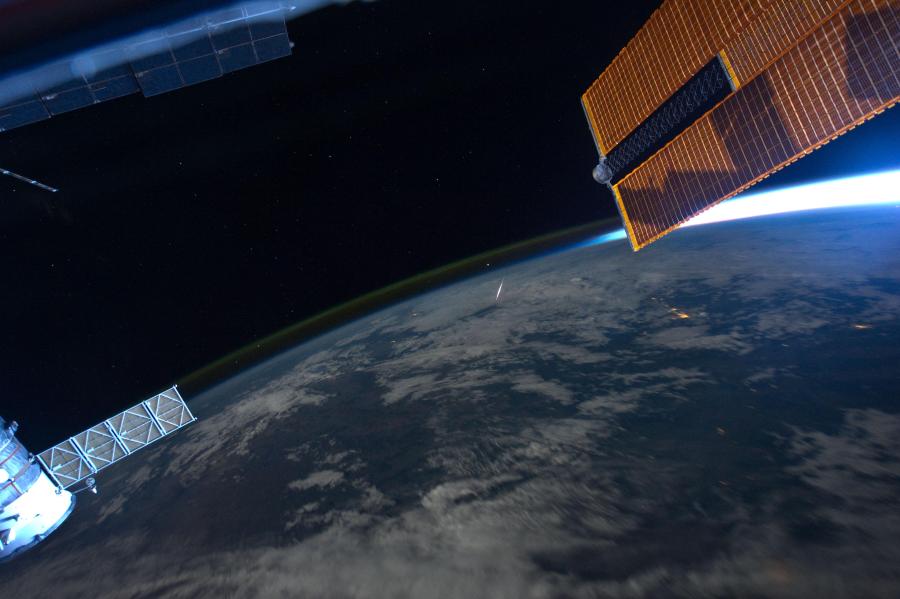
Credit: NASA. Public domain.
Did You See It? How to Report a Fireball to the AMS
If you witnessed the June 28 fireball — or any future fireball — your report is scientifically valuable. The American Meteor Society uses crowd-sourced sightings to triangulate trajectory, entry angle, and terminal point of fireballs. Each additional report improves the accuracy of the orbital solution.
When reporting, try to include: the time you saw it, the direction it was travelling (compass bearing), how high above the horizon it appeared, the duration, any colours or sounds, and whether you saw fragmentation or a terminal flash. Video or photo evidence is especially helpful.
The fireball was reported at approximately 5:03 a.m. Central Daylight Time on Sunday, June 28, 2026.
What states could see the Louisiana fireball?
The fireball was spotted across at least five southern states: Louisiana, Mississippi, Alabama, Arkansas, and Texas.
Why was the fireball green?
The green colour is produced by magnesium and oxygen burning as the meteoroid ablates at high altitude. Magnesium — common in ordinary chondrite meteorites — emits strongly at the green wavelength of 518 nanometres when excited by heat.
Did any meteorites fall from the Louisiana fireball?
No confirmed meteorite recovery has been reported. The bright terminal flash suggests the object fragmented fully at altitude. If debris did reach the ground, it would be east to northeast of the last visible flash point.
Is this part of the Perseid meteor shower?
No. This appears to be a sporadic meteor — not associated with any known active shower radiant. The Perseids peak in mid-August; the nearest active shower in late June is the June Boötids, but the trajectory does not match that radiant.
Can I see a fireball with a telescope?
A telescope is not ideal for watching fireballs or meteor showers — its narrow field of view makes it impossible to track fast-moving meteors in real time. Naked-eye observing from dark skies gives you the best chance of seeing fireballs.