NASA Swift Telescope Boost Mission Launches From Marshall Islands
Telescope Advisor
Breaking Space News · Updated July 4, 2026
NASA Swift Boost Mission Launches Successfully From Marshall Islands
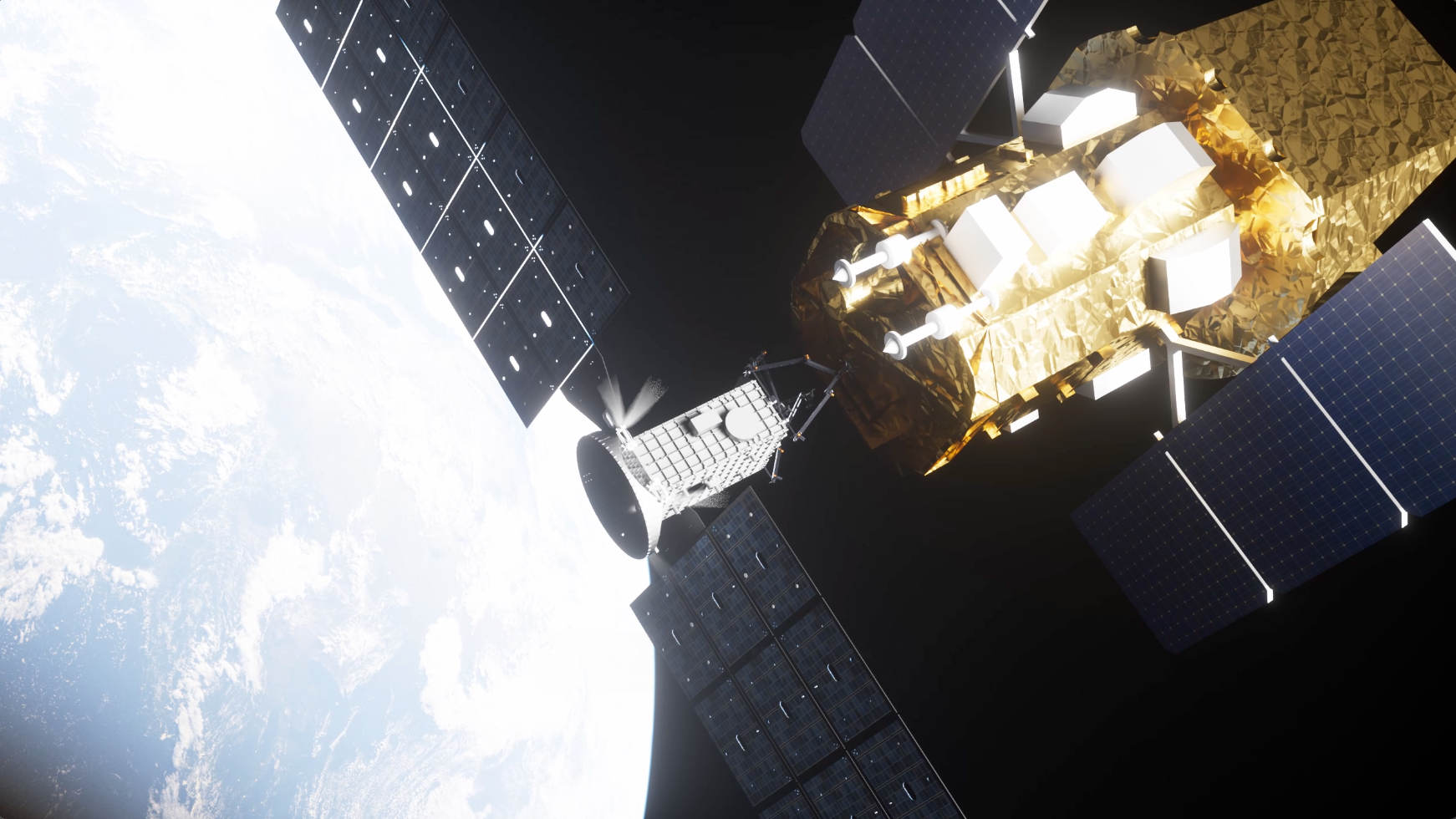
Katalyst Space's LINK spacecraft launched Friday, July 3 from Kwajalein Atoll aboard a Pegasus XL rocket. Now in orbit, LINK will chase down NASA's 20-year-old Swift Observatory and push it back to a safe altitude.
July 3
Launch completed
$30M
Mission cost
20 yrs
Swift in orbit
+149 mi
Orbit to be raised
By Telescope Advisor Editorial Team|Published: |Reviewed & approved by Juhi Sahni, Senior Editor|Editorial Standards
Juhi Sahni
Senior Editor, Space News
Telescope Advisor
Senior Editor at Telescope Advisor, overseeing space news coverage and holding editorial responsibility for everything published on the site. Coverage includes NASA and ESA mission updates, JWST and Roman Space Telescope findings, sky-event guides, and equipment analysis that ties space science back to practical observing. Every factual claim is verified against primary sources — NASA/JPL Horizons, the International Meteor Organization, the US Naval Observatory, and mission briefings — before publication. LinkedIn →
LaunchedUpdated: |LINK spacecraft in orbit — signal acquisition in progress|Sources: NASA Swift mission page
Quick Answer: What Is Happening to the Swift Telescope?
NASA's Neil Gehrels Swift Observatory — the spacecraft that has detected thousands of gamma-ray bursts since 2004 — is sinking toward Earth's atmosphere due to 20 years of orbital decay accelerated by intense solar activity. Without intervention, Swift is expected to fall below the safe altitude of 186 miles by October 2026, at which point atmospheric drag would pull it down uncontrollably.
To prevent this, NASA awarded a $30 million contract to startup Katalyst Space Technologies. Their autonomous spacecraft, named LINK, launched successfully on July 3, 2026 at 4:36 a.m. EDT (8:36 p.m. Marshall Islands Time) from Kwajalein Atoll aboard a Northrop Grumman Pegasus XL rocket, deployed from the company's Stargazer L-1011 aircraft at approximately 40,000 feet over the South Pacific Ocean. LINK will spend roughly one month chasing Swift, dock with it using its three robotic arms, and then fire its thrusters over the following months to raise Swift's orbit from 224 miles to 373 miles — buying the observatory potentially another decade of scientific life.
What Is the Neil Gehrels Swift Observatory?
Swift launched on November 20, 2004 from Cape Canaveral aboard a Delta 7320 rocket. It was designed for one specific purpose: detect and characterize gamma-ray bursts (GRBs) — the most energetic explosions in the universe since the Big Bang — fast enough to alert ground-based telescopes before the afterglow faded.
Burst Alert Telescope (BAT)
Covers 1.4 steradians of sky simultaneously. Detects gamma-ray bursts and alerts the spacecraft within seconds to slew autonomously toward the source.
X-Ray Telescope (XRT)
Measures X-ray afterglow with 5 arcsecond positional accuracy. Gives astronomers coordinates precise enough to point ground-based telescopes at the source.
UV/Optical Telescope (UVOT)
Captures visible and ultraviolet light simultaneously with X-ray data, enabling Swift to study GRB afterglows across six wavelength bands in a single observation.
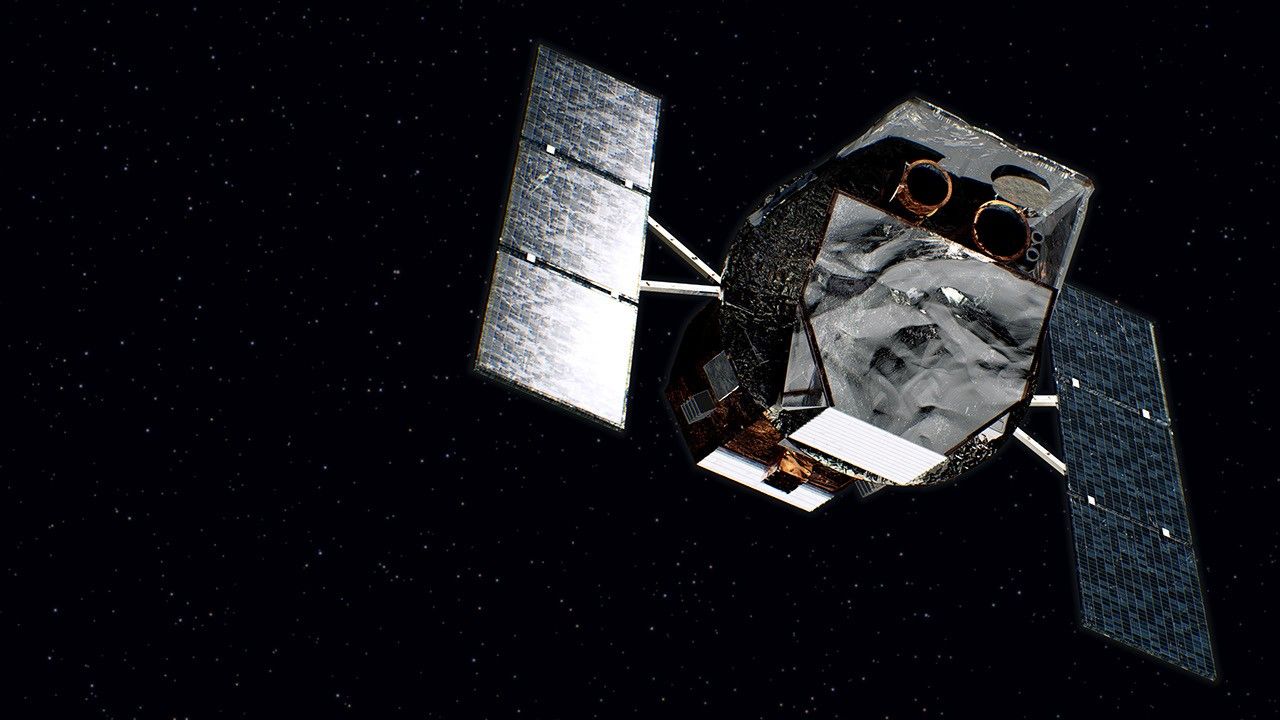
The Neil Gehrels Swift Observatory
Credit: NASA/Goddard Space Flight Center. Public domain.
In 20 years of operations, Swift has detected more than 1,600 gamma-ray bursts, observed thousands of X-ray binaries, novae, and supernovae, and contributed to discoveries including the first electromagnetic counterpart to a gravitational wave event. It is one of NASA's most scientifically productive observatories — delivering more peer-reviewed papers per operational dollar than almost any other mission in the agency's history.
Its ability to autonomously slew to a new target within 20–75 seconds of detecting a burst — and immediately transmit coordinates to 40 ground observatories worldwide — remains unique. No currently funded replacement mission replicates that capability.
Why Is Swift Falling? The Solar Activity Connection
Every satellite in low Earth orbit loses altitude over time. Residual atmosphere at those heights creates drag, slowing the spacecraft and causing it to gradually spiral inward. Swift was designed with this in mind — but orbital decay is not a constant rate.
Solar activity directly affects atmospheric density even at Swift's altitude. During solar maximum — the peak of the Sun's approximately 11-year activity cycle — increased ultraviolet and X-ray output heats Earth's upper atmosphere, causing it to expand. The result: more air molecules at any given altitude, more drag, and faster orbital decay. Solar Cycle 25, which peaked in 2025–2026, has been significantly more active than predicted, with higher-than-expected solar maximum intensity. Swift has been sinking faster than its designers modeled.
The October deadline
Swift currently orbits at approximately 224 miles (360 km) altitude. Once it falls below 186 miles (300 km) — projected to occur by October 2026 — Katalyst's LINK spacecraft may no longer be able to match Swift's orbit to execute the docking. LINK launched July 3 and is now in orbit, beginning its rendezvous chase.
How the Rescue Mission Works: Pegasus, LINK, and the Rendezvous
The mission architecture is unlike any prior NASA operation. There is no crewed element. Everything from launch to docking to orbital raising is autonomous.
Northrop Grumman's Pegasus XL rocket
The Pegasus XL launched Katalyst Space's LINK spacecraft from Kwajalein Atoll on July 3, 2026 as part of NASA's mission to boost the Swift Observatory. Photo Credit: Northrop Grumman.
1
July 3 launch — Pegasus rocket from Kwajalein Atoll
Northrop Grumman's Stargazer L-1011 carrier aircraft flew to Kwajalein Atoll in the Marshall Islands carrying Katalyst's LINK spacecraft attached to a Pegasus XL rocket. At approximately 40,000 feet, the Pegasus was released, ignited, and delivered LINK to its initial orbit at 4:36 a.m. EDT (8:36 p.m. Marshall Islands Time) on Friday, July 3.
2
One month rendezvous — LINK chases Swift
LINK's autonomous navigation system uses a combination of GPS and optical sensors to close the distance to Swift over approximately 30 days. The three-armed spacecraft is designed to clamp to Swift's exterior without requiring any specific docking port on the observatory. As of July 4, the Katalyst team is acquiring LINK's signal and confirming its solar panels and power systems are operational.
3
Two-to-three month orbital raising — 224 to 373 miles
Once attached, LINK fires its thrusters in a series of controlled burns over several months, gradually raising the combined stack's orbit from 224 miles to the target of 373 miles (600 km). At 373 miles, orbital decay will be negligible for another decade or more under even aggressive solar conditions.
4
Swift resumes science operations
With the mission complete, Swift continues detecting gamma-ray bursts, novae, and other transients — sending real-time alerts to ground observatories worldwide as it has for two decades. Katalyst's LINK remains attached or detaches, depending on mission parameters.
Rescue spacecraftKatalyst Space Technologies "LINK"
Mission cost$30 million (NASA contract)
Current orbit224 miles / 360 km
Target orbit373 miles / 600 km
Rendezvous timeline~30 days
Orbit-raising timeline2–3 months
Why This Matters for Astronomy — and Why It Is Historic
This is the first time NASA has contracted a commercial company to perform an autonomous rendezvous and orbit-raising operation on an existing science spacecraft. While robotic servicing has been studied and demonstrated at smaller scales, this mission marks the first fully autonomous commercial rescue of a NASA observatory.
From an astronomical standpoint, Swift's continued operation matters because:
Real-time GRB alerts. No other operational spacecraft can detect a gamma-ray burst and transmit coordinates to ground telescopes within minutes of detection. When Swift detects a burst, observatories from Hawaii to the Canary Islands pivot within seconds to catch the optical afterglow before it fades.
Multi-messenger astronomy. Swift alerts are coordinated with gravitational wave detectors (LIGO, Virgo) to identify electromagnetic counterparts to merging neutron stars — the events that forge heavy elements including gold and platinum.
No funded replacement. NASA's next-generation high-energy observatory, the Compton Spectrometer and Imager (COSI), will not launch until 2027 at the earliest and does not fully replicate Swift's rapid-response capability.
20 more years of data. Extending Swift's baseline to 30+ years enables long-term population studies of GRB rates, types, and host galaxies that are simply not possible with shorter datasets.
What This Means for Amateur Astronomers
Can you see Swift?
Swift is not typically visible to the naked eye at magnitude +6 or brighter, but it can be tracked with modest telescopes. Satellite tracking sites like Heavens-Above.com list Swift pass times by location. During the rendezvous phase, both LINK and Swift may appear as a slow-moving point of light in clear skies.
How do Swift detections affect your observing?
When Swift detects a bright GRB, the coordinates are published in real time to the Gamma-ray Burst Coordinates Network (GCN). Amateur astronomers with fast-slewing computerized mounts and sensitive cameras have successfully captured GRB optical afterglows — some peaking at magnitude 5–8, visible in modest instruments within minutes of the alert.
Mission Status: Launched
Launch: July 3, 2026 at 4:36 a.m. EDT (8:36 p.m. MIST)
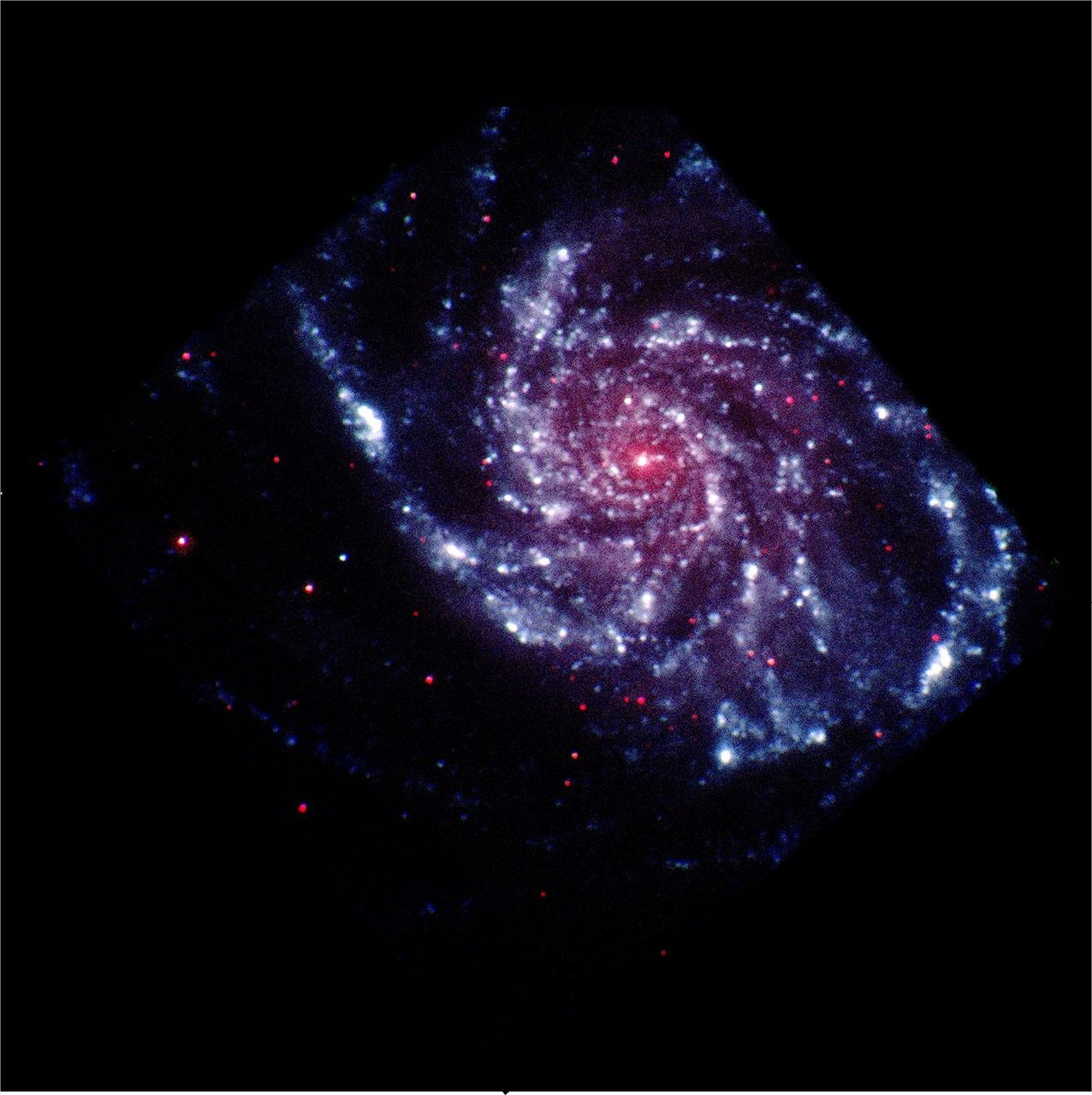
Galaxy M101 (Pinwheel Galaxy) — imaged by Swift's UVOT in ultraviolet
This is a sample of the science that would be lost if Swift re-enters. Credit: NASA/Swift/UVOT. Public domain.
Frequently Asked Questions
When did the Swift boost mission launch?
July 3, 2026 at 4:36 a.m. EDT (8:36 p.m. Marshall Islands Time) from Kwajalein Atoll, aboard a Pegasus XL rocket dropped from the Stargazer aircraft at ~40,000 feet. The LINK spacecraft reached orbit and the team is now acquiring its signal.
What is Katalyst Space Technologies's LINK spacecraft?
LINK is an autonomous three-armed spacecraft built by Katalyst Space Technologies under a $30 million NASA contract. It launched July 3 and is designed to clamp onto Swift, fire its thrusters, and raise its orbit from 224 to 373 miles.
Why is the Swift telescope falling back to Earth?
Swift orbits in low Earth orbit where residual atmosphere creates constant drag. Solar Cycle 25 has been more active than predicted, expanding Earth's upper atmosphere and increasing drag faster than Swift's designers modelled. Without intervention, Swift would re-enter the atmosphere uncontrolled.
Will Swift burn up safely if the mission fails?
NASA would conduct a controlled de-orbit to ensure any surviving debris falls in an uninhabited ocean area. However, the goal is to save the observatory so it can continue two more decades of science operations.
What does Swift study and why does it matter?
Swift studies gamma-ray bursts — the most energetic explosions in the universe — and other high-energy transients including supernovae, novae, and neutron star mergers. Its real-time alert system is used by 40+ observatories worldwide and has no funded replacement capable of matching its rapid-response capability.
Can amateur astronomers see Swift or the LINK spacecraft?
Swift can be tracked on Heavens-Above.com and similar satellite tracking tools. It is typically too faint for naked-eye viewing but may be visible in binoculars or a telescope during favourable passes. During the rendezvous phase, both spacecraft may appear as a slow-moving point of light.