


Roman Space Telescope First Light 2026: What to Expect | Telescope Advisor
Telescope Advisor Logo Telescope Advisor
Artist concept of the Nancy Grace Roman Space Telescope in orbit at L2 with its solar panels deployed

Space News · 2026

Roman Space Telescope First Light 2026: What to Expect

Set to launch in September 2026 aboard a SpaceX Falcon Heavy, the Nancy Grace Roman Space Telescope will begin its mission with first-light observations that promise to transform our view of the cosmos.

Launch Window

September 2026

Mirror Diameter

2.4 metres

Field of View

100× Hubble

Orbit

Sun-Earth L2

By Elena Reyes Published: Updated: Editorial Standards
Elena Reyes — Senior Science Editor

Elena Reyes

Senior Science Editor

Covers NASA missions, space science discoveries, and astronomical events for Telescope Advisor. Translates complex astrophysical research into practical insights for backyard observers. Based in the San Francisco Bay Area.

Quick Answer

The Nancy Grace Roman Space Telescope (formerly WFIRST) is scheduled to launch in early September 2026 on a SpaceX Falcon Heavy rocket. Its first-light observations — expected within weeks of reaching the L2 Lagrange point — will likely include a deep-field galaxy image, a wide-field star field to calibrate its instruments, and an exoplanet microlensing survey target. Roman's 300-megapixel Wide Field Instrument captures an area of sky 100 times larger than Hubble in a single exposure, making it the most efficient survey telescope ever built.


🔭

Not sure which telescope actually fits your goals?

Answer 5 quick questions about your budget, observing targets, and experience level — our Telescope Finder Tool recommends a specific model in under 2 minutes.

Find My Telescope →

Launch and Deployment

The Nancy Grace Roman Space Telescope is NASA's next flagship astrophysics mission, named after the agency's first Chief of Astronomy. After more than a decade of development, Roman is scheduled to launch in early September 2026 from Cape Canaveral Space Force Station in Florida aboard a SpaceX Falcon Heavy rocket — the same vehicle that launched the Europa Clipper mission and numerous national security payloads.

The launch window opens on approximately September 1, 2026, with daily opportunities extending through the month. Falcon Heavy's performance allows Roman to be injected directly into a trajectory toward the Sun-Earth L2 Lagrange point, approximately 1.5 million kilometres (930,000 miles) from Earth in the direction opposite the Sun. This is the same orbital location used by the James Webb Space Telescope, offering a stable thermal environment and uninterrupted views of the sky.

The coast to L2 takes approximately 30 days. During this period, the spacecraft will deploy its solar panels, communications antennas, and begin a series of instrument checkouts. The critical deployment sequence includes:

  • Solar panel deployment — Roman's two solar arrays generate 2.5 kilowatts of power, unfolding within hours of launch.
  • High-gain antenna deployment — A 2-metre antenna deploys to enable data downlink at up to 500 megabits per second through NASA's Deep Space Network.
  • Instrument activation — The Wide Field Instrument and Coronagraph Instrument power on and begin their calibration sequences.
  • First-light observations — Once at L2 and calibrated, Roman will target its first celestial objects, likely within the first two to four weeks after arrival.


What First Light Will Show

First light for a space telescope is a sequence of carefully planned calibration observations, not a single dramatic image. NASA's science team has designed a first-light campaign that demonstrates Roman's capabilities while producing scientifically valuable data from the very first exposure. Based on mission plans and the precedent set by Hubble and JWST, Roman's first-light targets will likely include:

Deep Field Reference Image

Roman's first public image will almost certainly be a deep-field observation — a long-exposure view of a small patch of sky revealing thousands of galaxies. Unlike Hubble's Ultra Deep Field, which covered a tiny area equivalent to a grain of sand held at arm's length, Roman's deep field will cover an area roughly the size of the full Moon, capturing hundreds of thousands of galaxies in a single exposure. This image will instantly be the largest deep-field survey ever conducted and will set a new standard for wide-field astrophysical imaging.

Galaxy Cluster Survey Target

Roman's wide field of view makes it ideal for imaging entire galaxy clusters in a single observation. Early targets may include the Perseus Cluster or the Virgo Cluster, both rich enough to demonstrate Roman's ability to resolve individual galaxies, measure gravitational lensing signals, and map dark matter distributions across an entire cluster field.

Microlensing Calibration Field

One of Roman's primary science programs is a galactic bulge microlensing survey to measure the frequency of exoplanets across the galaxy. First-light calibration for this program will target a dense star field toward the galactic centre, demonstrating Roman's ability to detect the subtle brightening caused by microlensing events. The data rate is extraordinary — each Roman exposure covers 0.28 square degrees at 0.11-arcsecond resolution, producing 300-megapixel images.

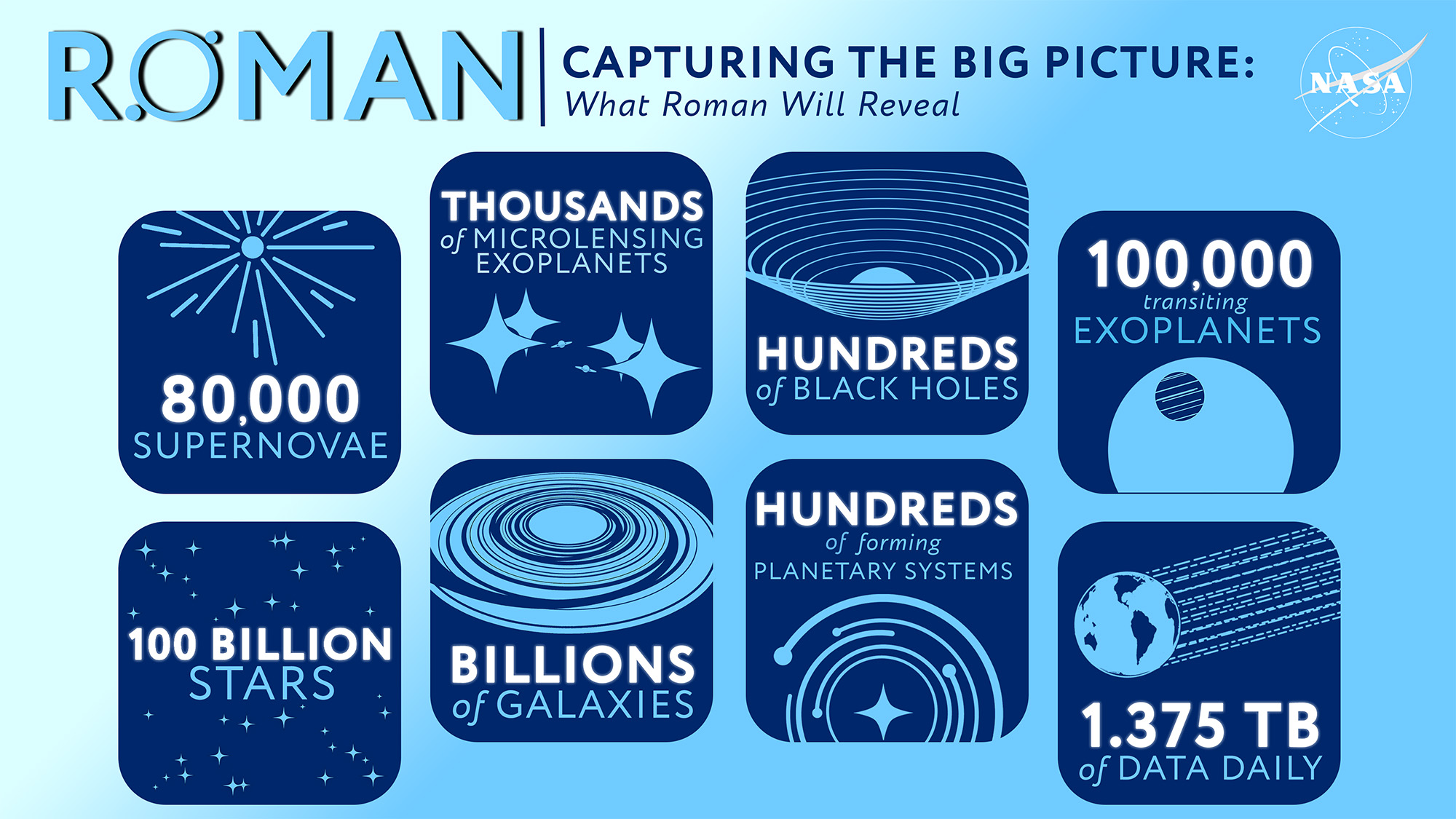
Infographic showing Roman Space Telescope specifications including mirror size, field of view, and instrument capabilities

Roman Space Telescope by the Numbers

Roman's 2.4-metre mirror, 300-megapixel camera, and 0.28-square-degree field of view make it the most powerful survey telescope ever deployed. Credit: NASA / GSFC.


Roman vs Hubble vs JWST — How They Compare

Roman occupies a unique niche in NASA's space telescope fleet. It is not a replacement for Hubble or JWST, but a complement that fills a critical gap: wide-field survey capability at high resolution.

Specification Roman Hubble JWST
Mirror2.4 metres2.4 metres6.5 metres (segmented)
Field of View0.28 deg² (100× Hubble)0.003 deg² (WFC3)0.0006 deg² (NIRCam)
Wavelength CoverageVisible to near-IR (0.48–2.3 µm)UV to near-IR (0.1–2.5 µm)Near to mid-IR (0.6–28 µm)
Camera Resolution300 megapixels16 megapixels (WFC3)4+ instruments
Survey SpeedBaseline (1,000× Hubble)SlowNarrow, deep
Primary MissionDark energy, exoplanet census, IR surveyGeneral-purpose UV/opticalFirst galaxies, exoplanet atmospheres
OrbitSun-Earth L2Low Earth (540 km)Sun-Earth L2
LaunchSeptember 20261990 (operating)December 2021 (operating)

The key difference is survey efficiency. Roman can survey an area of sky 1,000 times faster than Hubble at comparable resolution. This is not an incremental improvement — it enables entirely new types of science that require observing millions of galaxies or stars, such as statistical dark energy measurements and exoplanet demographics.


The Wide Field Instrument

Roman's primary instrument is the Wide Field Instrument (WFI), a 300-megapixel multi-filter camera that is the heart of the mission. The WFI contains an array of 18 H4RG-10 detectors — each a 4096 × 4096 pixel sensor — arranged in a 6 × 3 mosaic. The total focal plane measures approximately 16.5 centimetres across, making it the largest ever flown on a space telescope.

The WFI operates across a wavelength range of 0.48 to 2.3 micrometres, covering visible light through the near-infrared. It supports nine filters spanning this range, including broadband filters analogous to Hubble's F814W (near-infrared) and narrowband filters for specific emission lines such as H-alpha and H-beta. The instrument achieves an angular resolution of 0.11 arcseconds per pixel — similar to Hubble's resolution but across a field 100 times larger.

In a single exposure, the WFI captures a patch of sky 0.28 square degrees in area — roughly the size of a full Moon. A single Roman observing program can map thousands of square degrees in a few months, covering areas that would take Hubble centuries to image at comparable depth. This survey capability is what makes Roman transformational for dark energy research, where measuring the shapes and positions of billions of galaxies is required to trace the universe's expansion history.


Coronagraph Technology Demonstration

Roman carries a second instrument, the Coronagraph Instrument, which serves as a technology demonstration for future exoplanet direct-imaging missions. The coronagraph uses a series of masks and deformable mirrors to block the light from a host star, revealing the much fainter light reflected from orbiting exoplanets.

This is extremely challenging. A Jupiter-like planet orbiting a Sun-like star is roughly one billion times fainter than the star itself. The coronagraph must cancel the star's light with extraordinary precision — to one part in 10,000 — across a field just a few arcseconds wide. The Coronagraph Instrument achieves this using two deformable mirrors with 48 actuators each, capable of reshaping the mirror surface to correct for wavefront errors at the nanometre level.

The Coronagraph Instrument will image exoplanets in visible light, measuring their brightness, colour, and orbital properties. It will also perform spectroscopy on the brightest targets, searching for the presence of water, methane, oxygen, and other molecules in their atmospheres. This is a direct precursor to the proposed Habitable Worlds Observatory, a future NASA mission that will use similar technology to search for biosignatures on Earth-like exoplanets.


Primary Science Goals

Roman's science program is divided into three main pillars, each taking approximately one-third of the mission's five-year primary lifetime:

Dark Energy and the Expansion of the Universe

Roman will conduct the widest-ever galaxy survey to measure the effects of dark energy on cosmic structure. Using three complementary techniques — weak gravitational lensing, baryon acoustic oscillations, and Type Ia supernovae — Roman will map the distribution of dark matter across cosmic time and measure the equation of state of dark energy with far greater precision than any previous experiment. The survey will cover 2,000 square degrees of sky, imaging over a billion galaxies.

Exoplanet Demographics via Microlensing

Roman will conduct a large-area microlensing survey of the galactic bulge, monitoring 100 million stars for the gravitational microlensing signals caused by intervening planets. This technique is uniquely sensitive to planets at separations of 1–10 astronomical units — the region where most giant planets in our own solar system reside — and can detect planets as small as Mars. The survey is expected to discover roughly 1,400 exoplanets, including dozens of free-floating planets not bound to any star, providing the most complete statistical census of planetary systems across the galaxy.

Infrared Survey of the Sky

Roman's Wide Field Instrument will conduct a multi-band near-infrared survey of the entire sky visible from L2, covering wavelengths from 0.5 to 2.3 micrometres. This survey will complement the optical surveys conducted from the ground (like LSST) and the mid-infrared surveys from space (like Spitzer and WISE), providing the astronomical community with a transformative infrared dataset that will enable discoveries across every field of astrophysics — from the nearest asteroids to the most distant quasars.


Can You See Roman from Earth?

Unlike Hubble, which orbits Earth at 540 kilometres and can be seen with the naked eye as a bright moving star, Roman will orbit the L2 point 1.5 million kilometres away. At that distance, Roman will be a very faint object — approximately magnitude +14.5 during its coast to L2, fading to around magnitude +16 once it reaches its operational orbit.

For amateur astronomers, this means Roman will be a challenging but feasible target for medium-to-large telescopes. A 10-inch or larger Dobsonian under dark skies should be able to detect Roman as a faint point of light moving against the background stars during its 30-day coast to L2. After arriving at L2, it will remain within about 10 degrees of the Sun-Earth line, making it visible primarily in the evening or morning twilight.

For the best chance of spotting Roman, use orbital prediction tools like Heavens-Above or JPL's Horizons system once the spacecraft's orbital elements are published post-launch. A finder chart generated from these tools will show Roman's position relative to bright stars. Track it in the weeks immediately after launch, before it reaches L2 and fades beyond the reach of most amateur instruments.


Frequently Asked Questions

When will the Roman Space Telescope launch?

The Nancy Grace Roman Space Telescope is scheduled to launch in early September 2026 aboard a SpaceX Falcon Heavy rocket from Cape Canaveral Space Force Station, Florida. The launch window opens around September 1 with daily opportunities throughout the month.

What will Roman's first-light images show?

Roman's first-light observations will likely include a deep-field galaxy image covering an area as large as the full Moon, a calibration star field to test its instruments, and a microlensing survey target toward the galactic centre. These images will demonstrate Roman's unique wide-field survey capability.

How is Roman different from JWST and Hubble?

Roman has the same mirror size as Hubble (2.4 metres) but a field of view 100 times larger, making it the most efficient survey telescope ever built. Where Hubble and JWST study small areas in exquisite detail, Roman maps huge swaths of sky at high resolution, completing surveys 1,000 times faster than Hubble.

Can amateur astronomers see Roman in space?

Yes, Roman will be visible to moderate-sized amateur telescopes (10-inch or larger) during its 30-day coast to L2, at approximately magnitude +14.5. After reaching L2 it will be fainter but still trackable with larger scopes. Use orbital prediction tools after launch for finder charts.

What will Roman study during its mission?

Roman's three main science goals are: probing dark energy by mapping the distribution of a billion galaxies, discovering approximately 1,400 exoplanets through microlensing, and conducting a wide-field near-infrared survey of the entire sky visible from L2.