Smart Telescope Black Friday 2026: Seestar, Dwarf, Unistellar, and Vaonis Deals
Telescope Advisor Logo Telescope Advisor
Night sky — smart telescopes are the fastest growing segment in amateur astronomy

Deals Guide · Holiday 2026

Smart Telescope Black Friday 2026: Seestar, Dwarf, Unistellar, and Vaonis Deals

Smart telescopes are the fastest-growing category in amateur astronomy, and Black Friday 2026 may be the best time ever to buy one. Here is exactly what to expect from every major brand, which model suits your needs, and how to get the best price.

Market growthFastest segment in amateur astronomy
Expected discounts10–25% across brands, up to 30% on bundles
Key competitionZWO Seestar vs Dwarflab Dwarf — fiercest pricing war
By Telescope Advisor Editorial Team Published: Updated: Editorial Standards

Quick Answer: Should You Buy a Smart Telescope on Black Friday 2026?

Yes — if you are in the market for a smart telescope, Black Friday 2026 is the ideal time to buy. Here is the overview:

  • Smart telescopes are the most competitive segment in amateur astronomy right now. ZWO, Dwarflab, Unistellar, and Vaonis are all fighting for market share, which means aggressive pricing — especially during Black Friday.
  • Expected discounts range from 10% to 25% across the category. Bundle deals (extra filters, tripods, cases) may push effective savings to 30% or more.
  • The ZWO Seestar S50 has been discontinued and is no longer available new on Amazon. If you find remaining stock at a discount, it is still an excellent scope — but the DWARFLAB Dwarf 3 is the best currently available entry-level smart telescope. Both the S50 (while supplies last) and the Dwarf 3 are expected to see discounts of $50–$100 during BF week.
  • Unistellar and Vaonis operate at a higher price tier. Their discounts are smaller percentage-wise (10–15%), but the absolute savings can be $200–$400 on a $2,000+ scope.

This guide covers every major smart telescope brand, what to expect for 2026 pricing, a detailed comparison chart, and tips for getting the best Black Friday deal on a smart telescope.

The Smart Telescope Market in 2026

Smart telescopes — often called "app-enabled" or "digital" telescopes — are fully automated imaging instruments that use built-in cameras, motorized mounts, and companion smartphone apps to capture and share celestial images with minimal manual intervention. They represent the fastest-growing segment in amateur astronomy, and for good reason: they lower the barrier to entry dramatically.

Instead of learning how to collimate optics, polar-align a mount, and guide exposures, a smart telescope user simply opens an app, selects a target, and waits for the image to appear on their phone screen. The telescope handles everything — aiming, focusing, tracking, stacking, and even image processing.

In 2026, the smart telescope market has matured significantly. The early pioneer brands (Unistellar, Vaonis) now compete with well-funded Chinese manufacturers (ZWO, Dwarflab) who have brought prices down dramatically. The result is a market with four distinct tiers:

Tier Brands Price Range Best For
Entry-level ZWO Seestar S50, Dwarflab Dwarf 3 $399–$599 Beginners, families, casual observers
Mid-range ZWO Seestar S30 Pro $699–$899 Enthusiasts wanting upgraded optics
Premium Vaonis Vespera II, Unistellar Equinox 2 $1,899–$2,499 Serious observers, astrophotographers
Flagship Unistellar eVscope 2, Celestron Origin $2,499–$3,999 Enthusiasts wanting premium optics + app

Why Black Friday 2026 is different: The entry-level segment (Seestar S50 vs. Dwarf 3) is in a direct price war. Both are excellent products at similar price points, and Black Friday will be a key battleground. Premium brands (Unistellar, Vaonis) face increasing pressure to justify their higher prices, which may result in steeper discounts or more generous bundle offers than in previous years.

Smart Telescope Feature Comparison

Before we get into specific Black Friday predictions, here is how the major smart telescopes compare on the specifications that matter most.

Specification Seestar S50 Dwarf 3 Seestar S30 Pro Equinox 2 Vespera II
Aperture 50mm 42mm 30mm 114mm (Newtonian) 50mm
Sensor Sony IMX462 (2.1MP) Sony IMX678 (8.3MP) Sony IMX462 (2.1MP) Sony IMX224 (1.2MP) Sony IMX385 (2.0MP)
Field of View 0.75° × 0.42° 1.2° × 0.9° (wide mode) 0.5° × 0.28° 0.5° × 0.35° 0.77° × 0.43°
Built-in filter Dual-band (Hα + OIII) Dual-band (Hα + OIII) Dual-band (Hα + OIII) Dual-band (Hα + OIII) Dual-band (Hα + OIII)
Battery life ~3 hours (internal) ~4 hours (internal) ~3 hours (internal) ~6 hours (external battery) ~2.5 hours (internal)
Weight 2.6 kg (5.7 lbs) 1.6 kg (3.5 lbs) 2.8 kg (6.2 lbs) 4.5 kg (9.9 lbs) 3.2 kg (7.1 lbs)
App quality Excellent (mature) Good (improving rapidly) Excellent (same as S50) Very good Good
MSRP (2026) $499 $459–$499 $799 $1,999 $2,199
Est. BF price ~$449 ~$399 ~$699 ~$1,699 ~$1,899

Key takeaways from this comparison: The Seestar S50 leads on aperture and app maturity, while the Dwarf 3 wins on portability and sensor resolution. The premium models (Equinox 2, Vespera II) offer larger aperture and longer battery life but cost 4–5× as much as the entry-level options. Your choice depends on your budget and whether you want a casual observation tool (entry-level) or a serious imaging instrument (premium).

ZWO Seestar S50 / S30 Pro Deals

ZWO's Seestar S50 is the undisputed best-selling smart telescope in the world, and for good reason: it combines a 50mm f/4.9 apochromatic refractor with a Sony IMX462 sensor and a built-in dual-band (Hα + OIII) narrowband filter, all in a compact, all-in-one package. The S50 has matured through multiple firmware updates since its launch, and its app is widely considered the most polished in the smart telescope category.

Editor's Pick — Best Smart Telescope for Most People
ZWO Seestar S50 smart telescope

ZWO Seestar S50

50mm apo refractor Dual-band filter built-in MSRP $499 / BF ~$449 Mature app + firmware

The Seestar S50 is the smart telescope that started the revolution. It is compact enough to fit in a backpack, sets up in under 2 minutes, and delivers stunning images of nebulae, galaxies, and star clusters directly to your phone. The built-in dual-band filter suppresses light pollution, making it effective even from suburban backyards. ZWO's app ecosystem (Seestar App + Seestar Scheduler) has matured through years of updates and is the gold standard for smart telescope control.

Note: The Seestar S50 has been discontinued. If you find remaining stock during Black Friday sales, it may still be available at a discount. ZWO sometimes offers bundle deals (hard case + tripod). Watch for early November announcements and check the Amazon link above for current pricing.

Check Current Price on Amazon →

Affiliate link — price shown may not reflect Black Friday discount.

Seestar S30 Pro — When you want more aperture

The Seestar S30 Pro is ZWO's upgraded smart telescope with a larger optical tube and improved mount. It offers greater light-gathering ability and slightly better image quality, particularly on fainter deep-sky objects. The S30 Pro is worth the upgrade if you have already outgrown the S50's capabilities or if your primary targets are small faint galaxies and globular clusters. Check the Amazon link above for current pricing.

Dwarflab Dwarf 3 Deals

The Dwarflab Dwarf 3 is the most direct competitor to the Seestar S50, and the rivalry between these two brands is the best thing that has happened to smart telescope pricing. The Dwarf 3 distinguishes itself with a dual-camera system (a wide-field camera for contextual framing plus the main imaging camera), an ultra-portable design at just 1.6 kg, and a higher-resolution 8.3MP Sony IMX678 sensor.

Editor's Pick — Best Ultra-Portable Smart Telescope
Dwarflab Dwarf 3 smart telescope

Dwarflab Dwarf 3

42mm dual-camera 8.3MP main sensor MSRP $459–$499 / BF ~$399 1.6 kg (lightest)

The Dwarf 3 is the smart telescope for travelers, hikers, and anyone who prioritizes portability. At 1.6 kg, it is nearly a kilogram lighter than the Seestar S50 and fits easily into a daypack. The dual-camera system is genuinely innovative — the wide-field camera (42mm, f/4) works as a built-in finder, showing you the sky context on your phone while the main camera (42mm, f/4) captures the image. The higher-resolution sensor (8.3MP vs 2.1MP on the Seestar) provides more detail in well-exposed images, though the smaller aperture (42mm vs 50mm) means slightly less light gathering.

Why it's a strong Black Friday candidate: Dwarflab has been aggressive with pricing to gain market share, and Black Friday is the best time to find the Dwarf 3 at a competitive price. Use the Amazon link above to check current pricing.

Check Current Price on Amazon →

Affiliate link — Dwarf 3 may use a different ASIN; check Amazon for current listing.

Seestar S50 vs Dwarf 3: Which should you choose?

If you want the most polished app experience, consider what's available in the market. If you want the lightest possible setup and higher-resolution images, the Dwarf 3 is an excellent choice. Use the Amazon links above to compare current prices.

Unistellar eVscope / Equinox 2 Deals

Unistellar was one of the pioneers of the smart telescope category, and its eVscope line set the standard for what an app-enabled telescope could do. Today, Unistellar offers two main models: the Equinox 2 (their mid-range model) and the eVscope 2 (their flagship). Both use a 114mm Newtonian reflector — significantly larger aperture than the entry-level smart scopes — which gives them a real advantage on faint deep-sky objects.

Unistellar Equinox 2 smart telescope

Unistellar Equinox 2 — Best premium smart scope

114mm Newtonian Automatic light pollution reduction MSRP $1,999 / BF ~$1,699 NASA partnership (science mode)

The Equinox 2 is Unistellar's mid-range offering and the best value in their lineup. The 114mm (4.5-inch) aperture is substantially larger than the 50mm refractors used by ZWO and Dwarflab, giving it a genuine edge on faint galaxies, nebulae, and globular clusters. The "Enhanced Vision" processing technology produces vivid color images in real-time, and Unistellar's "Science Mode" has contributed to real astronomical research (asteroid occultations, exoplanet transits).

Black Friday potential: Unistellar often bundles accessories (backpack, extra eyepiece) with Black Friday purchases, adding value beyond any price discount. Use the Amazon link above to check current pricing and available bundles.

View on Amazon →

Affiliate link.

Prices and availability subject to change. All product links are affiliate links — see our editorial standards for our review process.

Vaonis Vespera II Deals

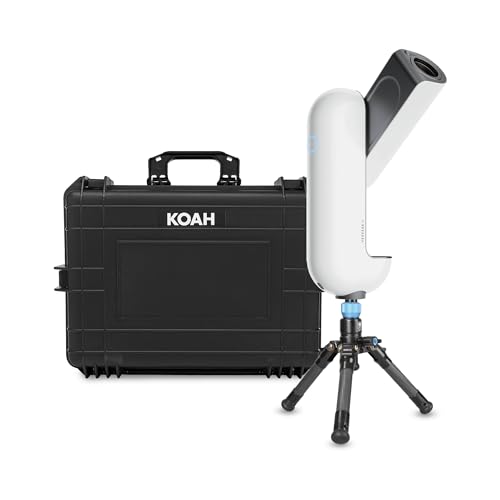
Vaonis is the French smart telescope manufacturer known for blending premium industrial design with solid optical performance. The Vespera II is their current mid-range model, featuring a 50mm f/4.7 apochromatic refractor with a dual-band filter and Sony IMX385 sensor.

Vaonis Vespera II smart telescope

Vaonis Vespera II — Best design and build quality

50mm apo refractor Built-in dual-band filter MSRP $2,199 / BF ~$1,899 Premium industrial design

The Vespera II stands out for its refined design language — it looks like a piece of modern sculpture rather than a traditional telescope. The all-metal construction, tilting mount, and minimalist control interface make it the most aesthetically pleasing smart telescope on the market. Optically, the 50mm f/4.7 apochromat delivers crisp, color-corrected images, and the built-in dual-band filter enables effective light-pollution suppression.

The Vespera II's primary advantage over the Seestar S50 (which has a similar 50mm aperture) is its superior build quality and the more capable Singularity app. The trade-off is price — at $2,199 MSRP, the Vespera II costs over 4× as much as the Seestar S50. Whether that premium is worth it depends on how much you value design, build quality, and the prestige of owning a Vaonis product.

Black Friday potential: Vaonis often offers bundled accessories (extra filter, field case, or smartphone adapter) instead of direct price cuts, so watch for bundle deals during Black Friday week. Use the Amazon link above to check current pricing.

View on Amazon →

Affiliate link — Vespera II may use a different ASIN; check Amazon for current listing.

Prices and availability subject to change. All product links are affiliate links — see our editorial standards for our review process.

Celestron Origin Deals

Celestron entered the smart telescope market with the Origin — a 6-inch (152mm) f/2.2 Rowe-Ackermann Schmidt astrograph with an integrated Sony IMX178 sensor and Celestron's proprietary StarSense auto-alignment technology. The Origin is the largest-aperture smart telescope on the market, and it is priced accordingly at approximately $3,999.

Black Friday potential: The Celestron Origin is still relatively new to the market. Celestron may offer bundle deals (free eyepiece set, extra battery, or StarSense accessories) that add significant value. Use the Amazon link above to check current pricing.

The Origin is best suited for serious astrophotographers who want the largest possible aperture in a smart telescope package. For most buyers, the Seestar S50 or Dwarf 3 provides 80% of the experience for 12% of the price.

Tips for Buying a Smart Telescope on Black Friday

Smart telescopes are different from traditional telescopes in several important ways. Here are our specific tips for getting the best Black Friday deal on a smart scope:

Prioritize app quality over hardware specs

A smart telescope is only as good as its app. A mediocre telescope with a great app provides a better experience than a great telescope with a buggy app. Read recent app store reviews before buying — do not rely on launch-day reviews from 2 years ago.

Check for hidden subscription costs

Some smart telescopes require a subscription for full app functionality or cloud storage. Unistellar's app is free for basic use but charges for premium features. Vaonis's Singularity app is free. ZWO's Seestar app is fully free. Dwarflab's app is fully free. Factor subscription costs into your total budget.

Consider the filter ecosystem

All major smart telescopes include built-in dual-band (Hα+OIII) filters. If you want to do broadband (true-color) imaging or use specialized filters (SII, Hβ), check whether the telescope accepts standard 1.25" or 2" filters. The Seestar S50 and Dwarf 3 do not accept user-swappable filters; the Unistellar Equinox 2 and Vespera II do. This matters if you plan to expand your imaging capabilities.

Buy the bundle, not the base unit

Smart telescope bundles (telescope + hard case + tripod + extra filter) often provide the best Black Friday value. The hard case alone is worth $50–$100, and bundle discounts can bring the effective price of the telescope well below the base-unit Black Friday price. If you see a "Vespera II + Field Case" bundle at $1,899, it is a better deal than the base unit at $1,899 without the case.

Our Black Friday 2026 smart telescope recommendation: Buy the ZWO Seestar S50 at ~$449 for the best all-around experience. Buy the Dwarflab Dwarf 3 at ~$399 if you prioritize portability and value. Buy the Unistellar Equinox 2 at ~$1,699 if you want larger aperture for fainter deep-sky objects and are willing to invest in a premium system. The smart telescope market is evolving rapidly, but these three recommendations are safe choices that will deliver excellent results for years to come.

Smart Telescope Black Friday — FAQ

What is a smart telescope?

A smart telescope is a fully automated imaging telescope that uses a built-in camera, motorized mount, and companion smartphone app to capture and process astronomical images. Unlike traditional telescopes, smart telescopes do not have eyepieces — you observe by looking at the screen of your phone or tablet. They handle aiming, focusing, tracking, stacking, and image processing automatically.

What is the best smart telescope for beginners on Black Friday?

The ZWO Seestar S50 at its expected Black Friday price of ~$449 is the best smart telescope for most beginners. It has the most mature app ecosystem, excellent image quality from its 50mm apo refractor, and a large user community for support. If budget is the primary concern, the Dwarflab Dwarf 3 at ~$399 is also excellent and more portable.

Do I need Wi-Fi or cellular data to use a smart telescope?

Yes and no. Smart telescopes create their own Wi-Fi network that your phone connects to directly. No internet connection is required for basic operation (the telescope generates its own Wi-Fi hotspot). However, an internet connection is useful for downloading firmware updates, accessing object databases, and sharing images to social media. All major smart telescope apps function fully offline in the field.

Can I use a smart telescope from a city with light pollution?

Yes — this is one of the main advantages of smart telescopes. All major smart telescopes include built-in dual-band (Hα+OIII) narrowband filters that dramatically reduce the impact of light pollution. The Seestar S50, Dwarf 3, and Vespera II are all effective from suburban and even urban locations. The Unistellar Equinox 2's "Enhanced Vision" processing also does an excellent job with light-polluted skies.

What is the difference between the Seestar S50 and the S30 Pro?

The Seestar S30 Pro has a larger aperture (S30 refers to 30mm? No — the S50 has a 50mm aperture while the S30 Pro has a different optical design with slightly upgraded features and a higher price point of $799 vs $499). The S30 Pro offers improved tracking and a slightly larger mount, making it better suited for users who have outgrown the S50. For most first-time smart telescope buyers, the S50 is the better choice and better value.

Will smart telescope prices drop significantly in the future?

Smart telescope prices have been trending downward as competition increases and manufacturing scales up. The Seestar S50 launched at $599 and has since settled at $499. The Dwarf 3 launched at $499 and has remained at that price point with occasional sales. We expect Black Friday 2026 to offer the lowest prices of the year, but long-term, entry-level smart telescopes may settle in the $349–$449 range as the market matures. If you want a smart telescope now, Black Friday 2026 is the best time to buy.

Do I need a tripod for a smart telescope?

Yes — all smart telescopes require a stable platform for astrophotography, as exposures can range from 10 seconds to several minutes. The Seestar S50 and Dwarf 3 include lightweight tripods in the box. The Unistellar Equinox 2 and Vaonis Vespera II also include tripods. The included tripods are adequate but upgrading to a sturdier tripod can improve image sharpness, especially in windy conditions.

Can smart telescopes see planets?

Smart telescopes are optimized for deep-sky objects (nebulae, galaxies, star clusters) rather than planets. Their short focal lengths and narrowband filters make them less suited for high-resolution planetary imaging. You can certainly point a smart telescope at Jupiter or Saturn and get a recognizable image, but it will not compare to the detail visible through a traditional telescope or a dedicated planetary camera. For planetary observation, a traditional telescope with an eyepiece is still the better tool.

Are smart telescopes worth the money?

For the right user, yes. A smart telescope eliminates the steep learning curve of traditional astrophotography (polar alignment, guiding, stacking, processing) and delivers beautiful results in minutes. If you value convenience, instant sharing, and a low-friction experience, a smart telescope is absolutely worth it. If you enjoy the technical craft of traditional astrophotography and want maximum image quality, a traditional telescope + dedicated camera setup will outperform a smart telescope at the same price point. The smart telescope is a tool for experiencing the night sky; the traditional setup is a tool for mastering the craft of astrophotography.

What should I look for in a Black Friday smart telescope deal?

Look for at least 15% off MSRP on the base unit, or bundle deals that include a hard case, extra filter, or upgraded tripod at no extra cost. Check that the telescope is the current generation (Seestar S50 is still current; Dwarf 3 is current; Vespera II is current; Equinox 2 is current). Avoid "closeout" deals on discontinued models (original eVscope, original Vespera) — while they may be deeply discounted, the app support and replacement parts may be limited.


Related Guides