

Webb Catches Exoplanet HD 80606 b Getting Roasted by Its Star (2026) | Telescope Advisor
Telescope Advisor Logo Telescope Advisor
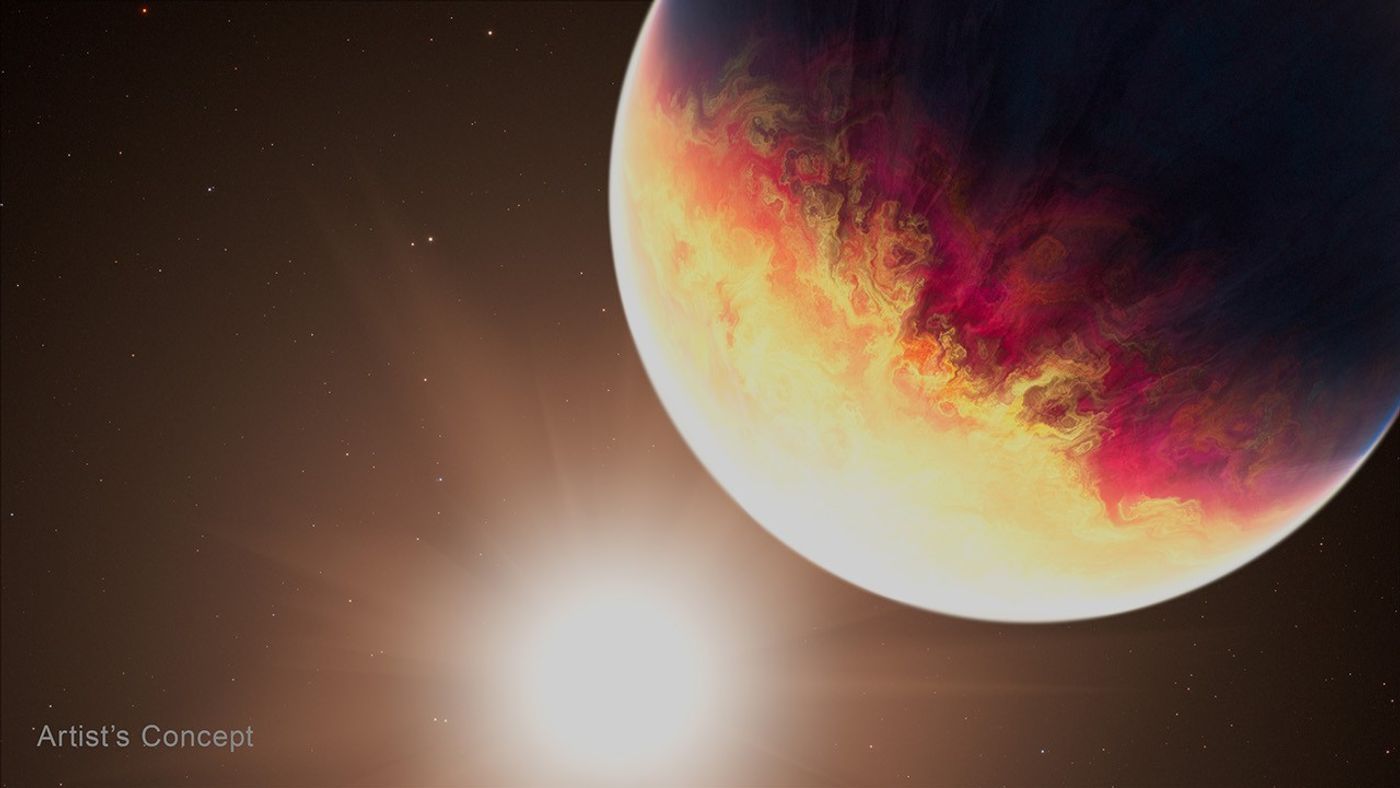
Artist concept of exoplanet HD 80606 b — a white-hot planet on one side fading to yellow, swirls of red, and black on the dark side, with a bright Sun-like star to its lower left against a starry space background

NASA News · Webb Exoplanet Science · June 2026

Webb Catches Exoplanet HD 80606 b Getting Roasted by Its Star

NASA's James Webb Space Telescope has captured an extreme exoplanet in the midst of a violent roasting — HD 80606 b, a gas giant four times the mass of Jupiter, whose wildly elliptical orbit sends it plunging close enough to its star to experience a temperature spike of 1,100 degrees Fahrenheit in just hours.

ObjectHD 80606 b
Mass4× Jupiter
Orbit111 days (highly eccentric)
Results PublishedJune 17, 2026
By Elena Reyes Published: Updated: Editorial Standards
Elena Reyes — Senior Science Editor

Elena Reyes

Senior Science Editor

Covers NASA missions, space science discoveries, and astronomical events for Telescope Advisor. Translates complex astrophysical research into practical insights for backyard observers. Based in the San Francisco Bay Area.

A Planet Being Roasted in Real Time

On June 17, 2026, researchers using NASA's James Webb Space Telescope presented stunning new observations of one of the most extreme exoplanets ever discovered — HD 80606 b, a gas giant with four times the mass of Jupiter on a bizarre, highly elliptical 111-day orbit. The findings, presented at the 248th meeting of the American Astronomical Society in Pasadena, California, show Webb's Mid-Infrared Instrument (MIRI) capturing the planet's temperature skyrocketing by an extraordinary 1,100 degrees Fahrenheit (over 600 degrees Celsius) as it swings past its Sun-like host star at closest approach — a phenomenon astronomers call periastron.

"Hot Jupiters are already considered some of the most extreme exoplanets we know of, but even among that population, HD 80606 b is one of the most extreme," said Tiffany Kataria, the study's principal investigator at NASA's Jet Propulsion Laboratory in Southern California. "We typically think of hot Jupiters as hot gas giants sitting right next to their stars, but this planet's highly eccentric orbit creates a completely different beast." The research team presented their preliminary findings at the AAS meeting, with the full analysis of Webb's rich dataset still underway.

The observation was years in the planning. Scheduling Webb's MIRI instrument to catch HD 80606 b at exactly the right moment was immensely complex given the planet's 111-day orbit and Webb's own field-of-regard constraints, which depend on Earth's position around the Sun. The team's patience paid off: Webb captured the planet before, during, and after its periastron passage, including a precious secondary eclipse — when the planet passed behind its star from Webb's perspective — providing a clean measurement of the planet's dayside temperature.

Artist concept of HD 80606 b — a white-hot exoplanet being roasted by its Sun-like star, fading from brilliant white through yellow and red to black on the dark side
Exoplanet HD 80606 b (Artist's Concept) — This artist's concept shows exoplanet HD 80606 b being "roasted" as its orbit approaches periastron, the point at which it is closest to its host star, which is similar to our Sun. The planet appears white-hot on the star-facing side, with the extreme heat fading through yellow and red swirls to black on the far side. Credit: Artwork: NASA, ESA, CSA, Joseph Olmsted (STScI).


What Is HD 80606 b?

HD 80606 b is a gas giant exoplanet located approximately 190 light-years from Earth in the constellation Ursa Major. Discovered in 2001 through the radial velocity method, it belongs to a class of exoplanets known as "hot Jupiters" — Jupiter-mass planets that orbit extremely close to their host stars. But HD 80606 b stands out even among this extreme group.

What makes HD 80606 b unique is its orbit. Unlike most hot Jupiters, which have circular orbits and sit at a constant distance from their star, HD 80606 b follows a dramatically elliptical path. At its farthest, the planet is about as far from its star as Earth is from the Sun. At its closest — periastron — it plunges to within just a few stellar radii of the star's surface, experiencing a gravitational and thermal shock that would tear less robust worlds apart.

This extreme orbital geometry is thought to be the result of a dynamical interaction known as the Kozai-Lidov mechanism, where a distant stellar companion (HD 80606 is part of a binary star system) perturbs the planet's orbit over millions of years, gradually stretching it into the highly eccentric shape we observe today. The planet's 111-day orbit means its dramatic roasting event occurs only a few times per year, making each observation window precious.

Key facts: HD 80606 b

  • Mass: 4 times Jupiter's mass
  • Orbital period: 111 days
  • Distance: ~190 light-years in Ursa Major
  • Temperature spike: 1,100°F (610°C) at periastron
  • Discovered: 2001 (radial velocity)
  • Also known as: "The Roasted Exoplanet"

🔭

Not sure which telescope actually fits your goals?

Answer 5 quick questions about your budget, observing targets, and experience level — our Telescope Finder Tool recommends a specific model in under 2 minutes.

Find My Telescope →

How Webb Caught the Roasting

The research team used Webb's MIRI (Mid-Infrared Instrument) for an extended observation of HD 80606 b spanning the planet's periastron passage. MIRI is ideal for this study because mid-infrared wavelengths are sensitive to temperature variations and chemical signatures in planetary atmospheres. The observation strategy was meticulously planned: capture the planet's thermal emission before, during, and after its closest approach to the star, then measure how the spectrum changed over time.

During periastron, HD 80606 b also passed behind its star from Webb's perspective — an event known as a secondary eclipse. This is a golden opportunity for exoplanet astronomers. By measuring the combined light of star plus planet before the eclipse, then subtracting the star's light alone during the eclipse, the team could isolate the planet's own thermal emission with exceptional precision. This technique allows Webb to effectively "smell" the planet's atmosphere, identifying molecules by their unique spectral fingerprints.

"Observing a planet like HD 80606 b is actually very efficient because its unusual orbit, with the corresponding swings in temperature and chemical composition, allow us to gather data under varying conditions in just hours and apply those findings to other hot Jupiters or more conventional exoplanets," said Laura C. Mayorga, co-investigator on the study and an exoplanet astronomer at the Johns Hopkins Applied Physics Laboratory in Laurel, Maryland.

"Webb has shown that the planet's increase in temperature was even more extreme than we anticipated based on Spitzer data," added Kataria. The preliminary results suggest that HD 80606 b's atmosphere responds to the stellar heating far more dramatically than models predicted — a finding that will help refine our understanding of atmospheric dynamics on hot Jupiters across the galaxy.

The 'Roasted Exoplanet' — A Long-Held Nickname

HD 80606 b has carried the nickname "the roasted exoplanet" for years, even earning its own poster in NASA's popular Galaxy of Horrors series — a collection of imaginative exoplanet posters designed to highlight the more extreme and terrifying worlds discovered beyond our solar system. The poster, titled "The Roasted Planet," depicts HD 80606 b as a world subjected to periodic infernos as its orbit carries it close to its star.

The nickname is well-earned. As HD 80606 b approaches periastron, the stellar radiation flux increases by a factor of several hundred — from Earth-like levels at apastron (farthest point) to a scorching blast comparable to standing a few thousand miles above the Sun's surface at closest approach. The planet's dayside temperature skyrockets so rapidly that the atmosphere likely experiences shock heating, driving extreme winds and possibly even generating weather patterns unlike anything seen on other planets.

★ NASA's Galaxy of Horrors: The "Roasted Planet" poster is part of NASA's Exoplanet Exploration program's public outreach series, which uses creative and scientifically grounded artwork to showcase the incredible diversity of exoplanets. View the Roasted Planet poster →

From Spitzer to Webb: Building on a Legacy

Before Webb turned its golden mirrors toward HD 80606 b, NASA's now-retired Spitzer Space Telescope laid the critical groundwork. Spitzer's infrared observations of the planet in the 2000s and 2010s revealed the basic temperature structure and hinted at the dramatic heating that occurs during periastron. But Spitzer's relatively small 0.85-meter mirror and limited spectral resolution could only provide broad-brush measurements — enough to know something extraordinary was happening, but not enough to understand the details.

Webb's 6.5-meter primary mirror and sophisticated MIRI spectrometer change this entirely. Where Spitzer could measure total infrared brightness, Webb can resolve individual spectral features corresponding to specific molecules — water, methane, carbon dioxide, and more — allowing astronomers to build a complete picture of how the planet's atmospheric chemistry changes as it heats up and cools down.

"Spitzer did amazing work on this exoplanet, and now Webb is building on that legacy by enabling us to drill down to distinguish specific chemical signatures like methane and carbon dioxide, which is just amazing progress," said Ryan Challener, co-author and research associate at the Cornell Center for Astrophysics and Planetary Science. "There's so much to learn from this one dataset here — we really are just getting started deciphering what Webb has to tell us."


Why This Matters for Exoplanet Science

The study of HD 80606 b is far more than a curiosity about one extreme world. This planet serves as a natural laboratory for testing our understanding of atmospheric physics under conditions that cannot be replicated on any other known exoplanet. Its rapid temperature swing — from relatively mild to inferno-hot in just hours — allows scientists to observe atmospheric chemistry in transition, providing a unique window into how planetary atmospheres respond to extreme stellar heating.

These findings have direct implications for the broader study of hot Jupiters, which are among the most commonly detected exoplanets in our galaxy. By understanding how HD 80606 b's atmosphere behaves under extreme and rapidly changing conditions, astronomers can refine their models for less extreme hot Jupiters that orbit their stars at constant close distances. The insights gained from HD 80606 b will improve our ability to interpret data from thousands of other exoplanets.

For amateur astronomers, the value of this research is contextual. While HD 80606 b itself is far too distant and faint to be observed with backyard telescopes — it was discovered via the radial velocity method, detecting the star's wobble rather than direct imaging — the science it produces enriches our understanding of the exoplanet population as a whole. When you observe Jupiter through your telescope, you are looking at a planet that shares fundamental characteristics with worlds across the galaxy, some of which experience conditions far more extreme than anything in our own solar system.

Can You See HD 80606 b From Your Backyard?

HD 80606 b cannot be seen directly through any amateur telescope. The planet was discovered via the radial velocity method — measuring the tiny gravitational wobble it induces in its host star — and has never been directly imaged, even by Webb. Its host star, HD 80606, is a 9th-magnitude star in the constellation Ursa Major, making it visible through binoculars or a small telescope under dark skies as a faint point of light.

To find HD 80606, look for the familiar bowl of the Big Dipper (part of Ursa Major). The star is located near the southeastern edge of the constellation, roughly halfway between the bright star Alkaid (at the end of the Dipper's handle) and the faint constellation Leo Minor. A detailed star chart or a smartphone astronomy app like Stellarium or SkySafari will help pinpoint its exact location.

While you cannot see the planet itself, pointing a telescope at the star that hosts this extreme world is a powerful connection to the science. When you look at HD 80606, you are looking at the star around which a 4-Jupiter-mass planet completes a 111-day elliptical orbit, experiencing temperature swings that would vaporize any known material. Pair this observation with a session on Jupiter itself — comparing the calm, banded giant in our own system with its extreme cousin 190 light-years away — for a rich, science-connected observing experience.

Frequently Asked Questions

What is HD 80606 b and why is it called the roasted exoplanet?

HD 80606 b is a gas giant exoplanet four times the mass of Jupiter, located 190 light-years away in Ursa Major. It's called the "roasted exoplanet" because its highly elliptical 111-day orbit carries it extremely close to its Sun-like star, causing its temperature to spike by 1,100°F (610°C) in just hours during closest approach. NASA even created a "Roasted Planet" poster for it as part of their Galaxy of Horrors series.

How did Webb observe HD 80606 b?

Webb used its MIRI (Mid-Infrared Instrument) to observe HD 80606 b before, during, and after its periastron (closest approach to its star). During periastron, the planet passed behind its star in a secondary eclipse, allowing the team to isolate the planet's thermal emission by subtracting the star's light. This provided detailed spectroscopic data on temperature and potential chemical signatures.

Can I see HD 80606 b through my telescope?

No, HD 80606 b cannot be seen directly through any amateur telescope — it was discovered via the radial velocity method and has never been directly imaged. However, its host star HD 80606 is a 9th-magnitude star in Ursa Major, visible through binoculars or a small telescope under dark skies. Observing the star that hosts this extreme world can be a meaningful connection to the science.

How does HD 80606 b compare to other hot Jupiters?

HD 80606 b is considered one of the most extreme hot Jupiters known. While typical hot Jupiters have circular orbits and constant high temperatures, HD 80606 b's highly eccentric orbit means its temperature swings dramatically — from relatively mild to 1,100°F hotter in just hours. This makes it an ideal laboratory for studying how exoplanet atmospheres respond to rapid, extreme heating, with insights that apply to thousands of other exoplanets.

What role did Spitzer play in this discovery?

NASA's Spitzer Space Telescope laid the groundwork by providing early infrared observations of HD 80606 b, revealing its basic temperature structure and hinting at the dramatic heating during periastron. Webb builds on this legacy with its larger mirror and advanced spectrometers, enabling detailed chemical fingerprinting — distinguishing specific molecules like methane and carbon dioxide — that Spitzer's more limited instruments could not resolve.

Where is HD 80606 b located in the sky?

HD 80606 b orbits the star HD 80606, which is located approximately 190 light-years away in the constellation Ursa Major (the Great Bear). The star is roughly 9th magnitude, making it visible through binoculars or a small telescope under dark skies. It can be found near the southeastern edge of Ursa Major, roughly halfway between Alkaid (the end star of the Big Dipper's handle) and the constellation Leo Minor.


Sources & References

This article is based on original reporting from primary sources. The scientific details, images, and quotes were sourced from NASA's official release and the exoplanet catalog entry.

All data and imagery used under NASA's media usage guidelines. Telescope Advisor editorial team independently verified factual details against NASA primary sources before publication. Images are locally hosted under /images/nasa/.