What Does Jupiter Look Like Through a Telescope? Real Views Guide (2026)
Telescope Advisor Logo Telescope Advisor
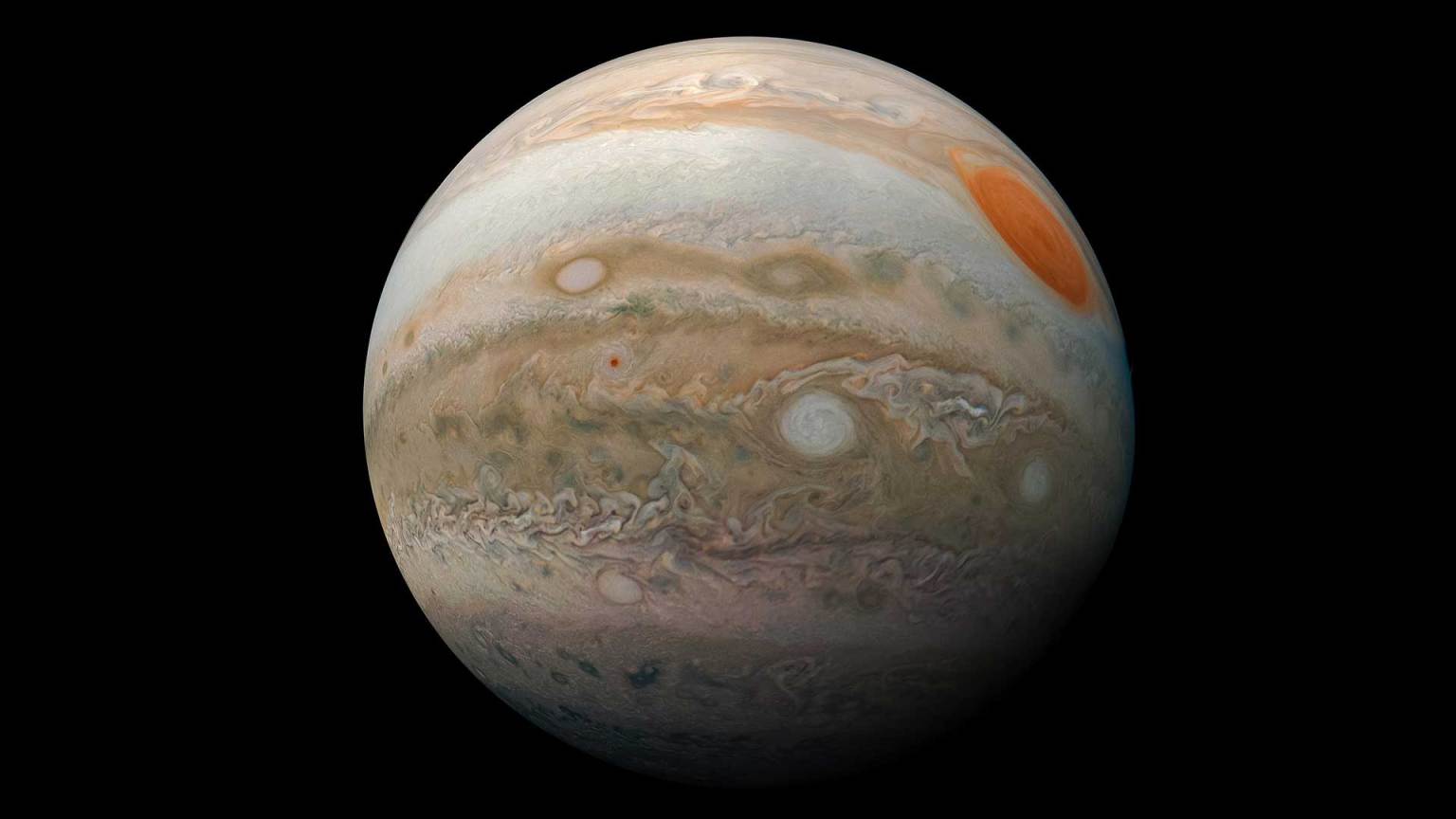
Jupiter as captured by NASA — cloud bands and Great Red Spot through a telescope

Visual Guide · Jupiter 2026

What Does Jupiter Look Like Through a Telescope?

Jupiter through a telescope is a showstopper. Even at low power, the four Galilean moons are visible as a line of tiny stars. At higher magnification, the planet's cloud bands emerge in shades of cream, tan, and russet. This guide shows what Jupiter looks like at different aperture sizes — from a small 70mm refractor to an 8-inch Dobsonian — so you know what to expect before you look.

Cloud Bands

Visible in Any Scope

4 Moons

Io, Europa, Ganymede, Callisto

Aug 2026

Next Opposition

50×

Minimum Magnification

By Telescope Advisor Editorial Team Published: Updated: Editorial Standards

Quick Answer: What Does Jupiter Look Like in a Telescope?

Through any telescope at 50× or higher, Jupiter appears as a bright cream-colored oval crossed by two or more dark horizontal bands — like a mini striped planet. The planet is large enough (35–48 arcseconds across at opposition) to show detail even at low power. The four Galilean moons — Io, Europa, Ganymede, and Callisto — form a neat line on either side of the planet, changing positions hourly. Through a 70mm telescope at 75×, you see two prominent cloud belts. Through an 8-inch telescope at 150×, multiple belts, zones, and the Great Red Spot (if facing Earth) are visible. Jupiter is the easiest planet to observe and the one that delivers the most immediate visual reward.


🔭

Not sure which telescope actually fits your goals?

Answer 5 quick questions about your budget, observing targets, and experience level — our Telescope Finder Tool recommends a specific model in under 2 minutes.

Find My Telescope →

What Jupiter Looks Like Through Different Apertures

Jupiter's large apparent size makes it the most forgiving planet for small telescopes. Here is what each aperture class reveals.

Aperture Example Scope Jupiter View at 100×
60–70mmAstroMaster 70AZTwo dark equatorial belts. Planet bright cream. Four moons as pinpricks. Red Spot glimpsed as a faint notch on opposition nights.
80–100mmInspire 100AZTwo main belts plus a hint of a third (north temperate belt). Red Spot visible as a pale oval. Moons show distinct brightness differences.
114–130mmHeritage 130PThree belts steady. Red Spot as a salmon-colored oval. Multiple zones between belts visible. Ganymede's disk resolvable at high power.
150–203mmClassic 200PFour or five belts. Red Spot shows internal detail. Oval BA visible. Festoons and rifts in the belt structure. Moons show surface brightness variations.
250mm+10-inch DobsonianSix or more belts. Red Spot detailed with surrounding turbulence. Multiple ovals. Shadow transits of moons show as black dots on the cloud tops.

Jupiter is unique among planets because it shows meaningful detail even at modest magnification. A 70mm scope at 75× reveals enough banding to satisfy any observer. The planet's rapid rotation (a day on Jupiter is just under 10 hours) means you can see cloud features move across the disk in a single observing session.

The Great Red Spot — What You Can Really See

The Great Red Spot (GRS) is Jupiter's most famous feature — a storm larger than Earth that has raged for centuries. Through a telescope, it looks nothing like the dramatic red vortex in NASA images. Here is what to realistically expect.

Through small telescopes (70–100mm): The GRS appears as a faint, pale pinkish-gray notch in the South Equatorial Belt. It is subtle — if you do not know it is there, you might miss it. It looks more like a bulge or a missing section of the belt than a distinct spot.

Through medium telescopes (130–200mm): The GRS becomes a recognizable oval, salmon-pink in color, sitting within a gap in the South Equatorial Belt. At 150×, you can see it is not perfectly round — it is elongated east-west. On good nights, the surrounding turbulence (the "Red Spot Hollow") darkens the contrast.

Through large telescopes (250mm+): The GRS shows internal detail — darker filaments wrapping around the core, and a distinct "bowl" shape where the surrounding belt curves around it. The color is more orange than red.

Timing matters: The GRS is only visible when it faces Earth, which happens roughly every 2 hours (since Jupiter rotates in 9.9 hours). Use a Jupiter GRS transit calculator (available in most astronomy apps) to see when the spot will be centered. For detailed transit timing, see our Jupiter opposition guide.

Galilean Moons — A Live Solar System in Your Eyepiece

The four Galilean moons are visible in any telescope, even a small 60mm refractor. They appear as tiny "stars" lined up near Jupiter. Their positions change noticeably in 30 minutes — watching them move is one of astronomy's simplest pleasures.

  • Io (magnitude 5.0): The innermost moon. The fastest moving — you can see its position change in 15 minutes. Color: yellow-white. Occasionally visible as a disk in 130mm+ scopes.
  • Europa (magnitude 5.3): The brightest moon despite its smaller size because its icy surface reflects 67% of sunlight. Color: white. Appears farther from Jupiter than Io.
  • Ganymede (magnitude 4.6): The largest moon in the solar system. Visible as a distinct disk in 114mm+ telescopes at high power. Surface brightness variations detectable in 200mm+ scopes as a patchy appearance.
  • Callisto (magnitude 5.6): The outermost moon. Its orbit takes it much farther from Jupiter — sometimes appearing several Jupiter-diameters away. Its dark, cratered surface makes it the least reflective, but it is still easy to spot.

Special events to watch for: Moon shadow transits are the most dramatic. When Io or Ganymede casts a shadow on Jupiter's cloud tops, you see a tiny black dot moving across the planet at high power. These are visible in 80mm+ telescopes. Moon occultations (when a moon disappears behind Jupiter) and eclipses (when a moon enters Jupiter's shadow) are also frequent and fascinating. Use Stellarium or the Sky-Skan app to predict events.

Best Magnification for Jupiter

Jupiter is bright enough and large enough to handle a wide range of magnifications. Here is what works best:

  • 50–75×: Great for seeing the four moons and the two main equatorial belts. Jupiter is small but sharp. Good for quick looks and introducing others.
  • 100–150×: The sweet spot. Two or three belts clearly visible. Red Spot detectable. Moons show as disks in 130mm+ scopes. Best balance of image size and sharpness.
  • 175–250×: For 6-inch and larger scopes. Multiple belts and zones. Red Spot shows internal detail. Shadow transits visible. Requires good atmospheric seeing.
  • 300×+: Only for 8-inch+ scopes on exceptional nights. Pushes detail to the limit — you see subtle festoons, rifts, and the fine structure of the polar regions. Usually not sustained due to atmospheric turbulence.

Pro tip: Because Jupiter is so bright, do not be afraid to push magnification higher than you would for other objects. Image brightness remains adequate up to 250× even in a 130mm scope. A good 2× Barlow is the most cost-effective way to reach the 150–200× sweet spot.

When to Look — Jupiter in 2026

Jupiter reaches opposition on August 18, 2026. At opposition, Jupiter is at its closest to Earth (about 390 million miles) and largest in apparent size (48 arcseconds). It rises at sunset and is visible all night.

Observing window in 2026: Jupiter is a rewarding target from June through November. In June, it rises around midnight and is well placed in the early morning. By August (opposition), it is visible from dusk to dawn. Through November, it remains well placed for evening observing. Jupiter is high in the sky from mid-northern latitudes in 2026, which means steadier views than Saturn (which stays lower). For exact timing, see our Jupiter opposition 2026 guide.

Best Gear for Jupiter Observing

Editor's Pick — Best Jupiter Telescope Under $600
Sky-Watcher Classic 200P — best telescope for Jupiter viewing

Sky-Watcher Classic 200P Dobsonian

The 200P at 150× with a 10mm eyepiece shows Jupiter's multiple cloud bands, the Great Red Spot as a salmon oval, and three or four moons as distinct disks. The 8-inch aperture provides the light gathering and resolution to see festoons, rifts, and the subtle texture of the equatorial belts. The Dobsonian mount is exceptionally stable at high magnifications — essential for Jupiter when you are trying to see the GRS flicker in and out of view through atmospheric turbulence.

Celestron AstroMaster 70AZ — entry-level Jupiter viewing

Celestron AstroMaster 70AZ — Best budget Jupiter scope

Even at $110, the AstroMaster 70AZ shows Jupiter's two equatorial belts clearly at 75×. The four moons are always visible. The view is small but unmistakable. Add a 2× Barlow (available for under $40) to reach 150× and you will see hints of the third belt. This is the minimum telescope for a satisfying Jupiter observation.

Celestron NexStar 8SE — GoTo telescope for Jupiter

Celestron NexStar 8SE — Best GoTo for Jupiter

The NexStar 8SE's long focal length (2032mm) provides high native magnification perfect for Jupiter. At 200×, the planet fills the eyepiece with detailed cloud bands, the Great Red Spot in color, and shadow transits of moons as sharp black dots. The GoTo system tracks Jupiter automatically — letting you observe continuously without repositioning, which matters when you are trying to catch a shadow transit event.

All product links are affiliate links — see our editorial standards.

Why Jupiter Looks Different in Your Telescope vs. Photos

If you have seen the Juno spacecraft's images of Jupiter, your telescopic view will be dramatically different. Here is why, and why the real view still matters.

  • No processed color: Juno's images are color-enhanced composites. Your eye sees Jupiter in pastel cream, tan, and beige — not the saturated oranges and blues in press photos.
  • The Red Spot is not red: It is pale salmon-pink. The "Great Red" Spot is a misnomer for visual observers — it is a "Great Pale Salmon Spot." The red color is subtle even in large scopes.
  • Contrast is lower: Photographs stretch contrast to reveal detail. Through the eyepiece, the belts are visible but subtle — they do not jump out at you. They fade into the surrounding zones gradually.
  • Atmospheric turbulence: Jupiter's low altitude from northern latitudes means its light passes through more atmosphere. On most nights, the image shimmers or "boils" at high power. Patience is key — brief moments of clarity punctuate longer periods of softness.

The real reward of Jupiter observing is not image quality — it is the experience of watching a living planet. The moons shift positions. The belts drift. The Red Spot rotates into view. No photograph captures the dynamic, real-time experience of Jupiter through the eyepiece. For more on managing expectations, see our price tier comparison guide.

FAQ: Jupiter Through a Telescope

Can I see Jupiter's bands with a cheap telescope?

Yes — any telescope with 60mm aperture or larger shows Jupiter's two main equatorial belts at 50× or higher. A $110 AstroMaster 70AZ shows them clearly. Binoculars will not show the bands — you need a telescope.

How many moons of Jupiter can I see?

All four Galilean moons (Io, Europa, Ganymede, Callisto) are visible in any telescope. Smaller moons like Amalthea require 300mm+ aperture and exceptional conditions.

What is the best time to see the Great Red Spot?

The GRS is visible when it faces Earth, roughly every 2 hours. Use a Jupiter transit calculator in an astronomy app to predict when it will be centered. Around opposition (August 18, 2026) provides the best views.

Can I see Jupiter from the city?

Yes — Jupiter is bright enough to be seen from any urban location. Its surface detail (belts, zones) is unaffected by light pollution. The moons are also visible. Jupiter is the best planet for city astronomy.

What colour does Jupiter appear through a telescope?

Jupiter appears cream-colored with darker tan or brownish belts. The zones (lighter bands) are pale cream. The polar regions are slightly bluish-gray in larger scopes. No vivid colors — the beauty is in the banded structure.

Can I see a moon shadow transit with my telescope?

Yes — moon shadow transits are visible in 80mm+ telescopes. Io and Ganymede cast the most prominent shadows. You see a tiny black dot moving across Jupiter's cloud tops over about 2 hours. Use an app to predict transit times.


Related Guides