What JWST Found in Abell2744-QSO1
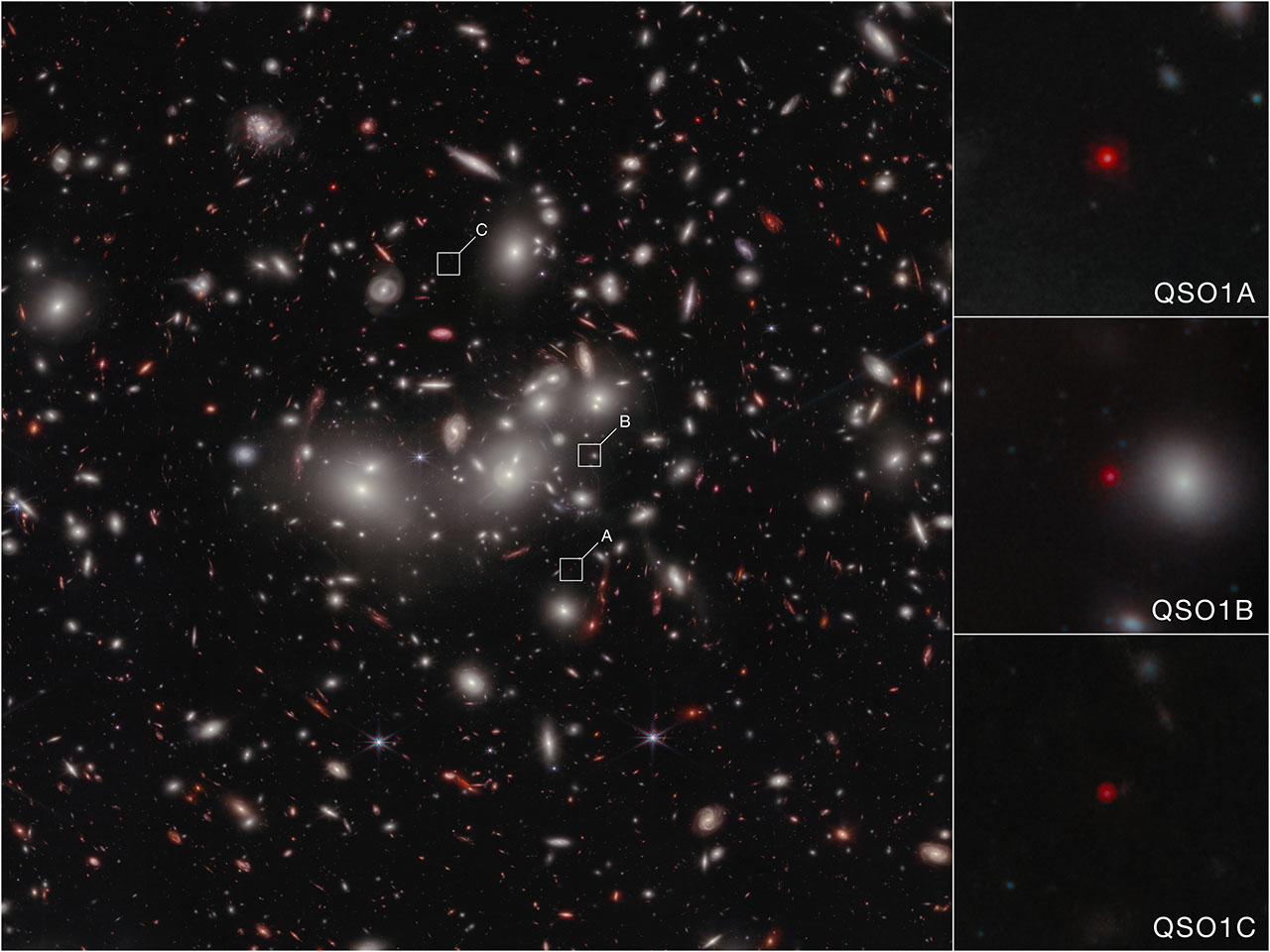
Among all the Little Red Dots now catalogued, the object designated Abell2744-QSO1 has attracted the most scientific attention. It is located more than 13 billion light-years from Earth, corresponding to a time when the universe was only about 700 million years old — roughly 5 percent of its current age. The "Abell2744" part of the name tells you how astronomers found it: the galaxy cluster Abell 2744, nicknamed Pandora's Cluster, sits in the foreground at a much closer distance and acts as a gravitational lens, bending and magnifying the light of background objects including this one.
Gravitational Lensing: Nature's Telescope
Pandora's Cluster (Abell 2744, centred at RA 00h 14m 19s, Dec -30° 23' 19" in the southern constellation Sculptor) is one of the most massive galaxy clusters known. Its enormous gravity warps the fabric of spacetime around it, bending light rays from objects far behind it — exactly as predicted by Einstein's general relativity. For Abell2744-QSO1, this lensing effect produces three separate magnified images of the same object in the JWST field of view. Each image represents the same Little Red Dot seen from a slightly different path around the cluster's gravity well. The magnification factor means Webb can study this object at a level of detail that would otherwise be impossible with any current or planned telescope.
NIRSpec IFU: Mapping the Black Hole
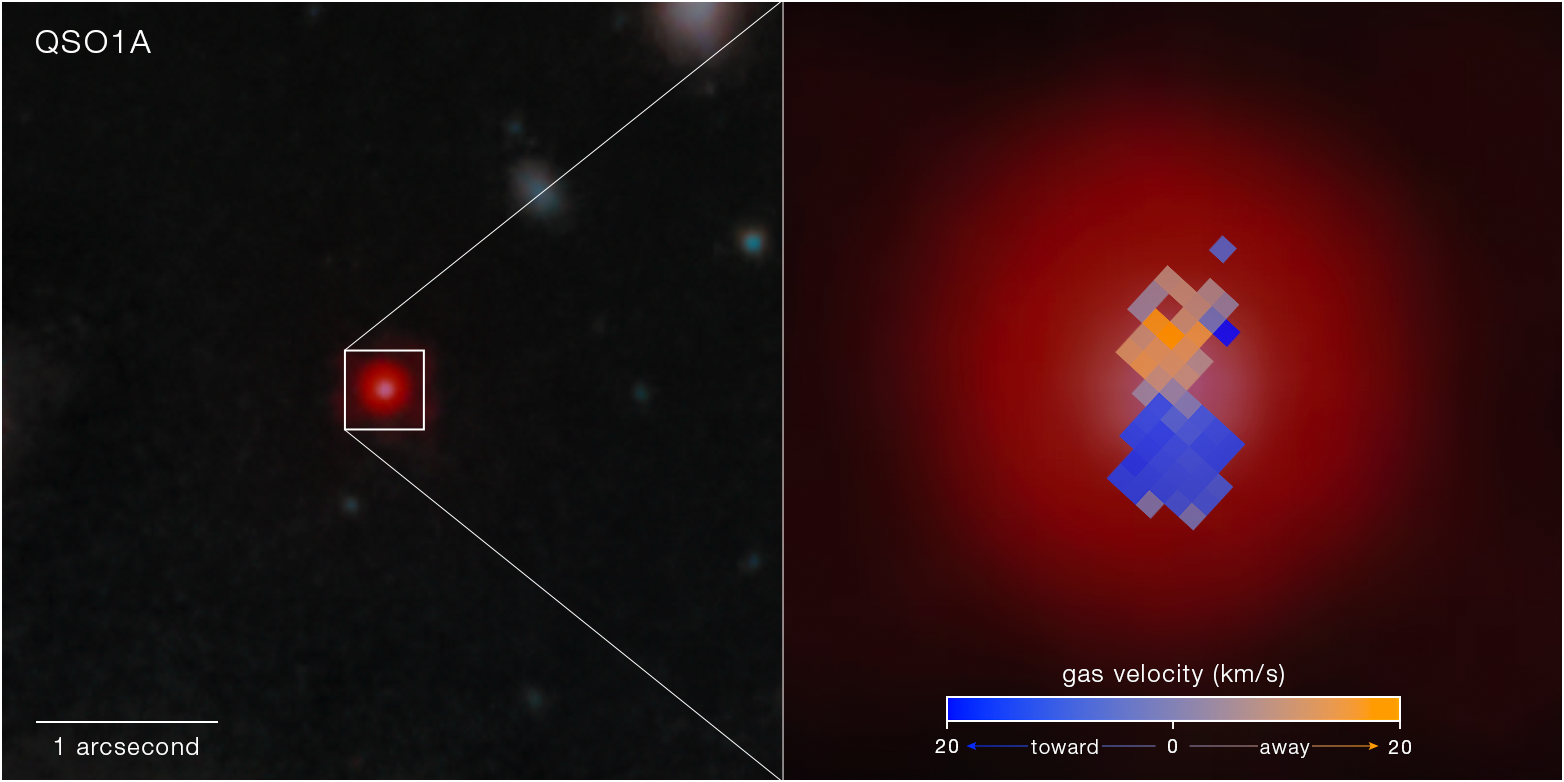
The 2026 study used Webb's NIRSpec Integral Field Unit (IFU), an instrument that simultaneously captures spectra across a two-dimensional patch of sky rather than at a single point. By mapping the velocity of gas around the central source in Abell2744-QSO1, astronomers could apply the same principles used to weigh black holes in nearby galaxies — measuring how fast gas is orbiting, then calculating the mass needed to produce that orbital speed. The result: a black hole of approximately 50 million solar masses, sitting inside a galaxy only about 1,300 light-years in diameter.
To put that size in perspective: the distance from Earth to the centre of the Milky Way is about 26,000 light-years. The entire galaxy hosting this ancient black hole is smaller than the distance from our Solar System to the nearest open star cluster.
The Black Hole IS the Galaxy
What makes Abell2744-QSO1 so extraordinary is that when the mass budget is examined, the black hole outmasses the stellar component. In present-day galaxies, supermassive black holes typically account for about 0.1–0.2 percent of the host galaxy's bulge mass. In Abell2744-QSO1, the black hole is effectively as massive as all the stars combined — or more so. The object is better described as a supermassive black hole with a modest galaxy growing around it, rather than a galaxy that happens to have a black hole at its centre.
Two Theories for Where the Black Hole Came From
If the black hole predates its host galaxy, it must have formed by some mechanism other than the standard model, in which black holes grow from stellar remnants (dead massive stars) inside a galaxy that already exists. The 2026 analysis identified two leading explanations:
- Primordial black hole: A black hole that formed in the extreme density of the very early universe — possibly within the first second after the Big Bang — from density fluctuations in the primordial plasma, before any stars existed. Primordial black holes are a long-standing theoretical prediction, but direct evidence for their existence at this mass scale would be a landmark discovery.
- Direct-collapse black hole: A black hole that formed from the direct gravitational collapse of a massive cloud of pristine (metal-free) primordial gas in the early universe, bypassing the normal stellar evolutionary pathway. This is a theorised process that requires very specific conditions — primarily the absence of molecular hydrogen, which would otherwise fragment the cloud into smaller pieces that form stars rather than a single massive object.
Both scenarios are consistent with the current data. Distinguishing between them will require further spectroscopic observations and, eventually, gravitational wave detection from merging black holes of appropriate masses.