10 Best Nebulae to See With a Telescope: Orion, Ring, Crab & More (2026 Observing Guide)
Telescope Advisor Logo Telescope Advisor
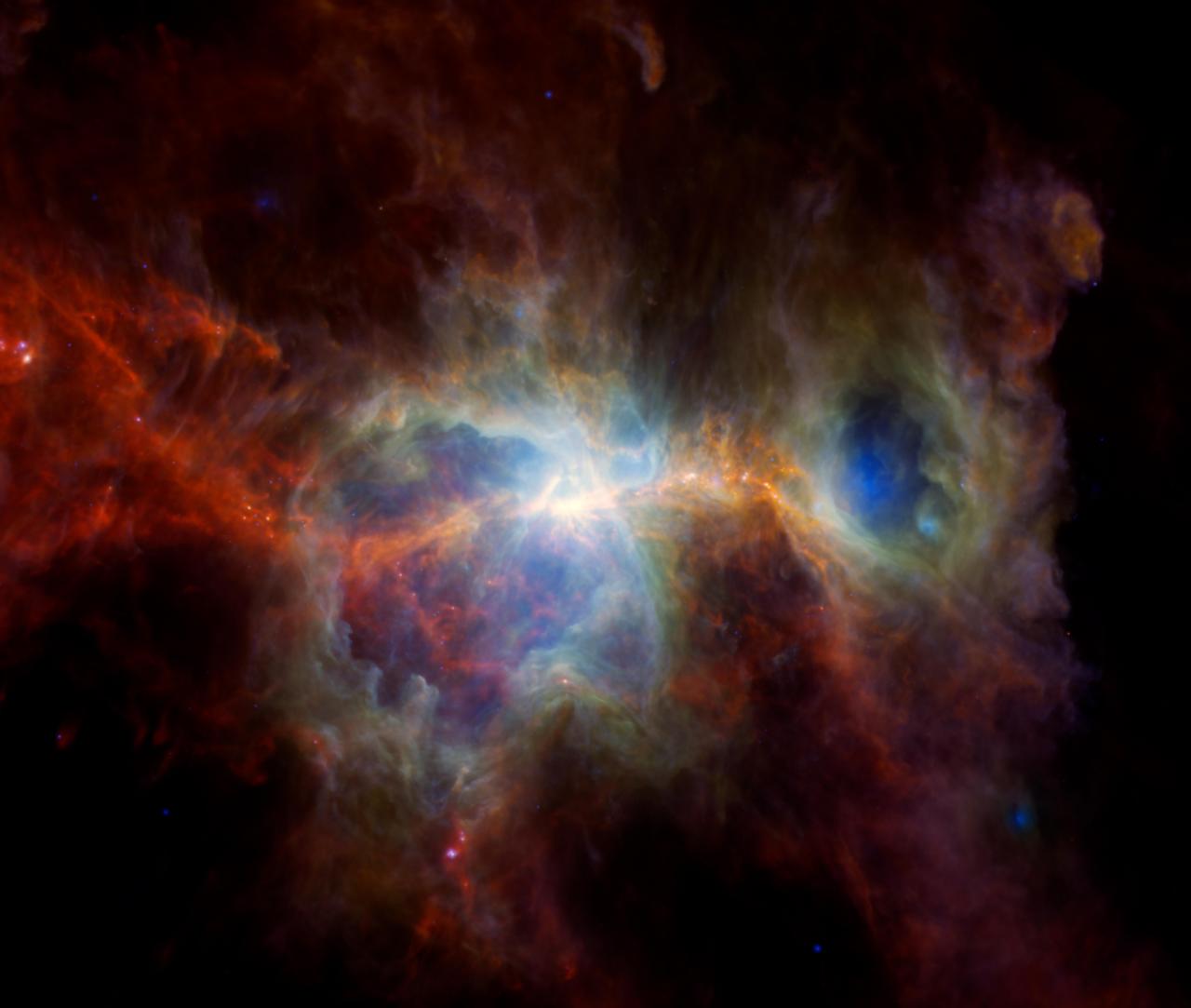
The Orion Nebula — a vast cloud of glowing gas and dust where new stars are being born, photographed by the Hubble Space Telescope

Observing Guide · Deep-Sky Objects

10 Best Nebulae to See With a Telescope Orion, Ring, Crab & More — Ranked by Visibility

Nebulae are the most beautiful objects in the night sky — vast clouds of glowing gas where stars are born and die. Most telescope owners never point their scope at a nebula because they don't know which ones are actually visible. This guide fixes that. Here are the 10 brightest nebulae your telescope can show you tonight — ranked, with exact locations, best months, and realistic previews of what each aperture reveals.

Brightest nebulaOrion Nebula (M42) — visible naked eye
Smallest scope needed70mm refractor
Types of nebulaeEmission, reflection, planetary, supernova
Best seasonWinter (Orion region)
By Telescope Advisor Editorial Team Published: Updated: Editorial Standards

Quick Answer: What Are the Best Nebulae to See With a Backyard Telescope?

The Orion Nebula (M42) is the brightest and best nebula for any telescope — visible to the naked eye as the fuzzy "star" in Orion's sword, it is stunning through any 70mm+ scope. The Ring Nebula (M57) is the best planetary nebula — a tiny smoke ring visible even from city skies. The Lagoon Nebula (M8) is the summer showpiece, rivaling M42 in brightness from July through September. For a quick-start tonight: if it's winter, point your scope at Orion's sword. If it's summer, aim at the Sagittarius Teapot's spout. You will see at least one bright nebula within 60 seconds.

Emission nebulae

Glow from ionized gas excited by nearby hot stars. Example: Orion Nebula (M42).

Reflection nebulae

Reflect light from nearby stars. Blue color from scattered starlight. Example: Pleiades nebulosity.

Planetary nebulae

Shells of gas ejected by dying stars. Often ring-shaped. Example: Ring Nebula (M57).

Supernova remnants

Expanding debris from exploded stars. Example: Crab Nebula (M1).
What Are Nebulae? How They Form, Their Types, and Why They Glow

Nebulae are vast clouds of gas — mostly hydrogen, with helium and traces of heavier elements — mixed with microscopic dust grains. They range from a few light-years to hundreds of light-years across. The Orion Nebula spans about 24 light-years and contains enough material to form roughly 2,000 stars the size of our Sun. It is the closest major star-forming region to Earth at 1,344 light-years away.

Emission nebulae glow because high-energy ultraviolet light from nearby hot, young stars ionizes the hydrogen gas. When electrons recombine with protons, they emit light at specific wavelengths — most notably the deep red hydrogen-alpha line at 656 nanometers. This is the characteristic red glow seen in Hubble photos of nebulae. Reflection nebulae do not produce their own light — they scatter and reflect light from nearby stars, appearing blue for the same reason Earth's sky is blue: shorter wavelengths scatter more efficiently. Planetary nebulae have nothing to do with planets — William Herschel named them in the 1780s because their round, disk-like appearance through his telescope reminded him of Uranus. They are the ejected outer atmospheres of dying Sun-like stars, illuminated by the exposed hot core — a white dwarf — at their center.

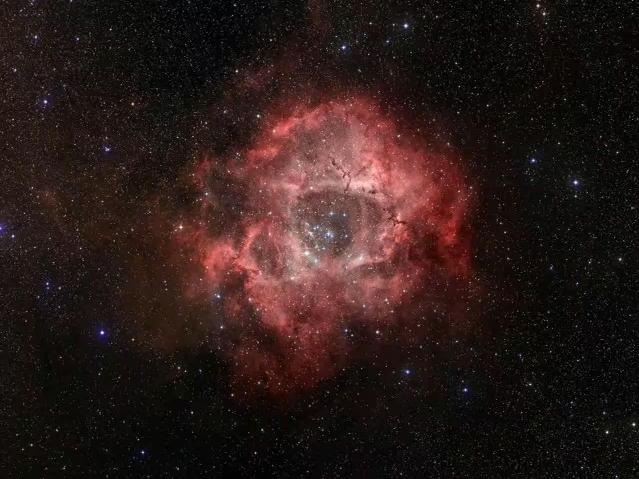
The Rosette Nebula in infrared — a stellar nursery where new stars are actively forming

Rosette Nebula — A Stellar Nursery in Monoceros

The Rosette Nebula (NGC 2237) spans 130 light-years and contains the open cluster NGC 2244 at its center — young, hot stars whose radiation carved out the hollow in the nebula's center. This infrared view from the Gemini Observatory reveals stars forming inside the dense gas clouds. Through a backyard telescope, the Rosette is a challenging target — large but faint, requiring dark skies and a wide-field scope. Credit: Gemini Observatory/NSF/AURA.

Why Nebulae Look Gray Through a Telescope — Not Like Hubble Photos

This is the most important thing to understand before you point a telescope at a nebula. Hubble photographs show nebulae in vivid reds, blues, and purples. Through a backyard telescope, the same nebulae appear as faint, gray-green clouds. This is not a flaw in your telescope or your eyes. It is a fundamental difference between how cameras and human eyes work.

The human retina contains two types of light-sensitive cells: rods and cones. Cones detect color but require bright light. Rods are far more sensitive in low light but cannot distinguish color — they only see brightness. When you look through a telescope eyepiece at a faint nebula, you are using your rod cells almost exclusively, which is why nebulae appear as shades of gray. A camera sensor, by contrast, can accumulate light over minutes or hours of exposure time, building up color information that your eye simply cannot gather in real time. The Hubble images you see online are often false-color composites combining visible, infrared, and ultraviolet data — beautiful, but not what a human eye would ever see.

That said, the view through a telescope is still genuinely moving. The Orion Nebula through a 130mm scope at 50× is a three-dimensional cloud of glowing gas with texture, structure, and the Trapezium — a tight cluster of four young stars — embedded at its heart. You are seeing a stellar nursery with your own eyes, in real time, from your backyard. The experience is not diminished by the lack of color — it is enhanced by the directness of the observation. This is not a photograph. This is light that traveled 1,300 years to reach your retina.

The 10 Best Nebulae for Backyard Telescopes — Ranked by Visibility

These 10 nebulae are chosen for visibility through common amateur telescopes (70mm to 200mm aperture), northern-hemisphere accessibility, and the quality of the viewing experience. All are visible from suburban skies; some require darker conditions for best results.

#1 — Brightest & Best

Orion Nebula (M42) — Constellation: Orion

The finest nebula in the sky for any telescope. Visible to the naked eye as a fuzzy "star" in Orion's sword. Through a 70mm scope at 45×, the nebula appears as a large gray-green cloud surrounding the four Trapezium stars. Through a 130mm+ scope, texture and structure become apparent — folds, tendrils, and dark lanes in the gas. The Trapezium stars are sharp and distinct. This is the one nebula every telescope owner should see. Best months: December–March. Location: Find Orion's belt, look below it for the sword — M42 is the middle "star."

#2 — The Iconic Ring

Ring Nebula (M57) — Constellation: Lyra

A planetary nebula — the remains of a dying star — that looks like a tiny smoke ring floating in space. Through a 70mm scope at 45×, M57 is unmistakable: a small but clear doughnut of light. Through a 130mm+ scope at 100×+, the ring shape is crisp and the central hole is dark and distinct. The central white dwarf — the exposed core of the dead star — is visible at magnitude 14.8 in 8-inch+ scopes under steady seeing. M57 is small (about 1 arcminute across) but high surface brightness makes it visible even under suburban light pollution. Best months: June–October. Location: Midway between Beta and Gamma Lyrae — the two bottom stars of Lyra's parallelogram.

#3 — The Lagoon (Summer Showpiece)

Lagoon Nebula (M8) — Constellation: Sagittarius

The brightest nebula of the summer sky and the second brightest overall after M42. Through a 70mm scope, M8 is a large, bright patch with an embedded star cluster (NGC 6530). Through a 130mm+ scope, the dark lane that divides the nebula — the "lagoon" itself — becomes visible. A UHC or OIII filter dramatically improves contrast on M8, making it one of the most rewarding filter targets in amateur astronomy. The Lagoon is 4,100 light-years away and spans 110 by 50 light-years. Best months: July–September. Location: Just above the spout of the Sagittarius Teapot, near the galactic center.

#4 — The Eagle Nebula

Eagle Nebula (M16) — Constellation: Serpens

The home of the "Pillars of Creation" — the most famous Hubble image ever taken. Through a backyard telescope, you will not see the Pillars (they require a large observatory telescope and narrowband filters), but you will see the open cluster NGC 6611 surrounded by a faint but definite glow. The cluster itself — dozens of bright blue-white stars — is the dominant feature in smaller scopes. Through an 8-inch+ scope under dark skies, the nebula becomes a faint, extensive haze around the cluster. M16 rewards patience and dark skies more than most nebulae. Best months: July–August. Location: In Serpens Cauda, near the border with Sagittarius and Scutum.

#5 — The Crab Nebula (Supernova Remnant)

Crab Nebula (M1) — Constellation: Taurus

The Crab Nebula is the expanding debris cloud from a supernova observed by Chinese astronomers in 1054 AD — it was bright enough to be visible in daylight for 23 days. Through a 70mm scope, M1 appears as a small, oval gray smudge. Through a 130mm+ scope, the oval shape is more defined, and under dark skies, subtle filamentary structure can be glimpsed at 100×+. The Crab is special not for its visual spectacle but for its history — you are looking at the aftermath of an explosion that humans witnessed and recorded nearly a thousand years ago. Best months: November–February. Location: About 1° northwest of Zeta Tauri, the star marking the southern horn of Taurus.

#6–#10 — Five More Must-See Nebulae

#6 Trifid Nebula (M20) — Sagittarius

A three-lobed nebula just north of M8. The dark dust lanes that divide it into three parts are visible in 130mm+ scopes. Through smaller instruments, it appears as a bright patch beside a small star cluster. Best July–September.

#7 Dumbbell Nebula (M27) — Vulpecula

The largest and brightest planetary nebula in the sky. Through a 70mm scope it is a rectangular gray patch; through a 130mm+, its apple-core or dumbbell shape is distinct. Best August–October.

#8 Owl Nebula (M97) — Ursa Major

A round planetary nebula with two dark "eyes." Through a 130mm+ scope, the round disk is clear, but the owl face requires 8-inch+ aperture and an OIII filter. Best March–June.

#9 Swan Nebula (M17) — Sagittarius

Also called the Omega Nebula. Bright and distinctive — the swan shape (or checkmark) is visible in 80mm+ scopes. Located just north of M16 in the Sagittarius Milky Way. Best July–August.

#10 Helix Nebula (NGC 7293) — Aquarius

The closest planetary nebula to Earth (650 light-years). Huge — half the apparent size of the full Moon — but low surface brightness. Requires dark skies and a wide-field scope at low power. Best September–November.

Best Telescopes for Viewing Nebulae

Nebulae reward aperture — the bigger the scope, the brighter and more detailed the view. But a wide field of view is equally important, especially for large nebulae like M42 and M8. These two telescopes balance aperture, field of view, and budget for excellent nebula observing.

Editor's Pick — Best Overall for Nebulae
Sky-Watcher Heritage 130P

Sky-Watcher Heritage 130P

130mm aperture reveals structure in M42, the Ring Nebula's central hole, and the Lagoon's dark dust lane. Wide-field views frame large nebulae beautifully. The best aperture-per-dollar for deep-sky observing.

Best Beginner — See M42 Tonight
Celestron AstroMaster 70AZ

Celestron AstroMaster 70AZ

70mm aperture shows the Orion Nebula as a distinct gray-green cloud with the Trapezium stars clearly resolved. M8, M17, and M57 are all visible. The most affordable entry point for nebula observing.

6 Tips for Seeing Nebulae Clearly Through Any Telescope

1

Use your lowest-power eyepiece first.

Most nebulae are large — M42 spans over 1° (two full Moons). A 25mm or 32mm eyepiece gives you the wide field needed to frame the entire nebula. High magnification makes nebulae fainter and harder to see. Start low, then increase magnification only if the nebula has bright, concentrated structure (like the Ring Nebula).

2

Get to dark skies. This matters more than aperture.

A 70mm scope under Bortle 3 rural skies will show you more nebula detail than a 200mm scope under Bortle 8 city skies. Light pollution washes out the faint, diffuse glow that is a nebula's defining characteristic. If you can only observe from the city, stick to high-surface-brightness nebulae: M42, M57, M27, and M17.

3

Invest in a UHC or OIII filter — the single best nebula accessory.

A narrowband filter (UHC = Ultra High Contrast, or OIII = Oxygen-III) blocks light pollution and skyglow while passing the specific wavelengths that nebulae emit. The effect is dramatic: a nebula that is barely visible without a filter can become distinct and detailed with one. The OIII filter is particularly effective on planetary nebulae (M57, M27, M97) and supernova remnants (M1). Expect to pay $50–100 for a quality filter.

4

Use averted vision — look slightly to the side.

The center of your retina (the fovea) is packed with color-sensitive cone cells but has few light-sensitive rod cells. By looking slightly to the side of a faint nebula, the light falls on the rod-rich peripheral retina, making the nebula appear up to 40% brighter. This technique — averted vision — is the single most important skill in deep-sky observing. Practice it on M42: stare directly at it, then shift your gaze slightly to the side and watch the nebula brighten.

5

Let your eyes dark-adapt for at least 20 minutes.

It takes 20–30 minutes in complete darkness for your eyes to reach full dark adaptation. Any white light — a phone screen, a neighbor's porch light, a car headlight — resets the clock. Use a dim red flashlight for reading star charts. The difference in what you can see before and after full dark adaptation is startling.

6

Observe when the nebula is highest in the sky.

When an object is near the horizon, you are looking through hundreds of miles of turbulent, light-polluted atmosphere. Wait until the nebula is at least 30° above the horizon — the view improves dramatically. For M42, this means observing around 10 PM in January when Orion is near the meridian.

Frequently Asked Questions

What is the easiest nebula to see with a telescope?

The Orion Nebula (M42) is by far the easiest — it is visible to the naked eye as the fuzzy "star" in Orion's sword, and through any telescope it is a distinct, bright cloud. It is the first deep-sky object most amateur astronomers ever see, and it remains one of the most rewarding at any experience level.

Can you see color in nebulae through a telescope?

Generally, no. The human eye's low-light vision (rod cells) does not perceive color. Through large telescopes (12-inch+) under very dark skies, some observers report a faint greenish tint in M42 — this is from doubly ionized oxygen at 500.7 nm, which falls near the peak sensitivity of human rod cells. But for most observers with most telescopes, nebulae appear as shades of gray. The vivid colors in Hubble photos come from long-exposure photography and false-color processing.

What size telescope do I need to see nebulae?

A 70mm refractor shows the brightest nebulae — M42, M8, M57 — as distinct gray clouds. A 130mm reflector reveals structure, texture, and dark lanes in M42 and M8. An 8-inch (200mm) Dobsonian under dark skies opens up dozens of additional nebulae, including fainter planetary nebulae and supernova remnants. The single biggest improvement comes not from aperture but from dark skies — a 70mm scope under Bortle 3 skies beats a 200mm scope under Bortle 8 for nebula observing.

What is a planetary nebula?

A planetary nebula is a shell of gas ejected by a dying Sun-like star at the end of its life. The name is misleading — it has nothing to do with planets. William Herschel coined the term in the 1780s because these objects appeared as round, planet-like disks through his telescope. The Ring Nebula (M57) and Dumbbell Nebula (M27) are classic examples. The central star — a white dwarf — is the exposed core of the dead star and is visible in large amateur telescopes.

Does a nebula filter really help?

Yes — dramatically. A UHC or OIII filter blocks skyglow and artificial light while passing the specific wavelengths nebulae emit. On the Orion Nebula, a UHC filter can make the difference between a faint gray smudge and a textured, structured cloud. On the Veil Nebula (NGC 6992), an OIII filter transforms a nearly invisible target into one of the finest sights in the summer sky. A nebula filter is the single most cost-effective accessory for deep-sky visual observing — more impactful than any eyepiece upgrade at the same price.

How are nebulae different from galaxies?

Nebulae are clouds of gas and dust within our own Milky Way galaxy — typically a few dozen to a few hundred light-years across and a few hundred to a few thousand light-years away. Galaxies are vast collections of billions of stars, tens of thousands to hundreds of thousands of light-years across, and millions to billions of light-years away. Through a telescope, nebulae appear as gray clouds with texture; galaxies appear as oval smudges of light with brighter centers. Historically, many objects we now know as galaxies (like the Andromeda Galaxy) were originally classified as "spiral nebulae" until Edwin Hubble proved they were separate galaxies in the 1920s.

Related Guides