Planets in Order: Easy Memory Trick + What Each Looks Like Through a Telescope
Telescope Advisor Logo Telescope Advisor
Planets of the solar system arranged in order from the Sun against a starfield background

Solar System Guide · Evergreen Reference

Planets in Order From the Sun: What Each One Looks Like Through a Telescope

Most people can name the planets but have never seen one through a telescope. This guide gives you the exact order, a memory trick you won't forget, and a realistic preview of what Mercury through Neptune actually look like through backyard equipment.

Number of planets8 (sorry, Pluto)
Closest to SunMercury (36M miles)
Farthest from SunNeptune (2.8B miles)
Visible to naked eye5 planets (through Saturn)
By Telescope Advisor Editorial Team Published: Updated: Editorial Standards

Quick Answer: What Is the Order of the Planets From the Sun?

The planets in order from the Sun are: Mercury, Venus, Earth, Mars, Jupiter, Saturn, Uranus, and Neptune. The first four are small, rocky inner planets. The next four are giant outer planets — Jupiter and Saturn are gas giants; Uranus and Neptune are ice giants. Pluto was reclassified as a dwarf planet in 2006 and is not counted among the eight major planets.

The most widely used mnemonic is: "My Very Educated Mother Just Served Us Noodles" (Mercury, Venus, Earth, Mars, Jupiter, Saturn, Uranus, Neptune). But we include a full suite of mnemonics — including funny and kid-friendly versions — later in this guide.

#PlanetTypeAvg. Distance from SunVisible Naked Eye?Smallest Telescope Needed
1MercuryRocky (terrestrial)36 million mi (0.39 AU)Yes — near horizon at dusk/dawn70mm refractor (phases visible)
2VenusRocky (terrestrial)67 million mi (0.72 AU)Yes — brightest planet70mm refractor (crescent/half-phase)
3EarthRocky (terrestrial)93 million mi (1 AU)— (we're on it)
4MarsRocky (terrestrial)142 million mi (1.52 AU)Yes — reddish-orange90mm refractor (polar cap, dark markings)
5JupiterGas giant484 million mi (5.2 AU)Yes — very bright70mm refractor (moons, two cloud belts)
6SaturnGas giant887 million mi (9.5 AU)Yes — yellowish70mm refractor (rings, Titan moon)
7UranusIce giant1.8 billion mi (19.2 AU)Barely — dark-sky only90mm refractor (tiny blue-green disk)
8NeptuneIce giant2.8 billion mi (30.1 AU)No — telescope only114mm reflector (faint blue dot)

What Is a Planet? (And Why Pluto Was Reclassified)

The International Astronomical Union (IAU) defines a planet by three criteria, adopted in 2006 after the discovery of Eris — a body larger than Pluto in the Kuiper Belt — forced astronomers to confront an uncomfortable question: if Pluto is a planet, what about dozens of other similarly sized objects orbiting beyond Neptune?

The three criteria are straightforward: (1) orbits the Sun, (2) has enough mass to be roughly spherical, and (3) has cleared its orbital neighborhood of other debris. Pluto passes the first two but fails the third — it shares its orbital zone with thousands of other Kuiper Belt objects. Mercury, by contrast, has gravitationally dominated its orbit despite being smaller than some moons.

The decision remains controversial — particularly among the public — but it reflects a scientific need for classification consistency. Without it, the solar system might have 50+ "planets" including Eris, Makemake, Haumea, and Ceres. The IAU created the separate category of "dwarf planet" specifically for these bodies.

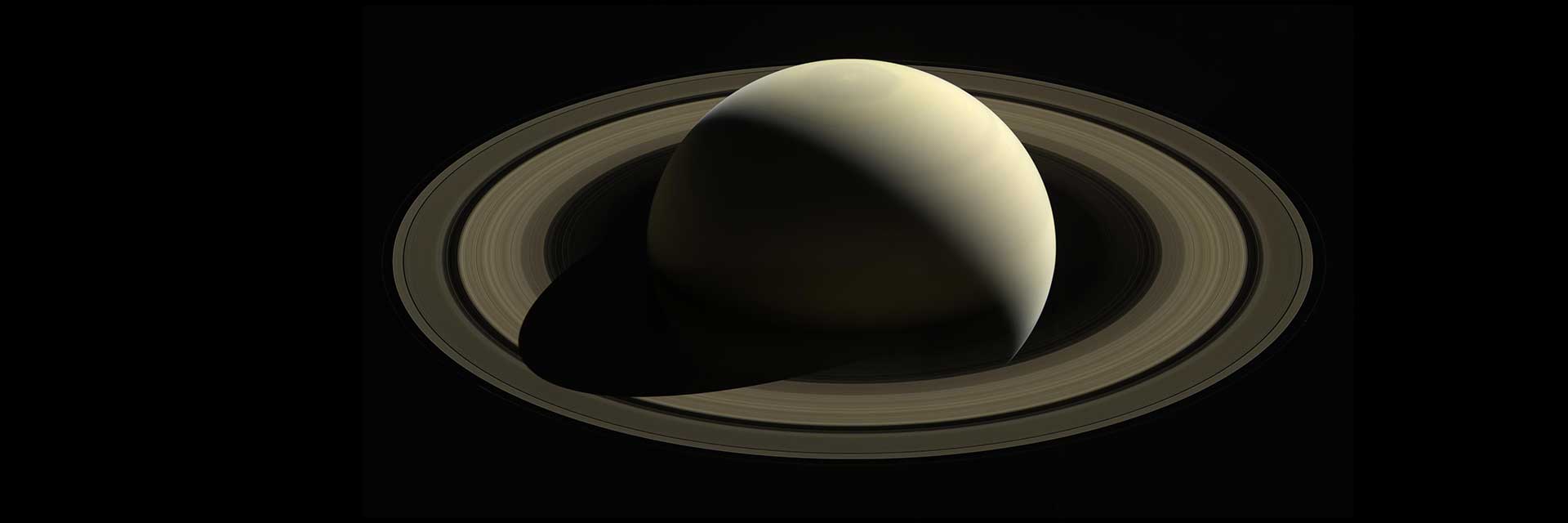
Saturn and its rings photographed by NASA's Cassini spacecraft — the most distant planet easily visible to the naked eye

Saturn — The Farthest Naked-Eye Planet

Saturn orbits at nearly 900 million miles from the Sun. Everything beyond — Uranus and Neptune — requires optical aid. Credit: NASA/JPL-Caltech/Space Science Institute.

Quick Comparison: Planet vs Dwarf Planet

Planet (8)Mercury, Venus, Earth, Mars, Jupiter, Saturn, Uranus, Neptune. All have cleared their orbital paths.
Dwarf Planet (5 recognized)Pluto, Eris, Haumea, Makemake, Ceres. Spherical, orbit the Sun, but share their orbits with other objects.

The Eight Planets in Order From the Sun

Each planet is a distinct world. The inner four are dense, rocky, and small — you could stand on any of them (though you would not survive long on three). The outer four are vast spheres of gas and ice with no solid surface. Here is the definitive reference for each, with key statistics and the telescope experience for backyard astronomers.

1
MercuryThe Swift Planet
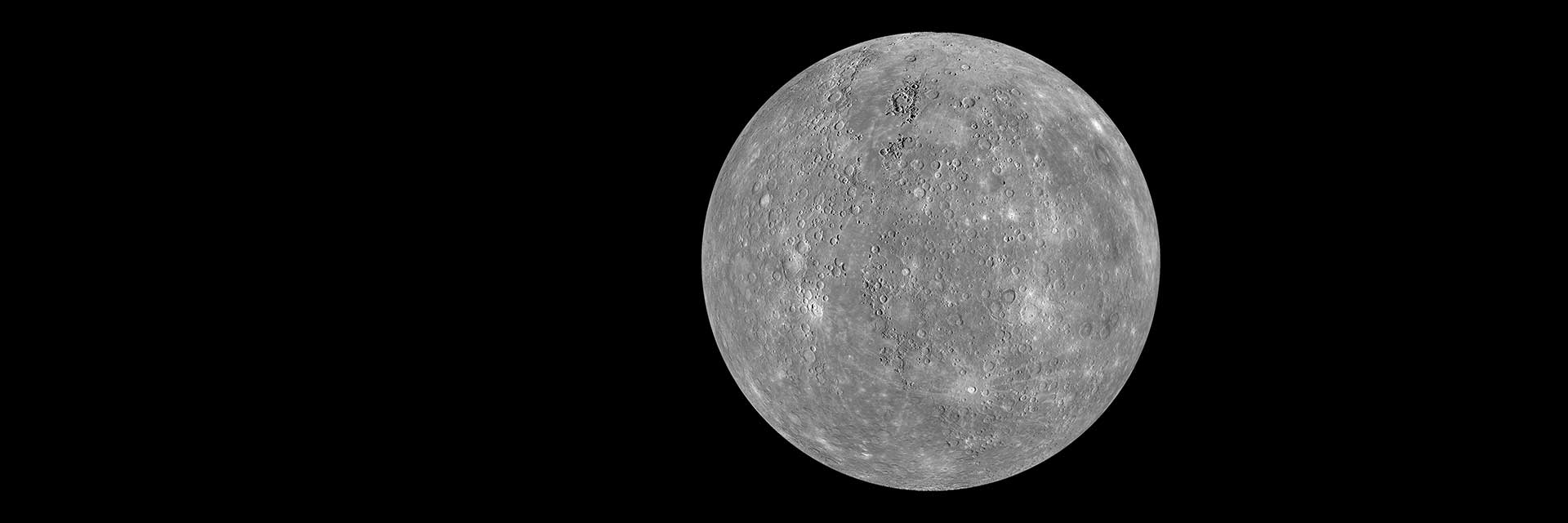
Mercury — full globe view from NASA's MESSENGER spacecraft showing the planet's heavily cratered gray surface

Credit: NASA/Johns Hopkins APL/Carnegie Institution (MESSENGER)

Mercury is the smallest planet — only slightly larger than Earth's Moon — and the closest to the Sun. It has virtually no atmosphere, which means surface temperatures swing from 800°F on the day side to −290°F at night. A day on Mercury (sunrise to sunrise) lasts 176 Earth days because of its slow rotation combined with its fast 88-day orbit.

Diameter: 3,032 mi Day: 59 Earth days Year: 88 Earth days Moons: 0

Telescope view: Mercury is challenging — it never strays far from the Sun's glare and is only visible low on the horizon in twilight. Through a 70mm+ telescope at 50-100×, Mercury shows phases like a tiny Moon, from crescent to gibbous. No surface detail is visible in amateur instruments because of its small apparent size (5–13 arcseconds) and low altitude, which produces atmospheric distortion.

2
VenusThe Evening Star
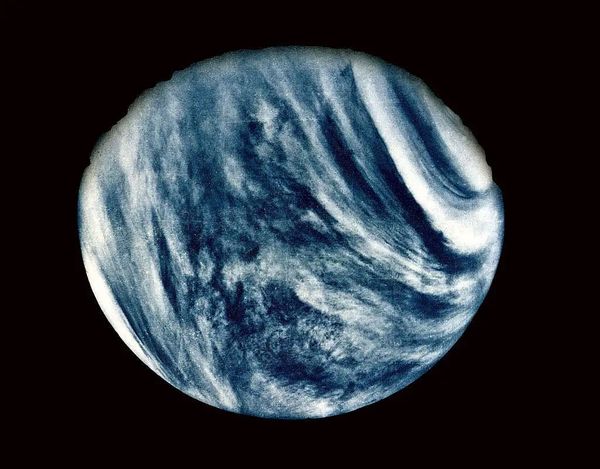
Venus — thick cloud cover photographed by NASA's Mariner 10 spacecraft

Credit: NASA/JPL-Caltech

Venus is nearly Earth's twin in size but a radically different world. Its thick carbon dioxide atmosphere creates a runaway greenhouse effect that makes the surface hot enough to melt lead (867°F). Venus rotates backward compared to most planets — the Sun rises in the west and sets in the east. It is the third-brightest object in Earth's sky after the Sun and Moon, and it is often called the "Morning Star" or "Evening Star" depending on when it's visible.

Diameter: 7,521 mi Day: 243 Earth days Year: 225 Earth days Moons: 0

Telescope view: Venus shows dramatic phases — from a thin crescent to a nearly full disk — visible in any 70mm telescope at 40×. The phases were first observed by Galileo in 1610 and provided early evidence for the heliocentric model. However, Venus's thick cloud layer is featureless in visible light; you will never see surface detail through a backyard telescope, only the brilliant white crescent or disk against a dark sky.

3
EarthOur Home
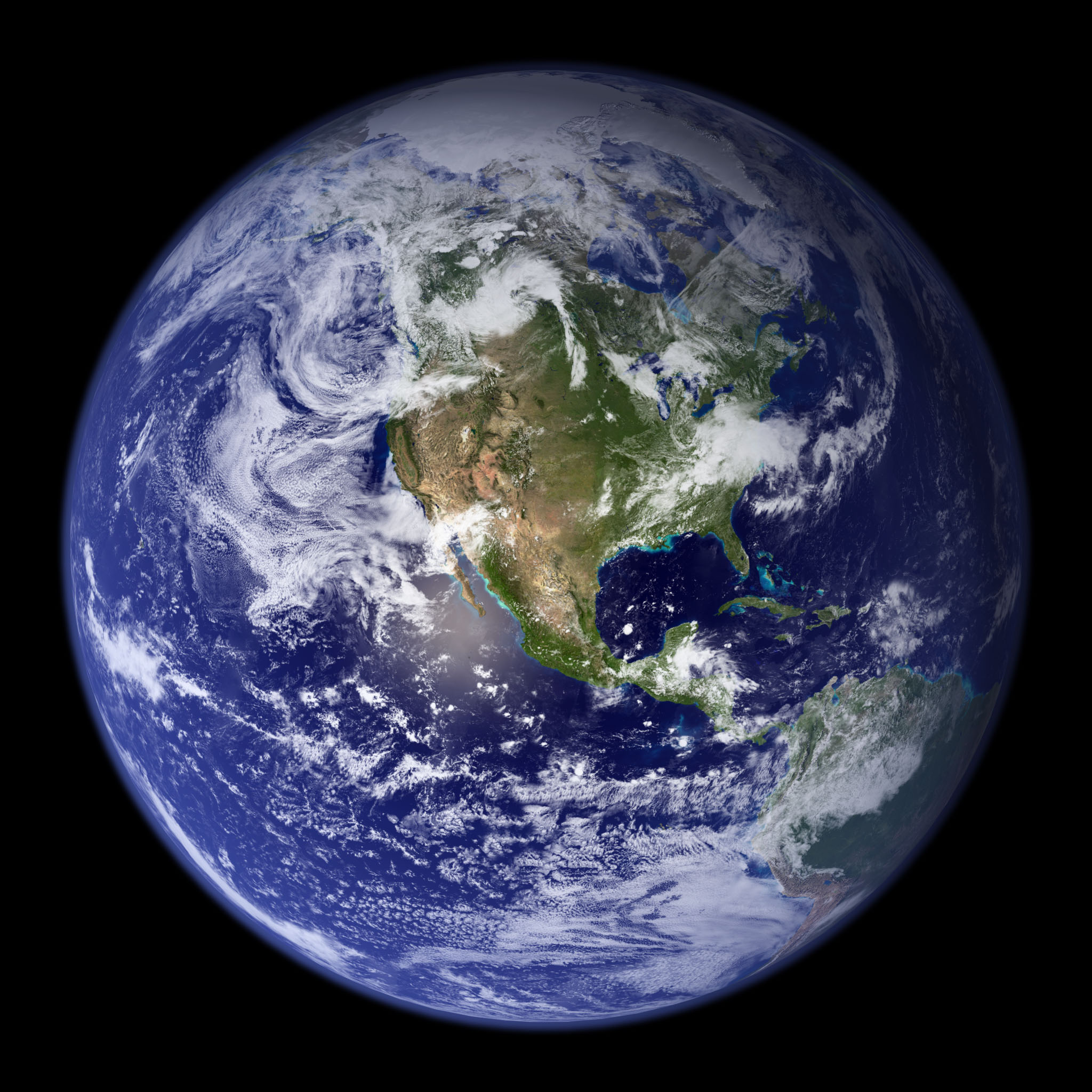
Earth — the Blue Marble, our home planet seen from space, showing the Americas, blue oceans, and white cloud swirls

Credit: NASA Goddard Space Flight Center / Blue Marble

Earth is the only known planet with liquid surface water and life. It orbits at precisely the right distance — the "habitable zone" — where temperatures allow water to exist as liquid, solid, and gas simultaneously. The Moon, at roughly one-quarter Earth's diameter, is proportionally the largest satellite relative to its parent planet in the solar system, and it stabilizes Earth's axial tilt, giving us stable seasons over geological timescales.

Diameter: 7,926 mi Day: 24 hours Year: 365.25 days Moons: 1

Telescope view: You're standing on it. Point your telescope at the Moon instead — it is the most rewarding object in any telescope. See our Moon observing guide for crater maps and best magnification recommendations.

4
MarsThe Red Planet
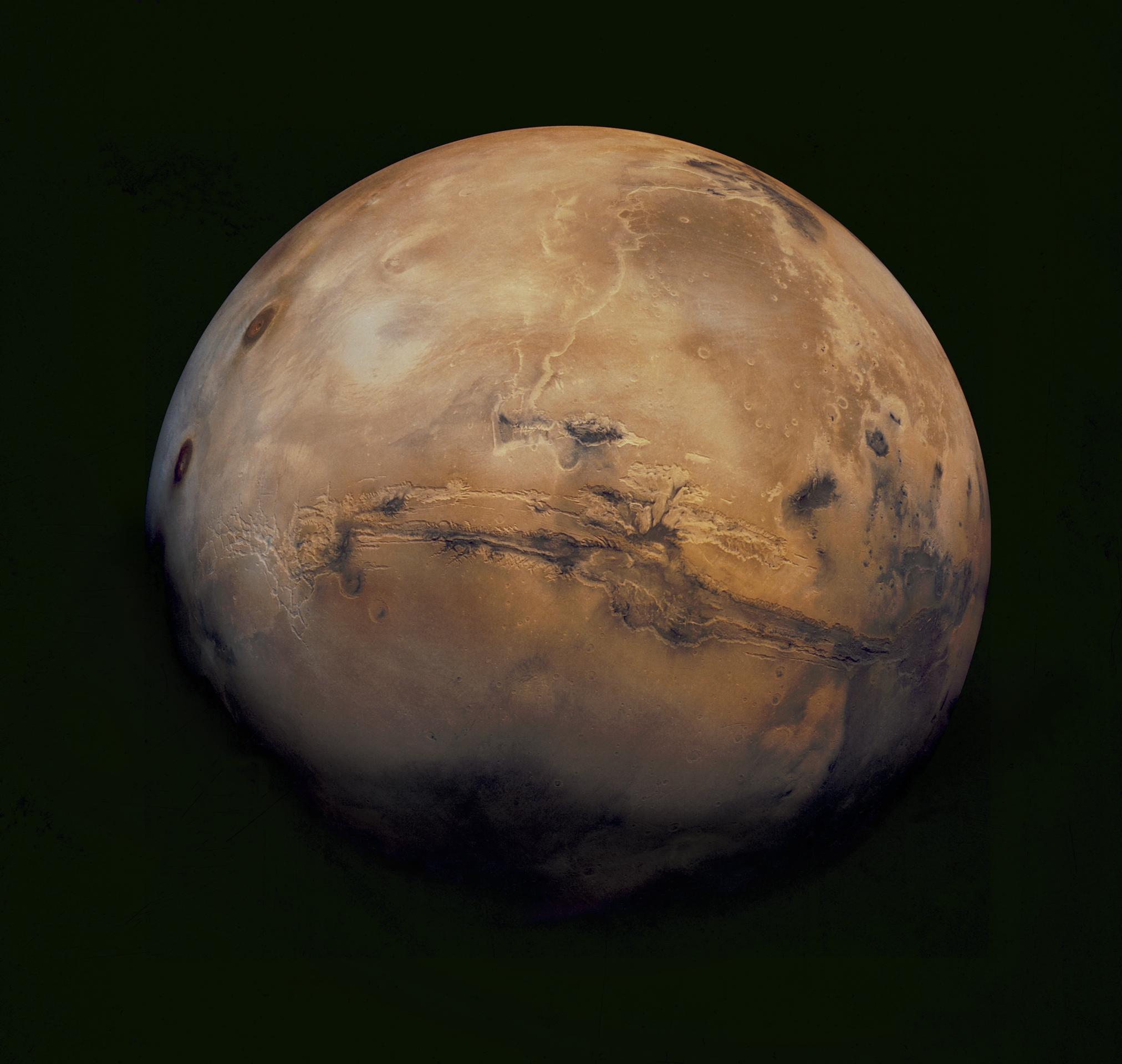
Mars — full globe of the Red Planet showing the massive Schiaparelli crater and rust-colored surface

Credit: NASA/JPL-Caltech

Mars gets its red color from iron oxide — literally rust — covering much of its surface. It hosts the solar system's largest volcano (Olympus Mons, 13.6 miles high) and deepest canyon (Valles Marineris, 2,500 miles long). Mars has polar ice caps made of water ice and frozen carbon dioxide, and NASA's Perseverance rover is currently collecting samples for eventual return to Earth. Mars remains the most compelling target for human exploration beyond the Moon.

Diameter: 4,212 mi Day: 24.6 hours Year: 687 Earth days Moons: 2

Telescope view: Mars is a challenging target that rewards patience. During opposition — when Earth passes between Mars and the Sun, every 26 months — Mars appears largest (up to 25 arcseconds) and shows genuine surface detail through a 90mm+ telescope at 150× or higher. You can see the white polar cap, dark surface markings (Syrtis Major), and occasional dust storms that obscure features for weeks. During non-opposition periods, Mars shrinks to a tiny 5–6 arcsecond orange dot with no visible detail. See our Mars telescope guide for opposition dates.

5
JupiterThe King of Planets
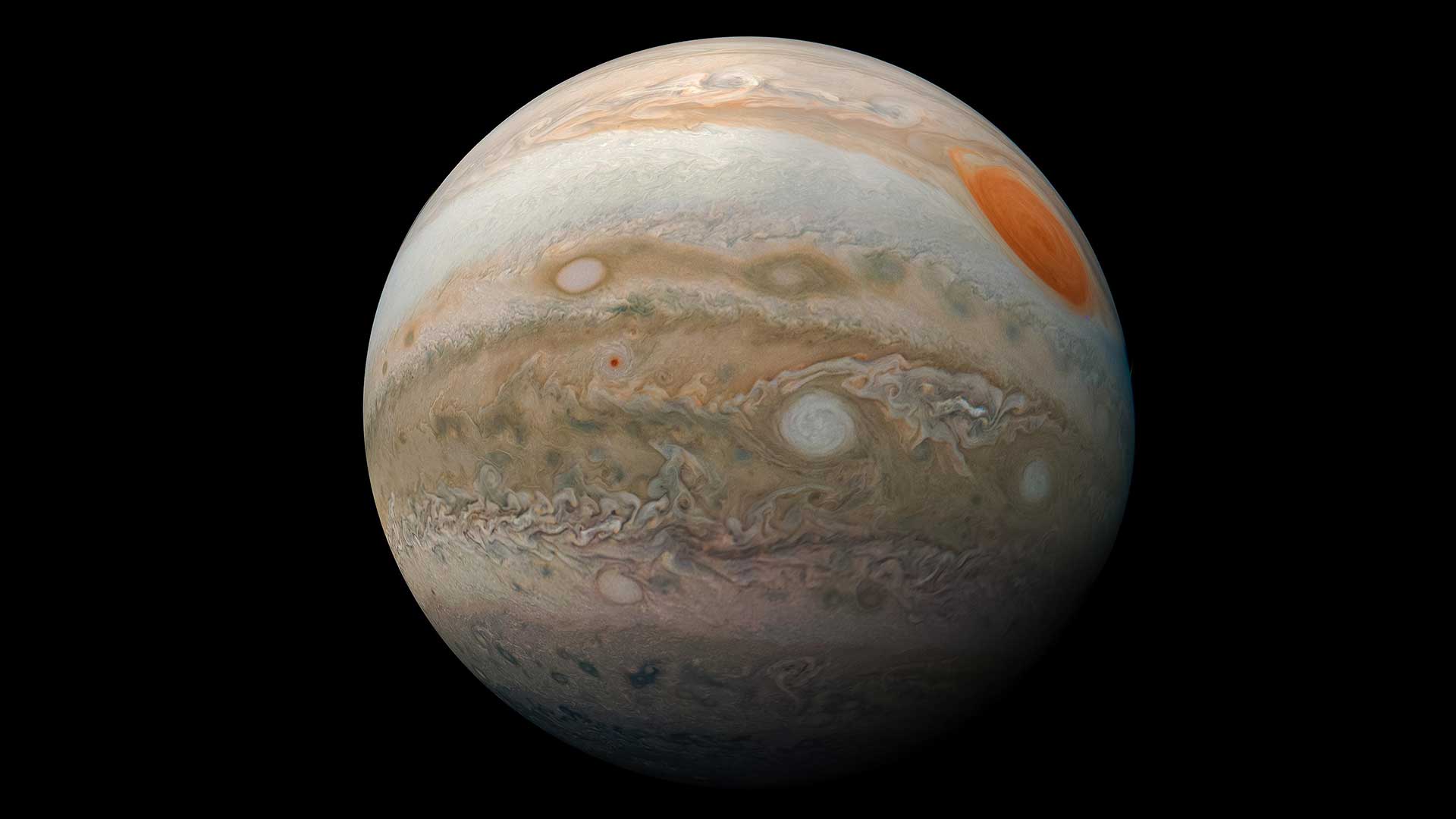
Jupiter — full marble portrait showing the Great Red Spot and colorful banded cloud structure from NASA's Juno spacecraft

Credit: NASA/JPL-Caltech/SwRI/MSSS (Juno)

Jupiter is more massive than all the other planets combined — 318 Earth masses. Its Great Red Spot is a storm that has persisted for at least 350 years and is wider than Earth. Jupiter's rapid 10-hour rotation flattens it visibly at the poles, creating an oblate shape apparent even in small telescopes. The planet has 101 confirmed moons, but the four Galilean moons — Io, Europa, Ganymede, and Callisto — discovered by Galileo in 1610 — are easily visible in any telescope or even 7× binoculars.

Diameter: 86,881 mi Day: 9.9 hours Year: 11.9 Earth years Moons: 101

Telescope view: Jupiter is the most rewarding planet in any telescope. Through a 70mm refractor at 50×, you will clearly see two dark equatorial cloud belts and all four Galilean moons as bright pinpricks flanking the planet. At 150× in a 130mm+ scope, additional belts and zones become visible, and the Great Red Spot — when facing Earth — appears as a pale salmon oval. The moons shift positions noticeably over the course of a single evening. See our full Jupiter telescope guide.

6
SaturnThe Ringed Giant
Saturn — the golden ringed giant with its full globe and magnificent ring system photographed by Cassini during its farewell tour

Credit: NASA/JPL-Caltech/Space Science Institute (Cassini)

Saturn's rings — composed of billions of ice and rock particles ranging from dust grains to house-sized boulders — span 175,000 miles across but are only about 30 feet thick. The rings are not solid; they are made of countless individual particles each in its own orbit. Saturn is the least dense planet in the solar system — it would float in water if you could find a bathtub large enough. Its largest moon, Titan, is bigger than the planet Mercury and has a thick nitrogen atmosphere and liquid methane lakes on its surface.

Diameter: 72,367 mi Day: 10.7 hours Year: 29.5 Earth years Moons: 146

Telescope view: Saturn changes lives. Through any telescope — even a 70mm department-store refractor at 25× — the rings are unmistakable. At 100× in a 114mm+ telescope, the Cassini Division (a dark gap between the A and B rings) becomes visible as a thin black line. Titan appears as an orange dot nearby. The view is so perfect it looks fake — many first-time observers accuse telescope owners of hiding a photograph in the eyepiece. See our Saturn telescope guide and how to see Saturn guide.

7
UranusThe Sideways Planet
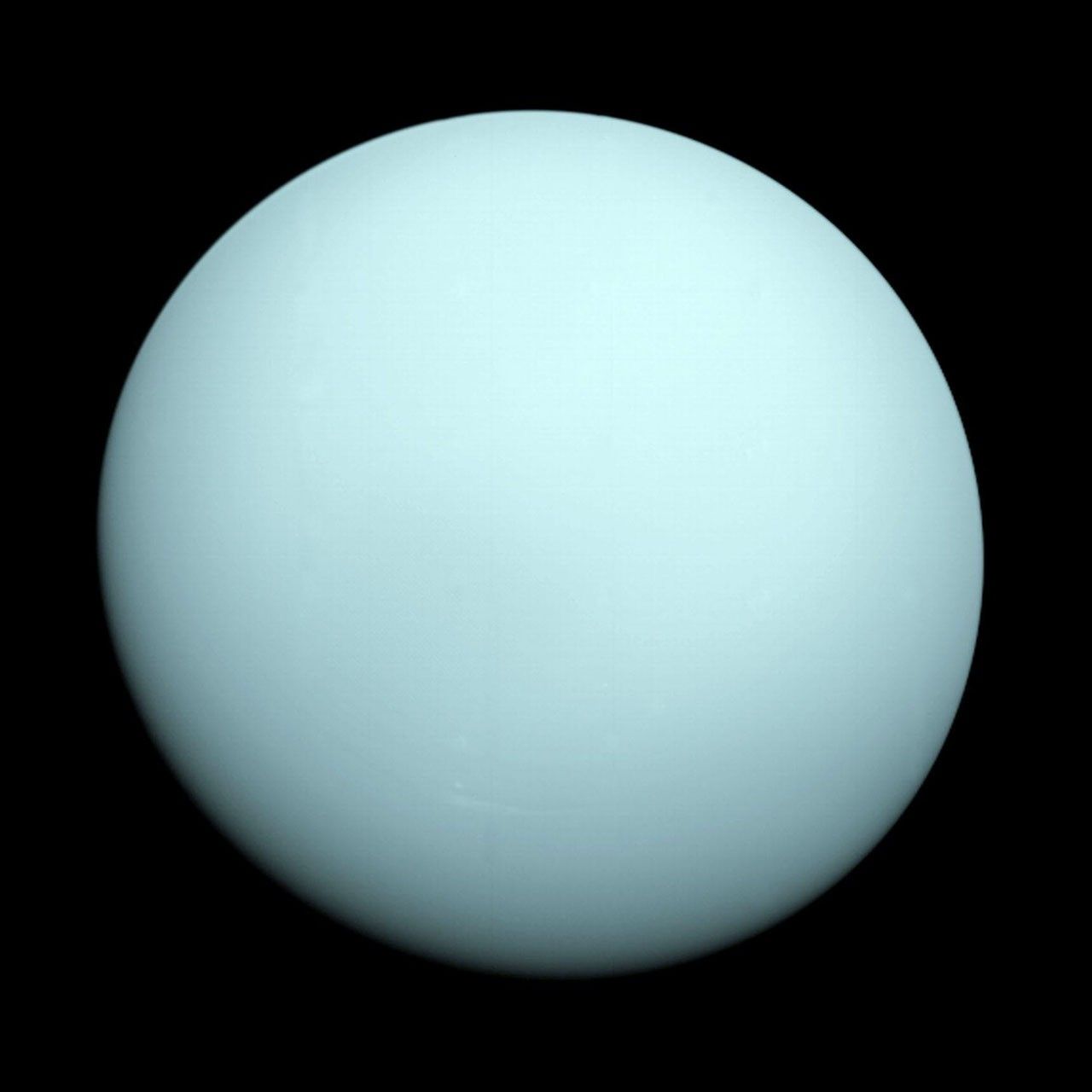
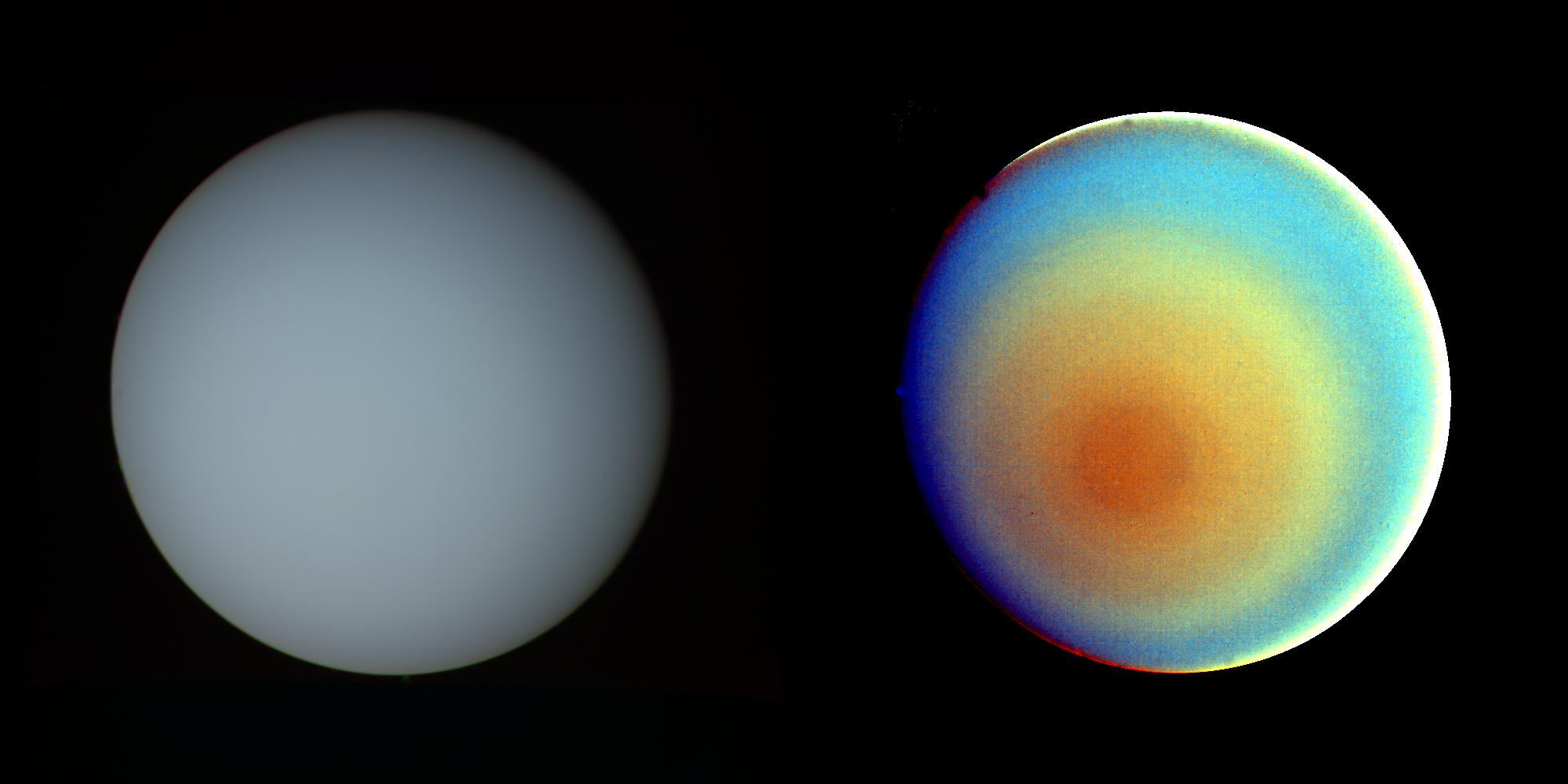
Uranus — the pale blue-green ice giant as captured by Voyager 2 during its historic 1986 flyby

Credit: NASA/JPL-Caltech (Voyager 2)

Uranus is tilted 98° on its side — it essentially rolls around the Sun like a ball. This extreme tilt, likely caused by a massive ancient collision, gives Uranus the most extreme seasons in the solar system: each pole gets 42 years of continuous sunlight followed by 42 years of darkness. Uranus was the first planet discovered with a telescope (by William Herschel in 1781), doubling the known size of the solar system. Its blue-green color comes from methane in its atmosphere absorbing red light.

Diameter: 31,518 mi Day: 17.2 hours Year: 84 Earth years Moons: 27

Telescope view: Uranus is faintly visible to the naked eye under dark skies (magnitude 5.7–5.9), but you need to know exactly where to look. Through a 90mm telescope at 100×, Uranus resolves into a tiny but unmistakable blue-green disk — clearly not a star. Higher magnification (150–200×) in a 130mm+ instrument makes the disk more obvious, but no surface detail or moons are visible in amateur telescopes except Titan-sized Titania under excellent conditions. See our Uranus telescope guide.

8
NeptuneThe Windiest World
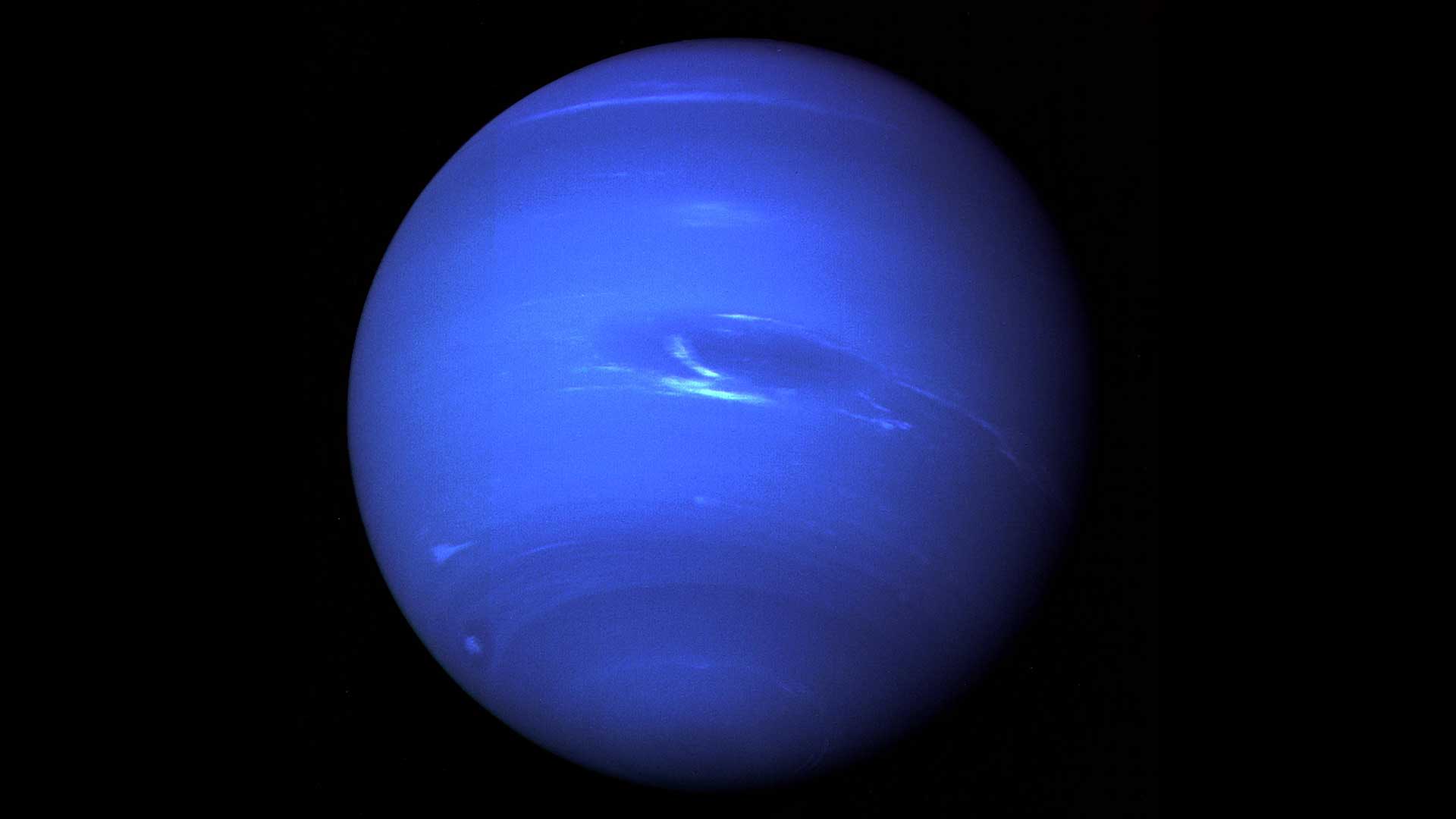
Neptune — the deep azure outermost planet showing cloud bands and the Great Dark Spot from Voyager 2's historic 1989 encounter

Credit: NASA/JPL-Caltech (Voyager 2)

Neptune was the first planet found by mathematical prediction rather than direct observation — astronomers Urbain Le Verrier and John Couch Adams independently calculated its position based on irregularities in Uranus's orbit, and Johann Galle spotted it within 1° of the predicted position in 1846. Neptune has the fastest winds in the solar system at over 1,200 mph — supersonic in its hydrogen-helium-methane atmosphere. Its largest moon, Triton, orbits backward and is likely a captured Kuiper Belt object.

Diameter: 30,599 mi Day: 16.1 hours Year: 165 Earth years Moons: 16

Telescope view: Neptune is invisible to the naked eye (magnitude 7.8) and requires at least a 114mm telescope to resolve as anything other than a faint star-like point. At 150× in a 130mm+ telescope, Neptune appears as a tiny, steady blue dot — noticeably different from surrounding stars. No surface detail, no moons (Triton at magnitude 13.5 requires a 10-inch+ telescope under excellent conditions). Finding Neptune is the real challenge; a GoTo mount or detailed finder chart is essential. See our Neptune telescope guide.

What Each Planet Looks Like Through a Telescope: Realistic Expectations

Marketing images on telescope boxes show Hubble-quality photos of planets. That is not what you will see. This section sets realistic expectations for what each planet actually looks like through common amateur telescope apertures. The good news: what you do see — Saturn's rings floating in blackness, Jupiter's moons lined up like a miniature solar system — is genuinely moving in a way that photographs are not.

Planet70mm Scope (25-75×)130mm Scope (50-200×)8-inch Scope (50-300×)
MercuryTiny half-disk or crescent, pale gray. No surface detail.Clear phase (crescent to gibbous). Still featureless disk.Sharper phase edge. Slight albedo variations at best.
VenusBright crescent or half-phase. Dazzling white, featureless.Large, brilliant phase disk. No surface or cloud detail in visible light.Bright enough to require a moon filter at high power. Phase clear; clouds featureless.
MarsSmall orange disk. Polar cap visible near opposition at 75×.Dark markings (Syrtis Major) visible at opposition, 150×+. Polar cap obvious.Multiple surface features visible at opposition. Dust storms detectable as blurring patches.
JupiterTwo dark belts clearly visible at 50×. 4 Galilean moons as bright dots.4+ belts, Great Red Spot when facing Earth. Moon shadows transit disk.Rich belt/zone detail, festoons, GRS hollow, moon transits and shadow transits clearly resolved.
SaturnRings clearly separated from disk at 25×. Titan visible. Cassini Division at 75× on steady night.Cassini Division obvious. 3-5 moons visible. Ring shadow on planet visible.Encke Gap (barely). Multiple ring bands. 5+ moons. Color variations in rings and disk.
UranusTiny pale dot. Hard to distinguish from star at 25×.Small blue-green disk at 100×. Clearly non-stellar.Definite pale disk at 150×. Titania (magnitude 13.9) detectable with patience.
NeptuneNot visible or indistinguishable from faint star.Tiny blue dot at 100×. Just barely resolvable as a disk.Small but clear blue disk at 150×. Triton (magnitude 13.5) detectable under dark skies.

Note: All descriptions assume steady atmospheric seeing and proper collimation. Heat rising from rooftops, jet streams, and high humidity degrade fine detail significantly. A 70mm scope under excellent conditions can outperform a poorly collimated 8-inch under turbulent skies.

Planet Mnemonics: Memory Tricks That Actually Work

A mnemonic turns the first letter of each planet into a memorable sentence. The classic version works, but we have collected several alternatives — some funny, some modern, and some specifically designed for kids.

Classic (most common)

My Very Educated Mother Just Served Us Noodles

Mercury, Venus, Earth, Mars, Jupiter, Saturn, Uranus, Neptune

Funny (adult-friendly)

My Very Evil Monster Just Scared Us Naked

Same order — more memorable for older kids and adults

Kid-friendly (food theme)

My Very Energetic Monkey Jumps Sideways Upward Now

Works for young children — all clean, all visual

Modern (updated vocabulary)

Many Very Educated Men Just Screwed Up Nature

Edgy variant — works for teenagers and college students

You can also create your own — the only requirement is that the first letter of each word matches the first letter of each planet in order: M V E M J S U N. The more absurd or personal the sentence, the better it sticks. Memory research consistently shows that vivid, emotional, or bizarre mental images are recalled far more reliably than neutral information.

Best Telescopes for Seeing the Planets

Planets are bright but small. Unlike deep-sky objects where raw aperture is everything, planetary observing rewards optical quality, steady mounting, and the right focal length. A 4-inch apochromatic refractor can show more planetary detail than a poorly collimated 10-inch Dobsonian. Here are our top telescope picks specifically for planet viewing, each chosen for a different budget and experience level.

Best Budget Starter
Celestron AstroMaster 70AZ refractor telescope

Celestron AstroMaster 70AZ

Shows Jupiter's belts + moons, Saturn's rings, Venus phases, and the Moon in sharp detail. The best sub-$100 planetary starting point. Includes two eyepieces (20mm and 10mm) giving 45× and 90×.

Editor's Pick — Best Overall Planetary Scope
Sky-Watcher Heritage 130P tabletop Dobsonian telescope

Sky-Watcher Heritage 130P

130mm aperture reveals 5+ Jupiter belts, Cassini Division in Saturn's rings, and Mars surface detail at opposition. Collapsible tube fits in a backpack. The best aperture-per-dollar for planetary observing.

For a complete breakdown of planetary telescope options across all budgets, see our dedicated best telescope for viewing planets guide.

Dwarf Planets: Pluto, Ceres, and the Kuiper Belt

Pluto was demoted in 2006, but it remains scientifically fascinating — the New Horizons flyby in 2015 revealed a world with mountains of water ice, nitrogen glaciers, and a heart-shaped plain called Sputnik Planitia. The IAU currently recognizes five dwarf planets, all of which orbit the Sun and are spherical but have not cleared their orbital neighborhoods:

Pluto

Diameter 1,477 mi. Kuiper Belt. 5 moons including Charon (half Pluto's size). Requires a 10-inch+ telescope at magnitude 14.4 — a tiny, faint dot even in large amateur instruments.

Eris

Diameter 1,445 mi. Scattered disc. Slightly smaller than Pluto but 27% more massive. Its discovery in 2005 triggered the planet-definition crisis. Magnitude 18.7 — beyond all but the largest observatory telescopes visually.

Ceres

Diameter 590 mi. Asteroid belt (between Mars and Jupiter). The only dwarf planet in the inner solar system. Visible in a 70mm telescope at magnitude 7-9 — appears as a star-like point. NASA's Dawn mission revealed bright salt deposits in Occator Crater.

Haumea & Makemake

Both are Kuiper Belt objects. Haumea is egg-shaped due to its rapid 4-hour rotation and has two moons and a ring system. Makemake is reddish and has one known moon. Both require 12-inch+ telescopes at magnitudes beyond 17.

For the dedicated amateur, seeing Pluto is a legitimate achievement — a rite of passage that requires a 10-inch or larger telescope, dark skies, a detailed finder chart, and confirmation over two nights to detect its motion against background stars. See our guide to seeing Pluto through a telescope.

Frequently Asked Questions

What is the correct order of the planets from the Sun?

Mercury, Venus, Earth, Mars, Jupiter, Saturn, Uranus, Neptune. Use the mnemonic "My Very Educated Mother Just Served Us Noodles" to remember the first letters.

Why is Pluto no longer a planet?

Pluto fails the IAU's third criterion for planethood: it has not cleared its orbital neighborhood of other objects. It shares its orbital zone with thousands of Kuiper Belt objects. It was reclassified as a dwarf planet in 2006.

How many planets are visible without a telescope?

Five: Mercury, Venus, Mars, Jupiter, and Saturn. Uranus is technically visible to the naked eye under perfectly dark skies but requires knowing exactly where to look. Neptune always requires optical aid.

What is the smallest telescope needed to see Saturn's rings?

A 70mm refractor at 25× magnification clearly shows Saturn's rings separated from the planet's disk. Even a 50mm finder scope at 15× can show the rings as "ears" on either side of the planet. The view improves dramatically at 100×+ in a 114mm or larger instrument.

Can I see the planets in order through a telescope in one night?

Rarely. The planets are spread across the sky along the ecliptic, and some (like Mercury) are only visible briefly at dusk or dawn. Occasionally a "planetary parade" occurs when several planets align in the evening sky. See our astronomy events calendar for upcoming alignments.

What is the hottest planet?

Venus (867°F surface temperature). Despite being farther from the Sun than Mercury, Venus's thick carbon dioxide atmosphere traps heat through a runaway greenhouse effect, making it hotter than Mercury's sunlit side (800°F).

Related Guides