Best Smart Telescope for Beginners 2026: Easy Deep-Sky Imaging from Your Backyard
Telescope Advisor Logo Telescope Advisor
Smart telescope — automated astrophotography for beginners

Buying Guide · Smart Telescopes 2026

Best Smart Telescope for Beginners 2026

Smart telescopes are revolutionizing backyard astronomy. They use built-in cameras and computers to capture and stack images automatically — revealing galaxies, nebulae, and star clusters in color, even from light-polluted city skies. This guide ranks the best smart telescopes for beginners in 2026, comparing the ZWO Seestar S50, Unistellar eQuinox 2, and Vaonis Vespera II.

Entry

Best Value Pick

Auto

No Experience Needed

Color

Nebula in Real Time

City

Works in Light Pollution

By Telescope Advisor Editorial Team Published: Updated: Editorial Standards

Quick Answer: What Is the Best Smart Telescope for a Beginner?

The ZWO Seestar S50 is the best smart telescope for beginners in 2026. It is the most affordable entry point into smart telescope astronomy. It is fully automated: turn it on, connect to your phone, select a target from the database, and within 60 seconds you see a recognizable image. The built-in solar filter lets you observe the Sun safely. For beginners who want deeper sky reach and are willing to spend more, the Unistellar eQuinox 2 offers larger aperture, longer battery life, and the ability to see fainter objects. A smart telescope is the only way to see nebula color and galaxy detail from light-polluted city skies without learning astrophotography.


🔭

Not sure which telescope actually fits your goals?

Answer 5 quick questions about your budget, observing targets, and experience level — our Telescope Finder Tool recommends a specific model in under 2 minutes.

Find My Telescope →

What Is a Smart Telescope?

A smart telescope is an all-in-one astronomical imaging device that combines a telescope, camera, computer, and automated mount into a single unit. There is no eyepiece — you observe on your phone or tablet screen. The telescope aligns itself, tracks objects automatically, and captures hundreds of short exposures that it stacks in real time to produce a single detailed image.

Why this matters for beginners: Traditional telescopes require you to know the sky, find objects manually or set up GoTo alignment, choose the right eyepiece, and accept that deep-sky objects look like gray smudges. Smart telescopes eliminate all of that. You select "Orion Nebula" on your phone, the telescope points itself, and within minutes you see a full-color image of the nebula on your screen — revealing structure and color that would be invisible through a traditional telescope of any aperture under the same light-polluted sky.

The trade-off: There is no eyepiece. You observe on a screen, which some purists argue is "not real observing." The images are good but not equal to professional astrophotography. And smart telescopes cost more per inch of aperture than traditional scopes. But for a beginner who wants to see the Orion Nebula in color from their city balcony on the first night, a smart telescope is the most effective tool available. For a broader overview, see our smart telescopes explained guide.

Quick Comparison: Smart Telescopes for Beginners

Telescope Aperture Sensor Setup Time Battery Best For Price
ZWO Seestar S5050mmIMX46260 seconds3–4 hoursBest value — beginner-friendlyView on Amazon
Unistellar eQuinox 2114mmIMX3472 minutes8–10 hoursBest deep-sky reachView on Amazon
Vaonis Vespera II50mmIMX46260 seconds3–5 hoursBest app + portabilityView on Amazon


1. ZWO Seestar S50 — Editor's Pick for Beginners

Editor's Pick — Best Beginner Smart Telescope
ZWO Seestar S50 smart telescope — best for beginners

ZWO Seestar S50

The Seestar S50 has become the best-selling smart telescope for good reason. It is the most affordable smart telescope on the market and delivers images of the Orion Nebula in color, the Andromeda Galaxy's dust lanes, and the Ring Nebula's donut shape — all from suburban skies, all within minutes of unboxing.

Key features: 50mm f/4.9 APO refractor, Sony IMX462 sensor, built-in dew heater, dual-band filter for nebulae, solar filter (white light), and a 3–4 hour battery. The app is intuitive and includes a database of hundreds of deep-sky objects. The built-in electronic focuser ensures sharp images every time. The Seestar S50 weighs only 6.3 pounds, making it genuinely portable for dark-sky trips.

2. Unistellar eQuinox 2 — Best for Deeper Reach

Unistellar eQuinox 2 smart telescope

Unistellar eQuinox 2

The eQuinox 2 is the smart telescope for beginners who want to see fainter, more distant objects. Its 114mm aperture (4.5 inches) collects over 5× more light than the 50mm Seestar S50, which means deeper images, better galaxy detail, and the ability to reach 12th-magnitude objects. The eQuinox 2 can show you spiral structure in the Whirlpool Galaxy (M51) and the faint Veil Nebula filaments that smaller smart scopes cannot reach.

Key features: 114mm f/3.9 Newtonian, Sony IMX347 sensor, 8–10 hour battery (entire night), Autonomous Field Detection for instant alignment, and "Enhanced Vision" live stacking. The Unistellar app includes citizen science campaigns — you can contribute to real asteroid occultation measurements and exoplanet transit observations. The eQuinox 2 is more expensive, but for beginners who want the deepest reach without learning astrophotography, it is the ultimate tool.

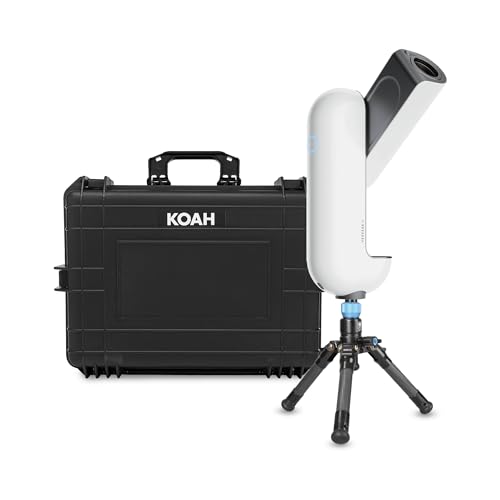
3. Vaonis Vespera II — Best App Experience

Vaonis Vespera II smart telescope

Vaonis Vespera II

The Vespera II is the most polished smart telescope experience. Its Gravity app is widely regarded as the best mobile astronomy app on the market — intuitive, beautiful, and responsive. The telescope itself is compact and stylish, folding into a monopod-like form factor that is genuinely carry-on friendly. The 50mm f/4.7 APO refractor produces sharp, color-corrected images, and the built-in dual-band filter reveals emission nebulae in vivid detail.

Key features: 50mm f/4.7 APO refractor, Sony IMX462 sensor, built-in dual-band filter, 3–5 hour battery, and the best app in the business. The Vespera II supports "live stacking" with real-time image improvement visible on your phone screen. It also includes a solar filter for white-light solar observing. The main limitation vs the Seestar S50 is the significantly higher price for the same 50mm aperture.

Which Smart Telescope Should You Choose?

Seestar S50

Choose this if you are new to astronomy and want the best value. It delivers spectacular views of the brightest deep-sky objects. The solar filter adds daytime value. Best for: beginners on a budget, families, casual observers. See price on Amazon →

eQuinox 2

Choose this if you want the deepest reach possible from a smart telescope. The 114mm aperture reveals objects that smaller scopes cannot reach. The 8-hour battery powers all-night sessions. Best for: deep-sky enthusiasts, citizen scientists, serious upgraders. See price on Amazon →

Vespera II

Choose this if app quality and design matter most. The Gravity app makes the telescope disappear — you just browse and tap targets. The compact form factor travels beautifully. Best for: design-conscious users, travelers, those who value software experience. See price on Amazon →

FAQ: Smart Telescopes for Beginners

What is the cheapest smart telescope that actually works?

The ZWO Seestar S50 is the most affordable smart telescope that delivers real, recognizable deep-sky images. Smart telescopes below this price point do not exist — the technology requires a quality camera sensor, automated mount, and onboard computer that cannot be produced for less. Check the latest price on Amazon →

Can a smart telescope replace a traditional telescope?

No — they are different tools for different experiences. A traditional telescope gives you the direct eyepiece experience of seeing Saturn's rings or lunar craters in real time. A smart telescope shows you deep-sky objects in color on a screen. Many astronomers own both. For a beginner who wants to see the most impressive views with the least effort, a smart telescope is the better first purchase.

Can I use a smart telescope from the city?

Yes — this is where smart telescopes excel. Their live-stacking technology overcomes light pollution by combining multiple short exposures. From a Bortle 8 city balcony, a Seestar S50 shows you the Orion Nebula in color, while a traditional telescope of any aperture shows only a faint gray patch. Smart telescopes are the best tool for urban deep-sky observing.

Can I see planets with a smart telescope?

Yes, but the view is different from a traditional telescope. Smart telescopes capture and stack video frames of planets, producing a single sharp image on your screen. The Seestar S50 and eQuinox 2 both handle planetary imaging, but the result is a still image, not a real-time eyepiece view. For planets, many observers prefer a traditional telescope.

Do I need Wi-Fi to use a smart telescope?

Yes — smart telescopes create their own Wi-Fi network that your phone or tablet connects to directly. Internet is not required during observing; the telescope's internal database contains all target coordinates. However, downloading the app and updates requires internet before your first session.


Related Guides