Best Telescope for City Skies 2026: Top Urban Stargazing Picks for Light-Polluted Areas
Telescope Advisor Logo Telescope Advisor
Night sky over a city skyline — urban stargazing with the right telescope

Buying Guide · Urban Astronomy 2026

Best Telescope for City Skies 2026

Most telescope buyers live in cities or suburbs where light pollution is a daily reality. The right telescope for urban skies is not the same as the right telescope for dark skies — you need contrast, smart features, and portability to escape when you can. This guide ranks the best telescopes for city and suburban observing in 2026.

Smart

Best for Light Pollution

Compact

Balcony-Friendly

Portable

Take to Dark Sites

GoTo

Easiest Finding

By Telescope Advisor Editorial Team Published: Updated: Editorial Standards

Quick Answer: What Is the Best Telescope for City Skies?

The Celestron StarSense Explorer LT 114AZ is the best telescope for urban observers in 2026. Its StarSense app-based sky recognition tells you exactly what you are looking at — invaluable when light pollution hides the faint stars you need for traditional star-hopping. For city residents who want to see deep-sky objects despite light pollution, the ZWO Seestar S50 smart telescope uses real-time image stacking to reveal nebula color and galaxy structure that is invisible to the eye through any traditional telescope under bright skies. For the best combination of portability and value, the Sky-Watcher Heritage 130P is small enough to carry on public transit to darker locations.


🔭

Not sure which telescope actually fits your goals?

Answer 5 quick questions about your budget, observing targets, and experience level — our Telescope Finder Tool recommends a specific model in under 2 minutes.

Find My Telescope →

Why City Observing Is Different — and What Actually Works

Observing from a city or bright suburb (Bortle 6–9) is fundamentally different from observing under dark skies. Light pollution raises the sky background brightness, which reduces contrast on everything you look at. The impact varies by target type:

  • The Moon and planets — largely unaffected by light pollution. They are bright enough to punch through any skyglow. Saturn's rings, Jupiter's bands, and lunar craters look identical from downtown Manhattan and a remote desert.
  • Bright double stars — also unaffected. Color contrasts (golden Albireo, orange Betelgeuse) are just as vivid from the city.
  • Bright nebulae — the Orion Nebula (M42) is visible from Bortle 8 skies, but its outer wings fade into the glow. A UHC filter helps significantly.
  • Galaxies — heavily impacted. Only the brightest cores of M31, M81, and M82 are detectable from urban skies. Spiral structure is invisible without a dark sky.
  • Faint nebulae and galaxies — the Veil Nebula, Pinwheel Galaxy (M101), and most NGC objects are invisible from Bortle 7+ skies regardless of telescope size.

This leads to three strategic approaches for city observers: (1) buy a telescope optimized for the Moon and planets, where city skies do not matter; (2) buy a portable telescope you can take to dark sites; or (3) buy a smart telescope that uses electronic image stacking to overcome light pollution. Each approach is valid, and the best choice depends on your specific situation.

For more on how light pollution affects different targets, see our light pollution impact guide and Bortle class guide.

The single most important factor for city telescopes

Portability matters more than aperture when you live in a city. A 5-inch telescope that you take to Bortle 4 skies every new Moon will show you more galaxies and nebulae than an 8-inch telescope that never leaves your Bortle 8 backyard. If you cannot easily carry your telescope, you will not use it at dark sites — and dark sites are where the magic happens. Our best portable telescopes guide has more on travel-friendly options.

Quick Comparison: Best City Telescopes

Telescope Aperture Strategy Best For Portability Price
StarSense Explorer LT 114AZ114mmPhone-guided findingEasiest urban setupHigh$$
Heritage 130P130mmPortable + apertureBudget + dark-site travelVery high$
ZWO Seestar S5050mm (smart)Live stackingDeep-sky from the cityVery high$$$
NexStar 8SE203mmGoTo + aperturePlanets + bright DSO from homeModerate$$$$


1. Celestron StarSense Explorer LT 114AZ — Editor's Pick

Editor's Pick — Best City Telescope Overall
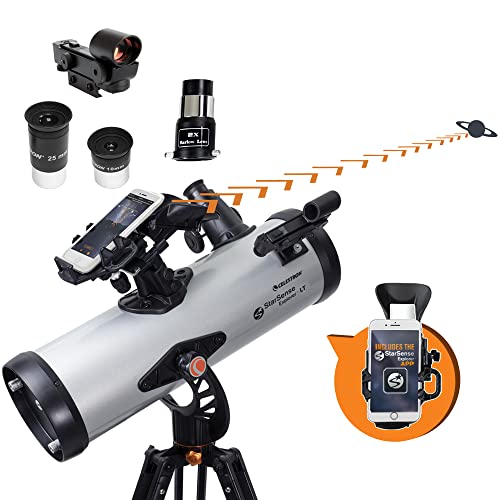
Celestron StarSense Explorer LT 114AZ — phone-guided telescope for urban stargazing

Celestron StarSense Explorer LT 114AZ

The StarSense Explorer LT 114AZ solves the biggest problem city observers face: finding objects when light pollution hides the faint guide stars needed for traditional star-hopping. Its StarSense dock holds your smartphone, and the free app analyzes the night sky through the telescope to tell you exactly what you are looking at. No GoT overs, no complex setup — just align the phone, and the app identifies objects in real time.

The 114mm (4.5-inch) aperture is generous for a scope at this price point and shows bright urban targets well. Saturn's rings are clearly separated, Jupiter's main cloud bands are visible, and the Moon is spectacular. From dark skies, the Orion Nebula shows wing structure and the Trapezium. The alt-azimuth mount is smooth and includes a slow-motion control cable for fine adjustment. Setup takes under 5 minutes.

2. Sky-Watcher Heritage 130P — Best Budget City Scope

Sky-Watcher Heritage 130P — portable telescope for urban observers

Sky-Watcher Heritage 130P

The Heritage 130P is our top recommendation for city dwellers on a budget who want the option of dark-sky travel. At under $250, it delivers 130mm of aperture in a 10-pound package that collapses to fit in a backpack. From the city, it shows excellent lunar and planetary views — Saturn's Cassini Division, Jupiter's cloud bands, and lunar craters in sharp detail. The Moon through the 130P from any urban balcony is a genuinely breathtaking sight.

Where the 130P truly shines for urban observers is its portability. Strap it to a backpack, take a 30-minute train or drive to Bortle 4 skies, and you have a telescope that reveals the Orion Nebula's wings, the Andromeda Galaxy's bright core, and dozens of star clusters. For city residents who can travel to darkness, the Heritage 130P offers the best aperture-to-portability ratio of any telescope under $500.

3. ZWO Seestar S50 Smart Telescope — Best for Deep-Sky from the City

ZWO Seestar S50 smart telescope — real-time stacked imaging from city skies

ZWO Seestar S50 Smart Telescope

The Seestar S50 represents a fundamentally different approach to city astronomy. Instead of fighting light pollution with aperture, it uses a 50mm f/4.9 refractor with a built-in Sony IMX462 sensor to capture and stack exposures in real time. What this means in practice: from a Bortle 8 balcony, the Seestar S50 can show you the Orion Nebula in color, the Andromeda Galaxy's dust lanes, and the Ring Nebula's donut shape — objects that are invisible or featureless through any traditional telescope of similar aperture under the same sky.

The Seestar is fully automated — turn it on, connect to your phone, select a target from the database, and the telescope aligns, tracks, and begins stacking frames automatically. Within 60 seconds, a recognizable image appears on your phone screen. Within 5 minutes, the stacked image rivals what a 10-inch Dobsonian shows visually from dark skies. It is not a replacement for the eyepiece experience — there is no eyepiece — but for city observers who want to see deep-sky objects, it is the most effective tool available.

4. Celestron NexStar 8SE — Best for Planetary City Observing

Celestron NexStar 8SE — computerized telescope with GoTo

Celestron NexStar 8SE

The NexStar 8SE is the best telescope for city observers whose primary interest is the Moon and planets — because those targets are unaffected by light pollution, and the 8-inch aperture delivers spectacular detail. Saturn's Cassini Division is sharp, Jupiter shows multiple cloud bands and the Great Red Spot, and lunar craters are razor-sharp at 200×. The GoTo system makes finding these targets effortless even when few stars are visible through the city glow.

For deep-sky observing from the city, the 8SE has the same limitations as any traditional telescope — M42 shows its core but not the wings, M81 is a faint patch — but the GoTo database of 40,000+ objects means you can at least attempt targets and build experience. On nights when you travel to dark skies, the 8SE transforms into a serious deep-sky instrument.

How to Choose Your City Telescope

You observe from home only (no travel)

Get the StarSense Explorer LT 114AZ for general use or the Seestar S50 for deep-sky. If planets are your priority, stretch to the NexStar 8SE — lunar and planetary views from the city are outstanding.

You can drive to dark skies occasionally

The Heritage 130P is your best choice. It is inexpensive enough to keep as a travel scope, and from dark skies its 130mm aperture reveals dozens of galaxies and nebulae. Add a UHC filter for even better results.

You want both city and dark-sky capability

Consider the NexStar 8SE or the Heritage 150P. The 8SE serves as a planetary powerhouse at home and a deep-sky instrument when transported. The 150P is more portable and budget-friendly.

For more guidance, see our light pollution telescope guide and apartment balcony telescope guide.

FAQ: City Telescope Buying Guide

Can I see galaxies from the city?

Only the brightest galaxy cores are visible from urban skies. M31 (Andromeda Galaxy) shows as a faint elongated glow, and M81/Bodes Galaxy appears as a faint patch. Spiral structure and dust lanes are invisible from Bortle 6+ skies. For galaxy observing from the city, a smart telescope like the Seestar S50 that uses electronic stacking is far more effective than any traditional telescope.

Is a bigger telescope better for city skies?

For the Moon and planets, yes — more aperture reveals more detail regardless of light pollution. For deep-sky objects, larger aperture helps with bright nebulae but reaches diminishing returns on faint galaxies, because the sky background glow also increases with aperture. A 6-inch scope in the city shows about the same deep-sky objects as a 10-inch scope in the same location — the difference is small. The best upgrade for city deep-sky is not more aperture but a dark-sky location or a smart telescope.

What is a smart telescope and is it worth it for city use?

A smart telescope (like the ZWO Seestar S50 or Unistellar eQuinox 2) uses a built-in camera and computer to capture and stack short exposures in real time, revealing deep-sky objects that are invisible to the eye through a traditional telescope. For city observers, they are the only way to see nebula color, galaxy structure, and faint objects from light-polluted skies. The trade-off is that you view on a screen, not through an eyepiece.

What can I see with a telescope from a city balcony?

From a city balcony, you can see: the Moon in spectacular detail (craters, maria, mountains), Saturn's rings, Jupiter's cloud bands and four Galilean moons, Venus's crescent phase, Mars (during opposition), the Orion Nebula as a bright patch, the Andromeda Galaxy as a faint glow, dozens of double stars, and the brightest star clusters (Pleiades, Beehive). That is a lifetime of observing material.

Do light pollution filters help from the city?

Yes — a UHC or OIII filter can significantly improve contrast on emission nebulae like the Orion Nebula, even from urban skies. They do not help with galaxies or star clusters. A UHC filter is the single highest-value accessory upgrade for city-based nebula observers. See our full filter guide for details.

Should I buy a GoTo telescope for city use?

GoTo is especially useful for city observers because light pollution hides the faint stars needed for traditional star-hopping. A GoTo telescope like the NexStar 8SE can find objects automatically even when only the Moon and a few bright planets are visible to the naked eye. The StarSense Explorer achieves similar convenience using your phone's camera and app — a good middle ground between fully manual and fully automated.
Related Guides