Best Telescope for Deep-Sky Beginners (2026): First Scopes for Galaxies and Nebulae
Telescope Advisor Logo Telescope Advisor
Deep field image showing many distant galaxies

Deep-Sky Starter Guide · 2026

Best Telescope for Deep-Sky Beginners (2026): First Scopes for Galaxies, Nebulae, and Clusters

Deep-sky observing is where astronomy becomes addictive. The first time you resolve a globular cluster into stars, pull structure out of Orion Nebula, or detect Andromeda stretching beyond your eyepiece field, you understand why aperture, sky quality, and session planning matter more than hype specs. This guide gives you beginner-safe telescope picks and a detailed first-year path so your results improve every month, not just on perfect nights.

5

Ranked scopes

90-day plan

Skill builder

Bortle aware

City to dark sky

Beginner-safe

No gear trap

By Telescope Advisor Editorial Team Published: Updated: Editorial Standards

Quick Answer: What Is the Best Telescope for Deep-Sky Beginners?

For most beginners, the best deep-sky telescope is an 8-inch Dobsonian, specifically the Sky-Watcher Classic 200P. It gives the strongest balance of light gathering, contrast, and cost efficiency. Deep-sky objects are faint, which means aperture is your friend. A larger mirror collects more photons and turns low-contrast smudges into structured targets you can learn and revisit with confidence.

If you need maximum convenience and fast setup in suburban skies, a smart option like Seestar S50 can accelerate your early success. If your goal is traditional visual observing skill, manual Dobsonian platforms remain the best value for the majority of users who can handle a bigger tube and base. The right answer depends less on brand and more on your weekly routine, transport limits, and your tolerance for learning curve.

The big beginner mistake is buying by advertised magnification. Deep-sky performance is mostly about aperture, dark adaptation, and practical eyepiece choices. This guide keeps you centered on those fundamentals so your first purchase still feels right one year from now.

Top 5 Beginner Telescopes for Deep-Sky Observing (Ranked)

Editor's Pick - Best Overall Deep-Sky Beginner Telescope
Sky-Watcher Classic 200P Dobsonian telescope

1) Sky-Watcher Classic 200P Dobsonian

If your goal is to see more, aperture wins. The Classic 200P gives an 8-inch mirror at a price point where many alternatives force compromises in optics or mount quality. In practical use, this means brighter nebula structure, stronger globular cluster resolution, and better galaxy detection under the same sky than smaller entry scopes. The f/6 focal ratio is forgiving for beginners while still rewarding better eyepieces. You can run low power for star-hopping, medium power for wide clusters, and targeted higher power for planetary nebulae without the system feeling fragile.

The main tradeoff is size. This is not a tiny grab-and-go tube. But for users who can move it safely and observe from a yard or car-access dark site, it is the strongest long-term value in beginner deep-sky observing.

View on Amazon →
ZWO Seestar S50 smart telescope

2) ZWO Seestar S50

Deep-sky beginners often quit because the first month feels like assembly and troubleshooting rather than observing. Seestar S50 flips that. Automated alignment, tracking, and live stacking make first results reachable in light-polluted locations where traditional visual setups struggle. It is not a replacement for large-aperture visual telescopes, but it is a powerful bridge for beginners who want confidence quickly.

Use case: frequent short sessions, city or suburban conditions, and users who value consistency over manual workflow depth.

View on Amazon →
Sky-Watcher Heritage 130P telescope

3) Sky-Watcher Heritage 130P

For small homes, limited storage, or users who need quick transport, the Heritage 130P remains one of the best beginner value platforms. The tabletop Dob format keeps motion intuitive while giving enough aperture to show meaningful deep-sky detail on bright objects like M42, M31 core, M13, and open clusters. It is especially strong for users who can place it on a stable surface and observe regularly rather than waiting for rare full setup nights.

The key to success with this scope is expectation management. You are trading raw aperture for portability. Under dark skies, it still punches well above its footprint.

View on Amazon →
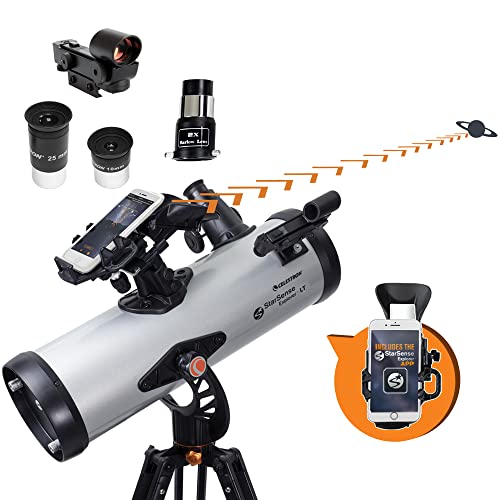
Celestron StarSense Explorer LT 114AZ telescope

4) Celestron StarSense Explorer LT 114AZ

Many beginners are not blocked by optics. They are blocked by target acquisition. The StarSense workflow helps users find objects more often and spend less time lost between stars. For bright deep-sky targets this can be the difference between productive sessions and abandoned gear. Aperture is modest compared with Dobsonian options, but for users in heavy light pollution who need guidance and momentum, this model can be a smarter first step than a larger manual setup they do not use consistently.

Think of it as a learning accelerator. Once star navigation confidence improves, users can upgrade aperture with less risk of frustration.

View on Amazon →
Celestron NexStar 8SE telescope

5) Celestron NexStar 8SE

The 8SE is a proven all-around platform for users who want GoTo convenience in a compact package. While its long focal length is less naturally wide-field than fast Newtonians, it delivers strong lunar, planetary, and targeted deep-sky performance with a controlled learning curve. For beginners with limited observing time, GoTo and tracking can dramatically improve session consistency.

If you know you value automation and do not want a large Dobsonian base, this remains one of the most practical premium beginner options.

View on Amazon →
🔭

Not sure which telescope actually fits your goals?

Answer 5 quick questions about your budget, observing targets, and experience level — our Telescope Finder Tool recommends a specific model in under 2 minutes.

Find My Telescope →

What You Will Actually See in Year One

Deep-sky beginners do better when expectations are calibrated correctly. You are not seeing colorful space-agency images through an eyepiece. You are training your eye to detect subtle structure, contrast gradients, and star density differences. This is still visually rewarding, but the reward comes from skill growth, not instant color saturation.

In the first 30 days, most users learn to identify bright targets quickly: Orion Nebula, Andromeda core, Pleiades, Beehive Cluster, and several globulars. By month two, with better dark adaptation and star-hopping habits, users start detecting shape and texture differences across targets. By month three, many beginners can compare sessions by transparency and seeing quality, track improvement, and intentionally choose magnification and filters based on target class.

Target Type Beginner Expectation Best First Approach
Open clustersBright, immediately rewarding, high star densityLow-to-medium power with wide field
Globular clustersCore glow first, outer star resolution improves with apertureMedium power after centering at low power
Emission nebulaeCloud-like structure, brightness varies by sky qualityDark adaptation and optional nebula filter
GalaxiesCore first, faint halo and shape with practiceDark site priority, moderate magnification
Planetary nebulaeSmall bright targets, detail improves with powerCenter carefully, then raise magnification

The highest-impact beginner habit is keeping a simple observing log. Write down target, eyepiece, sky condition, and what detail you saw. This trains pattern recognition and makes progress obvious. Over several sessions you will notice that your eye starts pulling out structure that was invisible on day one.

Bortle and Light-Pollution Strategy for Beginners

Your sky quality can matter as much as your telescope. A smaller scope under darker skies can outperform a larger scope under heavy skyglow on many faint targets. Beginners who understand Bortle class avoid expensive gear frustration and build better observing habits earlier.

  • Bortle 8-9 (city): Focus on bright clusters, Moon, planets, and selected bright nebulae. Smart telescopes or guided apps improve efficiency.
  • Bortle 6-7 (suburban): Strong beginner zone for many Messier objects with 6-inch to 8-inch aperture.
  • Bortle 4-5 (rural edge): Deep-sky structure becomes much easier; galaxies and faint nebulae become meaningful targets.
  • Bortle 2-3 (dark site): Major jump in contrast and target count, even with modest apertures.

If you observe mainly from suburban or city skies, build a split strategy: do short frequent sessions at home for skill retention, then monthly dark-sky trips for deep target work. This pattern improves results faster than waiting only for rare perfect nights.

For beginners, consistency beats intensity. Thirty regular sessions across mixed conditions usually produce more practical competence than five ideal dark-sky sessions with long gaps in between.

Deep-Sky Beginner Buying Framework

Use this framework before buying any telescope. It prevents mismatched purchases and keeps your first setup aligned with real use patterns.

  1. Start with your observing environment: home-only, mixed, or dark-site regular. This determines how much aperture you can actually use.
  2. Define transport reality: if the setup is hard to move, it will be used less. Choose a scope you can deploy without friction.
  3. Prioritize optical throughput: aperture and good collimation beat accessory bundles.
  4. Budget for eyepiece strategy: one low-power and one medium-power eyepiece matter more than many low-quality extras.
  5. Choose your workflow: manual skill-building versus app-assisted or fully automated smart workflow.
  6. Plan an upgrade path: first upgrades should be eyepieces, chair, and finder improvements, not random accessories.

Most regret comes from skipping step one and buying by marketing claims. If your sky is bright and your time is limited, convenience and repeatability may outperform bigger optics that rarely leave storage.

First 90 Days: Deep-Sky Beginner Progress Plan

This plan is intentionally practical. It teaches setup consistency, target acquisition, and observation quality before advanced complexity.

Weeks 1-2: Setup and Bright Target Confidence

Learn mount movement, finder alignment, and cooldown behavior. Focus on bright open clusters and Orion Nebula. Use low power first on every target. Log session details and note which steps slow you down. The goal is repeatable setup and reliable centering, not target count.

Weeks 3-4: Star-Hop and Tracking Discipline

Add a short list of 8 to 12 predictable targets by season. Practice moving between them without restarting your process. Begin testing moderate magnification on globular clusters and compact nebulae. Compare detail differences as transparency changes.

Weeks 5-8: Contrast and Detail Training

Revisit familiar objects under different sky conditions to train subtle-detail recognition. Try dark adaptation discipline: 20 to 30 minutes without bright white screens. If using filters, evaluate one target with and without filter to understand when it helps.

Weeks 9-12: Structured Deep-Sky Sessions

Build themed sessions: one open-cluster night, one nebula night, one galaxy night. This improves pattern recognition and simplifies eyepiece decisions. At this stage most beginners can detect clear improvement in target acquisition speed and observable structure.

By day 90, you should have a personal reference list of reliable targets by season and sky condition. That is the foundation of long-term progress.

Accessories That Actually Improve Beginner Deep-Sky Results

Most accessory spending in month one is wasted. These are the upgrades that consistently produce better sessions for beginners.

1) Stable binocular companion

A quality astronomy binocular helps with initial sky orientation and broad target framing, especially before telescope lock-in.

Celestron SkyMaster 15x70 binoculars

Celestron SkyMaster 15x70

Strong beginner astronomy binocular for cluster sweeps and pre-scope target confirmation.

2) Two good eyepieces, not many cheap ones

A low-power wide-field eyepiece and a medium-power eyepiece cover most beginner deep-sky sessions. This simplifies choices and improves image quality consistency.

  • Low power for finding and framing large targets.
  • Medium power for cluster resolution and compact nebula detail.
  • Avoid chasing very high power early unless target and seeing justify it.

If your budget allows only one upgrade after purchase, choose observing comfort: a stable chair and disciplined setup workflow. Comfort increases session length, and session length increases what you learn and see.

7 Common Deep-Sky Beginner Mistakes (and Better Alternatives)

  1. Buying by magnification claim: focus on aperture and optical quality instead.
  2. Ignoring sky quality: schedule dark-site sessions even if monthly.
  3. Skipping finder alignment: align in daylight to avoid night frustration.
  4. Using bright phone screens: protect dark adaptation with low red light.
  5. Changing too many variables at once: keep session goals narrow and repeatable.
  6. Overaccessorizing early: master core workflow before buying niche gear.
  7. No observing log: logging is the fastest route to visible improvement.

Beginners who avoid these mistakes typically progress faster, enjoy sessions more, and make better upgrade decisions with lower total spend.

Seasonal Deep-Sky Roadmap for Beginners

One of the fastest ways to improve deep-sky results is to stop choosing random targets and start observing seasonally. Every season gives you a stable set of headline objects that are easier to locate, easier to revisit, and easier to compare over time. When beginners revisit the same targets across different nights, they develop visual sensitivity and confidence much faster than if they chase a new list every session.

Use the framework below as a practical training path. You do not need to complete every target in one season. The point is to repeat observations on a smaller set and improve the quality of what you see.

Winter Priority Targets

  • M42 Orion Nebula: best beginner emission nebula for structure and contrast training.
  • M45 Pleiades: wide-field cluster that teaches framing and low-power eyepiece strategy.
  • M35 in Gemini: useful for star density comparison across magnification changes.
  • M1 Crab Nebula: higher-difficulty target that introduces subtle contrast detection.

Spring Priority Targets

  • M13 in Hercules: ideal globular cluster for learning when to step up magnification.
  • Leo Triplet region: beginner galaxy hunting benchmark for sky quality and patience.
  • M3 globular cluster: excellent target for evaluating seeing stability and focus precision.
  • Virgo bright galaxies: great training ground for detecting bright cores and halo shape.

Summer Priority Targets

  • M8 Lagoon Nebula: one of the most rewarding beginner nebulae in dark skies.
  • M20 Trifid Nebula: contrast challenge that rewards careful dark adaptation.
  • M22 globular cluster: easy and bright target for star resolution practice.
  • M57 Ring Nebula: compact planetary nebula that teaches centering and magnification control.

Autumn Priority Targets

  • M31 Andromeda Galaxy: best beginner galaxy for scale and brightness profile training.
  • Double Cluster in Perseus: reliable wide-field showcase and finder alignment check.
  • M33 Triangulum Galaxy: stronger dark-sky test for low surface brightness observation.
  • NGC 457 Owl Cluster: easy pattern-recognition target useful for outreach and confidence.

A simple seasonal list creates momentum. You always know what to observe next, and every session has a clear objective. That removes analysis paralysis and makes astronomy feel more rewarding than searching random catalog entries.

From Beginner to Advanced Beginner: The First Upgrade Decisions

Once you complete around 20 to 30 productive sessions, you move from true beginner to advanced beginner. This is the stage where upgrades can help, but only if they solve a real bottleneck. Random gear purchases at this phase create complexity without improving your view.

Use this bottleneck checklist before buying anything:

  • If targets are hard to locate: improve finder alignment workflow and star-chart routine first.
  • If views feel dim: prioritize darker skies and longer dark adaptation before changing optics.
  • If stars look soft: check collimation, focus discipline, and telescope cooldown timing.
  • If framing feels limited: add one better low-power eyepiece with wider apparent field.
  • If sessions are short: improve comfort (chair, organization, setup sequence) rather than optics.

Most beginners are surprised that workflow upgrades often beat optical upgrades in month three. A smoother setup process leads to more observing time, and more observing time leads to better results on every target. Hardware matters, but habits magnify hardware value.

When you are ready for a true optical upgrade, choose one that aligns with your dominant target class. If you mostly observe large nebulae and clusters, prioritize wide-field performance and transport-friendly aperture gains. If you are increasingly galaxy-focused and can access dark skies, larger aperture has the highest return. If your schedule is constrained and your sky is bright, smart-assisted workflows can produce more frequent success even if visual aperture per dollar is lower.

The best upgrade is the one that increases the number of successful nights you can run each month. That is the practical metric that predicts long-term progress.

FAQ: Deep-Sky Beginner Telescope Buying

Is an 8-inch Dobsonian too much for a beginner?

Not usually. If you can handle the size and move it safely, an 8-inch Dob is one of the best beginner long-term values for deep-sky observing.

Can I see galaxies from a city with a beginner telescope?

You can detect bright galaxy cores, but faint structure is harder. Dark-site trips make the biggest difference for galaxy observing quality.

Should beginners choose a smart telescope or manual scope?

Choose based on routine. Smart scopes improve convenience and consistency; manual scopes build sky-navigation skills and often provide stronger aperture-per-dollar value.

Do I need expensive filters on day one?

No. Learn core workflow first. Filters help specific targets, but they are not substitutes for aperture, dark adaptation, and good sky conditions.