
NASA News · Hubble Black Holes · July 2026
Hubble Discovers First of Omega Centauri's Missing Black Holes — A 94-Year Cosmic Dance
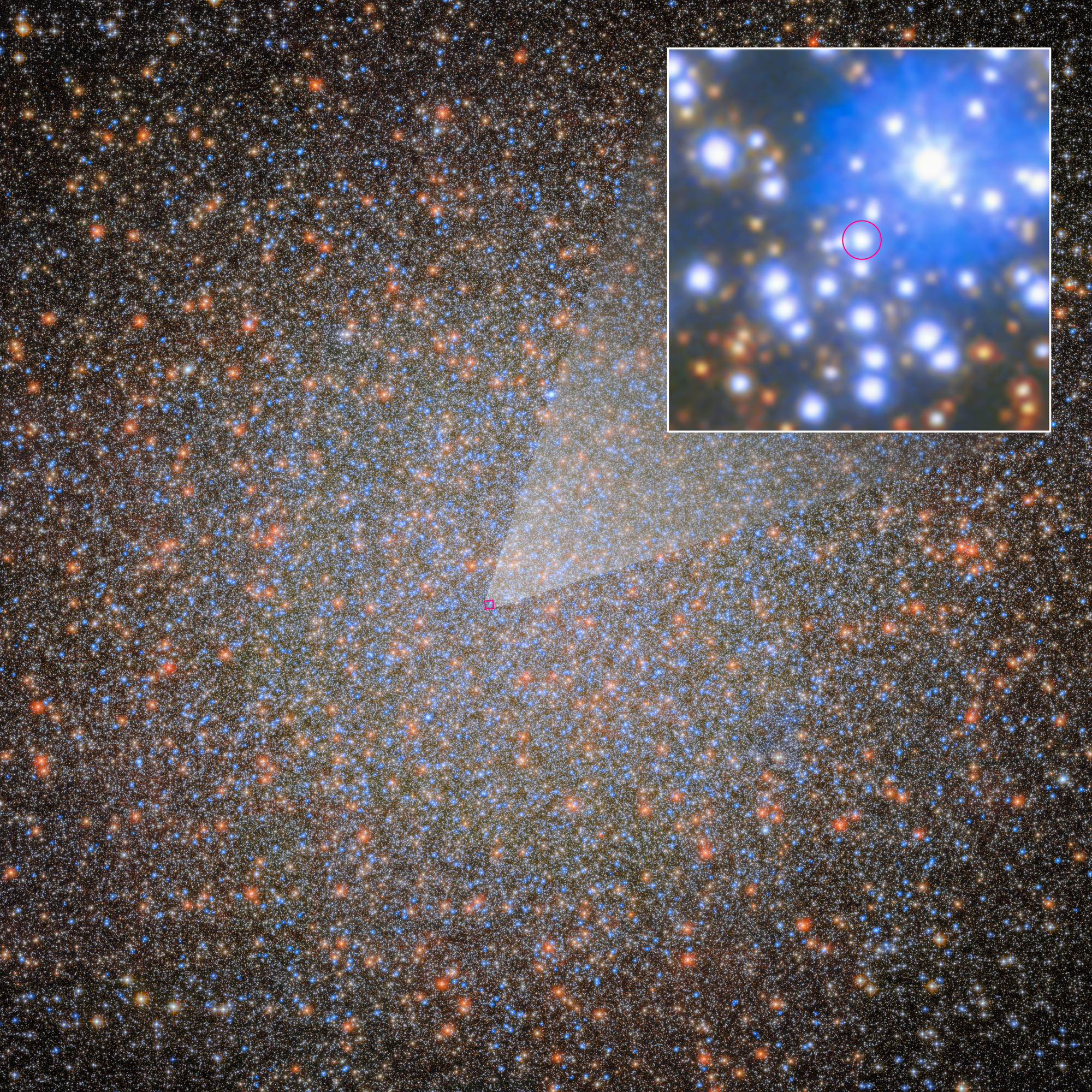
After decades of searching, astronomers using NASA's Hubble and Webb space telescopes have finally found the first stellar-mass black hole in the giant globular cluster Omega Centauri. Named oMEGACat BH-2, it has the longest orbital period of any known black hole binary — and its surprisingly low mass is already challenging theories of how stars form and evolve in metal-poor environments.
Black Hole Mass4.46 solar masses
Orbital Period94 years (longest known)
Host ClusterOmega Centauri
Distance18,000 light-years
By Telescope Advisor Editorial Team
|
Published:
|
Updated:
|
Reviewed & approved by Juhi Sahni, Senior Editor
Editorial Standards

Elena Reyes
Senior Science Editor
Covers NASA missions, space science discoveries, and astronomical events for Telescope Advisor. Translates complex astrophysical research into practical insights for backyard observers. Based in the San Francisco Bay Area.
Content reviewed by our editorial team. Research and drafting assisted by AI to ensure unbiased, data-driven analysis. Learn more about our editorial process.
The Discovery: How Hubble and Webb Found Omega Centauri's First Stellar-Mass Black Hole
The globular cluster Omega Centauri has puzzled astronomers for decades. Composed of approximately 10 million gravitationally bound stars, it is the largest globular cluster in the Milky Way's halo — so large and bright that it was once mistaken for a star itself (hence its "Omega" designation in Bayer's catalogue). Models of stellar evolution predict that within this dense swarm of stars, there should be about 10,000 stellar-mass black holes — the remnants of massive stars that exploded as supernovae billions of years ago, when the cluster was young.
But for years, these black holes remained frustratingly invisible. Previous searches used the radial velocity method (measuring the speed of stars along our line of sight) or looked for radio and X-ray emission from material accreting onto black holes — and came up empty. The black holes were there, but the techniques used to find them were simply not sensitive enough to detect them in Omega Centauri's crowded, complex environment.
Now, a team led by Matthew Whitaker of the University of Utah, Salt Lake City, has broken the deadlock using a different approach: astrometry, the precise measurement of a star's position and motion across the sky over time. By sifting through more than 20 years of Hubble archival data (from 2002 to 2023) and pulling in recent Webb near-infrared observations to refine their measurements, the team identified a star whose tiny, systematic wobble revealed the presence of an invisible, massive companion — a black hole.
Dubbed oMEGACat BH-2, this is the first stellar-mass black hole ever detected in Omega Centauri, and the first stellar-mass black hole in any globular cluster to be discovered using astrometry. "With Hubble and Webb data, we were able to see the motion of the visible main sequence star that is part of this binary, which is about 18,000 light-years away in the dense environment of Omega Centauri," said Whitaker. "The precision of these measurements is incredible, down to a fraction of a pixel on Hubble and Webb's detectors. It would not have been possible to find this black hole without these two space telescopes."
The team's findings, published July 13, 2026, in The Astrophysical Journal Letters, also refine a past study by a different group that suggested this binary system contained a neutron star. By expanding the earlier investigation with 21 years of Hubble astrometric data and adding Webb's near-infrared precision, the team was able to tightly constrain the mass of the dark companion — ruling out the neutron star possibility and confirming it is a black hole.
The Mystery of Omega Centauri's Missing Black Holes
Why has it taken so long to find black holes in globular clusters? The answer lies in the unique physics of these ancient stellar systems — and the limitations of the techniques used to search for them.
Omega Centauri is approximately 12 billion years old, nearly as old as the universe itself. During its first few hundred million years, the cluster formed a generation of massive stars — many of which would have been 20 to 100 times the mass of the Sun. These stars burned through their nuclear fuel in just a few million years and then exploded as supernovae, leaving behind stellar-mass black holes. Over the subsequent billions of years, these black holes should have settled into the cluster's core through a process called mass segregation — a gravitational sorting effect that causes heavier objects to sink toward the centre of a star cluster. Today, models suggest that Omega Centauri's core should contain a dense population of black holes, totalling roughly 10,000 objects.
Why Previous Searches Failed
Radial velocity surveys measure the Doppler shift of a star's spectrum to detect wobbles from unseen companions — but in a crowded globular cluster, the spectra of multiple stars blend together, making it nearly impossible to isolate individual stars. X-ray and radio searches looked for material falling onto black holes, but most stellar-mass black holes in globular clusters are "quiet" — they have no nearby gas to accrete, so they emit no detectable radiation.
What Astrometry Changes
Astrometry measures the position of a star on the sky with extraordinary precision over time, detecting the tiny gravitational tug of an invisible companion. Unlike radial velocity, astrometry does not depend on the star's spectrum being clean — it simply requires high-resolution images taken over many years. Hubble's long baseline of observations (more than two decades) and its exquisite resolution make it uniquely suited for this technique.
Why Webb Was Essential
Webb's near-infrared observations added critical precision. The star's motion measured by Hubble covered the period when it was moving fastest — its closest approach to the black hole. Webb data from a different wavelength regime helped the team refine the astrometric measurements and rule out systematic errors, giving them the confidence to announce the black hole detection.
How Astrometry Cracked the Case After 20 Years
The discovery of oMEGACat BH-2 is a triumph of archival astronomy — the practice of extracting new science from data collected years or decades ago, often for entirely different purposes.
The team began with Hubble observations of Omega Centauri taken over more than two decades — from 2002 through 2023. These images, captured by Hubble's Advanced Camera for Surveys (ACS) and Wide Field Camera 3 (WFC3), were originally obtained for a variety of scientific programmes studying stellar populations, proper motions, and the cluster's dynamics. By re-analysing this vast dataset with custom astrometric reduction software, the team measured the positions of millions of stars in the cluster with sub-pixel precision — detecting motions as small as a fraction of a pixel over the 21-year baseline.
Among those millions of stars, one stood out. Its motion across the sky was not a simple straight line (as expected for a star moving through the cluster), but a slight, periodic wobble superimposed on its overall path — the telltale signature of an unseen companion tugging on it gravitationally. The amplitude of the wobble revealed the mass of the invisible object: at least 4.46 solar masses, well above the maximum mass of a neutron star (about 2.1 solar masses) and firmly in black hole territory.
To confirm their detection, the team used Webb's NIRCam to observe the same star in the infrared. Webb's sharp vision at infrared wavelengths provided an independent measurement of the star's position, free from potential systematic errors in the Hubble data. The Webb observations also helped the team refine the star's brightness and colour, confirming it is a normal main sequence star of 0.78 solar masses and ruling out the possibility that it was a more exotic object. A past study had suggested this binary might contain a neutron star; the combined Hubble and Webb data ruled that out definitively.
A Surprising Mass and a 94-Year Orbit
oMEGACat BH-2 has two properties that make it particularly interesting — and somewhat surprising — to astronomers.
The Longest-Period Black Hole Binary Ever Found
Based on the combined Hubble and Webb data, the team determined that the visible star orbits oMEGACat BH-2 once every 94 years — making this the longest-period black hole binary system ever discovered. To put that in perspective: the star takes nearly a human lifetime to complete a single orbit around its black hole companion. Most previously known black hole binaries have orbital periods measured in hours or days. A 94-year orbit means the two objects are separated by roughly the distance from the Sun to about 30 AU (astronomical units) — comparable to the distance between the Sun and Neptune.
This extremely wide separation is a crucial clue to the system's origin. Tight black hole binaries (with periods of hours or days) are typically formed through common-envelope evolution, where the black hole and its companion star interact directly during the star's red giant phase. A binary with a 94-year orbit cannot have formed that way — the two objects are simply too far apart to have interacted significantly. Instead, the team concludes that oMEGACat BH-2 was dynamically formed: the star and the black hole were not born together but happened to encounter each other in Omega Centauri's dense stellar environment and became gravitationally bound.
Lower-Than-Expected Mass in a Metal-Poor Environment
The black hole's mass — 4.46 solar masses — is surprisingly low given the environment in which it formed. Omega Centauri is a metal-poor environment, meaning its stars contain a much lower abundance of elements heavier than helium (what astronomers call "metals") compared to the Sun. In metal-poor environments, theoretical models predict that stars should lose less mass through stellar winds during their lifetimes, and therefore the black holes they leave behind should be more massive — typically 10 to 20 solar masses or more.
"While we already knew that the star was 0.78 solar masses, we can now calculate the black hole's mass, which is 4.46 solar masses and therefore too heavy to be a neutron star. However, its mass is much lower than would be expected in a metal-poor environment like Omega Centauri," said Anil Seth of the University of Utah, a coauthor of the study. "This is surprising and exciting. We now know that a metal-poor star is able to form a black hole like this, and we need to figure out how that happens. This detection is providing some data to those who do that kind of modeling."
What This Means for Black Hole and Cluster Science
The discovery of oMEGACat BH-2 is far more than a single black hole detection. It has implications that ripple across several fields of astrophysics.
Constraining Black Hole Formation Models
The mass of oMEGACat BH-2 provides a crucial data point for testing models of how stellar-mass black holes form from metal-poor progenitor stars. Its lower-than-expected mass suggests that some assumptions about stellar evolution in low-metallicity environments may be incorrect — perhaps metal-poor stars lose more mass through their winds than we think, or perhaps the black hole formed through a different evolutionary pathway.
Gravitational Wave Progenitors
"It's important to understand black hole populations in globular clusters because there's uncertainty about their physics and formation," said Seth. "More specifically, understanding the process of forming black holes and then dynamically forming binaries is vital, because it affects our ability to interpret and understand gravitational wave events. Environments like Omega Centauri are the primary places where we think binaries are merging and creating these waves."
Dynamical Evolution of Star Clusters
The team calculated that a binary system like oMEGACat BH-2 will survive for less than a billion years before it is torn apart by gravitational encounters with passing stars — much shorter than the cluster's 12-billion-year age. This means the binary formed relatively recently in cosmic terms, and that other black hole binaries in Omega Centauri have already been disrupted.
A New Window for Finding Black Holes
This discovery demonstrates that astrometry — using long-baseline observations from space telescopes — is a viable technique for finding stellar-mass black holes in globular clusters. The Hubble archive contains decades of imagery covering dozens of globular clusters, each containing hundreds of thousands or millions of stars.
What's Next: Roman Telescope and the Search for More
The discovery of oMEGACat BH-2 is just the beginning. The team plans to expand their search to find more black holes in Omega Centauri and other globular clusters — and they have a powerful new tool on the horizon.
"With Hubble and Webb, we can continue to look at Omega Centauri and expand our search for similar systems within other clusters," said Whitaker. The same astrometric technique that found oMEGACat BH-2 can be applied to thousands of other stars in the cluster, potentially revealing dozens or even hundreds of additional black hole binaries.
Looking further ahead, NASA's Nancy Grace Roman Space Telescope, scheduled for launch later this year, promises to transform the search for black hole binaries. "We're very excited for the launch of Roman because it will image the crowded galactic bulge, including the galactic center, very regularly with Hubble-like resolution and with a much wider field of view," said Whitaker. Roman's 0.28-square-degree field of view — 100 times wider than Hubble's NIRCam — and its planned wide-area surveys will allow astronomers to search for black hole binaries across vast regions of the sky.
Frequently Asked Questions
What is oMEGACat BH-2?
oMEGACat BH-2 is a stellar-mass black hole discovered in the globular cluster Omega Centauri, about 18,000 light-years from Earth. It has a mass of 4.46 Suns and is locked in a 94-year orbit with a visible main sequence star of 0.78 solar masses. It is the first stellar-mass black hole found in Omega Centauri and has the longest orbital period of any known black hole binary system.
How was the black hole discovered?
The black hole was discovered using astrometry — the precise measurement of a star's position and motion across the sky over time. By analysing more than 20 years of Hubble Space Telescope archival data (2002–2023) combined with recent James Webb Space Telescope near-infrared observations, astronomers detected the tiny gravitational wobble of a visible star caused by its invisible black hole companion.
Why is Omega Centauri expected to have so many black holes?
Omega Centauri is composed of about 10 million stars and is approximately 12 billion years old. Early in its history, it formed massive stars that exploded as supernovae, leaving behind stellar-mass black holes. Models predict roughly 10,000 such black holes in the cluster, most of which have sunk to its core through mass segregation.
What makes the 94-year orbital period special?
The 94-year orbital period is the longest ever measured for a black hole binary system. Most known black hole binaries have orbital periods measured in hours or days. The wide separation (~30 AU) suggests the star and black hole formed through a chance encounter in the dense cluster rather than being born together.
Why is the black hole's mass surprising?
At 4.46 solar masses, oMEGACat BH-2 is less massive than models predict for metal-poor environments like Omega Centauri. In metal-poor stars, weaker stellar winds should produce more massive black holes (typically 10–20+ solar masses). The lower mass suggests black hole formation models may need revision.
Does this affect gravitational wave research?
Yes. Globular clusters are thought to be key factories for black hole mergers detected by LIGO and Virgo. Dynamically formed binaries like oMEGACat BH-2 can eventually merge through gravitational wave emission. Understanding how common these binaries are is essential for interpreting gravitational wave observations.
Can I see Omega Centauri with my telescope?
Yes! Omega Centauri (NGC 5139) is visible to the naked eye as a 3.7-magnitude fuzzy star from dark sites and is spectacular in binoculars and telescopes. Best observed from latitudes south of 40° north — visible from the southern US and excellent from the Southern Hemisphere. At 36 arcminutes across, it is the largest globular cluster in the sky.
What telescopes were used?
The discovery combined data from NASA's Hubble Space Telescope (20+ years of archival astrometric data) and NASA's James Webb Space Telescope (near-infrared confirmation). The team plans to continue using both observatories to search for more black hole binaries in other globular clusters.
Related Articles
🛰️
🕳️
⚪
🔭
🚀
🔭
Roman vs Hubble vs Webb
How the three great observatories compare.
What Is a Black Hole?
A beginner-friendly guide to black hole types and formation.
M13 Hercules Globular Cluster Guide
How to find and observe the northern sky's finest globular.
Best Telescopes for Deep-Sky
Top picks for globular clusters, nebulae, and galaxies.
Roman Space Telescope Launch Aug. 2026
What NASA's next flagship observatory means for astronomy.
Best Binoculars for Stargazing
Ideal for viewing Omega Centauri and Milky Way star fields.