
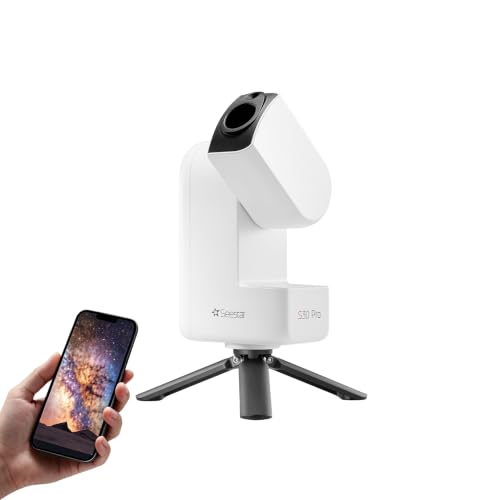

Seestar S50 Pro vs S50: Should You Wait or Buy Now? 2026
Telescope Advisor Logo Telescope Advisor
Night sky with Milky Way stretching across the horizon — the kind of deep-sky view smart telescopes like the Seestar S50 and S50 Pro are designed to capture

Smart Telescope Guide · 2026

Seestar S50 Pro vs S50: Should You Wait or Buy Now?

The Seestar S50 is discontinued. The S50 Pro has been announced but not released. If you are shopping for a smart telescope in mid-2026, you face an uncomfortable choice: buy the outgoing S50 while stock lasts, or hold out for the Pro — which could be months away at an unknown price. This guide breaks down the decision by your situation, budget, and timeline.

S50 statusDiscontinued — stock remaining
S50 Pro statusAnnounced, late 2026 window
Price gapEst. $250–500 difference
Our callBuy S50 now — unless you can wait
By Elena Reyes Published: Updated: Reviewed & approved by Juhi Sahni, Senior Editor Editorial Standards
Elena Reyes — Senior Science Editor

Elena Reyes

Senior Science Editor

Covers NASA missions, space science discoveries, and astronomical events for Telescope Advisor. Translates complex astrophysical research into practical insights for backyard observers. Based in the San Francisco Bay Area.

Quick Answer: Buy or Wait?

If you have never owned a smart telescope and want to start observing this summer: Buy the Seestar S50 now. It is still available at retailers while stocks last, it is the most mature smart telescope on the market with two years of firmware updates, and at its current price it represents exceptional value. You will get excellent results immediately — the S50's 50mm aperture and built-in astrophotography stacker produce images that rival setups costing three times as much.

If you already own a smart telescope and are looking for an upgrade: Wait for the S50 Pro. The Pro is expected to offer a larger aperture (rumored 60–70mm), improved sensor, and better build quality. As an upgrade from an S30, Dwarf 3, or another entry-level smart scope, the Pro will represent a meaningful step forward rather than a lateral move.

If you are a bargain hunter: Buy the S50 now while discounted. Discontinued models typically see price reductions of 20–30% as retailers clear inventory. The S50 will not lose its ability to capture excellent images just because a new model exists — it remains the same capable telescope it was before the Pro was announced.

✅ Buy S50 now if:

  • This is your first smart telescope
  • You want to use it this summer/fall
  • Budget is a primary concern
  • You found a discount on remaining stock

⏳ Wait for Pro if:

  • You already own a smart telescope
  • You want the largest possible aperture
  • You are not in a hurry (can wait months)
  • You want the latest sensor technology

✅ Consider Dwarf 3 if:

  • You want a smart telescope available now
  • Portability is your top priority
  • You want mechanical leveling and stabilization
  • You prefer a landscape-friendly field of view


The Situation: S50 Discontinued, S50 Pro Announced

In early 2026, ZWO quietly discontinued the Seestar S50 — the smart telescope that arguably created the consumer smart telescope category. The S50 had been on the market since 2023 and sold tens of thousands of units worldwide. Its successor, the Seestar S50 Pro, was announced shortly after with promises of improved optics, a larger aperture, and a refined design. But as of July 2026, ZWO has not released a firm ship date or final pricing for the Pro.

This creates what economists call a "replacement cycle dilemma": the product you could buy today is about to be superseded, but the replacement is not yet available at a confirmed price. The S50 remains a capable, well-supported device, but buying a discontinued product carries risks around future support and resale value. Meanwhile, the Pro's unknown timeline means waiting could mean missing an entire observing season.

Adding to the complexity, the DWARFLAB Dwarf 3 — currently the S50's most direct competitor — is in stock and shipping. The Dwarf 3 offers comparable capabilities with a different design philosophy: it is more portable, has mechanical leveling, and a wider native field of view that suits both astrophotography and landscape nightscapes. If you need a smart telescope today and the S50's uncertain future concerns you, the Dwarf 3 is a viable alternative that sidesteps the wait-or-buy question entirely.

S50 Pro: What We Know and What's Still Unconfirmed

We track the S50 Pro's development closely in our Seestar S50 Pro Everything We Know page, which we update within 24 hours of any ZWO announcement. Here is a summary of what is confirmed versus what is still unconfirmed as of July 2026.

✅ Confirmed Facts

  • The S50 Pro is a real product in active development (ZWO confirmed via official channels)
  • It will feature a larger aperture than the S50 — the exact size is not yet confirmed, but industry sources point to 60–70mm
  • The Pro will use a white finish (distinct from the S50's black)
  • It will be compatible with the existing Seestar accessory ecosystem (tripod, case, dew shield)
  • ZWO has committed to ongoing firmware support for the original S50 alongside the Pro

🔶 Unconfirmed / Rumored

  • Exact aperture size (60mm? 70mm? some sources say 65mm)
  • Release date (estimated late 2026, but ZWO has not named a month)
  • Final price (estimated $749–999, based on the S50's launch price and typical Pro-model premiums)
  • Sensor type and resolution (improved sensor expected, specifications unknown)
  • Whether the Pro will include dual-band or multi-bandpass filter built in
  • Software feature exclusivity (some S50 features may arrive via firmware on the original S50)

Our commitment: This page will be updated within 24 hours of any confirmed S50 Pro announcement from ZWO. The unconfirmed estimates above are clearly labeled as such — we separate facts from speculation so you can make an informed decision without being misled by rumors. Bookmark this page or our S50 Pro tracker for the latest verified information.

Spec Comparison: S50 vs S50 Pro (Estimated) vs Dwarf 3

The table below compares the current Seestar S50 with the estimated specs of the upcoming S50 Pro and the currently available Dwarf 3. Where specs are unconfirmed for the Pro, we have marked them as "estimated" and noted the basis for the estimate.

Specification Seestar S50 S50 Pro (Estimated) Dwarf 3
Aperture 50mm 60–70mm (est.) 52mm
Focal length 250mm (f/5) ~300mm (f/5 est.) 40mm (f/0.77)
Sensor Sony IMX462 (2.1MP) Improved sensor (est.) Sony IMX678 (8.3MP)
Field of view ~1.1° × 0.6° ~1.0° × 0.6° (est.) ~3.0° × 2.0°
Built-in filter Dual-band (Ha+OIII) Dual-band (likely improved) Dual-band (Ha+OIII)
Weight ~3.0 kg ~3.5 kg (est.) ~1.5 kg
Leveling Manual (tripod legs) Manual (likely similar) Mechanical (built-in)
Price (MSRP) Was $499 Est. $749–999 $599
Availability Limited stock remaining Late 2026 (est.) In stock now
GoTo / tracking Alt-Az, ASCOM Alpaca Alt-Az (likely enhanced) Alt-Az, ASCOM Alpaca

Key takeaway from the specs: The S50 Pro's primary advantage will be aperture — more light collection means brighter images and shorter exposure times for faint deep-sky objects. The Dwarf 3's advantage is its dramatically wider field of view and 8.3MP sensor, which captures more sky in each image and allows for wider composition. The S50 (original) sits in the middle: narrower than the Dwarf 3 but more established with a proven track record and a large user community.

Decision Tree: Three Paths, One Clear Answer for Each User Type

Rather than a one-size-fits-all recommendation, here is a decision framework based on your specific situation. Find the scenario closest to yours.

🟢

Path A: Buy the S50 Now — You Are a First-Time Buyer on a Budget

If this is your first smart telescope and you have never used one before, the S50 is the right choice. Here is why: The S50 has a mature software ecosystem, thousands of user-generated processing guides on YouTube and forums, and two years of bug fixes. You will spend less time troubleshooting and more time capturing images. The S50 is capable of producing gallery-worthy images of the Orion Nebula, Andromeda Galaxy, Ring Nebula, and dozens of other deep-sky objects — the same targets the Pro will capture, just with slightly longer exposures. The money you save buying the S50 at its end-of-life discount can go toward accessories like a sturdy tripod, extra batteries, or a hard case.

🟡

Path B: Wait for the Pro — You Already Own a Smart Telescope

If you currently own a Seestar S30, S30 Pro, Dwarf 2, or another entry-level smart scope, the S50 Pro represents a genuine upgrade rather than a lateral move. The larger aperture will deliver noticeably better performance on faint targets like nebulae and galaxies. The improved sensor (if confirmed) will give you higher resolution and better dynamic range. You already have a working scope, so you are not missing any observing time by waiting. The key risk is timeline uncertainty: if the Pro slips to early 2027, you might miss the winter deep-sky season. Set a personal deadline — if the Pro is not shipping by October 2026, revisit the decision.

🟢

Path C: Buy the Dwarf 3 — You Want a Smart Telescope Available Now with a Different Design

The Dwarf 3 is not a compromise — it is a different design philosophy that may suit your needs better than either Seestar model. Its 52mm aperture is comparable to the S50, but its ultra-fast f/0.77 optics and 8.3MP sensor give it a wider, more versatile field of view. The built-in mechanical leveling eliminates the tedious tripod-adjustment process that S50 users face. At $599, it is priced between the discounted S50 and the estimated Pro. If you want a smart telescope today, the Dwarf 3 is a mature, well-reviewed product with a growing community. You can buy it now, start imaging tonight, and never worry about whether you made the right call on the Pro.

The Case for Buying the Seestar S50 Now

Proven Track Record

The Seestar S50 has been on the market since 2023 and is one of the most-reviewed smart telescopes ever made. Over two years of firmware updates have transformed it from a promising first-generation product into a polished, reliable imaging system. Early issues with focusing, plate solving, and filter calibration have all been addressed. You are buying a mature product, not a beta.

Immediate Availability

The S50 is in stock at multiple retailers as of July 2026. If you order today, you could be capturing deep-sky images this weekend. The Pro, by contrast, has no confirmed release date — if it slips to 2027, you would miss the entire fall 2026 observing season, including the Orion Nebula season (best viewed October–February).

Discount Pricing

Discontinued models almost always sell at a discount as retailers clear inventory. The S50 originally launched at $499 and has been seen at $399–449 at various retailers. At the most affordable price, the S50 represents exceptional value — you are getting a capable astrophotography rig for roughly the price of a mid-range eyepiece set for a conventional telescope.

Mature Ecosystem

The S50 has a large, active user community on Cloudy Nights, Reddit (r/seestar), and Facebook. Thousands of image processing tutorials, troubleshooting guides, and accessory recommendations exist. The ASCOM Alpaca driver support means you can control the S50 from third-party software like SharpCap, NINA, and Astroberry. The Pro may take months or years to develop a comparable ecosystem.

Firmware Commitment

ZWO has publicly committed to continuing firmware support for the original S50 alongside the Pro. Several software features that were initially expected to be Pro-exclusive may arrive on the S50 via firmware updates — just as the S50's ASCOM Alpaca support and mosaicking capabilities were added after launch. Buying the S50 now does not mean you are buying abandoned technology.

The Case for Waiting for the S50 Pro

Larger Aperture = Better Light Collection

If the S50 Pro delivers a 60–70mm aperture (a 44–96% increase in light-gathering area over the S50's 50mm), the difference on faint deep-sky objects will be substantial. More aperture means brighter sub-exposures, which means better signal-to-noise ratio in the final stacked image. For targets like the Horsehead Nebula, Veil Nebula, and other faint emission nebulae, the Pro will produce noticeably cleaner images in less time.

Improved Sensor Technology

The S50 uses a Sony IMX462 sensor — a 2.1MP sensor that was already a few years old when the S50 launched. A successor model nearly always includes a sensor upgrade. A higher-resolution sensor (even 4–6MP) would give the Pro significantly more detail in lunar, planetary, and wide-field deep-sky images, making it a more versatile instrument.

Refined Build and Design

The S50 Pro's white finish and improved build quality (rumored magnesium alloy construction instead of the S50's polycarbonate) suggest ZWO is targeting a more premium feel. Better heat dissipation, improved internal baffling, and a more robust focuser mechanism are typical second-generation improvements that may not appear on the spec sheet but meaningfully improve the user experience.

Future-Proofing

If you tend to keep your equipment for 3–5 years, the Pro will age better. Its higher specifications will remain competitive for longer against the inevitable wave of smart telescopes from competitors (Celestron and Meade are both rumored to be developing smart scope entries). The S50, while capable today, will increasingly show its age as the category evolves.

Dwarf 3: The Third Option Available Now

The Dwarf 3 deserves serious consideration as an alternative that sidesteps the wait-or-buy dilemma entirely. It is in stock, well-reviewed, and offers capabilities that neither the S50 nor the S50 Pro (as currently understood) can match.

DWARFLAB Dwarf 3 Smart Telescope — compact, portable smart telescope with built-in leveling

DWARFLAB Dwarf 3

The Dwarf 3's 52mm aperture is comparable to the S50, but its f/0.77 optical system collects light more efficiently, making it faster for deep-sky imaging. The 8.3MP Sony IMX678 sensor captures significantly higher-resolution images than the S50's 2.1MP sensor. The built-in mechanical leveling — a unique feature — simplifies setup: you place the Dwarf 3 on a flat surface, press a button, and it levels itself automatically, eliminating the tripod-adjustment process that can take 5–10 minutes with the S50.

Where Dwarf 3 Excels

  • Wide-field imaging: The 3° × 2° field of view captures large deep-sky objects (Andromeda Galaxy, Pleiades, North America Nebula) in a single frame — the S50's narrower field requires mosaicking for these targets
  • Portability: At 1.5 kg, the Dwarf 3 is half the weight of the S50, making it genuinely pocketable for travel
  • Leveling: Mechanical leveling eliminates the most tedious part of smart telescope setup
  • Resolution: 8.3MP sensor provides 4× the resolution of the S50 for lunar, daytime, and wide-field imaging
  • Availability: In stock now with no wait for a successor model

Where S50 Excels Over Dwarf 3

  • Narrow-field detail: The S50's 250mm focal length provides more magnification for small targets (planetary nebulae, galaxies)
  • Mature software: Two years of firmware refinement vs. the Dwarf 3's ~1 year
  • Community size: Larger user community means more tutorials, presets, and troubleshooting help
  • ASCOM Alpaca support: Well-established third-party software compatibility

Resale Value: Will the S50 Depreciate When the Pro Launches?

If you buy the S50 now and decide to upgrade to the Pro later, how much value will the S50 retain? Based on patterns observed with other ZWO products and the broader smart telescope market, here is a realistic depreciation forecast:

Timeline Estimated S50 Resale Value Notes
Before Pro launch (mid-2026) $300–380 Strong demand for discontinued model; collectors and late adopters drive prices
Pro launch month $250–320 Temporary dip as early adopters flood the used market; Pro scarcity limits the drop
3–6 months after Pro launch $200–280 Market stabilizes; S50 becomes entry-level price point for the Seestar ecosystem

The S50 is unlikely to lose more than 40–50% of its value even after the Pro launches, because it remains a functional, well-supported device — not an obsolete one. The used price floor is effectively set by the S30 Pro (~$299 new), below which the S50 would represent exceptional value as a used purchase. For comparison, the original Seestar S30 (discontinued in 2025) still sells used for $150–200, or about 50–60% of its original price — excellent retention for consumer electronics.

Expected Timeline and What to Watch For

Based on ZWO's typical product development cadence and industry sources, here is the most likely timeline for the S50 Pro:

Q3

July – September 2026

ZWO is expected to release final specifications and begin pre-orders during this window. Watch for announcements at major astronomy trade shows (NEAF, AstroFest). Prototype units may be shown at these events with hands-on first impressions from reviewers. This is also when final pricing is likely to be confirmed.

Q4

October – December 2026

Most optimistic scenario for first shipments. Early units typically go to reviewers and pre-order customers. First-batch units may have minor firmware issues that get resolved in subsequent production runs. If you pre-order, be prepared for potential delays — ZWO has a history of optimistic ship dates.

Q1 2027

January – March 2027

Conservative scenario for general availability. By this point, firmware should be stable, third-party accessories should be announced, and the user community will have produced initial reviews and guides. This is also when the Pro will likely appear on Amazon with regular stock rather than limited pre-order allocations.

What to watch: The most reliable leading indicator is when ZWO files FCC certification documents for the Pro — this typically happens 2–3 months before shipping begins. We will update our S50 Pro tracker page when these documents appear.

Get the Seestar S50 While Stock Lasts

If our decision framework points you toward buying the S50 now, do not wait — remaining inventory is selling quickly as the discontinuation becomes more widely known. The S50 remains an excellent smart telescope that will produce stunning deep-sky images the night it arrives.

ZWO Seestar S50 Smart Telescope — compact all-in-one astrophotography device with 50mm aperture and dual-band filter

Frequently Asked Questions

Is the Seestar S50 discontinued?

Yes, ZWO has officially discontinued the Seestar S50. Remaining inventory is still available at retailers, but no new units are being manufactured. ZWO has stated they will continue firmware support for the S50 alongside the upcoming S50 Pro.

When does the Seestar S50 Pro come out?

ZWO has not announced a specific release date. Industry sources suggest a late 2026 release window, with the most optimistic scenario being October–December 2026 and a more conservative estimate of early 2027. The timeline depends on manufacturing readiness and component availability.

How much will the Seestar S50 Pro cost?

The S50 Pro's price has not been officially announced. Based on the S50's $499 launch price and typical Pro-model premiums in the smart telescope market, the estimated price range is $749–999. Final pricing will be confirmed when ZWO opens pre-orders.

Should I buy the S50 or wait for the Pro?

Buy the S50 now if this is your first smart telescope, you are on a budget, or you want to start imaging immediately. Wait for the Pro if you already own a smart telescope and want a meaningful upgrade, or if you are patient and want the best possible aperture and sensor technology.

Will the S50 still get firmware updates after the Pro launches?

Yes. ZWO has publicly committed to continuing firmware support for the original S50 alongside the Pro. Several features initially expected to be Pro-exclusive may also arrive on the S50 via firmware updates, similar to how ASCOM Alpaca support and mosaicking were added to the S50 after its initial release.

Is the Dwarf 3 better than the Seestar S50?

"Better" depends on your priorities. The Dwarf 3 has higher resolution (8.3MP vs 2.1MP), a wider field of view, and built-in mechanical leveling for easier setup. The S50 has a more mature software ecosystem, larger user community, and narrower field that is better for smaller deep-sky targets. Both are excellent smart telescopes available now.

Will the S50 Pro work with existing Seestar accessories?

Yes. ZWO has confirmed that the S50 Pro will be compatible with the existing Seestar accessory ecosystem, including the standard tripod, hard case, and dew shield. This means S50 owners upgrading to the Pro can keep their current accessories.