
Seestar S30 Pro vs S50 vs Dwarf 3: Which to Buy in 2026?
Telescope Advisor Logo Telescope Advisor
Andromeda Galaxy M31 — one of the best targets to compare budget smart telescopes on

Smart Telescope Comparison · 2026

Seestar S30 Pro vs Seestar S50 vs DWARFLAB Dwarf 3: Which to Buy?

Three budget smart telescopes, all at similar price points, with fundamentally different strengths. The S30 Pro wins on sensor and field of view; the S50 wins on aperture; the Dwarf 3 wins on software. This guide tells you which matters most for your observing goals.

Widest FOVS30 Pro (4.6°)
Most ApertureS50 (50mm)
Best SoftwareDwarf 3
Best BatteryS30 Pro (6 hrs)
By Telescope Advisor Editorial Team Published: Updated: Editorial Standards

The Quick Answer: Which Smart Telescope Should You Buy?

Buy the S30 Pro if...

You want large nebulae and galaxies to fill the frame. Its 4.6-degree wide field captures targets that the S50 crops significantly. Best for wide-field observers who value coverage and image quality over raw aperture depth.

Buy the Seestar S50 if...

You prioritize faint, compact targets where aperture depth matters more than field width. If you find remaining S50 stock at a meaningful discount vs the S30 Pro, the 50mm aperture advantage on dim objects is real and practical.

Buy the Dwarf 3 if...

Software quality, mosaic automation, and Stellar Studio post-processing matter more than optical performance. The Dwarf 3's stitching software is better than ZWO's, and its community is large and active.


🔭

Not sure which telescope actually fits your goals?

Answer 5 quick questions about your budget, observing targets, and experience level — our Telescope Finder Tool recommends a specific model in under 2 minutes.

Find My Telescope →

The Three Contenders: Quick Profiles

ZWO Seestar S30 Pro

ZWO Seestar S30 Pro — The Wide-Field Specialist

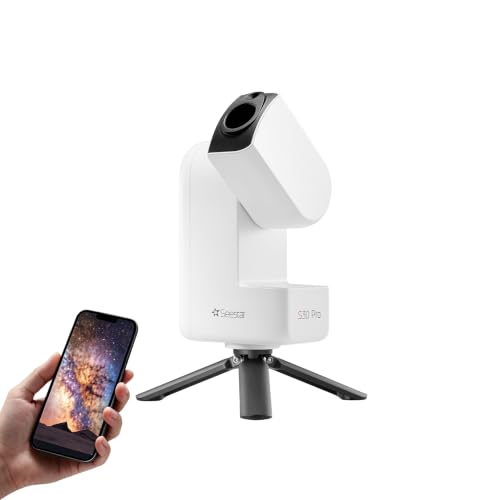
Released late 2025 as the successor to the original Seestar S30. The S30 Pro is ZWO's most technically capable entry-tier telescope, pairing an 8.3MP Sony IMX585 sensor with a 30mm f/5.3 quadruplet APO lens and a massive 4.6-degree telephoto field. It also includes a 63-degree wide-angle camera for Milky Way panoramas, a built-in solar filter, and a 6-hour battery. At its price tier, no other smart telescope matches its field of view and sensor resolution combination. Full review: ZWO Seestar S30 Pro Review.

ZWO Seestar S50

ZWO Seestar S50 — The Aperture Champion (Discontinued Stock)

The Seestar S50 launched in 2023 and democratized smart telescopes at a price point that created an entirely new category. Discontinued by ZWO in late 2025 (production ceased, S50 Pro expected late 2026), but significant stock remains on Amazon. Its defining advantage is aperture: 50mm gathers approximately 2.8× more light than the S30 Pro's 30mm. The 2MP IMX462 sensor and 1.29-degree field are the weak points — but the optical depth advantage on faint targets is genuine and meaningful for patient observers.

DWARFLAB Dwarf 3

DWARFLAB Dwarf 3 — The Software-First Alternative

DWARFLAB's third-generation smart telescope uses a 24mm telephoto and a very wide-angle second camera, similar in concept to the S30 Pro but with different execution. The Dwarf 3's optical system (telephoto lens vs the S30 Pro's quadruplet APO) is a weaker choice for pure image quality, and the 2.2-degree field is narrower than the S30 Pro's 4.6 degrees. The Dwarf 3's genuine advantage is in software: the Stellar Studio processing pipeline and mosaic automation are generally regarded as more capable than ZWO's equivalent tools. Full review: DWARFLAB Dwarf 3 Review.

Full Specification Comparison

Specification Seestar S30 Pro Seestar S50 DWARFLAB Dwarf 3
Aperture 30mm 50mm ← winner 24mm
Telephoto Sensor 8.3MP IMX585 ← winner 2MP IMX462 2.1MP
Telephoto FOV 4.6° × 2.6° ← winner 1.29° × 0.73° 2.2° × 1.6°
Optics type (tele) Quadruplet APO ← winner Triplet APO Telephoto lens
Wide-angle camera Yes, 63° ← winner No Yes, ~150°
Battery 6 hours ← winner 4.5 hours 3.5 hours
Solar filter Built-in ✓ Built-in ✓ No ✗
Mosaic software Basic Basic Advanced ← winner
FITS export No No No
Storage 128GB 128GB 64GB (SD card)
Weight ~1.5 lbs ← lightest 2.2 lbs 3.5 lbs
Price tier Entry-plus Entry (remaining stock) Entry-plus
Production status Current model Discontinued (remaining stock) Current model

Field of View: The Decision-Maker for Most Buyers

For most beginners choosing their first smart telescope, field of view is the most consequential practical difference between these three models. It determines what fits in your frame and what gets cropped.

S30 Pro (4.6° × 2.6°)

Fits in one frame:

  • ✓ Full Orion Nebula complex (M42 + M43 + NGC 1977)
  • ✓ Andromeda Galaxy M31 + companions M32 and M110
  • ✓ Full Pleiades (M45) with surrounding nebulosity
  • ✓ Large open clusters with surrounding star field
  • ✓ Lagoon + Trifid Nebulae together

S50 (1.29° × 0.73°)

Fits in one frame:

  • ✓ M42 core (but NOT the full Orion complex)
  • ✓ M31 core only (M32/M110 off-frame)
  • ✓ Smaller open clusters
  • ✓ Planetary nebulae (Ring M57, Dumbbell M27)
  • ✗ Pleiades cluster: crops significantly

Dwarf 3 (2.2° × 1.6°)

Fits in one frame:

  • ✓ M42 + M43 (but not the Running Man NGC 1977)
  • ✓ M31 core + M110 (M32 marginal)
  • ✓ Many open clusters
  • ~ Pleiades fits partially — some stars cropped
  • ✗ Full Orion complex: needs mosaic mode

The practical implication:

The showpiece targets beginners most want to photograph — the Orion Nebula, Andromeda, and the Pleiades — are all large objects. The S30 Pro captures them in their full context. The S50 shows only the core of each. For a first-time user excited to show the Andromeda Galaxy to family members, the S30 Pro's wide view is consistently more impressive than the S50's cropped core. This is why we recommend the S30 Pro for most first-time buyers in 2026.

Aperture vs Field of View: Who Actually Benefits from the S50's 50mm?

The S50's 50mm aperture gathers approximately 2.8× more light per exposure than the S30 Pro's 30mm. This is a real, measurable advantage — but only on specific targets under specific conditions.

When the S50's aperture advantage shows clearly:

  • Faint, compact galaxies beyond M31 and M33 — objects at magnitude 10–13 that are small enough to fit in the S50's 1.29-degree frame
  • Globular clusters (M13, M92, M5) where the 50mm aperture resolves more stars around the outer edges
  • Very faint planetary nebulae at the limit of what the class can image
  • When you want to minimize total stacking time on a specific target that fits in the 1.29-degree frame

When the S30 Pro's FOV matters more than aperture:

  • All large extended objects — Orion Nebula complex, Andromeda, Pleiades, Rosette Nebula, North America Nebula
  • Wide star fields and constellation framing
  • Milky Way panoramas (with the 63-degree wide camera)
  • Multiple targets in a single frame (e.g. Leo Triplet — M65, M66, NGC 3628 together)

Bottom line: For the targets beginners typically want to image in their first 1–2 years of smart telescope use, the S30 Pro's wider field produces more satisfying results more often. Experienced observers who specifically want to push to fainter, smaller targets — and are willing to do longer stacking sessions — get real value from the S50's aperture. The S30 Pro is the better starting point for most people. The S50 is the better choice for patient observers who accept field limitations in exchange for depth.

Software and App Comparison

Seestar App (S30 Pro + S50)

  • Strengths: Clean, intuitive interface; reliable alignment; solid target catalogue; real-time stacking preview; responsive team updates
  • Weaknesses: Basic mosaic mode (limited control, small grid options); no FITS export; post-processing limited to in-app adjustments
  • Community: Very large user community; extensive YouTube tutorials; active Facebook group

DWARFLAB App + Stellar Studio

  • Strengths: Advanced mosaic mode (stitch multiple frames automatically); Stellar Studio post-processing; better histogram controls; EQ mode support
  • Weaknesses: Steeper learning curve; occasional firmware stability issues; fewer tutorial resources than ZWO
  • Community: Smaller but dedicated; strong Reddit presence; firmware updates frequent

Verdict

For beginners who want to start shooting immediately with minimal friction: Seestar app wins. It is more polished, better documented, and has more community tutorials. For observers who want more control over their images and are willing to invest time in the software: DWARFLAB's Stellar Studio wins. If mosaic panoramas are a priority, DWARFLAB's implementation is meaningfully better than ZWO's.

Category-by-Category Winners

Widest field of view

S30 Pro wins (4.6°)

11× wider than S50; 2× wider than Dwarf 3. The most impactful practical difference for most beginners.

Best sensor quality

S30 Pro wins (8.3MP IMX585)

Same sensor as the Vaonis Vespera II (a premium telescope). 4× more pixels than the S50 and Dwarf 3.

Most light gathering (aperture)

S50 wins (50mm)

2.8× more light than S30 Pro; 4.3× more than Dwarf 3. Best for faint, compact deep-sky targets.

Best mosaic software

Dwarf 3 wins

DWARFLAB's mosaic automation and Stellar Studio post-processing are meaningfully better than ZWO's basic mosaic mode.

Best battery life

S30 Pro wins (6 hours)

S30 Pro's 6-hour battery covers most summer all-night sessions. S50 at 4.5 hours is second; Dwarf 3 at 3.5 hours is shortest.

Solar observing

S30 Pro and S50 tie

Both have built-in solar filters. The Dwarf 3 has no solar observing capability.

Best value for beginners

S30 Pro wins

Best field, best sensor, longest battery — the strongest all-round package for first-time smart telescope buyers in 2026.

Most portable

S30 Pro wins (~1.5 lbs)

Lightest of the three at ~1.5 lbs. S50 at 2.2 lbs is second. Dwarf 3 at 3.5 lbs is noticeably heavier.

Who Should Buy Each One?

Choose the Seestar S30 Pro if:

  • You are new to smart telescopes and want impressive results from the showpiece targets (Orion Nebula, Andromeda, Pleiades) in full — not cropped
  • You want the longest battery life for dark-sky site sessions
  • Wide-field astrophotography and Milky Way panoramas interest you
  • Solar observing of sunspots and the August 12 eclipse matters
  • You want a current-model telescope with active software support from ZWO

Choose the Seestar S50 if:

  • You specifically want to push to faint, compact targets where 50mm aperture makes a visible difference
  • You find remaining S50 stock at a meaningfully lower price than the S30 Pro — the aperture advantage justifies a discount
  • You have already bought a companion wide-field instrument (binoculars, wide-angle camera) and specifically need aperture depth, not coverage

Choose the DWARFLAB Dwarf 3 if:

  • Mosaic imaging and automated panorama stitching are priorities — the Stellar Studio implementation is the best in this price class
  • You want more post-processing control than either ZWO model offers
  • You enjoy engaging with an active development community and are comfortable with more frequent firmware updates
  • Solar observing is not important to you

FAQ: S30 Pro vs S50 vs Dwarf 3

Which is better overall — the Seestar S30 Pro or Seestar S50?

For most first-time buyers in 2026, the S30 Pro is the better purchase. Its wider 4.6-degree field captures large targets that matter to beginners (Orion Nebula complex, Andromeda Galaxy, Pleiades) in full context rather than as crops. Its 8.3MP IMX585 sensor delivers significantly more detail. And its 6-hour battery outperforms the S50's 4.5 hours. The S50's advantage — 50mm aperture gathering 2.8× more light — matters most for experienced observers who specifically pursue faint, compact deep-sky targets that fit within the S50's narrow 1.29-degree frame.

Is the Seestar S50 worth buying since it's discontinued?

Yes, if you find it at a meaningfully lower price than the S30 Pro. The S50 remains a capable telescope despite being discontinued. ZWO continues providing software support for it, and the existing user community is large and helpful. The aperture advantage (50mm vs 30mm) on faint targets is real. At similar prices, the S30 Pro is the stronger modern choice. But if remaining S50 stock is priced significantly below the S30 Pro, the aperture-per-dollar value can favor the S50 for observers who accept its narrower field of view.

Why would someone choose the Dwarf 3 over the Seestar S30 Pro?

Two main reasons: software capability and mosaic workflow. DWARFLAB's Stellar Studio post-processing pipeline gives users more control over how their images are processed — including better histogram management, more stacking options, and more refined mosaic stitching. For observers who want to create wide-panorama images of the Milky Way or image subjects that require multiple frames stitched together, the Dwarf 3's automation handles this more smoothly than ZWO's equivalent tools. The S30 Pro wins on optical quality and field of view; the Dwarf 3 wins on post-processing control and mosaic workflow.

Which of these three is best for photographing the Andromeda Galaxy?

The S30 Pro is the best choice for Andromeda. Its 4.6-degree telephoto field fits the entire Andromeda Galaxy M31 — including its companion dwarf galaxies M32 and M110 — in a single frame with comfortable margins. The Dwarf 3's 2.2-degree field shows M31 with M110 but crowds M32. The S50's 1.29-degree field shows only the bright core of M31; the spiral arm extent, M32, and M110 are all cut off. For Andromeda specifically, the S30 Pro is the clear winner.

Can any of these three see planets?

All three produce limited planetary results — this is a fundamental characteristic of the entry-tier smart telescope category. Jupiter's disk and Saturn's rings are identifiable through all three, but detailed features (Jupiter's belts, Saturn's Cassini Division) are not cleanly resolved. The S50's larger aperture gives it a slight advantage on planets over the S30 Pro, and the S30 Pro slightly outperforms the Dwarf 3 on planets. But none of the three are recommended for planetary observing — for that, a traditional telescope with 80mm+ aperture at 100–200× magnification delivers dramatically better results. See our best planet telescopes guide.

Do all three need internet to work?

No — all three create their own WiFi hotspots and operate without internet access. Initial app installation and catalogue updates require internet, but active observing sessions work fully offline. This makes all three suitable for remote dark-sky sites, camping, and field use. Each telescope's battery (6 hours S30 Pro / 4.5 hours S50 / 3.5 hours Dwarf 3) determines how long you can observe without mains power.

Is there a better smart telescope for roughly the same price?

At the same entry-plus price tier, the three options above are the primary contenders in 2026. The next tier up — the Vaonis Vespera II — offers an 8.3MP sensor and 2.5-degree field in a premium mid-range package, but at a higher price. The DWARFLAB Dwarf Mini offers more portability at a lower price with smaller sensors. For a complete picture of all smart telescopes across all price tiers, see our full smart telescope brand comparison.


Related Guides