

Telescope Advisor Logo Telescope Advisor
Digital tablets showing star maps — the Sky-Watcher AZ-GTi mount brings smartphone control to any telescope

Mount Review · Sky-Watcher AZ-GTi 2026

Sky-Watcher AZ-GTi Mount Guide: WiFi GoTo Alt-Azimuth Mount Review

The Sky-Watcher AZ-GTi is one of the most innovative telescope mounts released in the past decade. By replacing the traditional hand controller with smartphone WiFi control, it strips away the complexity that intimidates many beginners while offering surprising versatility — including the ability to operate as a small equatorial mount with an optional wedge. This guide covers everything the AZ-GTi does, what it does well, where it falls short, and which telescopes pair best with it.

WiFi GoToSmartphone controlled
5 kg PayloadCompact scopes only
Dual ModeAlt-az or EQ mode
42K ObjectsSynScan database
By Elena Reyes Published: Updated: Reviewed & approved by Juhi Sahni, Senior Editor Editorial Standards
Elena Reyes — Senior Science Editor

Elena Reyes

Senior Science Editor

Covers NASA missions, space science discoveries, and astronomical events for Telescope Advisor. Translates complex astrophysical research into practical insights for backyard observers. Based in the San Francisco Bay Area.

Quick Answer: Is the AZ-GTi the Right Mount for You?

The Sky-Watcher AZ-GTi is the best GoTo mount for visual observers who want smartphone-controlled convenience with a small telescope. It excels with compact Maksutov-Cassegrains like the Skymax 127 and small refractors like the Startravel 80. Its WiFi control eliminates the hand controller clutter that makes other GoTo mounts feel intimidating, and the SynScan app is intuitive enough for complete beginners. The AZ-GTi can also be converted to a basic equatorial mount with an optional wedge, enabling short-exposure astrophotography. However, its 5 kg payload limit means it is not suitable for larger telescopes, and the WiFi connection can occasionally drop in areas with radio interference.

This guide covers everything you need to know about the AZ-GTi: how it works, which telescopes to pair with it, how to use it in EQ mode, and the honest trade-offs you should consider before buying.
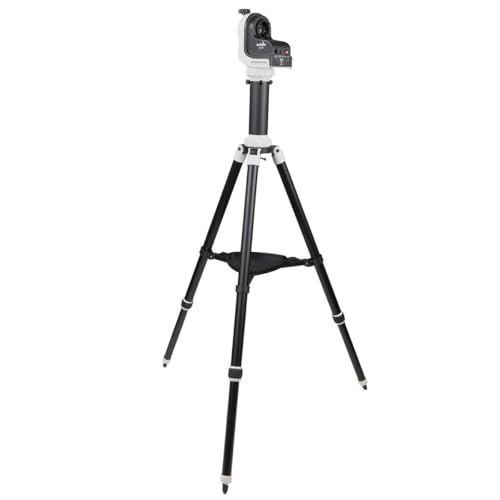


What Is the Sky-Watcher AZ-GTi?

The AZ-GTi is a compact, lightweight alt-azimuth GoTo mount that communicates with your smartphone or tablet over WiFi. It was designed as a response to one of the most common complaints about traditional GoTo mounts: the hand controller. For decades, every computerized telescope came with a bulky hand controller covered in dozens of buttons, requiring users to navigate complex menus for basic operations. The AZ-GTi replaces this entirely with the SynScan Pro app, running on an iOS or Android device. You download the app, connect to the mount's WiFi network, and control GoTo slewing, tracking, and object selection from a clean, intuitive touch interface.

The mount head weighs only 1.7 kg and measures 20 cm across, making it genuinely portable. It mounts on any sturdy tripod with a 3/8-inch thread — the included aluminium tripod is adequate for visual use, though upgrading to a sturdier tripod improves stability. The AZ-GTi uses high-quality worm gears for quiet, accurate slewing, and it tracks automatically once aligned, keeping objects centred in the eyepiece for extended observation sessions. The GoTo database includes 42,000 objects from the Messier, NGC, IC, and Caldwell catalogs, plus the Moon, planets, bright stars, and double stars.

The AZ-GTi represents a significant step forward in making GoTo technology accessible to beginners. For a broader look at how it fits into Sky-Watcher's mount lineup, see our Sky-Watcher mounts guide.

Key Features and Specifications

The AZ-GTi's specifications reveal its design philosophy: prioritise portability and convenience over raw capacity. The 5 kg (11 lb) payload limit is the defining constraint — it tells you the types of telescopes the AZ-GTi can carry with authority. Within this limit, the mount delivers excellent performance: quiet slewing at speeds up to 3 degrees per second, accurate GoTo pointing (typically within 5 to 10 arc-minutes of the target after a two-star alignment), and smooth tracking that keeps objects centred for visual observation.

The mount operates on 8 AA batteries (not included) or an optional 12V DC power supply. Battery life is approximately 10 to 12 hours with standard alkaline batteries, though lithium AA batteries are recommended for cold-weather sessions. The SynScan Pro app is available for both iOS and Android and supports multiple alignment methods: two-star alignment, three-star alignment, one-star alignment, and bright star alignment. The app also includes a planetarium view that shows the current sky and allows you to tap on any object to slew to it.

A particularly useful feature is the autotracking mode, which keeps the selected object centred even as the Earth rotates. This is a significant upgrade over manual mounts, where you constantly adjust the slow-motion controls to keep an object in view at high magnification. The AZ-GTi tracks in both RA and Dec axes, so objects stay centred for as long as you want to observe them. The mount can also be controlled via ASCOM for computer-controlled astronomy, making it compatible with popular planetarium software like Stellarium and Cartes du Ciel.

Compatible Telescopes for the AZ-GTi

Choosing the right telescope for the AZ-GTi is critical — the 5 kg payload limit means you need to consider the total weight of the optical tube plus finderscope, eyepiece, diagonal, and any accessories. The following Sky-Watcher telescopes pair naturally with the AZ-GTi and provide excellent performance within its capacity limits.

Sky-Watcher Skymax 127 Maksutov-Cassegrain telescope on AZ-GTi mount

Sky-Watcher Skymax 127 on AZ-GTi

This is the most popular AZ-GTi bundle. The Skymax 127's compact Maksutov-Cassegrain tube weighs approximately 2.7 kg, well within the mount's capacity. The 1500mm focal length provides exceptional planetary and lunar views with GoTo convenience. The complete setup is compact enough for airline travel.

Sky-Watcher Startravel 80 wide-field refractor on AZ-GTi mount

Sky-Watcher Startravel 80 on AZ-GTi

The Startravel 80 is a lightweight 80mm f/5 achromatic refractor weighing only 1.6 kg. On the AZ-GTi, it provides wide-field views with a 3.4-degree field of view, making it ideal for sweeping star fields, observing large open clusters, and enjoying bright Milky Way targets.

Other compatible telescopes include the Skymax 102 (lighter than the 127, excellent for travel), the Evostar 72ED (a fine wide-field imaging scope for EQ mode), and small achromatic refractors in the 70mm to 80mm range. The 102mm f/9.8 achromatic refractor sold in the AZ-GTi 102 bundle is also a good match, providing longer-focal-length views of the Moon and planets. For reference, see our Evostar ED refractor guide for more on compatible refractors.

Telescopes that exceed the AZ-GTi's capacity: Heritage 130P (3.7 kg) and Heritage 150P (4.5 kg) are technically within the payload limit but their large volume catches the wind, causing instability. The Classic 200P Dobsonian, Skyliner 200P, and any 8-inch or larger telescope are far too heavy. The Virtuoso GTi 130P is the better choice if you want GoTo with a 130mm Newtonian — see the comparison section below.

Setup and Alignment Guide

Setting up the AZ-GTi is straightforward, but following the correct sequence saves frustration. Start by mounting the AZ-GTi head on a tripod and levelling it using the built-in bubble level. Attach your telescope, ensuring it is balanced — slide the tube in the saddle until it stays in position when you release the clutch. Balance is important because the AZ-GTi has clutches rather than counterweights, and an unbalanced load forces the motors to work harder, reducing tracking accuracy.

Power on the mount, wait for the blue LED to start flashing, then open the SynScan Pro app on your phone or tablet. The app will detect the mount's WiFi network — connect to it, then select your observing location from the app's built-in map or GPS. Choose a two-star alignment: the app recommends two bright stars that are well separated in the sky. Centre each star in the eyepiece using the direction buttons in the app, tap Align, and the mount calculates its pointing model. The alignment typically takes five minutes and is accurate enough for reliable GoTo slewing to any object in the database.

Once aligned, tap any object in the app's database and the mount slews to it automatically. The SynScan app includes a Tonight's Best list that shows the most impressive objects currently visible, which is helpful for beginners who do not know what to look for. The app also includes a time-lapse and intervalometer feature for basic astrophotography. If you experience WiFi dropouts, try switching from 2.4 GHz to a dedicated astronomy tablet with airplane mode enabled — phone notifications can interrupt the WiFi connection.


🔭

Not sure which telescope actually fits your goals?

Answer 5 quick questions about your budget, observing targets, and experience level — our Telescope Finder Tool recommends a specific model in under 2 minutes.

Find My Telescope →

EQ Mode: Using the AZ-GTi for Astrophotography

One of the AZ-GTi's most interesting features is its ability to operate as a small equatorial mount when mounted on the optional Sky-Watcher equatorial wedge. The wedge tilts the mount head to your latitude, converting the alt-azimuth motion into equatorial motion. In EQ mode, the AZ-GTi can track the sky without field rotation, enabling long-exposure astrophotography that is impossible in standard alt-az mode.

The EQ mode has significant limitations. The 5 kg payload capacity is reduced in EQ mode because the mount is operating at an angle, and the worm gears are not designed for the continuous loads of equatorial tracking. Practical imaging experience with the AZ-GTi in EQ mode suggests limiting the payload to approximately 3.5 kg and keeping sub-exposures under 60 seconds without guiding. With an autoguider, 2 to 3 minute exposures are achievable, though guiding performance is not as smooth as dedicated equatorial mounts like the HEQ5 Pro.

The AZ-GTi in EQ mode is best suited for wide-field astrophotography with small refractors and DSLR cameras. The Evostar 72ED with a mirrorless camera is a popular lightweight combination that stays within the reduced payload limits. For planetary imaging, the AZ-GTi in alt-az mode is excellent — the short video captures used for lucky imaging do not suffer from field rotation, and the GoTo makes finding and centring planets effortless. For dedicated deep-sky imaging, however, the HEQ5 Pro is a substantially better investment. See our best mount for astrophotography guide for a discussion of the HEQ5 Pro and other dedicated imaging mounts.

Pros, Cons and Trade-Offs

What the AZ-GTi Does Well

  • Smartphone WiFi control eliminates hand controller complexity.
  • SynScan app is intuitive, with a clean interface and planetarium view.
  • Compact and lightweight — genuine airline carry-on potential.
  • Dual AZ/EQ mode provides flexibility to explore basic imaging.
  • Quiet slewing motor does not disturb observing sessions.
  • ASCOM compatible for computer-controlled astronomy.
  • Excellent value for a GoTo mount at its price point.

Where the AZ-GTi Falls Short

  • 5 kg payload limit restricts telescope choices significantly.
  • WiFi connection can drop with phone notifications or interference.
  • EQ mode is a compromise — it works but cannot match dedicated EQ mounts.
  • Batteries drain faster than expected in cold weather.
  • Clutches rather than counterweights make balance sensitive.
  • No built-in GPS — location must be set manually in the app.
  • Included aluminium tripod is adequate but not premium.

AZ-GTi vs Virtuoso GTi: What Is the Difference?

The AZ-GTi and the Virtuoso GTi share the same GoTo technology and SynScan app control, but they serve different purposes. The AZ-GTi is a standalone mount head that you attach to a tripod and pair with your own optical tube. It is designed for telescope owners who want to upgrade from a manual mount to GoTo without buying a whole new telescope. The Virtuoso GTi, by contrast, is a complete telescope package — the mount is integrated into a tabletop base, and it comes with a specific optical tube (the Heritage 130P Newtonian or the Skymax 127 Maksutov).

The practical difference is that the AZ-GTi offers more flexibility. You can mount any compatible telescope on it, swap tubes between sessions, and upgrade the optical tube independently. The Virtuoso GTi is a fixed package — the optical tube is matched to the tabletop base and cannot be swapped. If you already own a small telescope or want the flexibility to change configurations, the AZ-GTi is the better choice. If you want a complete, out-of-the-box GoTo solution with no assembly decisions, the Virtuoso GTi is simpler.

For visual observers who want the widest range of telescope options, the AZ-GTi paired with a Skymax 127 for planets and a Startravel 80 for wide-field is a versatile two-tube setup on a single mount. This flexibility is the AZ-GTi's strongest advantage over the Virtuoso GTi. See our best Sky-Watcher beginner telescope guide for more on the Virtuoso GTi as a beginner package.


Frequently Asked Questions

What telescopes work with the Sky-Watcher AZ-GTi?

Telescopes under 5 kg total weight, including accessories. The best matches are the Skymax 127, Skymax 102, Startravel 80, Evostar 72ED, and small 70-80mm achromatic refractors. Heritage series Newtonians technically fit the weight limit but their large volume makes them unstable in wind.

Can the AZ-GTi be used for astrophotography?

Yes, with the optional equatorial wedge. In EQ mode, the AZ-GTi supports short-exposure deep-sky imaging with sub-60-second unguided exposures or 2-3 minute guided exposures. It is also excellent for planetary lucky imaging in alt-az mode. For dedicated long-exposure astrophotography, a HEQ5 Pro is a better choice.

Does the AZ-GTi come with a tripod?

The AZ-GTi mount head is sold both with and without the aluminium tripod. The bundle with tripod is more economical if you do not already own a sturdy tripod. The included aluminium tripod is adequate for visual use, but upgrading to a sturdier tripod improves stability, especially for imaging.

How do I connect my phone to the AZ-GTi?

Download the SynScan Pro app from the App Store or Google Play. Power on the mount, wait for the blue LED to flash, go to your phone's WiFi settings and connect to the mount's network (SSID starts with "SynScan"). Open the app, select your location, and begin alignment. No internet connection is needed — the mount creates its own WiFi network.

Is the AZ-GTi better than the Virtuoso GTi?

The AZ-GTi is better if you want flexibility to use different telescopes on the same mount. The Virtuoso GTi is better if you want a complete, integrated GoTo telescope package with no assembly decisions. The AZ-GTi can also be upgraded to EQ mode with a wedge, while the Virtuoso GTi tabletop base cannot.

How long do the batteries last in the AZ-GTi?

With 8 fresh alkaline AA batteries, expect 10 to 12 hours of typical use. Lithium AA batteries last longer, especially in cold weather. The mount can also be powered via the optional 12V DC adapter, which is recommended for extended sessions or imaging runs where battery changes would be disruptive.