Telescope Advisor Logo Telescope Advisor
Milky Way arching over a dark sky — Sky-Watcher mounts and tripods provide stable platforms for every observing style

Sky-Watcher Mount Guide · 2026

Sky-Watcher Mounts & Tripods Guide: AZ-GTi, EQ Series & Star Adventurer

A telescope mount is the most important equipment decision you will make — it determines tracking accuracy, setup speed, and how long your gear lasts. Sky-Watcher's mount lineup spans from the WiFi-enabled AZ-GTi alt-azimuth mount to the heavy-duty EQ6-R Pro equatorial platform. This guide covers every current Sky-Watcher mount and tripod, with honest advice for visual observers, astrophotographers, and everyone in between.

WiFi GoToAZ-GTi ecosystem
EquatorialEQ5 to EQ6-R Pro
Star TrackersStar Adventurer series
TripodsSteel, aluminium, carbon
By Elena Reyes Published: Updated: Reviewed & approved by Juhi Sahni, Senior Editor Editorial Standards
Elena Reyes — Senior Science Editor

Elena Reyes

Senior Science Editor

Covers NASA missions, space science discoveries, and astronomical events for Telescope Advisor. Translates complex astrophysical research into practical insights for backyard observers. Based in the San Francisco Bay Area.

Quick Answer: Which Sky-Watcher Mount Should You Choose?

Your choice of Sky-Watcher mount depends entirely on your observing goal and equipment weight. For general visual observing with a small telescope, the AZ-GTi WiFi mount offers the best combination of convenience, portability, and GoTo capability. For astrophotography with a DSLR and camera lens, the Star Adventurer 2i or Star Adventurer GTi are the entry points. For dedicated deep-sky imaging with a proper telescope, the HEQ5 Pro or EQ6-R Pro are the industry standards. The EQ5 remains a solid budget equatorial option for visual use and casual imaging. Tripod selection follows the same logic — the collapsible aluminium tripod included with most mounts serves well for visual use, while heavier stainless steel tripods reduce vibration for imaging.

This guide walks through every Sky-Watcher mount and tripod option in detail, with honest use-case recommendations and the trade-offs you need to understand before buying.


Why the Mount Matters More Than the Telescope

Many first-time telescope buyers focus entirely on the optical tube — aperture size, focal length, and eyepiece magnification. But experienced astronomers know that the mount is the true foundation of any observing session. A premium telescope on a wobbly mount delivers shaky, frustrating views. A modest telescope on a rock-solid mount delivers crisp, steady images and effortless tracking.

Sky-Watcher understands this philosophy deeply. Their mount lineup is engineered with specific payload capacities, gear systems, and tripod dampening characteristics that match different use cases. The AZ-GTi uses high-quality worm gears for quiet, accurate GoTo slewing. The EQ5 and HEQ5 use larger worm wheels for smoother tracking. The EQ6-R Pro uses a belt-driven gear system that virtually eliminates periodic error for long-exposure astrophotography. Each mount also pairs with a specific tripod — the aluminium collapsible tripod for portable setups, the stainless steel pier tripod for permanent installations, and the tubular steel tripod for maximum stability.

For a broader overview of mount types and terminology, see our how to choose a telescope mount guide before diving into the Sky-Watcher-specific details below.

Sky-Watcher AZ-GTi: The WiFi GoTo Alt-Azimuth Mount

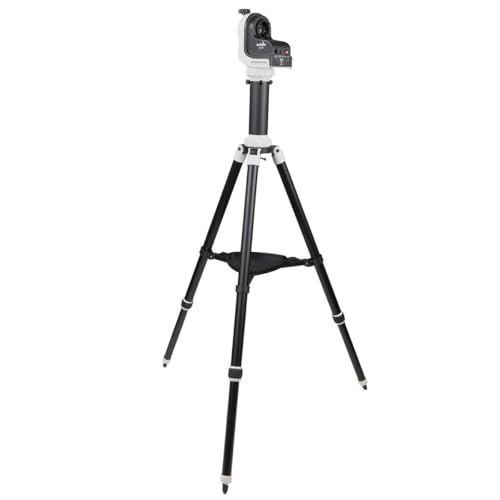
Sky-Watcher AZ-GTi WiFi-enabled GoTo alt-azimuth mount head

Sky-Watcher AZ-GTi Mount Head

Alt-azimuth GoTo mount with built-in WiFi, 5 kg payload, SynScan app control, 42,000+ object database, dual AZ/EQ mode, compact design.

The AZ-GTi is Sky-Watcher's most innovative mount of the past decade. It is a compact, lightweight alt-azimuth GoTo mount that communicates with your smartphone or tablet over WiFi, eliminating the need for a hand controller. The SynScan Pro app handles alignment, object selection, and slewing, making the AZ-GTi one of the most beginner-friendly GoTo mounts on the market. Setting up is straightforward: mount the head on a tripod, level it, connect your phone to the mount's WiFi network, launch the app, perform a two-star alignment, and start observing.

The AZ-GTi operates in alt-azimuth mode by default, which is ideal for visual observing. However, Sky-Watcher also provides an equatorial wedge that converts the AZ-GTi into a small equatorial mount capable of basic tracking for short-exposure astrophotography. This dual-mode flexibility makes the AZ-GTi an excellent choice for the observer who wants to explore both visual and introductory imaging without buying two mounts.

The payload capacity of 5 kg (11 lb) limits the AZ-GTi to smaller telescopes. It pairs naturally with the Sky-Watcher Startravel 80, the Skymax 102 and 127 Maksutovs, and small refractors up to 80mm aperture. Heavier instruments like 130mm Newtonians or long-tube refractors will exceed the mount's capacity and produce poor tracking. For a deeper look at what the AZ-GTi can carry, see our dedicated AZ-GTi mount guide.

The AZ-GTi is also available bundled with several Sky-Watcher telescopes: the AZ-GTi 102 (a 102mm f/9.8 achromatic refractor), the AZ-GTi 127M (the Skymax 127 Maksutov-Cassegrain), and the AZ-GTi Startravel 80. These bundles offer excellent value since the mount head alone costs roughly the same whether purchased separately or as part of a kit.


🔭

Not sure which telescope actually fits your goals?

Answer 5 quick questions about your budget, observing targets, and experience level — our Telescope Finder Tool recommends a specific model in under 2 minutes.

Find My Telescope →

Sky-Watcher EQ5: The Budget Equatorial Mount

Sky-Watcher EQ5 German equatorial mount with tripod

Sky-Watcher EQ5 Mount

German equatorial mount, 9 kg payload, slow-motion controls, aluminium tripod, optional RA motor drive, suitable for visual and casual imaging.

The EQ5 is Sky-Watcher's entry-level German equatorial mount, designed for visual observers who want to explore equatorial tracking without spending HEQ5 money. It carries telescopes up to 9 kg (20 lb), which covers most 80mm to 102mm refractors, 114mm to 130mm Newtonians, and Maksutov-Cassegrains up to 127mm. The mount ships with slow-motion control cables for manual tracking, and an optional RA motor drive can be added for basic motorised tracking.

The EQ5 uses an aluminium tripod with accessory tray and spreader. The tripod legs are adjustable height and feature steel tips for grass and rubber feet for hard surfaces. The mount head uses 32mm-diameter steel shafts with brass worm gears — adequate for visual use but not precise enough for serious long-exposure astrophotography. The periodic error on the EQ5 is typically around 20 to 30 arc-seconds peak-to-peak, which causes visible star trailing in exposures longer than 60 seconds without guiding.

Where the EQ5 shines is as a first equatorial mount for the budget-conscious visual observer. If you are moving from an alt-azimuth mount and want to learn polar alignment, equatorial tracking, and how to navigate by RA and Dec coordinates, the EQ5 is a capable and affordable training platform. It is also adequate for planetary imaging, where short video captures do not demand the precision of deep-sky mounts. For dedicated astrophotography, however, the HEQ5 Pro is a dramatically better investment that will not need upgrading as quickly.

Sky-Watcher HEQ5 Pro: The Astrophotography Entry Standard

Sky-Watcher HEQ5 Pro German equatorial mount — the gold standard for beginner astrophotography

Sky-Watcher HEQ5 Pro Mount

German equatorial GoTo mount, 13.6 kg payload, SynScan hand controller, belt-driven RA, illuminated polar scope, autoguider port, stainless steel tripod.

The HEQ5 Pro is widely regarded as the entry-level standard for serious deep-sky astrophotography. It occupies a sweet spot in the mount market — affordable enough for committed beginners, yet capable enough to produce professional-quality images with the right technique. The 13.6 kg (30 lb) payload capacity handles the most common imaging rig: an 80mm to 100mm ED refractor, guide scope, astrophotography camera, filter wheel, and dew control gear, all within the recommended 2:1 payload ratio for imaging.

What sets the HEQ5 Pro apart from the EQ5 is the belt-driven RA axis. Sky-Watcher replaced the traditional worm gear with a toothed belt drive system that significantly reduces periodic error — from the 20 to 30 arc-seconds of the EQ5 down to approximately 7 to 10 arc-seconds on the HEQ5. This lower native error is much easier for autoguiding software to correct, resulting in round stars in 5-minute and even 10-minute exposures. The SynScan GoTo hand controller includes a 42,000-object database, making target selection quick and precise.

The HEQ5 also includes an illuminated polar finderscope for accurate polar alignment, a critical step for long-exposure imaging. The stainless steel tripod provides superior vibration dampening compared to the aluminium tripod of the EQ5. The mount head weighs 12 kg (26 lb) and the tripod adds another 5 kg (11 lb), making the total package manageable for one person to carry in two trips. For many astrophotographers, the HEQ5 Pro is the only mount they ever need — it supports 80mm to 100mm refractors beautifully and handles the transition from DSLR to dedicated astronomy cameras without complaint. See our best telescope mount for astrophotography guide for a comparison with other mounts in this class.

Sky-Watcher EQ6-R Pro: The Heavy-Duty Imaging Platform

Sky-Watcher EQ6-R Pro heavy-duty German equatorial mount for serious astrophotography

Sky-Watcher EQ6-R Pro Mount

German equatorial GoTo mount, 20 kg payload, belt-driven RA and Dec, SynScan hand controller, illuminated polar scope, USB port, stainless steel pier tripod.

The EQ6-R Pro is Sky-Watcher's flagship equatorial mount for serious astrophotographers. It is the mount you buy when you know your imaging ambitions will grow beyond what the HEQ5 can handle. With a 20 kg (44 lb) payload capacity, the EQ6-R Pro comfortably carries 6-inch to 8-inch Schmidt-Cassegrain telescopes, dual imaging rigs with off-axis guiders, or a 130mm apochromatic refractor with full accessory kit. The recommended imaging payload of 10 kg (22 lb) still leaves generous headroom for most advanced setups.

The EQ6-R Pro features belt-driven gearing on both RA and Dec axes — an upgrade over the HEQ5's single-belt design. This dual-belt system reduces periodic error to approximately 5 to 7 arc-seconds peak-to-peak, making it one of the smoothest-tracking mounts in its price class. The stainless steel pier tripod is significantly more rigid than the standard tripod, with 2-inch diameter legs and a heavy spreader that virtually eliminates vibration. The mount includes a USB port for direct computer control, an illuminated polar scope with reticle, and the SynScan GoTo system with 42,000-object database.

The weight of the EQ6-R Pro is its main drawback for portable use. The mount head weighs 16.8 kg (37 lb) and the pier tripod adds another 8 kg (17.6 lb). This is not a mount you want to carry across a field — it is best suited for a semi-permanent backyard observatory or a roll-off roof shed. For the astrophotographer who has outgrown the HEQ5 and wants a platform that will support anything from a 100mm refractor to an 8-inch SCT, the EQ6-R Pro is the natural upgrade path. For a full discussion of mount payload calculations, see our telescope mount buying guide.

Sky-Watcher Star Adventurer Series: Portable Star Trackers

Sky-Watcher Star Adventurer GTi compact GoTo equatorial star tracker

Sky-Watcher Star Adventurer GTi

Compact GoTo equatorial mount, 5 kg payload, WiFi control, illuminated polar scope, autoguider port, ideal for DSLR astrophotography.

The Star Adventurer series occupies a unique niche in Sky-Watcher's lineup — these are not full equatorial telescope mounts but rather compact star trackers designed primarily for DSLR and mirrorless camera astrophotography. The Star Adventurer 2i is the entry-level model: a camera tracker that mounts on a standard photo tripod and tracks the sky using a built-in polar alignment scope. It is ideal for wide-field Milky Way shots, constellation photography, and beginning deep-sky imaging with telephoto lenses.

The Star Adventurer GTi is the upgraded model that adds WiFi GoTo capability. Unlike the 2i, which requires manual target positioning, the GTi can slew to objects automatically using the SynScan Pro app. This makes it significantly more useful for finding faint deep-sky objects with a camera and telephoto lens. The GTi also includes an autoguider port, allowing it to accept corrections from a guide scope and camera for longer unguided exposures.

Neither the 2i nor the GTi is designed to carry a full telescope — their 5 kg payload limit restricts them to camera bodies, lenses, and small finder-scope-sized guides. For dedicated star tracker advice, see our best star trackers for beginners guide and the Star Adventurer buying guide for model-by-model comparisons.

Sky-Watcher Tripods Compared

Sky-Watcher offers three main tripod types across their mount range, and understanding the differences helps you match the tripod to your observing style and location.

Aluminium collapsible tripod. This is the standard tripod supplied with the AZ-GTi, EQ5, and Star Adventurer mounts. It uses three-section 1.5-inch aluminium legs with an accessory tray and spreader. The aluminium tripod is the lightest option, weighing approximately 4.5 kg, and folds down to a compact length for transport. It is adequate for visual observing and short-exposure imaging, but it resonates more than steel tripods, making it less suitable for long-exposure astrophotography in windy conditions.

Stainless steel tripod. Supplied with the HEQ5 Pro, this tripod uses 1.75-inch stainless steel legs that provide superior dampening compared to aluminium. The extra weight — approximately 5.5 kg — is noticeable when carrying the setup, but the improvement in vibration dampening is significant. A light tap on the telescope tube dies out in under a second on the steel tripod, compared to two to three seconds on the aluminium version. For the astrophotographer setting up on grass or uneven ground, the steel tripod's extra mass provides a more stable platform.

Stainless steel pier tripod. Supplied with the EQ6-R Pro, this is the heaviest and most rigid tripod in Sky-Watcher's lineup. It uses 2-inch diameter legs with a heavy-duty cast spreader and leveling feet. The pier tripod weighs approximately 8 kg and provides the most stable platform for long-exposure imaging. The legs can be extended to a maximum height of 120 cm, and the leveling feet allow precise adjustment on uneven surfaces. For the astrophotographer building a semi-permanent setup, the pier tripod can be left in place with the mount head removed, allowing quick deployment without re-polar-aligning each session.

Sky-Watcher also sells a heavy-duty pier extension for permanent observatory installations. This replaces the tripod entirely and bolts directly to a concrete pier, providing the ultimate stability for imaging. For most users, the steel tripod supplied with the HEQ5 Pro offers the best balance of portability and stability, while the pier tripod is worth the extra weight if you are primarily imaging from a fixed location.

Sky-Watcher Mount Comparison Table

Mount Type Payload GoTo Tripod Best For
AZ-GTiAlt-azimuth5 kgWiFiAluminiumVisual, casual imaging
EQ5German EQ9 kgOptionalAluminiumVisual, planetary
HEQ5 ProGerman EQ13.6 kgSynScanSteelDeep-sky imaging
EQ6-R ProGerman EQ20 kgSynScanPier steelHeavy imaging rigs
SA 2iStar tracker5 kgNoPhoto tripodWide-field camera
SA GTiStar tracker5 kgWiFiPhoto tripodGoTo camera tracking

How to Choose the Right Sky-Watcher Mount

Selecting the right Sky-Watcher mount requires matching three factors: your observing goal, your equipment weight, and your portability requirements. The decision framework below walks through each scenario.

For pure visual observing with a small refractor or Maksutov, the AZ-GTi offers the most convenient experience. WiFi GoTo eliminates hand controllers, the SynScan app handles alignment, and the alt-azimuth motion is intuitive for visual work. If you prefer manual tracking and want to learn equatorial coordinates, the EQ5 on a budget or the HEQ5 Pro if you plan to upgrade later are both solid choices.

For wide-field camera astrophotography with a DSLR and camera lenses, the Star Adventurer 2i is the most affordable entry point. It requires a standard photo tripod and a basic understanding of polar alignment, but it delivers round stars at 50mm to 200mm focal lengths. The Star Adventurer GTi adds GoTo convenience for finding faint targets.

For dedicated deep-sky imaging with a telescope and autoguider, the HEQ5 Pro is the minimum entry point. It handles an 80mm ED refractor with guide scope and cooled camera within the 2:1 payload ratio. The EQ6-R Pro is the upgrade choice if you plan to use a larger telescope like a 6-inch or 8-inch SCT, or if you want the extra stability of the pier tripod.

For mixed visual and imaging where you cannot justify two mounts, the HEQ5 Pro is the most versatile option. It tracks well enough for unguided short exposures, supports autoguiding for deep-sky work, and its GoTo system makes finding objects effortless for visual sessions. The AZ-GTi with equatorial wedge is a lighter alternative for those who prioritize portability over imaging capability.

For a deeper dive into mount payload calculations and the 2:1 rule for imaging, see our astrophotography mount guide and the star tracker guide.


Frequently Asked Questions

What is the best Sky-Watcher mount for astrophotography?

The HEQ5 Pro is the best entry point for dedicated deep-sky astrophotography. Its 13.6 kg payload, belt-driven RA axis, and GoTo system support 80mm to 100mm refractors with autoguiding. For heavier setups like 6-inch SCTs, the EQ6-R Pro with 20 kg capacity and dual-belt drives is the upgrade choice.

Can the Sky-Watcher AZ-GTi be used for astrophotography?

Yes, with the equatorial wedge accessory, the AZ-GTi can operate as a small equatorial mount suitable for short-exposure astrophotography with lightweight optics. It is ideal for planetary imaging and introductory deep-sky work with small refractors, but its 5 kg payload limits its capability for serious long-exposure imaging.

What is the difference between EQ5 and HEQ5?

The HEQ5 Pro is a significant upgrade over the EQ5. It has a higher payload capacity (13.6 kg vs 9 kg), belt-driven RA for smoother tracking, built-in GoTo with SynScan hand controller, illuminated polar scope, autoguider port, and a stainless steel tripod instead of aluminium. The HEQ5 is suitable for deep-sky imaging while the EQ5 is best for visual use and planetary imaging.

Does Sky-Watcher make carbon fibre tripods?

Sky-Watcher currently offers aluminium, stainless steel, and pier-style steel tripods with their mount range. They do not manufacture a carbon fibre tripod. However, the AZ-GTi and Star Adventurer mounts use standard 3/8-inch threads and can be mounted on third-party carbon fibre photo tripods for weight reduction.

Which Sky-Watcher mount is best for visual observing?

For visual observing, the AZ-GTi offers the best experience with its WiFi GoTo, intuitive alt-azimuth motion, and compact size. The HEQ5 Pro is also excellent for visual use if you want equatorial tracking and the ability to upgrade to astrophotography later without buying a new mount.

How do I polar align a Sky-Watcher equatorial mount?

Sky-Watcher equatorial mounts include an illuminated polar finderscope. Align the mount roughly north, adjust altitude and azimuth bolts until Polaris appears in the reticle, then use the SynScan hand controller's Polar Alignment routine for precise alignment. The date-time display in the reticle helps position Polaris in the correct location for your observation time and location.