Telescope Advisor Logo Telescope Advisor
Milky Way astrophotography — the Sky-Watcher Star Adventurer series opens wide-field astrophotography to every DSLR owner

Star Tracker Buying Guide · 2026

Sky-Watcher Star Adventurer Buying Guide: 2i vs GTi vs Pro Pack

The Sky-Watcher Star Adventurer series has become the go-to choice for DSLR and mirrorless astrophotographers who want to capture sharp, tracked images of the night sky without the weight and complexity of a full equatorial mount. With three main models — the Star Adventurer 2i, Star Adventurer GTi, and Star Adventurer Pro Pack — choosing the right one can be confusing. This guide breaks down every model, compares their features head-to-head, and helps you match the tracker to your camera gear and astrophotography goals.

Entry ModelStar Adventurer 2i
GoTo UpgradeStar Adventurer GTi
Complete KitPro Pack
CompactStar Adventurer Mini
By Elena Reyes Published: Updated: Reviewed & approved by Juhi Sahni, Senior Editor Editorial Standards
Elena Reyes — Senior Science Editor

Elena Reyes

Senior Science Editor

Covers NASA missions, space science discoveries, and astronomical events for Telescope Advisor. Translates complex astrophysical research into practical insights for backyard observers. Based in the San Francisco Bay Area.

Quick Answer: Which Star Adventurer Should You Buy?

The Star Adventurer 2i is the best choice for most beginners. It offers all the core tracking functionality needed for wide-field Milky Way shots, constellation photography, and introductory deep-sky imaging with telephoto lenses up to 200mm. The Star Adventurer GTi is worth the upgrade if you want GoTo capability — the ability to have the mount automatically find and track faint deep-sky objects. The Pro Pack is essentially the 2i with additional accessories bundled together, while the Star Adventurer Mini is a niche product for travellers who prioritise ultra-portability above all else.

This guide explains exactly what each model does, how they differ, and which one matches your specific camera gear and astrophotography ambitions.


What Is a Star Adventurer and Why Do You Need One?

A star tracker is a specialised camera mount that rotates at the same rate as the Earth but in the opposite direction. This rotation keeps stars stationary in your camera frame during long exposures, eliminating the star trailing that occurs when the camera is mounted on a static tripod. Without tracking, a 14mm wide-angle lens on a DSLR can manage about 20 seconds before stars visibly trail. With a Star Adventurer, the same lens can expose for five minutes or longer, collecting dramatically more light and revealing faint nebulae and star colours invisible in untracked shots.

The Star Adventurer series is specifically designed for camera-based astrophotography rather than telescope use. All models mount on a standard photo tripod (using the 3/8-inch thread), accept a camera via a ball head or L-bracket, and track the sky using a built-in polar alignment scope and motor drive. The key differences between models lie in how you control the tracker, whether it can find objects automatically, and the accessories included in the box.

For a broader overview of star tracker options across all brands, see our best star trackers for beginners guide before reading the detailed Sky-Watcher comparisons below.

Star Adventurer 2i: The Entry-Level Standard

Sky-Watcher Star Adventurer 2i star tracker for DSLR astrophotography

Sky-Watcher Star Adventurer 2i

Star tracker with built-in polar scope, 5 kg payload, Bluetooth control via smartphone app, dual-axis tracking, supports DSLR/mirrorless cameras and small telephoto lenses.

The Star Adventurer 2i is the model that put Sky-Watcher on the map in the star tracker market. It replaced the original Star Adventurer with Bluetooth connectivity, allowing you to control tracking speed and direction from the free Star Adventurer Console app on your smartphone. This eliminates the need to touch the tracker during operation, reducing vibration and improving image sharpness.

The 2i tracks in two axes: RA (right ascension) for sidereal, solar, or lunar tracking, and Dec (declination) for fine adjustments via a manual slow-motion cable. The built-in illuminated polar scope makes alignment straightforward — you centre Polaris in the reticle using the altitude and azimuth adjustment bolts, then fine-tune using the date-time dial that shows Polaris's position for your observation time.

Payload capacity is rated at 5 kg (11 lb), which comfortably handles a full-frame DSLR with a 70-200mm f/2.8 zoom lens, or a mirrorless camera with a 135mm or 200mm prime lens. Going much heavier — like a DSLR with a 400mm telephoto — pushes the tracker beyond its optimal range and results in poorer tracking performance. The 2i runs for approximately 10 hours on 4 AA batteries, making it reliable for full-night sessions.

The main limitation of the 2i is that it does not have GoTo capability. To frame a specific deep-sky object, you need to manually position the camera using the ball head and fine adjustment knobs. This works well for bright, obvious targets like the Milky Way core, Orion, or the Andromeda Galaxy, but it becomes challenging for smaller, fainter objects like planetary nebulae or distant galaxies. If GoTo matters to you, the GTi model below is the upgrade path.

Star Adventurer GTi: WiFi GoTo Tracking

Sky-Watcher Star Adventurer GTi compact GoTo equatorial star tracker with WiFi

Sky-Watcher Star Adventurer GTi

GoTo star tracker with WiFi control, 5 kg payload, SynScan Pro app, illuminated polar scope, autoguider port, USB power, compact design for travel.

The Star Adventurer GTi is the GoTo-capable upgrade to the 2i. It replaces the 2i's Bluetooth control and manual target positioning with full WiFi GoTo capability via the SynScan Pro app. After polar alignment, you simply select a target from the app's database — which includes thousands of deep-sky objects, planets, and bright stars — and the GTi slews to it automatically. This is a transformative feature for astrophotographers who want to capture specific objects without spending time manually framing them.

The GTi also includes an autoguider port, which the 2i lacks. This allows you to connect a guide scope and guide camera to the mount, enabling closed-loop tracking corrections for significantly longer exposures. With autoguiding, the GTi can deliver round stars at focal lengths up to 300mm or even 400mm, whereas the unguided 2i starts showing tracking errors beyond 200mm. The autoguider port alone is worth the upgrade if you plan to use longer telephoto lenses or a small refractor like the Sky-Watcher Evostar 72ED.

The GTi payload capacity is the same 5 kg as the 2i, so it is not designed for larger telescopes. However, the GoTo capability makes it significantly more useful for finding and framing faint targets. The mount runs on USB power (5V, 2A), which is convenient for field use with a power bank. The illuminated polar scope is identical to the 2i's, providing the same polar alignment accuracy. For astrophotographers who plan to progress from wide-field shots to more specific deep-sky targets, the GTi is the better long-term investment.

Star Adventurer Pro Pack: The Complete Starter Bundle

Sky-Watcher Star Adventurer Pro Pack complete kit with tracker, tripod, and accessories

Sky-Watcher Star Adventurer Pro Pack

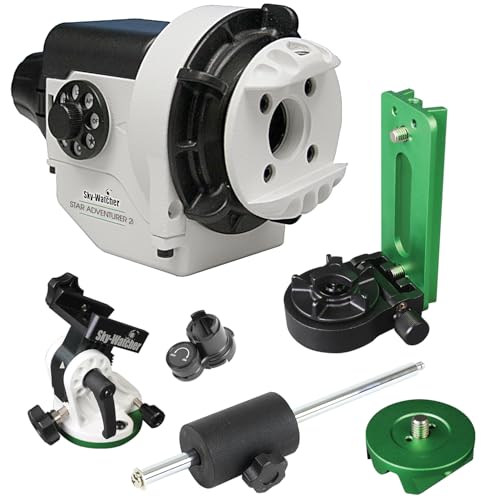
Complete kit: Star Adventurer 2i tracker head, stainless steel tripod, ball head, counterweight kit, polar scope illuminator, and hard carry case.

The Star Adventurer Pro Pack is not a different tracker model — it is a comprehensive bundle built around the 2i tracker head. The Pro Pack includes the 2i tracker, a stainless steel tripod, an adjustable ball head, the L-bracket and counterweight kit, a polar scope illuminator, and a hard carry case. If you are starting from scratch with no existing tripod or mounting hardware, the Pro Pack provides everything you need in one purchase.

The stainless steel tripod included in the Pro Pack is significantly more stable than the aluminium photo tripods many beginners start with. It reduces vibration dampening time from several seconds to under a second, which directly translates to sharper long exposures. The counterweight kit allows you to balance heavier camera-lens combinations on the tracker, improving tracking accuracy. The hard case protects the tracker during transport and storage.

The value proposition of the Pro Pack depends on what you already own. If you have a good photo tripod and ball head, buying the 2i tracker head alone (the Astro Package) is more economical. If you need everything, the Pro Pack typically costs less than buying the components separately. The Pro Pack does not include GoTo capability — for that, you need the GTi model. Sky-Watcher also sells a GTi Pro Pack variant that bundles the GTi tracker with the same tripod and accessories.

Star Adventurer Mini: Ultra-Compact Travel Tracker

📷

Sky-Watcher Star Adventurer Mini

Ultra-compact star tracker, 2 kg payload, GoTo via SynScan app, illuminated polar scope, USB power, ideal for travel and lightweight mirrorless setups.

The Star Adventurer Mini is the most portable member of the Star Adventurer family. Weighing only 430 grams (less than a pound), it is designed for travellers who need to fit a star tracker in carry-on luggage. The Mini includes GoTo capability through the SynScan app, an illuminated polar scope, and a 2 kg (4.4 lb) payload that handles mirrorless cameras with lightweight lenses up to 50mm or 85mm.

The Mini's small size comes with compromises. The 2 kg payload limits you to lighter camera bodies and shorter lenses — a full-frame DSLR with a 70-200mm lens is too heavy. The smaller polar scope makes alignment slightly more challenging, especially in the dark. The Mini also lacks an autoguider port, so all tracking is open-loop. For the traveller who primarily shoots Milky Way panoramas and wide-field constellations with a compact mirrorless setup, the Mini is a worthwhile space-saver. For anyone wanting to push into longer focal lengths or autoguided imaging, the 2i or GTi are better choices.

Star Adventurer Model Comparison Table

Feature 2i GTi Pro Pack Mini
Payload5 kg5 kg5 kg2 kg
GoToNoWiFiNo (2i based)WiFi
ControlBluetoothWiFi SynScanBluetoothWiFi SynScan
Autoguider PortNoYes (ST-4)NoNo
Polar ScopeIlluminatedIlluminatedIlluminatedIlluminated
Tripod IncludedNoNoSteelNo
Weight (head)740 g800 g740 g430 g
Power4x AAUSB 5V4x AAUSB 5V

How to Choose the Right Star Adventurer Model

The decision between Star Adventurer models comes down to three factors: your camera gear, your target type, and your workflow preferences.

Choose the Star Adventurer 2i if: You are new to astrophotography and want the most affordable entry into tracked imaging. You primarily shoot wide-field Milky Way panoramas, star trails, and basic deep-sky with lenses up to 200mm. You already own a sturdy photo tripod and ball head. You are comfortable manually framing targets using a red dot finder or trial-and-error.

Choose the Star Adventurer GTi if: You want GoTo capability to find faint deep-sky objects automatically. You plan to use a guide scope and autoguider for longer exposures at 200-400mm focal lengths. You prefer WiFi control over Bluetooth. You want the flexibility to later upgrade to a small telescope like the Evostar 72ED. The GTi is the best choice for astrophotographers who intend to grow their skills and equipment over time.

Choose the Star Adventurer Pro Pack if: You are starting from scratch and need everything — tracker, tripod, ball head, counterweights, and case — in one box. The Pro Pack is the most economical way to get a complete setup, especially if you do not already own a quality tripod. If you want GoTo, look for the GTi Pro Pack variant.

Choose the Star Adventurer Mini if: Travel weight is your absolute priority. You use a lightweight mirrorless camera with compact lenses. You are comfortable with the 2 kg payload limit and do not plan to use telephoto lenses or telescopes. The Mini is the most portable option for astrophotographers who fly frequently or hike to dark sky sites.

For more on how the Star Adventurer compares to other star trackers and full equatorial mounts, see our best star trackers guide and the Sky-Watcher mounts guide.

Setup and Polar Alignment Tips

Getting the best performance from any Star Adventurer model requires accurate polar alignment. The built-in polar scope makes this straightforward once you understand the procedure. Start by levelling the tripod and mounting the tracker with the polar scope roughly pointing north. Use the altitude adjustment bolts to set your latitude, then rotate the RA axis until the date-time dial matches your current time and date. Centre Polaris in the scope's reticle using the altitude and azimuth bolts. The illuminated reticle shows a small circle marking Polaris's offset from the true celestial pole, which changes throughout the night — rotate the reticle ring to match the current time and date.

A common mistake is overtightening the azimuth bolts after alignment. Snug is sufficient — overtightening can shift the mount slightly, undoing your alignment. Another tip: perform polar alignment before attaching your camera and lens, as the extra weight makes the adjustment bolts harder to turn. For the GTi model, the SynScan app includes a polar alignment helper that guides you through the process step by step, making it more beginner-friendly.

Battery management matters for the 2i and Pro Pack models. Use lithium AA batteries rather than alkaline — they last significantly longer and perform better in cold weather. For the GTi and Mini, a 10,000 mAh USB power bank provides enough power for multiple sessions. Always balance your camera and lens on the tracker using the sliding dovetail bar — an unbalanced setup forces the motor to work harder, introducing tracking errors. For detailed star tracker setup guidance, see our polar alignment guide.


🔭

Not sure which telescope actually fits your goals?

Answer 5 quick questions about your budget, observing targets, and experience level — our Telescope Finder Tool recommends a specific model in under 2 minutes.

Find My Telescope →


Frequently Asked Questions

What is the difference between Star Adventurer 2i and GTi?

The GTi adds WiFi GoTo capability and an autoguider port compared to the 2i. The 2i uses Bluetooth control without GoTo and lacks autoguiding support. The GTi can automatically slew to thousands of deep-sky objects via the SynScan app, while the 2i requires manual target positioning. Both have the same 5 kg payload capacity.

Can I use a telescope on a Star Adventurer?

Small telescopes under 5 kg total payload, such as the Sky-Watcher Evostar 72ED or a 50mm guide scope, can be used on the 2i or GTi with the counterweight kit. Larger telescopes like 80mm refractors or 130mm Newtonians exceed the trackers' capacity. For telescope-based astrophotography, an HEQ5 Pro or larger equatorial mount is recommended.

How long can I expose with a Star Adventurer?

With accurate polar alignment, a 14mm lens can expose for 5 minutes or more. At 50mm, expect 2-3 minutes. At 200mm, 30-60 seconds is typical without guiding. With the GTi's autoguider port and a guide scope, 200mm exposures can extend to 5 minutes. These times assume good polar alignment and a stable tripod.

Do I need a special tripod for the Star Adventurer?

Any sturdy photo tripod with a 3/8-inch mounting thread works. A lightweight travel tripod is not recommended — the tracker's motor introduces vibration that a flimsy tripod amplifies. A tripod weighing at least 3 kg with thick leg sections provides the stability needed for sharp tracked exposures. The Pro Pack's included steel tripod is an excellent match.

Can the Star Adventurer track the Moon and Sun?

Yes. The Star Adventurer supports sidereal, solar, and lunar tracking rates. Select the appropriate mode from the app or controller for your target. Lunar tracking is particularly useful for high-magnification Moon photography where even slight drift is noticeable. Solar tracking with proper solar filters enables safe H-alpha or white-light solar imaging.

Is the Star Adventurer Mini worth buying?

The Mini is worth it only if travel weight is your primary constraint. Its 2 kg payload limits you to mirrorless cameras with compact lenses. For most astrophotographers, the 2i or GTi offers better value with higher payload capacity, easier polar alignment, and more room to grow into longer focal lengths and autoguiding.