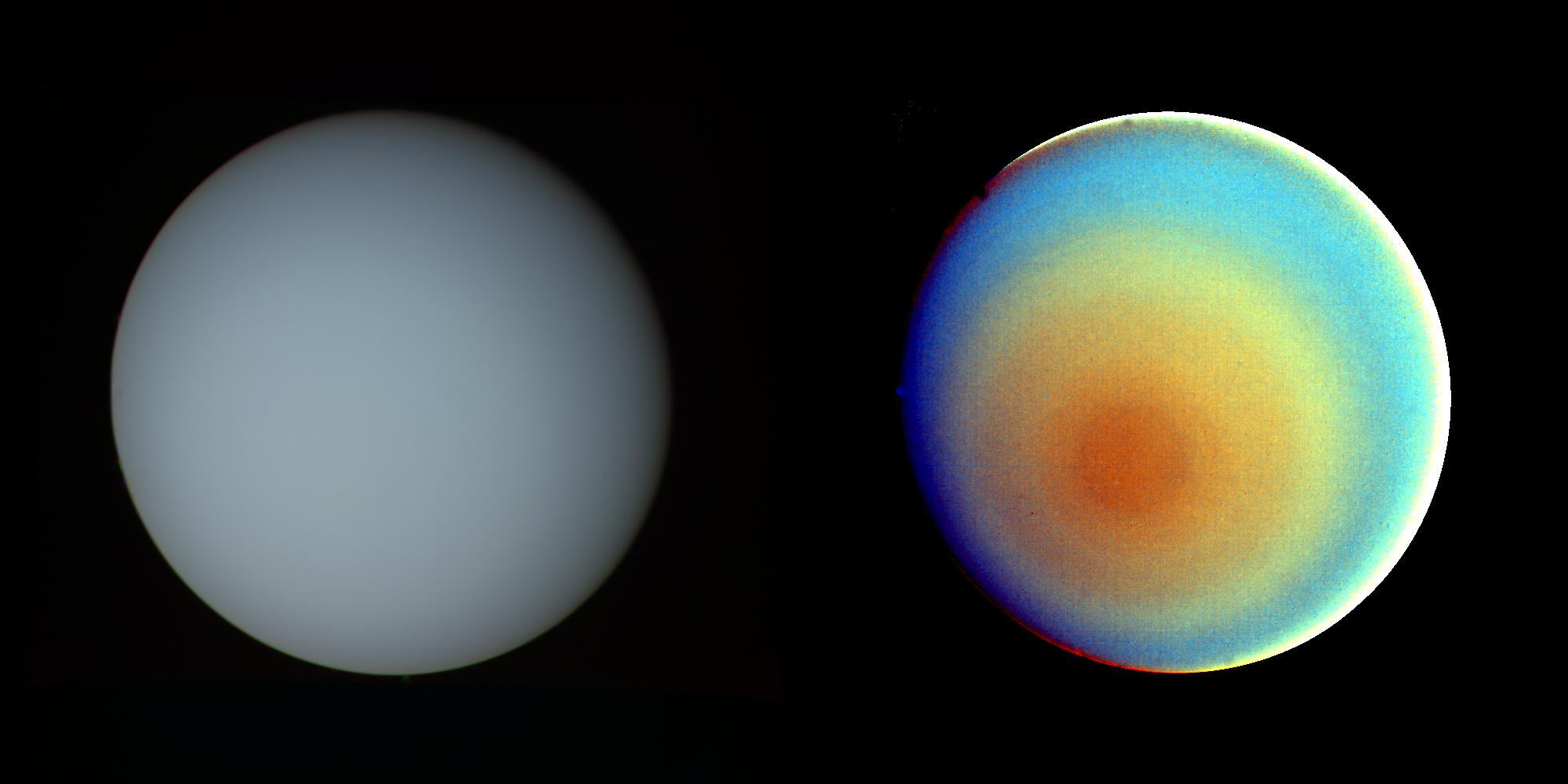
Uranus and Neptune — The Ice Giants
Uranus and Neptune are faint, distant worlds that challenge even experienced observers. Neither shows surface detail in amateur telescopes — they appear as small, featureless coloured disks. But finding them is a satisfying test of your star-hopping skills.
Uranus (magnitude 5.7, 3.5 arcseconds) appears as a tiny greenish-blue disk at 150×. It reaches opposition on November 26, 2026 in Taurus, visible from late evening through dawn. A 6-inch telescope at 150× reveals the disk clearly; an 8-inch or larger scope shows a subtle green tint. Uranus is 2.7–3.0 billion km from Earth at closest approach.
Neptune (magnitude 7.8, 2.3 arcseconds) is significantly fainter and smaller. Its opposition on September 23, 2026 places it in Pisces. A 6-inch scope at 200× shows it as a tiny blue-grey disk, but an 8-inch or larger instrument is needed for a confident detection. Neptune is 4.3–4.6 billion km from Earth. See our Neptune opposition guide for detailed charts.
Using Finder Charts and Apps
Finding the fainter planets — Uranus, Neptune, and sometimes Mercury — requires accurate star charts or a planetarium app. The free desktop software Stellarium can generate custom finder charts for any date and location, showing exactly where each planet lies among the background stars. Our Stellarium guide walks through the process step by step. For mobile use, apps like SkySafari and Star Walk 2 overlay planet positions on your phone's live sky view using its gyroscope — invaluable for quick identification. See our best astronomy apps guide for recommendations.
Planet Visibility in 2026 — What to Watch For
Beyond the routine monthly visibility cycles, several notable planetary events in 2026 are worth marking on your calendar. Saturn opposition on October 4 brings the ringed planet to its brightest and largest for the year — the best time to observe Cassini Division and the subtle banding on the planet's disk. Saturn's rings are tilting back toward Earth after being nearly edge-on in 2025, reaching approximately 7.5 degrees by opposition. This is the start of a multi-year improvement in ring visibility that peaks around 2032. See our Saturn opposition guide for full details.
Jupiter is visible in the evening sky through June 2026, then moves into the morning sky from September onward. The planet's four Galilean moons are visible in any telescope or even steady binoculars, changing position noticeably over a single evening. Venus dominates the western evening sky through mid-2026, showing a gradual phase progression from a thick crescent to a half-phase around greatest elongation. Mercury reaches greatest eastern elongation on June 15, offering a brief evening visibility window — see our conjunction guide for current planet positions.
Total solar eclipse on August 12, 2026 — while primarily a daytime event, the eclipse offers a rare opportunity to see the solar corona and planets Mercury, Venus, and Jupiter in the darkened sky simultaneously. The path of totality crosses Greenland, Iceland, and Spain. See our total solar eclipse guide for safe viewing methods.
Planet-Watching Checklist for Beginners
If you are new to observing planets, here is a quick-start routine that works for any planet on any clear night. First, check the planet's current visibility: is it in the evening or morning sky? What constellation is it in? Our astronomy apps guide lists the best tools for this. Second, let your telescope cool down for at least 30 minutes — warm telescope tubes create internal air currents that blur the view at high magnification. Third, start with your lowest-power eyepiece to locate the planet, then switch to higher powers once centred. Fourth, observe through the eyepiece for several minutes at a time — moments of steady atmospheric "seeing" come and go, and patience rewards you with brief but sharp views. Fifth, keep an observing log. Writing down what you see trains your eye and creates a record of improvement over time. For a complete beginner's roadmap, see our stargazing for beginners guide.