
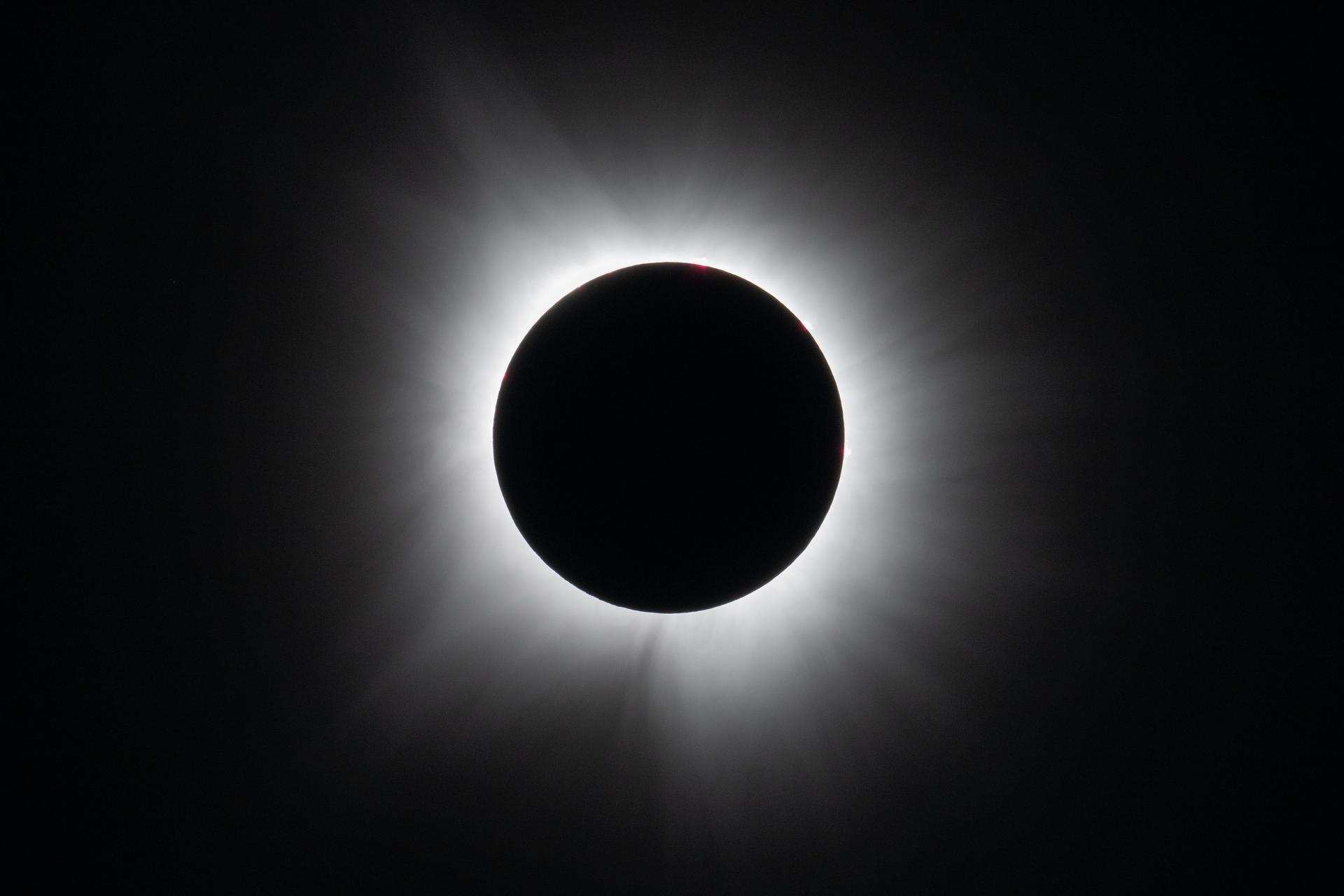
Total Solar Eclipse · August 2, 2027 · The Eclipse of the Century
Total Solar Eclipse August 2, 2027: The Longest Totality of the Century
On Monday, August 2, 2027, the Moon's shadow crosses North Africa and the Middle East, delivering up to 6 minutes 23 seconds of totality near Luxor, Egypt — the longest totality on land this century. This guide covers the path, the best places to watch, and the equipment you'll want, so you can plan ahead before the 2027 surge.
Planning ahead
This page covers the August 2, 2027 eclipse. We covered the August 12, 2026 eclipse here: August 2026 Eclipse Guide →
Why the 2027 Eclipse Is Historic
The August 2, 2027 total solar eclipse is routinely billed as the "eclipse of the century" — and for good reason. At greatest eclipse, totality lasts 6 minutes 23 seconds (383 seconds), the longest totality on land you can actually reach this century. The only longer one this century, the July 22, 2009 eclipse, reached 6 minutes 39 seconds — but that maximum fell over the remote Pacific Ocean. On land you can actually reach, 2027 is the longest of the century, and a longer one won't occur until June 3, 2114.
The numbers behind the spectacle: the Moon passes in front of the Sun with a magnitude of 1.079, the shadow of totality is up to 258 km (160 miles) wide, and greatest eclipse occurs at 10:07:50 UTC at coordinates 25.5°N, 33.2°E — in Egypt's Red Sea Governorate, about 160 km southeast of the maximum-duration point near Luxor. Roughly 89 million people live inside the shadow's path — more than twice the number who saw the 2024 North American eclipse, making it one of the most-watched eclipses in history.
Maximum totality
6 min 23 sec near Luxor, Egypt
Path width
Up to 258 km (160 mi)
Magnitude
1.079 · Greatest 10:07 UTC
Path of Totality — Where to Watch
Totality begins over the eastern Atlantic Ocean and makes landfall around the Strait of Gibraltar near sunrise — the extreme south of Spain (Cádiz, Málaga, the coast of Almería and Granada) and Gibraltar experience a brief totality, as do Ceuta and Tangier in Morocco. The shadow then sweeps east across Morocco, Algeria, Tunisia, and Libya, reaches its longest duration in Egypt near Luxor, crosses Saudi Arabia (Jeddah and Mecca), then Yemen (Sana'a) before ending over the Horn of Africa in Somalia and the Indian Ocean.
| Region | Key locations | What to expect |
|---|---|---|
| Southern Spain & Gibraltar | Cádiz, Málaga, Gibraltar | Brief totality at low altitude near sunrise |
| North Africa | Tangier (Morocco), Oran (Algeria), Sfax (Tunisia), Benghazi (Libya) | Longer totality as the shadow widens |
| Egypt | Luxor & the Red Sea coast | ⭐ Longest totality — up to 6 min 23 sec |
| Saudi Arabia | Jeddah, Mecca | Deep totality across the southwest |
| Yemen & Somalia | Sana'a (Yemen), Horn of Africa | Final path across the Arabian Peninsula & Africa |
Outside the path, a deep partial eclipse is visible across most of Europe — including Portugal and central/northern Spain — most of Africa, the Middle East, and parts of South and Southeast Asia. If you can't reach totality, even a deep partial is worth viewing — with certified solar filters, of course.
This guide's path details are validated against NASA's eclipse data and timeanddate.com; exact local times for specific cities will be added to the city sections below as we expand this page closer to the event.
Best Cities for Viewing
The greatest totality of the 2027 eclipse falls in Egypt, making the Nile Valley and Red Sea coast prime viewing territory. Two cities stand out as practical bases:
📍 Luxor, Egypt
The maximum-duration point lies roughly 60 km southeast of Luxor, so the city is perfectly placed for close to the longest totality on Earth. Easy flights via Cairo, world-class hotels, and the Valley of the Kings as a bonus.
📍 Jeddah, Saudi Arabia
A major international gateway directly on the path with strong tourism infrastructure, clear desert skies, and the Red Sea coast. Mecca, also on the path, is nearby for those able to visit.
More on-path options being developed: Tangier (Morocco), Oran (Algeria), Sfax (Tunisia), Benghazi (Libya), and Sana'a (Yemen). We'll expand this section with exact local times, weather odds, and logistics closer to the event.
What Equipment You'll Need
For every minute of totality, you'll first watch a partial phase that demands certified solar protection. Here's the gear to plan for in 2027.
Celestron EclipSmart Universal Solar Filter
ISO-certified full-aperture solar filter — safe viewing of the partial phases through most telescopes
Celestron NexStar 8SE
Computerised 8-inch Schmidt-Cassegrain — Celestron's classic go-to scope for eclipse travel & deep-sky
DWARFLAB Dwarf 3 Smart Telescope
Compact smart scope with a built-in solar filter option — easy to pack for the trip
Affiliate links — we may earn a commission at no extra cost to you. All three products verified live via the Amazon Creators API (August 2026). Always use ISO 12312-2 certified filters and eclipse glasses.
⚠️ Solar safety first
Never look at the partially eclipsed Sun without ISO 12312-2 certified eclipse glasses or a properly fitted solar filter. Only during the few minutes of totality is naked-eye viewing safe — and only inside the path. See our certified eclipse glasses guide. If you need help matching a scope, use the telescope finder tool or browse our best telescopes for viewing planets guide.
2027 vs 2026 Eclipse: How Do They Compare?
In many ways, 2027 is the sequel 2026 fans have been waiting for. The August 12, 2026 total solar eclipse crossed Greenland, Iceland, and Spain with a maximum totality of about 2 minutes 18 seconds. The 2027 event nearly triples that, reaching 6 minutes 23 seconds — a leap made possible because the Moon is near perigee (closest to Earth) just hours before the eclipse, so it appears larger and blocks the Sun for longer.
Geographically, 2026 was a north-Atlantic and European event, while 2027 swings south across the Mediterranean, North Africa, and the Arabian Peninsula. For Spain, the two are a rare back-to-back: 2026 crossed the north of the country, and 2027 clips the extreme south near Cádiz and Málaga — a second total eclipse in Spain within a year. If you chased 2026, our 2026 Europe eclipse hub has everything from that event, and this 2027 guide is where we'll build the same depth of detail going forward.
| Aug 12, 2026 | Aug 2, 2027 | |
|---|---|---|
| Max totality | ~2 min 18 sec | 6 min 23 sec |
| Path | Greenland · Iceland · Spain | N. Africa · Middle East · Spain/Gibraltar |
| Greatest eclipse | ~18:27 UTC | 10:07:50 UTC |
| People in path | ~12 million (est.) | ~89 million |
We'll Update This Page
We're publishing this guide now, in August 2026, so you can plan ahead — and so the content is ready and authoritative when the 2027 search surge begins. Over the coming months we'll add: exact local eclipse times by city, weather and cloud-cover outlooks, viewing-site recommendations with logistics, and first-hand reports as the event approaches.
Our editorial team verifies every fact against NASA and other authoritative sources, and we'll correct anything that changes. Bookmark this page and check back as we expand it — and subscribe to our 2027 astronomy events calendar so you never miss an update.
2027 Solar Eclipse — Frequently Asked Questions
When is the next total solar eclipse after 2026?
The next total solar eclipse after the August 12, 2026 event is August 2, 2027. (An annular solar eclipse occurs earlier, on February 6, 2027, but the next total is the 2027 eclipse covered on this page.) For Spain, 2027 is the second total eclipse within a year, after the 2026 eclipse.
Where is the 2027 solar eclipse visible?
The path of totality crosses southern Spain and Gibraltar, Morocco, Algeria, Tunisia, Libya, Egypt, Saudi Arabia, Yemen, and Somalia. A deep partial eclipse is visible across most of Europe (including Portugal and central/northern Spain), most of Africa, the Middle East, and parts of South and Southeast Asia.
How long is totality in the 2027 eclipse?
Totality lasts up to 6 minutes 23 seconds near Luxor, Egypt — the longest totality on land this century. (The only longer one this century, in 2009, reached 6 minutes 39 seconds over the remote Pacific Ocean.) A longer one on land won't occur until 2114.
What telescope do I need for the 2027 solar eclipse?
Any telescope works for the 2027 eclipse — the key is a properly fitted full-aperture solar filter for the partial phases, and certified ISO 12312-2 eclipse glasses for naked-eye viewing. During the few minutes of totality (inside the path only), you can safely remove the filter to see the corona. For scope recommendations, use the telescope finder tool or see our certified eclipse glasses guide.
Sources & Further Reading
- NASA Eclipse Web Site — official eclipse data (greatest eclipse 10:07:50 UTC, 383 s totality, 258 km path)
- Wikipedia — Solar eclipse of August 2, 2027 — path and duration (mirrors NASA figures)
- timeanddate.com — Solar Eclipse Aug 2, 2027 — path map and local times
Figures verified August 2026. Path and timing data are fixed by orbital mechanics; city-level times and weather will be added as the event approaches.
Related Guides
Total Solar Eclipse 2026
The August 12, 2026 event across Spain & Iceland
2027 Eclipse Prep Guide
Plan your 2027 eclipse trip months ahead
Best Telescopes for Viewing Planets
High-magnification scopes for sharp views
Telescope Finder Tool
Match a scope to your budget and goals
Astronomy Events Calendar 2027
Every major sky event next year
Certified Eclipse Glasses
ISO 12312-2 certified eye protection