
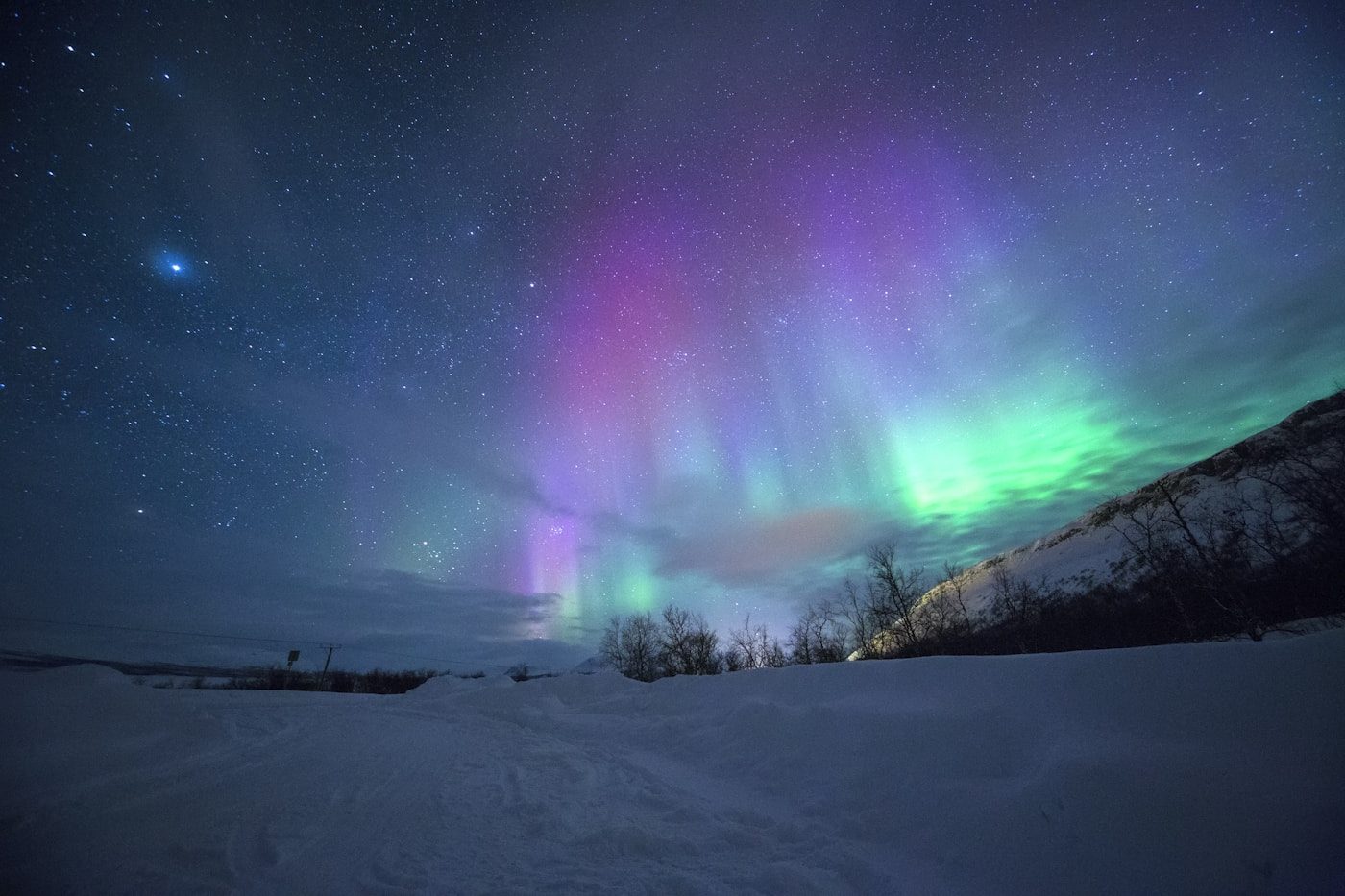
What Causes the Northern Lights? Aurora Borealis Explained for Stargazers
Telescope Advisor Logo Telescope Advisor
The aurora borealis photographed from the International Space Station — a green and red ribbon of light curving across Earth's upper atmosphere

Science Explained · Aurora Borealis

What Causes the Northern Lights? Aurora Borealis Explained

The northern lights are one of nature's most spectacular displays — but what actually causes them? From solar flares to Earth's magnetic field, this guide explains the science behind the aurora borealis in plain English, with practical tips for when and where to see them during Solar Cycle 25's peak.

TriggerSolar wind + magnetic field
Altitude100–400 km (60–250 mi)
ColoursGreen (most common), red, purple
Solar Cycle 25Peak 2025–2026
By Telescope Advisor Editorial Team Published: Updated: Reviewed & approved by Juhi Sahni, Senior Editor Editorial Standards

Quick Answer: What Causes the Northern Lights in Simple Terms

The northern lights (aurora borealis) are caused by charged particles from the Sun colliding with gas molecules in Earth's upper atmosphere. The Sun constantly emits a stream of charged particles called the solar wind. When this solar wind reaches Earth, our planet's magnetic field deflects most of it. But some particles become trapped and are funneled toward the north and south magnetic poles, where they accelerate into the atmosphere at speeds of up to 45 million mph. When these particles hit oxygen and nitrogen atoms at altitudes of 100–400 km, the atoms release energy in the form of light — creating the glowing curtains, arcs, and ribbons we see as the aurora.

This process is fundamentally the same as what happens inside a neon sign: electrical current excites gas atoms, which then emit coloured light as they return to their ground state. In the case of the aurora, the "current" is the solar wind, and the "gas" is Earth's upper atmosphere. The specific colours depend on which atmospheric gas is being excited and at what altitude — exactly as different gases produce different colours in advertising signs. The aurora is, in essence, a natural plasma physics laboratory visible to the naked eye, spanning thousands of square kilometres of sky.

The Science Behind the Aurora — Step by Step

1

The Sun releases charged particles

The Sun's corona — its outer atmosphere — is heated to millions of degrees, causing a continuous stream of charged particles (mostly electrons and protons) to escape the Sun's gravity. This is the solar wind, travelling at 400–800 km/s (roughly 1–2 million mph). During solar flares and coronal mass ejections (CMEs), the Sun can release billions of tons of additional particles in a single event, dramatically intensifying the solar wind.

2

Earth's magnetic field deflects — and funnels — the particles

Earth's magnetic field (the magnetosphere) acts as a shield, deflecting most of the solar wind around our planet. However, the field is weakest at the magnetic poles. As the solar wind pushes against the magnetosphere, some particles become trapped in the magnetic field lines and are funnelled toward the north and south polar regions.

3

Particles collide with atmospheric gases

As the trapped particles accelerate along magnetic field lines into the upper atmosphere, they collide with oxygen and nitrogen atoms at altitudes of 100–400 km. These collisions transfer energy to the atmospheric atoms, exciting them to a higher energy state. When the atoms return to their normal state, they release the excess energy as photons — particles of light.

4

Different gases produce different colours

The colour of the aurora depends on which gas is being hit and at what altitude. Green (the most common) is produced by oxygen atoms at 100–300 km. Red is produced by oxygen at higher altitudes (300–400 km) — it's rarer and requires more energy. Purple and blue are produced by nitrogen molecules, typically at lower altitudes (100–200 km) during intense geomagnetic storms.

Why 2026 Is a Great Year for Northern Lights

Solar Cycle 25 — the Sun's approximately 11-year activity cycle — is peaking in 2025–2026, and it has been significantly stronger than scientists predicted. This means more sunspots, more solar flares, more coronal mass ejections, and consequently, more frequent and intense aurora displays. During solar maximum, the auroral oval expands, pushing the northern lights visible from locations where they are rarely seen — including the northern United States, central Europe, and even parts of the southern hemisphere (where they are called the aurora australis).

For the best chances of seeing the aurora in 2026, monitor the KP index — a measure of geomagnetic activity ranging from 0 to 9. A KP of 5 or higher (considered a geomagnetic storm) typically brings the aurora visible to mid-latitude locations. During Solar Cycle 25's peak, KP 6–7 events have occurred multiple times, bringing the aurora as far south as Texas and Colorado. For real-time forecasts, see our northern lights tonight guide.

The KP Index and How to Use It

The KP index is the most important tool for predicting aurora visibility from your location. It measures disturbances in Earth's magnetic field on a scale of 0–9, with higher values indicating stronger geomagnetic activity. Here is what each level means for aurora viewing:

KP Level Aurora Visibility Visible From
KP 0–2Quiet — aurora weak, confined to polar regionsNorthern Canada, Alaska, Scandinavia
KP 3–4Active — bright aurora visible, auroral oval expandsNorthern US border states, Scotland, southern Scandinavia
KP 5–6Geomagnetic storm — aurora bright and dynamicNorthern half of US, central Europe, New Zealand (australis)
KP 7–8Strong storm — vivid colours, visible at mid-latitudesMidwest US, Colorado, Germany, southern UK
KP 9Extreme storm — rare, visible from low latitudesTexas, California, Mediterranean countries

For the best aurora photos, see our northern lights photography guide with full camera settings and technique.

Northern Lights vs. Southern Lights

The aurora borealis (northern lights) and aurora australis (southern lights) are the same phenomenon — just at opposite poles. When the solar wind funnels particles toward both the north and south magnetic poles simultaneously, both auroras appear at roughly the same time. The southern lights are harder to see because there are fewer land masses near the south magnetic pole, but observers in Tasmania, New Zealand's South Island, and southern Chile and Argentina can see them during strong geomagnetic storms.

Historical Auroral Events: From the Carrington Event to Today

The most extreme geomagnetic storm in recorded history was the Carrington Event of September 1–2, 1859. A massive solar flare — visible to the naked eye as a bright white light on the Sun's surface — released a coronal mass ejection that reached Earth in just 17.6 hours (compared to the typical 2–3 days). The resulting geomagnetic storm was so intense that aurora were reported as far south as Cuba, Mexico, Hawaii, and Tahiti. Telegraph systems worldwide failed, with operators reporting sparks and shocks from their equipment and, in some cases, telegraph paper catching fire. The aurora was bright enough to read newspapers by at tropical latitudes.

More recent strong events include the 1989 geomagnetic storm that caused a nine-hour blackout across Quebec, Canada, and the Halloween storms of 2003 which produced aurora visible as far south as Florida and Texas, caused satellite anomalies, and disrupted aircraft communications. During Solar Cycle 25's current peak, the May 2024 geomagnetic storm — the strongest in over two decades at KP 9 — produced aurora visible across most of the continental United States, Europe, and even parts of equatorial Africa. These events serve as reminders that the aurora is not merely a beautiful phenomenon but a visible manifestation of space weather that affects modern technological infrastructure, from GPS satellites to power grids.

Scientists monitor solar activity using spacecraft such as NOAA's DSCOVR satellite, positioned at the L1 Lagrange point 1.5 million kilometres from Earth. DSCOVR provides real-time measurements of solar wind speed, density, and magnetic field orientation — the key data needed to predict when a coronal mass ejection will arrive and how intense the resulting aurora may be. When the magnetic field carried by the solar wind points southward (opposite to Earth's northward-pointing magnetic field), magnetic reconnection occurs at the dayside magnetopause, dramatically increasing the transfer of energy into Earth's magnetosphere and producing the strongest auroral displays.

How to Prepare for Aurora Viewing

Do you need a telescope?

No — the aurora is best seen with the naked eye. Its curtains and arcs span tens of degrees across the sky, far too wide for a telescope's narrow field of view. Binoculars (7×50 or 10×50) can enhance the colour and detail of bright aurora displays. If you want to photograph the aurora, you need a DSLR or mirrorless camera with a wide-angle lens, a tripod, and manual exposure controls.

Where should you go?

For the best aurora viewing in the USA, see our complete guide to northern lights destinations in the US — covering Alaska, the northern states, and dark sky parks where solar maximum aurora is visible.

Aurora Viewing Checklist

  • ✅ Check the KP index forecast — aim for KP 5+
  • ✅ Find a dark location with a clear northern horizon
  • ✅ Check weather — clouds are your #1 enemy
  • ✅ Bring warm clothing — you may wait hours
  • ✅ Allow 15 minutes for eyes to dark-adapt
  • ✅ Look north 2–4 hours after local midnight


Frequently Asked Questions

What causes the different colours of the northern lights?

Green is produced by oxygen at 100–300 km altitude and is the most common. Red is produced by oxygen at 300–400 km and is rarer. Purple and blue are produced by nitrogen, typically during intense storms at lower altitudes.

Can you predict the northern lights?

Yes — the KP index provides a 30–60 minute forecast based on real-time measurements of the solar wind from the DSCOVR satellite. Longer-term predictions (1–3 days) are possible by monitoring solar flares and coronal mass ejections on the Sun's Earth-facing side.

Do the northern lights make sound?

Some observers report a faint crackling or hissing sound during intense aurora displays, but this is rare and debated. The aurora occurs at 100–400 km altitude, far above where sound waves can propagate to the ground. Any perceived sound is likely psychological or environmental.

Can you see the northern lights with a telescope?

The aurora is too large and diffuse for telescopic observation. It is best viewed with the naked eye. Binoculars can enhance colour and detail during bright displays, but a telescope's narrow field of view makes it unsuitable for aurora viewing.

Why are northern lights more common during solar maximum?

During solar maximum, the Sun produces more frequent and intense solar flares and coronal mass ejections. These send larger clouds of charged particles toward Earth, causing stronger geomagnetic storms that expand the auroral oval to lower latitudes where more people can see them.

What was the strongest aurora storm in history?

The Carrington Event of 1859 was the most extreme, producing aurora visible as far south as Cuba and Hawaii. During Solar Cycle 25, the May 2024 storm (KP 9) was the strongest in over 20 years, visible across most of the continental US and Europe.

How is the aurora forecast measured?

The KP index measures geomagnetic activity on a scale of 0 to 9 using magnetometer data from ground stations worldwide. A KP of 5 or higher indicates a geomagnetic storm. Real-time data from NOAA's DSCOVR satellite provides 30-60 minute forecasts of auroral activity.