Best Telescopes Under $1,000 (2026): 7 Top-Rated Picks Ranked by Use Case
Telescope Advisor Logo Telescope Advisor
Milky Way starfield — the night sky that awaits with a capable telescope under $1,000

Buying Guide · $500–$1,000 Tier

Best Telescopes Under $1,000 (2026): 7 Top-Rated Picks Ranked by Use Case

The $500–$1,000 bracket is the sweet spot where telescopes stop being toys and start being instruments. At this level you get GoTo tracking, 8 inches of aperture, or optically excellent refractors — but only if you choose the right tool for your goals. Here are seven picks, each ranked by what it does best.

$500–$1,000

Sweet-spot budget

7 Picks

Ranked by use case

GoTo / Dob

Two dominant types

10+ Years

Investment-grade gear

By Telescope Advisor Editorial Team Published: Updated: Editorial Standards

Quick Answer: What Is the Best Telescope Under $1,000 in 2026?

The Celestron NexStar 6SE is the best all-round telescope under $1,000 for most buyers in 2026. It combines a 6-inch Schmidt-Cassegrain optical tube, computerized GoTo tracking that finds objects automatically, and a compact form factor that travels easily. At roughly $900 (pricing fluctuates), it leaves room in your budget for one or two better eyepieces — and it will still be a capable instrument ten years from now.

If your priority is pure aperture per dollar for deep-sky observing, the Sky-Watcher Classic 200P Dobsonian (8 inches at ~$550) shows you more nebulae, galaxies, and star clusters than any other scope at this price — but you find targets manually. If you want smart-telescope simplicity, the Celestron StarSense Explorer LT 114AZ (~$350) uses your phone to guide you to objects without GoTo complexity or cost.

This guide breaks down seven telescopes across four categories — GoTo Schmidt-Cassegrains, Dobsonians, refractors, and smart scopes — so you can match the right instrument to your observing style, storage space, and long-term goals.

Related: Best Telescopes Under $500 · Best Telescopes 2026 (All Budgets)

🔭

Not sure which telescope actually fits your goals?

Answer 5 quick questions about your budget, observing targets, and experience level — our Telescope Finder Tool recommends a specific model in under 2 minutes.

Find My Telescope →

What $500–$1,000 Actually Buys You in 2026

Telescope pricing is not linear. A $300 scope and a $900 scope are not three times better — they are in a completely different category of instrument. Here is what changes when you cross the $500 threshold:

Feature Under $300 $500–$1,000 What Changes
MountLightweight, wobblySturdy, dampens quicklyStability at high magnification
TripodThin legs, plastic connectorsSteel or aluminum, 1.5–2" legsVibration settles in 2 seconds vs 8
EyepiecesKellner or Huygens, narrowPlössl or better, wider AFOVSharper edge-to-edge, more comfortable viewing
GoTo / TrackingNot availableReliable GoTo on several modelsPush a button, telescope finds objects
Optical QualityAdequate at low powerDiffraction-limited optics commonSharper at 200×, better contrast
Build Lifespan2–4 years typical10+ years with careWorth repairing, not replacing

The single biggest upgrade at this price is mount quality. A wobbly mount ruins the finest optics. Every telescope on this list has a mount solid enough that your limiting factor becomes atmospheric stability, not tripod shake. For a deeper look at what drives telescope value across all budgets, see our complete telescope price guide.

Editor's Pick — Best All-Round Telescope Under $1,000
Celestron NexStar 6SE — best telescope under $1,000 in 2026

1. Celestron NexStar 6SE

6" SCT 1500mm focal length GoTo + SkyAlign ~$900 street price

The NexStar 6SE is the telescope that beginner-to-intermediate astronomers graduate onto after outgrowing a first scope — and many experienced observers keep one as a grab-and-go companion. Its 6-inch Schmidt-Cassegrain optical design delivers bright, contrasty views of planets, the Moon, and brighter deep-sky objects in a package that weighs just 30 pounds fully assembled.

The SkyAlign technology lets you align on any three bright objects (stars, planets, even the Moon) and be observing within five minutes of powering on. Once aligned, the GoTo database of 40,000+ objects means you press a button and the telescope moves to your target. For a beginner who wants to spend time observing instead of star-hopping, this is transformative.

What you can see: Saturn's rings at 100× show the Cassini Division cleanly. Jupiter reveals two equatorial belts plus the Great Red Spot when it faces Earth. The Moon is breathtaking at any magnification. Brighter deep-sky objects (M13 Hercules Cluster, M42 Orion Nebula, M31 Andromeda Galaxy core) are well within reach. Faint galaxies beyond magnitude 11 require darker skies than most suburban backyards provide.

Limitations to know: The single-arm alt-az mount is excellent for visual observing but unsuitable for long-exposure astrophotography — the mount lacks equatorial tracking. The included 25mm Plössl eyepiece is acceptable but upgrading to a 9mm for planetary work and a 32mm for wide fields is highly recommended. The tripod, while sturdy for the weight, can vibrate in gusty wind. See our full NexStar 6SE review for detailed test results.

2. Sky-Watcher Classic 200P Dobsonian — Best for Deep-Sky

Sky-Watcher Classic 200P 8-inch Dobsonian
8" (203mm) aperture 1200mm focal length Manual Dobsonian mount ~$550

If raw light-gathering power is your priority, the Sky-Watcher Classic 200P delivers more aperture per dollar than anything else on this list. The 8-inch parabolic mirror collects 78% more light than a 6-inch scope — the difference between seeing M51 as a faint smudge and seeing spiral structure in the Whirlpool Galaxy.

This is the telescope for deep-sky enthusiasts who plan to observe from reasonably dark skies. Under Bortle 4 or better, the 200P reveals: the dust lanes in M31 Andromeda Galaxy, the full Veil Nebula complex with an O-III filter, dozens of globular clusters resolved to the core, and carbon-star colour contrasts that smaller apertures cannot reach.

Trade-off: It is manual — you push it by hand to find targets. The included 2-inch Crayford focuser accepts wide-field eyepieces, but you will want a 2-inch 32mm eyepiece (around $100–$150 extra) to take full advantage. At 55 pounds, it is not a travel scope. It also requires collimation (mirror alignment) every few sessions — see our collimation guide. For more options at this aperture, see best Dobsonian telescopes.

View on Amazon →

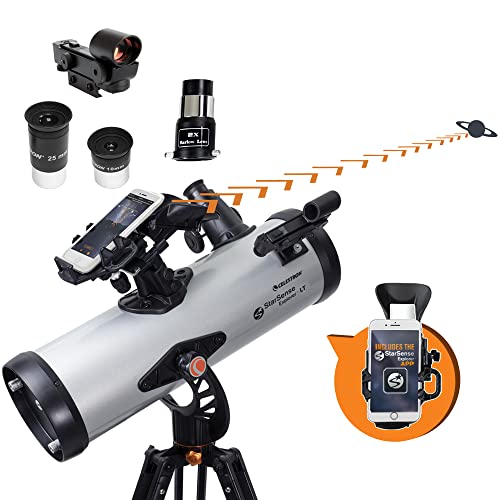
3. Celestron StarSense Explorer LT 114AZ — Best Smart Scope for Beginners

Celestron StarSense Explorer LT 114AZ
114mm (4.5") aperture 1000mm focal length StarSense phone app ~$350

The StarSense Explorer uses your smartphone's camera to determine exactly where the telescope is pointed, then displays direction arrows on the screen to guide you to any object. It is not GoTo — you push the tube manually — but the phone guidance eliminates the steepest part of the beginner learning curve: finding things.

The 114mm (4.5-inch) primary mirror captures enough light for satisfying views of Saturn's rings, Jupiter's bands, dozens of bright Messier objects, and fine lunar detail. The app includes a Tonight's Best list that automatically selects objects visible from your location and time. For a complete beginner who wants guided discovery without paying for GoTo motors, this is the most practical choice under $500.

Note: The mount is an alt-az design with slow-motion control cables. It tracks Earth's rotation in one axis if you adjust the cable, but not automatically. This is fine for visual observing at up to 150×. For deeper treatment of the StarSense system, see our StarSense Explorer DX review.

View on Amazon →

4. Celestron Omni XLT 102 — Best Refractor Under $1,000

Celestron Omni XLT 102 refractor telescope
102mm (4") aperture 660mm focal length CG-4 equatorial mount ~$650–$750

For observers who value crisp, high-contrast planetary and lunar views above all else, the Omni XLT 102 is the best refractor under four figures. Its 102mm f/6.5 achromatic doublet delivers clean images at up to 200× on the Moon and planets, with manageable false colour (chromatic aberration) that most users find unobtrusive at f/6.5.

The CG-4 equatorial mount is a genuine step up from the mounts included with most $300 refractors. It tracks rotation smoothly, includes slow-motion cables in both axes, and supports basic entry-level astrophotography with a DSLR at prime focus. Lunar and planetary imaging are feasible; deep-sky long exposures require more tracking precision than the CG-4 can reliably deliver without autoguiding.

Who this is for: The Moon- and planet-obsessed observer who wants the sharpest possible image at a given aperture and is willing to learn equatorial polar alignment. Not for the grab-and-go crowd — the CG-4 mount and counterweights take 10–15 minutes to set up. For a simpler refractor experience at lower cost, see best refractor telescopes.

View on Amazon →

5. Celestron NexStar 5SE — Best Compact GoTo

Celestron NexStar 5SE compact GoTo telescope
5" (125mm) SCT 1250mm focal length Fully assembled: 28 lbs ~$700

The NexStar 5SE is essentially a smaller, lighter, more affordable version of the 6SE with the same GoTo technology. At 28 pounds fully assembled with the tripod, it is genuinely portable — it fits in a passenger car seat and takes under five minutes to set up. The 5-inch aperture still delivers excellent planetary and lunar detail, though it falls noticeably short of the 6SE on deep-sky objects.

Choose the 5SE if: You travel to dark sites, have limited storage space, or want a GoTo scope that lives fully assembled in a corner of the living room and can be carried outside in one trip. The 5SE and 6SE share the same mount and GoTo hand control — upgrading to the 6SE later is expensive, so buy the larger aperture now if you have the budget and space. See our 6SE vs 8SE comparison for the full family breakdown.

View on Amazon →

6. Celestron AstroMaster 130EQ — Best Dedicated Planetary Scope

Celestron AstroMaster 130EQ telescope
130mm (5.1") aperture 650mm focal length (f/5) CG-3 equatorial mount ~$380

The AstroMaster 130EQ sits just above the $300 threshold into this guide's range because of one factor: its 130mm (5.1-inch) parabolic mirror delivers genuine planetary performance when paired with decent eyepieces. At 130×, Saturn's Cassini Division is cleanly resolved on steady nights, and Jupiter shows three to four cloud belts.

Important context: The CG-3 equatorial mount is functional but has limitations — the tripod legs are 1-inch steel, and the mount head shows some vibration at high power. Budget $50–$80 for vibration suppression pads or a sturdier tripod upgrade. The telescope's optical potential exceeds its mount's stability, but it is still the most capable dedicated planetary Newtonian under $500. See our best telescopes for viewing planets for more options.

View on Amazon →

7. Celestron NexStar Evolution 8 — The Stretch Pick (Just Over $1,000)

The Evolution 8 typically retails between $1,100 and $1,300, which is technically over the $1,000 ceiling of this guide. It appears here because it appears in this price discussion frequently: buyers researching $900 telescopes inevitably ask whether stretching to the Evolution 8 is worth it.

The honest answer: If you can reach $1,100–$1,300, the Evolution 8 is the best Schmidt-Cassegrain under $2,000. Its 8-inch aperture is 78% larger than the 6SE's (more light, finer detail), the built-in WiFi control via smartphone is genuinely convenient, and the batteries last 10+ hours on a charge. But it is also larger, heavier (44 pounds), and requires a more careful mount setup. The 6SE is a better choice if this is your first serious telescope; the Evolution 8 is the upgrade you buy after you know you are hooked. For the full breakdown, see our NexStar 8SE review (the Evolution shares the same optical tube).

Side-by-Side Comparison: 7 Telescopes Under $1,000

Model Type Aperture Focal Ratio Mount Est. Price Best For
NexStar 6SESCT GoTo6" (150mm)f/10Single-arm alt-az~$900All-round: planets + bright DSOs + GoTo
Classic 200PNewtonian Dob8" (203mm)f/5.9Manual Dobsonian~$550Deep-sky visual: galaxies, nebulae, clusters
StarSense LT 114AZNewtonian Smart4.5" (114mm)f/8.8Alt-az + phone guide~$350Beginners: app-assisted discovery
Omni XLT 102Refractor4" (102mm)f/6.5CG-4 equatorial~$650Planets + lunar + basic AP
NexStar 5SESCT GoTo5" (125mm)f/10Single-arm alt-az~$700Portable GoTo for planets/bright DSOs
AstroMaster 130EQNewtonian EQ5.1" (130mm)f/5CG-3 equatorial~$380Planetary: Saturn rings, Jupiter bands
Evolution 8SCT GoTo8" (203mm)f/10Single-arm alt-az WiFi~$1,100+Upgrade: serious visual + bright AP

Which Telescope Under $1,000 Should You Buy?

Your choice depends on one honest answer: what do you most want to see?

"I want to see Saturn's rings and Jupiter's bands — sharp and detailed."

NexStar 6SE or Omni XLT 102

"I want to see galaxies, nebulae, and star clusters from dark skies."

Sky-Watcher Classic 200P Dobsonian

"I am a complete beginner and want the easiest possible path to seeing things."

Celestron StarSense Explorer LT 114AZ

"I want the best all-rounder that does everything reasonably well."

NexStar 6SE — Editor's Pick

If you are still uncertain after reading this guide, use our Telescope Finder Tool — answer five questions and get a personalized recommendation based on your budget, light pollution level, and observing goals.

Frequently Asked Questions

Is a telescope under $1,000 good enough for astrophotography?

For planetary and lunar astrophotography, yes — any of the GoTo SCTs on this list can capture excellent images with a planetary camera. For deep-sky astrophotography (nebulae, galaxies), the $1,000 budget is tight because you also need a tracking mount that costs $600–$1,500. The Omni XLT 102 on the CG-4 mount can produce decent wide-field Milky Way shots and bright nebula images with a DSLR, but expect limitations. See our beginner astrophotography setup guide for dedicated AP recommendations.

Should I buy a GoTo telescope or a manual Dobsonian?

This is the central decision at this price. GoTo telescopes (NexStar 6SE, 5SE) find objects for you — you align once, then press buttons. Manual Dobsonians (Classic 200P) require you to learn the sky and push the tube by hand. GoTo is better if you have limited time and want to maximise observing minutes. Manual Dobsonians give you more aperture per dollar and a deeper understanding of the sky. Our GoTo vs manual guide covers this decision in detail.

Is the NexStar 6SE worth the extra cost over the 5SE?

Generally yes, if you have the budget and storage space. The 6SE's 6-inch aperture collects 44% more light than the 5-inch, which translates to visibly brighter deep-sky images and slightly finer planetary detail at high magnification. Both share the same mount and GoTo system. The main reason to choose the 5SE is portability — it is noticeably lighter and smaller.

Can I see galaxies with an 8-inch Dobsonian under suburban skies?

Yes, but with honest expectations. Under Bortle 5–6 suburban skies, an 8-inch Dobsonian reveals: M31 Andromeda Galaxy (bright core, hints of dust lanes), M81/M82 (core + cigar shape), M51 Whirlpool (core + companion), and M104 Sombrero (bright nucleus with extended glow). Fainter galaxies (NGC 4565, M101) are visible only as ghostly smudges. Dark skies (Bortle 3 or better) transform the 8-inch into a galaxy machine — see our Bortle class guide to find your sky quality.

How much should I budget for accessories with a $900 telescope?

Plan $100–$200 for essential upgrades: a 9mm or 10mm eyepiece for high-magnification planetary work ($50–$80), a 32mm eyepiece for wide-field views ($50–$80), and possibly a Celestron Omni 2× Barlow lens ($40–$50) to double your eyepiece options. Avoid the temptation to buy a full eyepiece set — two or three quality eyepieces outperform a dozen mediocre ones. See our best telescope eyepieces guide for recommendations.