
Can You See Uranus With a Telescope? Complete Observing Guide (2026)
Telescope Advisor Logo Telescope Advisor
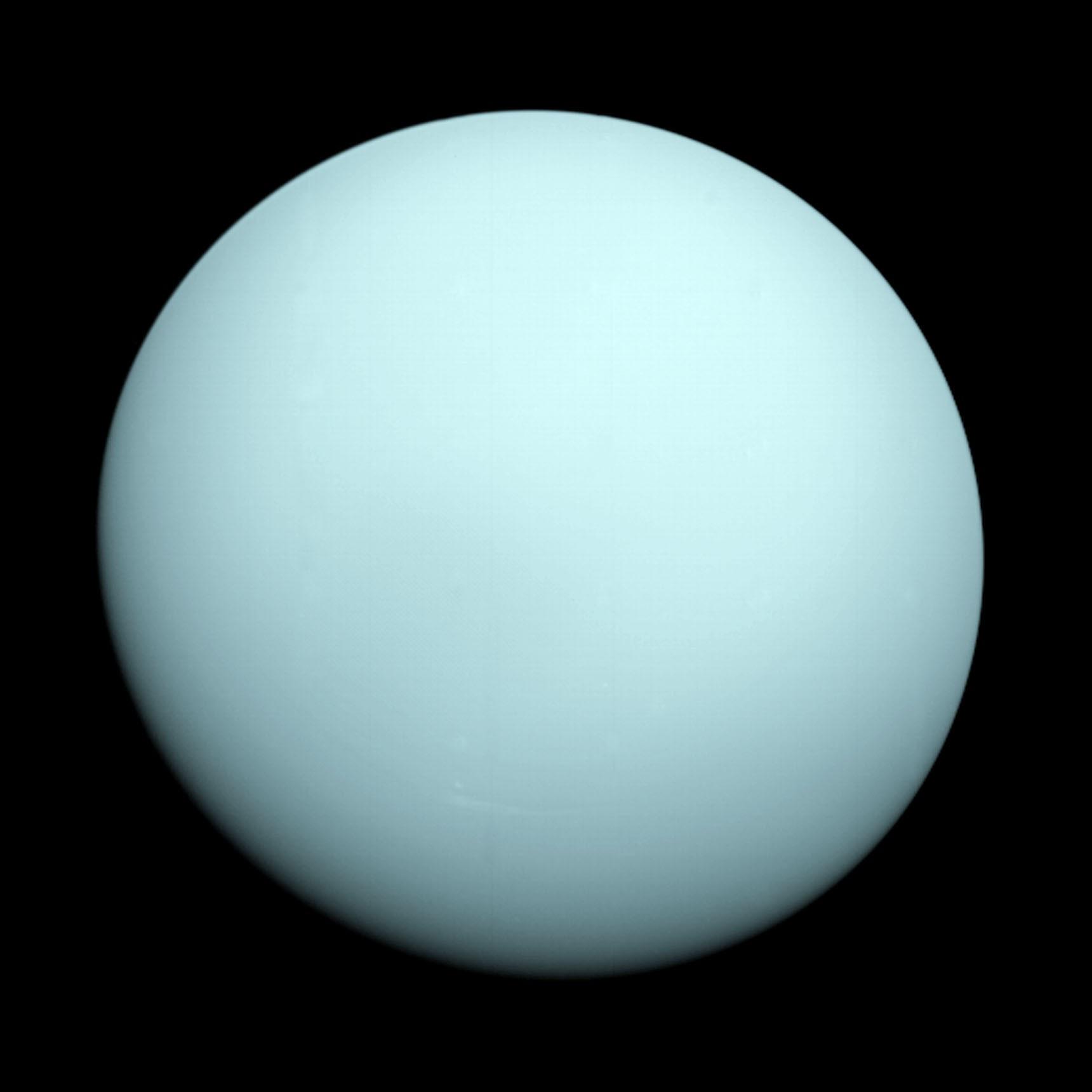
Uranus as seen by the Hubble Space Telescope — a pale blue-green disk with faint atmospheric bands

Observing Guide · Outer Planets

Can You See Uranus With a Telescope?

Uranus is the faintest planet visible to the naked eye — and through a telescope, it reveals a unique pale blue-green disk unlike any other planet. This guide covers exactly what to expect, the minimum aperture required, and how to find it in the 2026–2027 night sky.

Visible withBinoculars + telescope
Min. aperture70mm (disk), 130mm (detail)
Best viewingOpposition November 2026
Magnitude 20265.7 (binocular bright)
By Telescope Advisor Editorial Team Published: Updated: Editorial Standards

Quick Answer: Yes — It's a Pale Blue-Green Disk

Yes, you can see Uranus with a telescope — and it is immediately identifiable even at low magnification by its distinctive pale cyan colour. Unlike the bright white of Venus, the ruddy orange of Mars, or the yellow-white of Jupiter and Saturn, Uranus appears as a small, steady blue-green disk — the result of methane in its atmosphere absorbing red wavelengths and reflecting blue-green light.

Uranus is technically visible to the naked eye under extremely dark skies (magnitude 5.7 in 2026, on the edge of human visibility), but in practice, it is much easier to locate with binoculars or a finder scope. Through any telescope at 60×–100×, Uranus shows a tiny but unmistakable disk — the transition from a point source to a disk is the moment you know you have found it. A 130mm+ telescope under good conditions reveals the planet's subtle atmospheric banding and, on rare occasions at very high magnification (200×+), the faint ring system (discovered only in 1977) as an infinitesimally thin line around the disk.

Uranus reaches opposition in November 2026, when it is closest to Earth (approximately 2.75 billion km) and visible all night. This is the best time to observe it.


What Uranus Looks Like Through Different Telescopes

Through 70–80mm Telescope (60×–100×)

Uranus appears as a tiny, pale blue-green disk — definitely non-stellar in appearance. No surface detail is visible at this aperture, but the colour alone is distinctive enough to confirm the identification. The planet's disk is approximately 3.5 arcseconds in diameter at opposition — small but resolvable.

Through 130–200mm Telescope (150×–250×)

At 130mm+, Uranus shows a larger disk (still small — about 7 arcseconds at opposition in a 200mm scope) with subtle atmospheric banding. The polar region appears slightly darker than the equatorial band. The blue-green colour is more saturated. With excellent seeing, the epsilon ring (brightest of Uranus's rings) may be glimpsed as an extremely faint line with averted vision.

How to Find Uranus in 2026–2027

Uranus moves slowly through the sky — it takes 84 years to complete one orbit — so it stays within approximately 15° of a single zodiac constellation for several years at a time. Through 2026 and 2027, Uranus is located in Aries, near the border with Taurus.

Finding technique: Locate the Pleiades (M45) in the east in autumn/evening. Uranus is approximately 10° east-northeast of the Pleiades, near the star Botein (Delta Arietis). Use a star chart app like Stellarium or SkySafari to pinpoint its exact position on your observing date — Uranus moves only about 1° per month against the background stars, so a weekly check is sufficient.

2026 opposition: November 10–20, 2026. Uranus rises at sunset, culminates at midnight, and sets at sunrise. This is the best observing window for the next 12 months.

Best Equipment for Uranus

Unlike fast-moving Mercury, Uranus is easy to find once you know where to look — you have months of visibility each year. A GoTo telescope makes locating it trivial; with a manual scope, a good star chart or app is your best tool.

Celestron AstroMaster 70AZ refractor telescope

Minimum: 70mm Refractor

A 70mm refractor like the Celestron AstroMaster 70AZ is the minimum recommended for resolving Uranus as a disk. At 60×–80×, the planet appears as a tiny blue-green circle distinct from surrounding stars. A GoTo mount on this class of telescope makes finding Uranus effortless.

Check Price on Amazon →

For more telescope recommendations, see our best planetary telescopes guide.

Frequently Asked Questions

Can you see Uranus without a telescope?

Barely. Uranus is magnitude 5.7 in 2026, which is at the limit of naked-eye visibility under perfectly dark skies. In practice, binoculars (7×50 or 10×50) are by far the easiest way to see it without a telescope. Through binoculars, Uranus appears as a star-like point — you need a telescope to resolve its disk.

What does Uranus's colour look like through a telescope?

Uranus appears as a distinctive pale cyan or blue-green colour — a soft pastel shade that is unlike any star. The colour comes from methane in Uranus's upper atmosphere, which absorbs red light and reflects blue and green wavelengths. This colour is visible even in small telescopes at moderate magnification.

What size telescope do I need to see Uranus's rings?

Uranus's rings are extremely faint and challenging. A 250mm (10-inch) or larger telescope under excellent seeing conditions is required for any chance of detecting them visually, and even then, only the brightest epsilon ring may be glimpsed with averted vision. Most observers never see Uranus's rings — the planet's blue-green disk is the primary target.

Can you see Uranus's moons through a telescope?

Uranus has five major moons (Miranda, Ariel, Umbriel, Titania, Oberon) that are within reach of amateur telescopes, but they are challenging. Titania and Oberon (magnitude 13–14) are the easiest — visible in a 200mm+ scope under dark skies as faint star-like points near the planet. The smaller moons require larger apertures and excellent conditions.