HETEKAN 80mm Telescope Review 2026: Honest Beginner Assessment
Telescope Advisor Logo Telescope Advisor
Planets visible through a refractor telescope — testing what the HETEKAN 80mm actually reveals of Saturn, Jupiter and the Moon

Telescope Review · Budget Refractor

HETEKAN 80mm Telescope Review 2026: Honest Beginner Assessment

The HETEKAN 80mm 500mm refractor is a genuinely complete package — telescope, tripod, phone adapter, and backpack in one box, aimed squarely at first-time buyers on a budget. We assessed it objectively: what the optics deliver at 80mm f/6.25, who it suits, and when you should pay a little more for something better.

Aperture80mm (3.1 inches)
Focal length500mm (f/6.25)
Magnification range20×–150× (practical: 20–100×)
Rating4.4★ from 25+ reviews
By Telescope Advisor Editorial Team Published: Updated: Editorial Standards

Quick Verdict

HETEKAN 80mm 500mm Refractor Telescope

★★★★★ 3 / 5

The HETEKAN 80mm is a credible entry-level telescope for the right buyer — primarily children aged 8–13 or total beginners who want a complete out-of-the-box experience without the frustration of sourcing accessories separately. The included backpack, tripod, and phone adapter make it uniquely self-contained at this price tier. As an optical instrument, 80mm at f/6.25 shows the Moon in satisfying detail, clearly reveals Saturn's rings and Jupiter's main cloud belts, and will keep a curious beginner engaged for their first season. The limitations are real but predictable: the supplied eyepieces restrict you to fixed magnifications, the alt-azimuth mount requires manual nudging as Earth rotates, and the plastic construction is not built for decades of use. For serious beginners willing to spend a little more, the Sky-Watcher Heritage 130P offers significantly more optical performance at a modestly higher investment.

What works well

  • ✓ Complete package — tripod, phone adapter, backpack included
  • ✓ Satisfying Moon views at 50–75×
  • ✓ Saturn's rings clearly separated, Jupiter's equatorial bands visible
  • ✓ Lightweight and portable — 3.4kg with tripod
  • ✓ Quick setup — under 10 minutes first time out
  • ✓ 4.4★ customer satisfaction supports the value proposition

Genuine limitations

  • → Basic 1.25" eyepieces — limited optical quality at high power
  • → No slow-motion controls — planets drift across field quickly
  • → Chromatic aberration visible on Moon and bright planets
  • → 80mm aperture ceiling: ~150× practical max, limiting on deep-sky
  • → Plastic construction less durable than metal-focuser alternatives
  • → Only 25+ reviews — newer product, less established track record


Full Specifications

Type: Achromatic refractor
Aperture: 80mm (3.15 inches)
Focal length: 500mm
Focal ratio: f/6.25
Limiting magnitude: ~11.3 (theoretical)
Resolving power: 1.45 arcseconds
Included eyepieces: Multiple (see listing)
Eyepiece format: 1.25" standard
Finderscope: Included (red-dot or optical)
Mount: Alt-azimuth (manual)
Claimed magnification: 20×–150×
Practical max magnification: ~80–100×
Included accessories: Tripod, phone adapter, backpack, stickers
Tube material: Aluminium

What the HETEKAN 80mm Actually Shows

The most useful thing we can tell you about any beginner telescope is not its specifications — it's exactly what you'll see through the eyepiece on your first night out. Here's the honest target-by-target breakdown for the HETEKAN 80mm:

Target Magnification What You'll See Rating
Moon50–75×Craters, mountain ranges, maria clearly resolved — genuinely impressiveExcellent
Saturn50–80×Rings clearly separated, disk visible, Titan faintly detectableGood
Jupiter50–80×2 equatorial cloud belts, 4 Galilean moons as distinct dotsGood
Venus40–60×Phase clearly visible (gibbous, crescent) — one of the best beginner targetsGood
Double stars50–100×Wide doubles cleanly split (Albireo, Mizar); tight pairs challengingFair
Open clusters25–50×Pleiades, Hyades, Beehive — scattered star fields, pleasant at low powerGood
Orion Nebula (M42)25–40×Faint grey glow with Trapezium stars — identifiable but not dramaticFair
Andromeda Galaxy25×Faint oval smudge — present but underwhelming; finderscope makes locating challengingPoor
Globular clusters50×Compressed ball of light — M13 identifiable, stars unresolvedFair

The pattern is clear: the HETEKAN performs well on bright high-contrast targets — Moon, planets, Venus phases, wide double stars — and underperforms on faint extended objects (nebulae, galaxies) where aperture is decisive. This is entirely appropriate for an 80mm instrument and sets accurate expectations for first-time buyers. No 80mm telescope, regardless of brand or price, will produce more light than its aperture permits — physics, not quality, sets this ceiling. For guides on what each planet shows through a telescope, see what planets look like through a telescope.

Optical Quality at 80mm f/6.25

The HETEKAN uses an achromatic doublet refractor design — two glass elements that partially correct chromatic aberration (the false colour fringing that single-element lenses produce). At f/6.25, the chromatic correction is noticeably better than the very cheapest 50–60mm f/5 refractors (which produce strong purple fringing on the Moon), but falls short of apochromatic (APO) or semi-APO designs. Expect to see subtle purple or blue fringing around the bright lunar limb and around Venus at high magnification — it doesn't prevent useful observation, but it is present.

Chromatic aberration in context

Chromatic aberration in an achromatic doublet is physics, not a manufacturing defect. At f/6.25, the HETEKAN is a moderate-speed refractor — faster than the Celestron AstroMaster 70AZ (f/12.9) where CA is very well controlled, and slower than extreme budget f/4–f/5 designs where CA is severe. The practical result: lunar and planetary observing remains satisfying, the false colour is more visible when you know to look for it than it is when you're simply enjoying the view.

The 150× claim

The claimed 150× upper limit is achievable with the supplied Barlow and highest-power eyepiece, but it pushes beyond the practical quality ceiling for 80mm aperture. Above approximately 100× (50× per inch of aperture as a rule of thumb), image brightness drops, exit pupil shrinks below comfortable limits, and atmospheric turbulence — not the optics — becomes the limiting factor. Use the mid-range magnifications (50–80×) for the best experience on a typical night.

How 80mm compares to nearby aperture classes

Aperture vs HETEKAN 80mm Limiting Mag Practical max mag
60–70mm refractorLess light — simpler targets~11.070–100×
80mm (HETEKAN)This telescope~11.380–100×
130mm Newtonian+2.6× more light~12.7130–200×
150mm refractor/reflector+3.5× more light~13.0150–250×

Mount, Tripod, and Included Accessories

HETEKAN differentiates the 80mm from most competitors in its price tier by including a meaningful accessories package. The tripod, phone adapter, and dedicated backpack eliminate the "now what?" experience many beginners face after unboxing a bare telescope.

Alt-azimuth mount

The manual alt-azimuth mount moves horizontally (azimuth) and vertically (altitude) independently — the simplest and most intuitive design for new observers. You point the telescope at an object and it stays there until Earth's rotation moves the target out of the field, requiring a nudge. This is fine for casual observing, particularly of the Moon and slow-moving planets. It becomes frustrating at high magnification where targets drift across the field quickly. There are no slow-motion controls on this mount — adding a basic equatorial mount as a future upgrade path would address this limitation.

Tripod stability

The lightweight aluminium tripod is adequate for casual lunar and planetary observing at moderate magnifications. At 100×+, vibrations induced by focussing or touching the telescope take 3–5 seconds to damp — typical for budget tripods and the main practical annoyance at high power. On calm nights without wind this is manageable; on breezy evenings it becomes a frustration. The tripod's spread legs and adjustable height cover the practical range of sitting and standing observing positions.

The backpack — genuinely useful

The included backpack is a real differentiator. Beginner telescopes are frequently damaged or abandoned because they don't have a proper storage and transport solution — lenses collect dust, eyepieces go missing, and the tripod gets knocked over. The HETEKAN's dedicated pack keeps everything together and makes the telescope genuinely portable for dark-sky trips. It's a practical advantage over comparable scopes that leave storage to the buyer.

Smartphone adapter

The included phone adapter allows afocal photography — holding your phone camera up to the eyepiece. This technique works well for Moon photography and produces recognisable planet images. Don't expect astrophotography-quality results, but for sharing on social media or documenting your first views, it's a useful starter tool. See our Moon photography guide for technique tips.

Who Should Buy the HETEKAN 80mm

Good choice if:

  • Gift for a child aged 8–13 — complete, safe, encouraging. The backpack and phone adapter add child-appropriate fun factor. Moon and planet views will be genuinely exciting for this age group.
  • Absolute first telescope with no prior experience — the all-in-one package removes decision fatigue about accessories.
  • Portability is the top priority — 3.4kg total, packed into one backpack, is genuinely travel-friendly.
  • Hard budget ceiling that can't be stretched — within this price tier, the included accessories represent genuine value.

Look elsewhere if:

  • Deep-sky observing is the goal — galaxies, nebulae, and globular clusters need more aperture than 80mm provides.
  • You can stretch the budget even slightly — the Heritage 130P offers 2.6× more light gathering and a parabolic mirror at a modest premium.
  • Long-term serious hobby — the lightweight construction and basic mount will feel limiting within 6–12 months of active use.
  • Primarily planetary observing — a 130mm+ aperture with better mount stability gives dramatically more Saturn and Jupiter detail.

🔭

Not sure which telescope actually fits your goals?

Answer 5 quick questions about your budget, observing targets, and experience level — our Telescope Finder Tool recommends a specific model in under 2 minutes.

Find My Telescope →

Better Alternatives to Consider

If budget allows for any of these, they represent meaningfully better value for most buyers:

Best Upgrade — Most Recommended Step-Up
Sky-Watcher Heritage 130P tabletop Dobsonian reflector

Sky-Watcher Heritage 130P

The Heritage 130P is consistently our top recommendation for anyone in the HETEKAN's target market who can stretch slightly. At 130mm aperture — versus 80mm — it gathers 2.6× more light, which translates directly into brighter, more detailed views of everything. The 130P's parabolic primary mirror eliminates the spherical aberration that budget Newtonian mirrors can suffer. The tabletop Dobsonian mount is actually simpler to use than an alt-azimuth with a tripod — no assembly, no vibration — and it's more stable at high magnification. The one genuine advantage the HETEKAN has is the backpack — the Heritage 130P needs to be transported separately. For every observing goal the HETEKAN serves, the Heritage 130P serves it better. Full review: Heritage 130P review.

Celestron AstroMaster 70AZ refractor telescope

Celestron AstroMaster 70AZ — Best refractor comparison

If you specifically want a refractor (for daytime use, no-collimation simplicity, and easy portability), the AstroMaster 70AZ is the established alternative. At 70mm it's slightly smaller than the HETEKAN's 80mm but built by Celestron — a dedicated astronomy brand with decades of quality control, genuine optics expertise, and a warranty you can actually use. The longer focal ratio (f/12.9 vs f/6.25) virtually eliminates chromatic aberration — Moon and planetary views are noticeably cleaner. See our AstroMaster 70AZ review.

Celestron StarSense Explorer LT 114AZ smartphone-guided telescope

Celestron StarSense Explorer LT 114AZ — Best tech upgrade

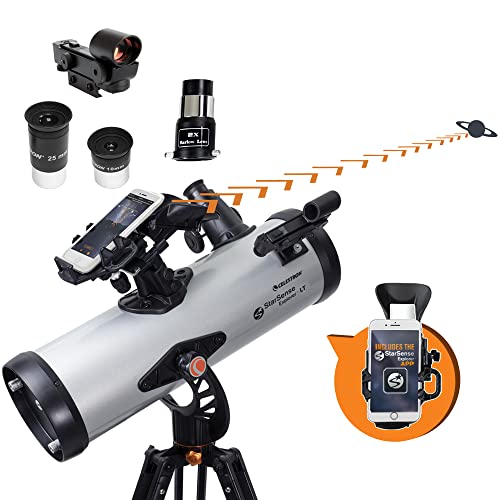
If the biggest barrier isn't budget but finding objects — which is one of the top reasons beginners give up — the StarSense Explorer is the solution. Its smartphone dock uses your phone's camera to analyse the star field and direct you to any object in the sky with an on-screen arrow. 114mm aperture beats the HETEKAN's 80mm, Celestron's quality control is established, and the StarSense navigation system removes the frustration that causes most beginners to abandon their telescope within months. The price premium over the HETEKAN is justified if finding objects is your pain point. See our best beginner telescope guide.

Affiliate links. Editorial standards.

HETEKAN 80mm FAQ

Is the HETEKAN 80mm telescope any good?

Yes, for its specific target audience. The HETEKAN 80mm delivers satisfying Moon and planet views (Saturn's rings, Jupiter's cloud belts) for a complete beginner or as a gift for a child. The included backpack, phone adapter, and tripod make it genuinely self-contained. As a long-term astronomy instrument or for deep-sky observing, it has meaningful limitations — 80mm aperture restricts faint-object performance and the basic mount will feel limiting as skills develop. It earns a 3/5 rating: genuinely competent for what it is, but surpassed by alternatives like the Heritage 130P for anyone who can spend slightly more.

Can the HETEKAN telescope see Saturn's rings?

Yes. At 50–80× magnification, Saturn's rings are clearly separated from the planet's disk in the HETEKAN 80mm. The rings appear as a distinctive oval band extending on either side of the planet — the view is unmistakably Saturn. The Cassini Division (the gap within the ring system) requires more aperture (80mm+ at 100×) and steady atmospheric seeing to detect — it is marginal in the HETEKAN. Saturn's moon Titan is visible as a faint star-like point near the planet at 50–80×. For October 2026's Saturn opposition (October 4), see our October sky guide.

What does 80mm aperture mean for a telescope?

Aperture is the diameter of the telescope's main lens (for a refractor) or mirror (for a reflector). It determines two critical things: how much light the telescope collects (directly proportional to aperture area, which goes as aperture squared) and its resolving power (maximum detail visible). An 80mm refractor collects 2.6× more light than a 50mm refractor, allowing you to see objects about 1.3 magnitudes fainter. Its resolving power (Dawes limit: 1.45 arcseconds) is high enough to split most common double stars and show meaningful planetary detail. However, 80mm significantly underperforms a 130mm scope in all respects — a 130mm collects 2.6× more light and resolves finer details. See our aperture guide.

Is the HETEKAN telescope good for beginners?

It's a reasonable starting point for absolute beginners, particularly as a gift. The 4.4★ rating suggests buyers are largely satisfied. However, for beginners who are serious about the hobby from the start, the Sky-Watcher Heritage 130P provides a more rewarding experience — more aperture, better mount stability, and a proven track record in the astronomy community. The Heritage 130P is the telescope that gets people hooked on astronomy long-term; the HETEKAN is the telescope that introduces astronomy without frightening off casual buyers. See our complete beginner telescope guide.

What is the maximum useful magnification for the HETEKAN 80mm?

The practical maximum magnification for 80mm aperture is approximately 80–100× on a typical night (the standard rule is 50× per inch of aperture). The telescope is claimed to reach 150× with a Barlow, which is achievable but produces dim, soft images in average atmospheric seeing conditions. On exceptional nights with steady air, 120–130× produces usable planetary views. For the best everyday experience, use eyepieces in the 50–80× range — this is where 80mm optics deliver their best optical performance.


Related Reviews and Guides