

Telescope Advisor Logo Telescope Advisor
Thousands of distant galaxies in a Webb deep field image — the kind of cosmic vista that includes worlds like Kepler-452b, 1,400 light-years away in the constellation Cygnus

Space Science · Exoplanets · Kepler Mission

Kepler-452b: Earth's Cousin — Complete Guide to the Distant Exoplanet

When NASA announced the discovery of Kepler-452b in July 2015, headlines around the world called it "Earth's older cousin" or "Earth 2.0." And for good reason: Kepler-452b is a near-Earth-sized exoplanet orbiting in the habitable zone of a Sun-like star — the first such world ever confirmed. Orbiting 1,400 light-years away in the constellation Cygnus, this remarkable planet offers a glimpse of what Earth might look like if it were 1.5 billion years older.

Planet typeSuper-Earth (1.6× Earth)
Distance1,400 light-years
Orbit385 days
StarG-type (Sun-like), 6 billion yrs old
By Elena Reyes Published: Updated: Reviewed & approved by Juhi Sahni, Senior Editor Editorial Standards
Elena Reyes — Senior Science Editor

Elena Reyes

Senior Science Editor

Covers NASA missions, space science discoveries, and astronomical events for Telescope Advisor. Translates complex astrophysical research into practical insights for backyard observers. Based in the San Francisco Bay Area.

What Is Kepler-452b?

Kepler-452b is a super-Earth exoplanet — a world larger than Earth but smaller than Neptune — orbiting within the habitable zone of a G-type star very similar to our Sun. Discovered by NASA's Kepler Space Telescope using the transit method, the planet was confirmed after careful analysis of data from the telescope's primary mission. It is located approximately 1,400 light-years from Earth in the constellation Cygnus.

The planet is about 60% larger in diameter than Earth, placing it firmly in the super-Earth category. Its mass is estimated to be roughly five times Earth's, giving it a surface gravity about twice that of Earth. Its orbital period of 385 days is remarkably close to Earth's 365-day year, and it receives roughly 10% more energy from its star than Earth receives from the Sun — placing it within the habitable zone where liquid water could theoretically exist on the surface.
Key Facts About Kepler-452b

PropertyValueCompared to Earth
Radius1.63 R⊙1.6× larger
Mass (estimated)~5 M⊙~5× Earth's mass
Orbital Period384.8 days~1.05× Earth year
Distance from Star1.05 AUSimilar to Earth–Sun distance
Stellar Flux1.1 S⊙10% more sunlight than Earth
Star Age~6 billion years1.5 billion years older than Sun
Star TypeG2VSame spectral type as the Sun
ConstellationCygnusSummer Milky Way region
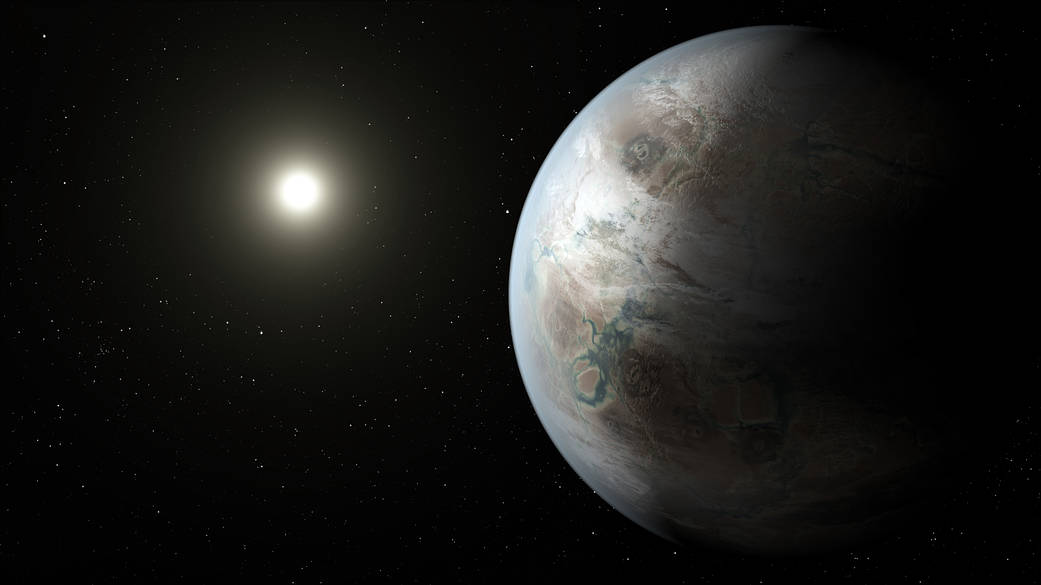
Artistic concept of Kepler-452b — a super-Earth exoplanet orbiting in the habitable zone of a Sun-like star, shown as a rocky world with clouds and surface water
Kepler-452b — Artistic Concept — This NASA artist's concept depicts one possible appearance of Kepler-452b, the first near-Earth-size world found in the habitable zone of a Sun-like star. The planet is about 60% larger than Earth and orbits its star every 385 days. Credit: NASA Ames/JPL-Caltech/T. Pyle.

Why Is It Called Earth's Cousin?

NASA's use of "Earth's older cousin" was carefully chosen. Kepler-452b is not a twin — it is larger, older, and orbits a slightly older star. But it is the closest analogue to an Earth-like habitable-zone world found around a Sun-like star. The comparison highlights the key similarities: a near-365-day orbit, a Sun-like host star, and a position in the habitable zone where temperatures could support liquid water. The "older cousin" aspect comes from the star's age — approximately 6 billion years versus the Sun's 4.6 billion — offering a potential preview of Earth's distant future.

Could Kepler-452b Support Life?

The honest answer is that we do not know — yet. Kepler-452b is in the habitable zone, meaning it receives enough stellar energy for liquid water to exist on its surface, assuming it has a surface and an atmosphere. However, at 1.6 times Earth's diameter, the planet is almost certainly a super-Earth with higher surface gravity, a thicker atmosphere, and potentially a different geological history.

The key unknown is the planet's composition. If Kepler-452b is a rocky super-Earth with a thin atmosphere, it could potentially support life. If it is a mini-Neptune with a thick hydrogen-helium envelope — like many super-Earths discovered by Kepler — then its surface would be under crushing pressure with no liquid water. Future observations with telescopes like the James Webb Space Telescope may be able to study the planet's atmosphere if it transits its star, but at 1,400 light-years away, detailed characterization is extremely challenging.

The concept of the habitable zone is critical here. Kepler-452b receives about 10% more energy from its star than Earth receives from the Sun. If it has a similar atmosphere, its surface temperature could be slightly warmer than Earth's — perhaps 30–35°C (86–95°F) on average. However, if its atmosphere is thicker (which is likely for a super-Earth), the greenhouse effect could raise temperatures far higher, potentially creating a runaway greenhouse similar to Venus. Without atmospheric data, we simply cannot determine whether Kepler-452b is a temperate water world or a scorching desert planet. This uncertainty is what makes future follow-up observations so important.

How Was Kepler-452b Discovered?

Kepler-452b was discovered using the transit method — the same technique used by the vast majority of exoplanet discoveries. NASA's Kepler Space Telescope stared continuously at a field of 150,000 stars in the constellations Cygnus and Lyra for over four years, measuring tiny dips in brightness caused by planets crossing in front of their stars. The dip caused by Kepler-452b is just 0.01% of the star's light — equivalent to noticing a flea crawling across a car headlight from two miles away.

The discovery was announced in July 2015 after three transits had been observed and confirmed. The team used additional observations from ground-based telescopes to rule out false positive scenarios (such as a background eclipsing binary star). The planet's size was calculated from the depth of the transit, while its orbital period was measured from the time between transits. The star's properties — temperature, size, and age — were determined from the star's spectrum and brightness, allowing the team to confirm that Kepler-452b orbits within the habitable zone.

The Kepler Mission's Legacy

Kepler-452b was one of the crowning discoveries of NASA's Kepler mission, which operated from 2009 to 2018. Over its lifetime, Kepler discovered more than 2,600 confirmed exoplanets and identified thousands more candidates. The mission revolutionized our understanding of planetary systems, showing that planets are more common than stars in the Milky Way and that small, rocky planets like Earth are abundant throughout the galaxy.

Before Kepler, we did not know whether Earth-sized planets in the habitable zone were rare or common. Kepler's answer was clear: they are common. Statistically, there may be as many as 10 billion Earth-sized planets in the habitable zone of Sun-like stars in the Milky Way alone. Kepler-452b was the first confirmation that such worlds exist — a milestone that transformed exoplanet science from the detection of hot Jupiters to the search for truly Earth-like worlds. Its successors, including TESS (launched 2018) and the future Roman Space Telescope, continue the work of finding and characterizing nearby habitable-zone planets that Webb can study in detail.

The study of exoplanets like Kepler-452b has profound implications for our understanding of life in the universe. If Earth-sized planets in the habitable zone are as common as Kepler suggests, then the potential for life elsewhere in the galaxy is enormous. Future missions, such as the proposed Habitable Worlds Observatory, aim to directly image Earth-like planets around nearby stars and analyze their atmospheres for biosignature gases like oxygen, methane, and water vapour. While Kepler-452b itself is too far away for such detailed study, it serves as a proof of concept that planets like Earth exist — and that finding one close enough to study in detail is only a matter of time.

Can You See Kepler-452b with a Telescope?

No. Kepler-452b is completely invisible to amateur telescopes. Its host star, Kepler-452 (also known as KOI-7016), has an apparent magnitude of approximately 13.5 — far too faint for all but the largest amateur instruments. The planet itself does not reflect enough light to be directly imaged from Earth. However, the constellation Cygnus, where Kepler-452b resides, is easily visible in the summer Milky Way and contains countless other deep-sky treasures viewable in any telescope.

Frequently Asked Questions

What is Kepler-452b?

Kepler-452b is a super-Earth exoplanet about 1.6 times the size of Earth, orbiting in the habitable zone of a Sun-like star 1,400 light-years away in Cygnus. It was discovered by NASA's Kepler mission in 2015.

Is Kepler-452b habitable?

Kepler-452b is in the habitable zone where liquid water could exist, but its composition is unknown. It may be a rocky super-Earth or a mini-Neptune with a thick atmosphere too hostile for life.

How far away is Kepler-452b?

Kepler-452b is approximately 1,400 light-years from Earth in the constellation Cygnus. At that distance, even light takes 1,400 years to reach us.

How big is Kepler-452b compared to Earth?

Kepler-452b has a radius about 1.6 times that of Earth and an estimated mass about 5 times Earth's. Its surface gravity would be roughly twice Earth's.

How long is a year on Kepler-452b?

A year on Kepler-452b is 385 days — just 20 days longer than an Earth year. Its orbit is nearly the same distance from its star as Earth is from the Sun.

Can I see Kepler-452b with my telescope?

No. The star Kepler-452 is magnitude 13.5, requiring a very large telescope. The planet itself is not directly visible. However, the constellation Cygnus is rich in deep-sky objects for any telescope.