Also popular on Telescope Advisor
Total Solar Eclipse · August 2, 2027
Total Solar Eclipse 2027: August 2, 2027 — Longest Totality Until 2114
The August 2, 2027 total solar eclipse is one of the most significant astronomical events of the 21st century. With a maximum totality duration of 6 minutes 23 seconds over the North Atlantic, and over 4 minutes of totality across accessible land in Spain, North Africa, and the Middle East, this is the longest total solar eclipse visible from land until the year 2114. This page is your early planning hub — bookmark it for updates as the eclipse approaches.
Eclipse Overview & Key Facts
The total solar eclipse of August 2, 2027 is the most anticipated eclipse since the Great American Eclipse of 2017 and the European eclipse of 2026. What makes it extraordinary is the duration of totality — the maximum possible length of a total solar eclipse is approximately 7 minutes 31 seconds. The 2027 eclipse achieves 6 minutes 23 seconds at its maximum point in the North Atlantic, and over 4 minutes across accessible land in Spain and North Africa. The next eclipse with longer totality visible from land occurs on July 5, 2114, making this a once-in-a-lifetime event for anyone who wants to experience the longest possible darkness.
The path of totality begins in the North Atlantic, sweeps south-east across southern Spain and Gibraltar, crosses the Strait of Gibraltar into Morocco, then continues across northern Algeria and Tunisia, through Libya and northern Egypt, across the Red Sea into Saudi Arabia, and ends in the Indian Ocean near Yemen. Major cities in the path include Gibraltar, Tangier, Rabat, Casablanca, Algiers, Tunis, Tripoli, and Alexandria. The eclipse occurs in the late morning in Europe (approximately 11:00-12:00 local time in Spain) and near midday in North Africa. This means the Sun will be high in the sky — unlike the 2026 sunset eclipse — providing excellent viewing conditions with a high altitude above atmospheric turbulence.
2027 Eclipse Fast Facts
Path of Totality
The 2027 eclipse path stretches approximately 15,000 km across the Earth's surface. The centreline begins in the North Atlantic near 35°N, 45°W, crosses southern Spain at the Strait of Gibraltar, then tracks across North Africa and the Middle East. The widest point of the path is approximately 260 km, with the longest duration near the centreline.
Land Totality Timeline (Approximate UTC)
| Location | Totality Begins (UTC) | Duration | Sun Altitude |
|---|---|---|---|
| Southern Spain | ~10:45 UTC | ~4 min 20 sec | ~45° |
| Morocco (Tangier) | ~10:50 UTC | ~4 min 30 sec | ~50° |
| Algeria (Algiers) | ~11:00 UTC | ~4 min 50 sec | ~60° |
| Tunisia (Tunis) | ~11:05 UTC | ~5 min 10 sec | ~65° |
| Libya (Tripoli) | ~11:15 UTC | ~5 min 30 sec | ~70° |
| Egypt (Alexandria) | ~11:25 UTC | ~5 min 40 sec | ~75° |
| Saudi Arabia (Medina) | ~11:50 UTC | ~5 min 00 sec | ~70° |
Spain & Gibraltar
For European eclipse chasers, Spain is the most accessible destination for the 2027 eclipse. The path of totality crosses southern Spain from west to east, passing through the provinces of Huelva, Seville, Cadiz, Malaga, and Granada before crossing the Mediterranean toward North Africa. The city of Seville (the largest in the path) will experience approximately 4 minutes 20 seconds of totality at around 12:45 CEST. Gibraltar, with its famous Rock, is near the centreline and will see about 4 minutes 30 seconds of darkness. The weather prospects are excellent: southern Spain typically has over 70% chance of clear skies at this time of year, with August being the driest and sunniest month.
Unlike the 2026 eclipse (which occurs at sunset low on the horizon), the 2027 eclipse happens in the late morning with the Sun high in the sky at 45 degrees altitude. This makes it dramatically easier to observe and photograph — you do not need a low western horizon, and the high Sun means steadier atmospheric conditions for telescopic observation and photography. Southern Spain's excellent infrastructure, international airports (Seville, Malaga, Gibraltar), and wide range of accommodation make it the most convenient choice for European and North American visitors.
North Africa (Morocco, Algeria, Tunisia)
The path of totality crosses North Africa from Morocco through Algeria and Tunisia, offering longer totality durations than Spain (up to 5+ minutes) and even higher Sun altitudes. Morocco is particularly accessible: Tangier, Rabat, and Casablanca are all near or within the path of totality. The Atlas Mountains provide elevated viewing locations with exceptional atmospheric clarity. Algeria's northern coast, including the capital Algiers, sits near the centreline, offering nearly 5 minutes of totality at 60 degrees altitude. Tunisia's Mediterranean coast, including Tunis and the ancient city of Carthage, provides a spectacular historical backdrop for the eclipse. For those willing to travel further, the Sahara Desert south of the coastal cities offers virtually guaranteed clear skies and a uniquely stark landscape for viewing.
Weather prospects in North Africa are among the best on the eclipse path. August is the height of the dry season across the Mediterranean coast of North Africa, with historical clear-sky probabilities exceeding 80% in most areas. The coastal regions have a slight risk of morning sea fog, but this typically burns off by 09:00, well before the eclipse begins. For the most reliable conditions, locations inland from the coast (50-100 km) offer near-guaranteed clear skies.
Middle East (Libya, Egypt, Saudi Arabia)
Continuing east, the path crosses Libya, northern Egypt (including Alexandria and the outskirts of Cairo), across the Red Sea into Saudi Arabia near the holy city of Medina, and finally ends in the Indian Ocean near Yemen. The duration of totality in Egypt approaches 6 minutes near the centreline — among the longest accessible from land anywhere in the path. Alexandria, Egypt's second-largest city on the Mediterranean, is positioned near the centreline and offers the combination of historical tourism and exceptional eclipse viewing. The pyramids of Giza are approximately 100 km south of the path centreline, so while Cairo itself may see a deep partial eclipse (99%+), totality requires a short drive north toward Alexandria or the Nile Delta region. Saudi Arabia's portion of the path includes the Medina region, offering over 5 minutes of totality in one of the world's most historically significant regions.
What to Expect: Observing the 2027 Eclipse
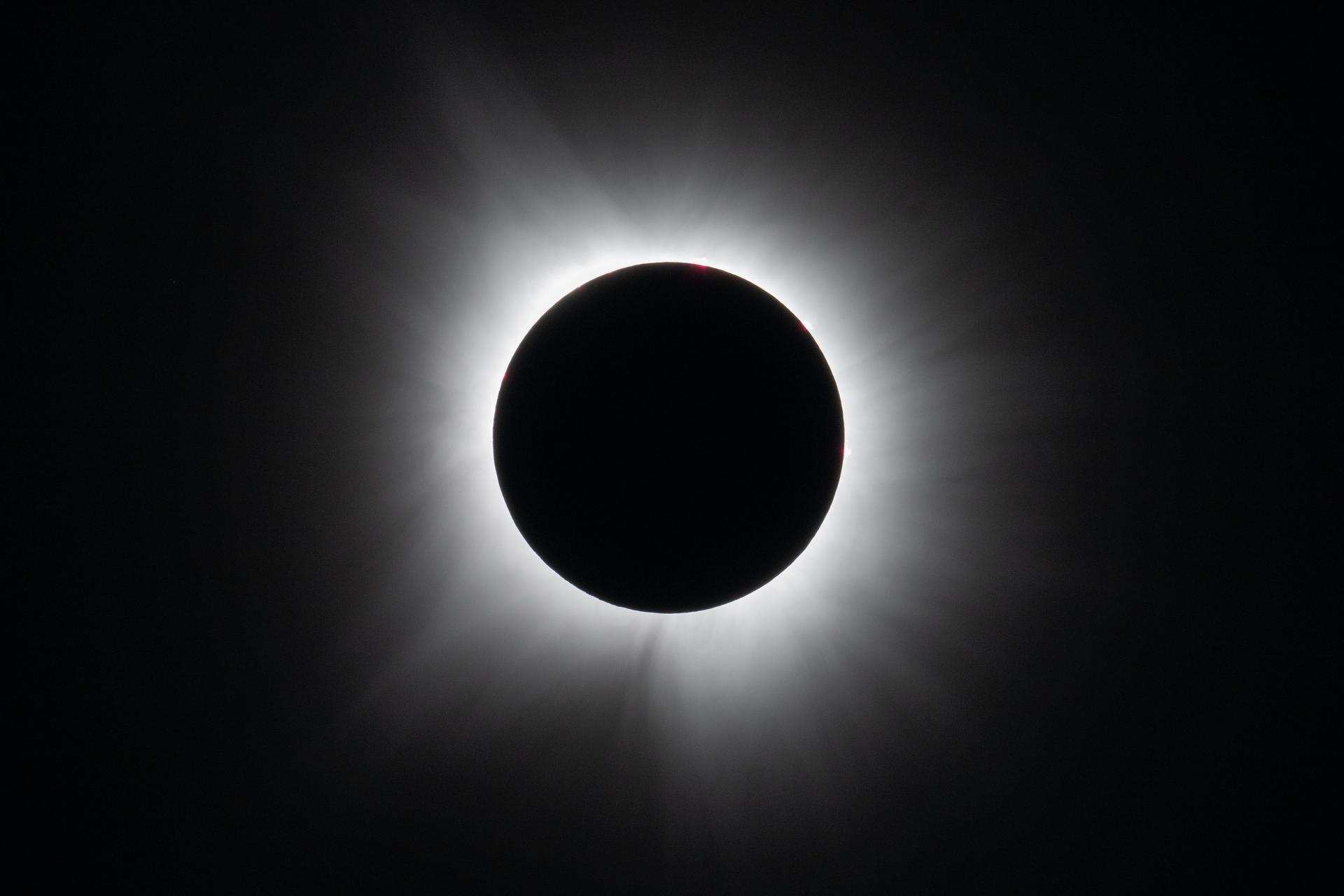
With totality durations of 4-6 minutes depending on your location, the 2027 eclipse offers an exceptionally long window to observe and photograph the corona. During totality, the sky darkens dramatically even though the Sun is high in the sky (unlike the 2026 sunset eclipse). The brighter stars and planets become visible, the temperature drops noticeably, and the solar corona appears as a pearly white halo extending several solar diameters from the Sun. The extended duration means you will have time to observe the corona with your eyes, through binoculars, and through a telescope, as well as capture multiple camera exposures.
The high altitude of the Sun (45-75 degrees depending on location) is a significant advantage for telescopic observation. At high altitude, the atmosphere is much thinner, reducing the turbulence that blurs fine detail. This means you can use higher magnification to observe the corona's intricate structure, including streamers, coronal loops, and possibly prominences at the solar limb. A telescope on a GoTo mount can track the Sun automatically throughout the partial phases and totality, making this an excellent opportunity for both visual observation and photography. For telescope and filter recommendations, see our eclipse glasses guide for the partial phases. For telescopes suitable for eclipse viewing, see our best telescopes for beginners guide.
2026 vs 2027: Which Eclipse Should You Choose?
If you are wondering whether to travel for the August 12, 2026 eclipse or wait for 2027, here is a comparison to help you decide:
| Factor | 2026 (Aug 12) | 2027 (Aug 2) |
|---|---|---|
| Land totality duration | ~70 sec (Spain centreline) | ~4-6 min (Spain to Egypt) |
| Sun altitude | 4-7° (very low, challenging) | 45-75° (high, excellent) |
| Weather prospects | Moderate (coastal cloud risk) | Excellent (dry season, high desert) |
| Access from Europe | Easy (Spain, Iceland) | Easy (Spain) / Moderate (N Africa) |
| Photography ease | Challenging (low Sun, short window) | Easy (high Sun, long window) |
| Crowds expected | High (Spain hotspots) | Moderate (many access points) |
| When to book | Now (June 2026) | Now for best options |
Our advice: Do both if you can. The 2026 eclipse is a dramatic sunset event but short and weather-dependent. The 2027 eclipse is a longer, higher-quality observing experience with much better weather odds. If you can only choose one, 2027 offers the better overall experience. If you are in Europe, the 2026 eclipse is closer and requires less travel. For the 2026 eclipse, see our 2026 Europe eclipse hub for full guides.
Eclipse Glasses & Safety Gear for 2027
ISO 12312-2 certified eclipse glasses are essential for observing all partial phases of the 2027 eclipse, both before and after totality. The Sun will be high in the sky and intensely bright, making proper eye protection absolutely mandatory. Never look at the partially eclipsed Sun without certified glasses, even for a moment. Here are our top recommendations for eclipse glasses and solar filters for the 2027 event:
Helioclipse Solar Eclipse Glasses (12-Pack)
The Helioclipse 12-pack is ideal for families and groups planning to travel to Spain or North Africa for the 2027 eclipse. Each pair is individually tested to ISO 12312-2 and CE certified. The included phone filter allows safe smartphone photography of the partial phases, perfect for capturing the approach to totality. With 12 pairs, you can share with travel companions and still have spares.
Affiliate link.
Lunt Solar Eclipse Glasses (5-Pack)
Lunt Solar Systems is a trusted name in solar optics. Their 5-pack is perfect for couples and small groups travelling to the eclipse path. Individually sealed, ISO 12312-2 and CE certified. The wide frame fits comfortably over prescription glasses. Lunt's metallised polymer filter material provides a neutral white solar image that many observers prefer for its natural colour rendition.
Affiliate link.
For those planning to observe through binoculars or a telescope during the partial phases, a front-mounted solar filter is essential. See our complete solar filter guide for SCT telescopes for detailed recommendations on telescope solar filters for the 2027 eclipse. For a full comparison of all certified eclipse glasses, visit our eclipse glasses guide.
Saros 136: The Historical Significance of the 2027 Eclipse
The August 2, 2027 total solar eclipse belongs to Saros series 136, one of the most historically significant eclipse families. Saros 136 has produced some of the most observed and scientifically important eclipses in modern history. Understanding the Saros cycle adds a deeper layer of appreciation for the 2027 event — you are participating in a sequence of eclipses that occurs every 18 years 11 days, a rhythm that ancient Babylonian astronomers recognised over 2,500 years ago.
Saros 136 began on June 14, 1360 with a small partial eclipse near the South Pole. It will produce a total of 71 eclipses over 1,280 years, ending on July 30, 2622. The series is currently near its peak, producing some of the longest totalities in the 21st and 22nd centuries. Notable members of Saros 136 include the eclipse of July 22, 2009 (the longest totality of the 21st century at 6 minutes 39 seconds, visible from Asia and the Pacific) and the eclipse of August 2, 2027 itself. The next major Saros 136 eclipse after 2027 will occur on August 13, 2045, with a maximum totality of approximately 6 minutes 6 seconds over North America. Each successive Saros 136 eclipse shifts approximately 120 degrees westward in longitude, which is why the 2009 event occurred in Asia, the 2027 event in Europe/Africa, and the 2045 event in the Americas.
What makes Saros 136 special for eclipse chasers is that it is currently in its "prime" — the period when the Earth passes closest to the centre of the Moon's shadow, producing the longest durations. This prime period lasts for several centuries, and we are fortunate to be alive during it. The 2027 eclipse is particularly significant because it offers the best combination of long duration and land accessibility for any Saros 136 eclipse in the 21st century. For historical comparison, the Saros 136 eclipse of July 29, 1878 was observed from the Rocky Mountains of the United States and contributed to early spectroscopic studies of the solar corona. The August 10, 1915 member of this series was observed by Arthur Eddington's team during World War I, though weather hampered their measurements. Each Saros 136 eclipse has advanced our understanding of the Sun, and the 2027 event will be no different.
2027 Eclipse vs. The 1991 Eclipse: A Generational Comparison
The July 11, 1991 total solar eclipse was one of the most significant astronomical events of the late 20th century, with a maximum totality of 6 minutes 53 seconds — the longest until 2027. The path crossed Hawaii, Mexico, Central America, Colombia, and Brazil. For many astronomers and eclipse chasers active today, 1991 was the defining eclipse of their lives. A comparison between 1991 and 2027 reveals fascinating parallels and important differences:
| Factor | 1991 (July 11) | 2027 (August 2) |
|---|---|---|
| Maximum totality | 6 min 53 sec | 6 min 23 sec |
| Land accessibility | Hawaii, Mexico, Colombia | Spain, N Africa, Egypt, Saudi Arabia |
| Sun altitude | ~80° (Hawaii), excellent | 45-75°, very good to excellent |
| Weather prospects | Moderate (Hawaii rain shadow) | Excellent (dry season Mediterranean) |
| Travel from Europe | Long-haul (10+ hours flight) | Short-haul (2-3 hours to Spain) |
| Saros series | Saros 136 (same as 2027) | Saros 136 |
| Digital photography | Film era (limited) | Full digital, smartphone, video |
The 1991 eclipse was the last great eclipse of the film photography era. Observers in Hawaii captured some of the most iconic eclipse images ever taken, using Kodachrome and Fujichrome film that required careful metering and bracketing. The 2027 eclipse, by contrast, occurs in an era of digital cameras, smartphone astrophotography, and live streaming. The technological context is one of the most striking differences — in 1991, few people had access to auto-guiding telescopes or real-time image processing. Today, affordable GoTo mounts, planetary cameras, and stacking software put professional-quality eclipse photography within reach of amateur astronomers. For tips on capturing the 2027 eclipse, see our eclipse travel and photography guide.
2027 Eclipse Weather Analysis: Where to Go for Clear Skies
Weather is the single biggest variable in eclipse observing, and the 2027 eclipse benefits from occurring during the height of the dry season across almost its entire land path. Unlike the 2026 eclipse (which occurs at sunset with low-altitude cloud risks), the 2027 eclipse takes place in the late morning with the Sun high in the sky, giving you a shorter atmospheric path and less susceptibility to horizon cloud. Here is a detailed weather analysis for each major region along the path of totality, based on historical satellite data from the European Centre for Medium-Range Weather Forecasts (ECMWF) and national meteorological agencies:
Southern Spain (Seville, Cadiz, Gibraltar)
Southern Spain has the best weather of any European eclipse destination in summer. The average cloud cover at 11:00 local time on August 2 in Seville is approximately 25-30%, meaning a 70-75% chance of clear or mostly clear skies. The region is influenced by the Azores High pressure system, which typically brings stable, dry conditions in July and August. The main weather risk is the Calima — suspended Saharan dust that can create a hazy sky even when technically "clear." However, the Calima is more common in winter and spring than in August. Gibraltar's proximity to the Strait of Gibraltar can create local cloud formations due to the Levanter wind, but these typically dissipate by mid-morning. The best locations in Spain are inland (Seville, 30-50 km from the coast) where sea breeze effects are minimised.
Morocco (Tangier, Rabat, Casablanca)
Morocco's Atlantic coast has a slightly higher cloud risk than inland areas due to morning coastal fog (the "camanche" in Arabic). Historical data shows that Tangier has a 30-35% cloud cover probability at 11:00 local time in August, with most of that being thin coastal stratocumulus that typically burns off by 09:00. The best strategy in Morocco is to choose a location 30-50 km inland from the coast, where the fog influence is negligible. The foothills of the Rif Mountains offer excellent viewing sites with clear skies, elevated perspectives, and dramatic landscapes. The region around Chefchaouen and the Talassemtane National Park provides both guaranteed clear skies and stunning natural scenery.
Algeria, Tunisia & Libya
The North African coastal strip from Algiers through Tunis to Tripoli has some of the best weather prospects on the entire eclipse path. August is the peak of the Mediterranean dry season, and historical satellite data indicates less than 20% average cloud cover at 12:00 local time across this region. Inland areas (50-100 km from the coast) approach 5-10% cloud cover, making them among the most reliable locations on Earth for eclipse viewing. The Sahara Desert, which begins just south of the coastal cities, offers virtually guaranteed clear skies, though travel logistics become more challenging. For eclipse chasers prioritising weather certainty above all else, the desert regions of southern Tunisia or northern Algeria are the optimal choice.
Egypt & Saudi Arabia
Egypt's Mediterranean coast (including Alexandria) benefits from the same dry summer pattern as the rest of North Africa, with 15-20% cloud cover probabilities. The Nile Delta region has a slight risk of morning haze due to evaporation from the river and irrigation canals, but this typically clears by 09:00. The best viewing locations in Egypt are west of Alexandria along the Mediterranean coast or south toward the desert where humidity drops sharply. Saudi Arabia's portion of the path covers the Medina region and the Red Sea coast, where August cloud cover is typically below 10%. The desert climate guarantees virtually cloud-free conditions, though the extreme heat (40-45°C) requires careful planning and hydration. The high altitude of the Sun in North Africa (60-75 degrees) means you are looking through minimal atmosphere, providing the sharpest possible telescopic views of the corona.