Common Beginner Mistakes at the $200 Level
Most disappointing first sessions with a $200 telescope are caused by user error, not equipment failure. Here are the five most common beginner mistakes and how to avoid them.
1. Using the highest magnification first. The 10mm eyepiece (often labeled as "high power") and the Barlow lens that came with your scope are not where you should start. Begin every session with your lowest-power eyepiece (largest number in mm). Find your target at low power, center it, focus it, and only then increase magnification if the image remains sharp.
2. Not letting the telescope cool down. A telescope brought from a warm house into cold night air needs 10 to 20 minutes to reach thermal equilibrium. During this time, tube currents inside the scope distort the image. Set up your scope, then go inside for 15 minutes. When you return, the views will be noticeably sharper.
3. Observing over rooftops or pavement. Buildings and pavement radiate heat absorbed during the day, creating rising air currents that destroy fine detail. Set up on grass or dirt whenever possible, and avoid pointing your scope over a neighbor's roof or a parking lot.
4. Not checking collimation on reflectors. If you own a Newtonian reflector (including tabletop Dobsonians), the mirrors can shift during transport. A two-minute collimation check before each session using a simple Cheshire eyepiece or laser collimator transforms soft, blurry images into sharp, detailed ones.
5. Trying to observe too many targets in one night. A satisfying session at this budget typically involves 3 to 5 targets observed over 60 to 90 minutes. Spending 15 to 20 minutes on a single object, using averted vision and varying magnification, reveals far more detail than rushing through a checklist of 15 targets where each one is barely glimpsed. The human eye-brain system needs time to adapt to low light levels and learn to extract subtle contrast from faint astronomical objects. After 15 minutes on a single globular cluster, you will typically notice structure that was invisible in the first 30 seconds. This improvement is not imagination — it is how the visual system accumulates contrast information over time under low-light conditions, and it is one of the fundamental skills that separates experienced observers from beginners using the same equipment.
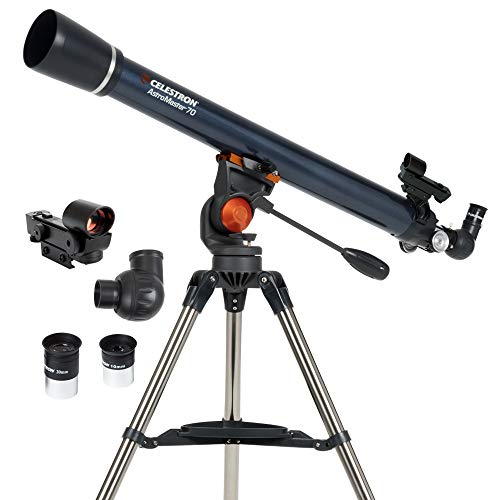
The best $200 telescope is the one that gets used. A Heritage 130P that sits on a shelf gathers zero photons. An AstroMaster 70AZ set up on the patio three nights a week reveals craters, rings, moons, and clusters that most people never see with their own eyes. At this budget, consistency of use matters far more than marginal differences in optical quality. Choose the scope that fits your space, your patience, and your schedule, and use it as often as the sky allows.