How does the Dwarf 3 compare to the Seestar S50?
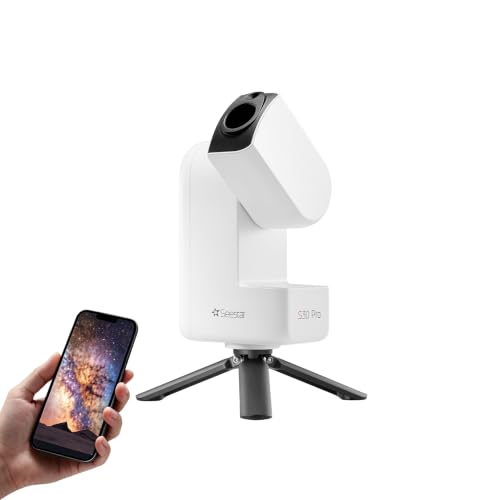
The S50 is discontinued and replaced by the S30 Pro. Compared to the S30 Pro, the Dwarf 3 has a higher-resolution 48MP sensor and is more portable. The S30 Pro has a larger 50mm aperture for fainter deep-sky targets. The Dwarf 3 offers better value for most buyers.
Can the Dwarf 3 see Saturn's rings?
Yes, but the view is small. The Dwarf 3's telephoto lens provides roughly 90× equivalent magnification — enough to show Saturn's rings as resolved from the planet, but not enough for detail like the Cassini Division. For serious planetary observing, a traditional telescope is much better.
Is the Dwarf 3 good for beginners?
Yes — it is one of the best beginner smart telescopes. Setup takes 3 minutes, the app guides you through everything, and the results on bright nebulae are impressive from night one. No astronomy experience is required.
What is the battery life of the Dwarf 3?
The Dwarf 3 has a built-in rechargeable battery that lasts 4–5 hours of continuous use. This is enough for a full evening session. Charging via USB-C takes approximately 2 hours.
Can I use the Dwarf 3 without Wi-Fi?
The Dwarf 3 creates its own Wi-Fi network that your phone connects to directly. Internet is not needed during observing. The internal database contains all target coordinates. App downloads and firmware updates require internet before your first session.
What accessories should I buy with the Dwarf 3?
The most impactful accessories: (1) A sturdy photo tripod with a 1/4-inch screw — the included tabletop tripod is adequate but a full-size tripod improves stability. (2) A USB-C power bank for extended sessions beyond the 4–5 hour battery. (3) A dew shield for humid nights — the lens can fog in damp conditions. (4) A protective hard case for travel. (5) A microSD card for expanded storage beyond the 128 GB internal.
How long does it take to set up the Dwarf 3?
Approximately 3 minutes from cold start to first image. Place the Dwarf 3 on a flat surface, power it on (hold the button for 2 seconds), connect your phone to its Wi-Fi network, open the DWARFLAB app, and tap a target. The automatic plate-solving identifies its position within 30–60 seconds. No tools, no assembly, no collimation, no star names needed. This is the fastest setup of any smart telescope on the market.
How does the Dwarf 3 compare to the Vaonis Vespera II?
The Vespera II is more refined — better app (Gravity), larger aperture (50mm), built-in solar filter, and more polished industrial design. However, the Vespera II costs significantly more (~$1,900 vs ~$500 for the Dwarf 3). The Dwarf 3 offers comparable 48MP resolution in a smaller, more portable package. The Vespera II is better for faint deep-sky and solar observing; the Dwarf 3 offers better value and portability. For most beginners, the Dwarf 3 is the smarter choice.
Can I do astrophotography with the Dwarf 3?
Yes — that is exactly what the Dwarf 3 is designed for. It produces stacked deep-sky images of bright nebulae and galaxies that are suitable for social media, personal enjoyment, and entry-level astrophotography. The live-stacking engine handles the image processing automatically. The 48MP sensor produces images that hold up well to cropping. Limitations: 30-second max exposures mean faint targets are challenging, and the alt-az mount produces field rotation in stacks longer than 30 minutes. For serious long-exposure astrophotography, an equatorial mount is required.
Is the Dwarf 3 worth the upgrade from the Dwarf Mini?
Yes, for most users. The Dwarf 3 offers: 4× higher resolution (48MP vs 12MP), a second wide-angle camera, internal battery (vs external battery pack on the Mini), double the storage (128 GB vs 64 GB), and faster processing. The Dwarf Mini remains a valid entry point at its lower price, but the Dwarf 3's improvements — especially the dual-camera system and battery life — justify the upgrade for anyone who can afford it. See our full Dwarf Mini review for the detailed comparison.
Can the Dwarf 3 image galaxies?
Yes — the Dwarf 3 images the brightest galaxies effectively with live stacking. M31 (Andromeda) shows dust lanes after 10 minutes. M81/M82 (Bode's / Cigar) show structure under dark skies. M51 (Whirlpool) spiral arms are visible from Bortle 4 or darker. M104 (Sombrero) shows the central bulge and dust lane. Fainter galaxies (M101, M100) require very dark skies and 15+ minute stacking. The 24mm aperture is the limiting factor — the S30 Pro's 50mm aperture reaches fainter galaxies more easily.
What is the limiting magnitude of the Dwarf 3?
The Dwarf 3's 24mm aperture reaches approximately magnitude 8–9 for visual-equivalent detection with live stacking. This means it can capture all Messier objects down to about magnitude 7 reliably, and some brighter NGC objects to magnitude 8–9 under good skies. By comparison, the Seestar S30 Pro (50mm aperture) reaches about magnitude 10–11. For the brightest Messier objects (M42, M31, M13, M57, M27, M45), the Dwarf 3 produces excellent results within 5–15 minutes of stacking.
Does the Dwarf 3 need a tripod?
The Dwarf 3 includes a small tabletop tripod that works well on flat surfaces. For backyard use, a full-size photo tripod with a 1/4-inch screw is recommended for stability, especially in wind or when imaging near the zenith. The Dwarf 3's lightweight design means any standard photo tripod works well. A tripod height of 40–60 inches is ideal for standing observation. The built-in leveling feet on the Dwarf 3 base make alignment quick on any tripod.