Telescope Advisor Logo Telescope Advisor
Partial solar eclipse progression sequence showing the Moon crossing the solar disk — similar to what New York City will see on August 12, 2026

City Eclipse Guide · New York City · August 12, 2026

New York City Eclipse 2026: Partial Solar Eclipse Times & Viewing Guide

New York City will see a partial solar eclipse on the afternoon of August 12, 2026, with approximately 20% of the Sun covered by the Moon at peak. The eclipse runs from 12:28 PM to 3:32 PM EDT, giving New Yorkers over three hours to observe. The Sun is high in the sky — no special horizon required — and any rooftop, park, or open area will work. Eclipse glasses are essential at all times: even at 20% coverage, the Sun remains dangerously bright.

Maximum coverage~20%
Maximum time~2:02 PM EDT
Duration~3 hrs 4 min
TimezoneEDT (UTC−4)
By Telescope Advisor Editorial Team Published: Updated: Editorial Standards

NYC Eye Safety Warning — Eclipse Glasses Required

Never look directly at the Sun without ISO 12312-2 certified eclipse glasses. This applies at all times during the partial phases. At 20% coverage, the remaining 80% of the Sun is still fully exposed and can cause permanent retinal damage in seconds. The relatively low coverage does not make it safer to look without protection. See our best eclipse glasses guide for certified products available in the US.


Quick Answer: Will New York City See the 2026 Solar Eclipse?

Yes. New York City will see a partial solar eclipse on August 12, 2026, running from approximately 12:28 PM to 3:32 PM EDT. At maximum coverage around 2:02 PM EDT, roughly 20% of the Sun's diameter will be obscured by the Moon. The Sun will appear as though someone took a noticeable bite out of its upper limb. This event is visible from anywhere in New York City with an open view of the sky — the Sun is high (around 55° altitude at maximum), so no horizon access is needed.

Eclipse glasses are essential. Even at 20% coverage, the Sun is many thousands of times brighter than safe viewing levels. The naked eye cannot perceive the partial phase without filtered viewing; without eclipse glasses, the Sun looks completely normal even though 20% is covered.

The real eclipse experience on August 12 is in Europe — the path of totality crosses northern Spain, giving cities like Bilbao and Zaragoza up to 2 minutes of total darkness. New York City's 20% partial is a modest but genuine astronomical event, worth catching with solar binoculars or eclipse glasses during the lunch or early afternoon break.

Naked eye (with eclipse glasses)

You'll see a clear "bite" shape taken from the Sun's upper disk. The overall brightness of the daylight barely changes at 20% — you won't notice sky darkening.

Solar binoculars (best tool)

The crisp lunar limb — the Moon's razor-sharp edge cutting across the Sun — becomes clearly visible. Sunspots along the solar disk may also be visible.

Solar telescope / filtered scope

Maximum detail — the progression of the Moon's limb across solar surface features. Any telescope with an ISO-certified solar filter works. Solar filter guide →

New York City Eclipse Times — August 12, 2026 (EDT)

All times below are in Eastern Daylight Time (EDT = UTC−4). The eclipse takes place entirely in the afternoon — a convenient window for most New Yorkers. The three-hour duration means that even with a 30-minute cloudy break, you will likely catch clear views during part of the event.

Event Time (EDT) Sun Altitude Coverage Notes
First contact (C1) ~12:28 PM EDT ~58° 0% — Moon begins crossing solar disk Start wearing eclipse glasses now
Maximum eclipse ~2:02 PM EDT ~55° ~20% — deepest coverage Best time to observe with solar binoculars
Last contact (C4) ~3:32 PM EDT ~47° 0% — Moon fully exits solar disk Eclipse complete; safe to remove glasses

Times are approximate for midtown Manhattan. Outer boroughs vary by less than 1 minute. Verify exact times for your precise location using NASA's eclipse explorer or TimeandDate.com.

New York vs the rest of the world on August 12, 2026

While NYC sees a modest 20% partial, the total solar eclipse passes through northern Spain the same day — cities like Bilbao, Burgos, and Zaragoza experience complete totality. The UK sees 87–92% partial at sunset. If you're in New York and want a more dramatic eclipse experience, the next total solar eclipse reachable from the US East Coast will be August 2044 (crossing the northern US states and Canada). The partial view from NYC on August 12 is your nearest opportunity to observe this generation's great European eclipse from American soil.

What Does 20% Solar Coverage Actually Look Like?

Many first-time eclipse observers expect dramatic sky changes at any coverage percentage. The reality at 20% is more subtle — but still visually striking with the right equipment and expectations.

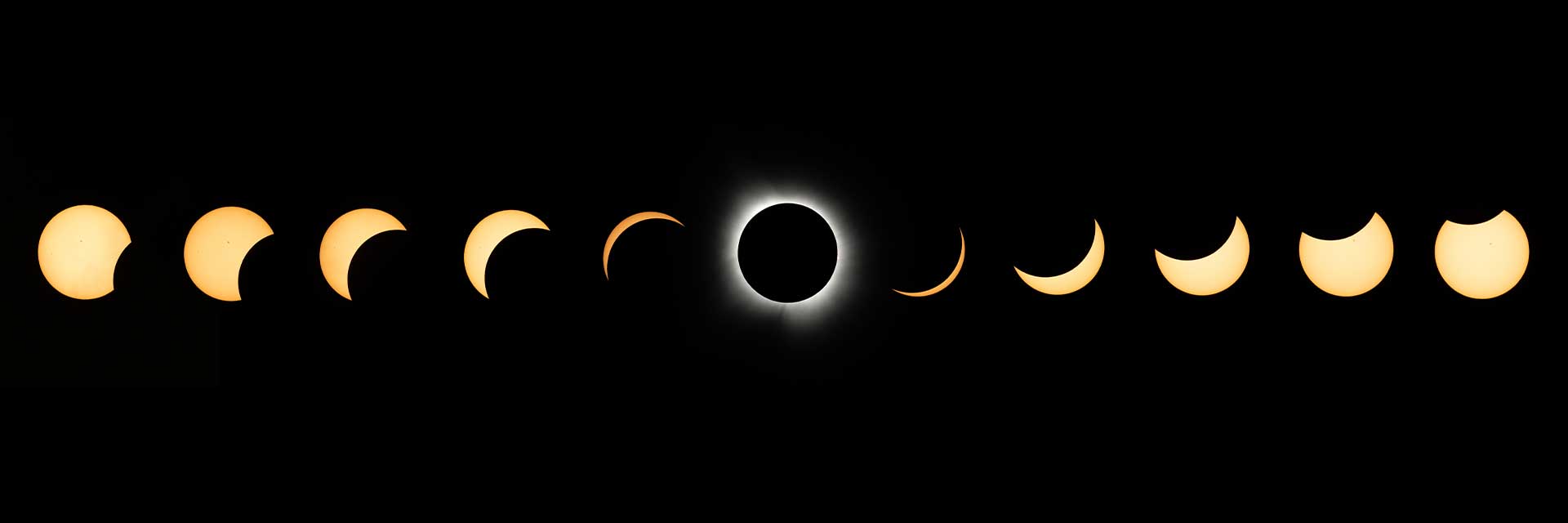
Solar eclipse progression showing partial phases — from first contact to maximum and back to final contact

Partial Solar Eclipse Progression

The Moon moves across the solar disk during the partial phases. At 20% coverage, roughly one-fifth of the Sun's diameter is covered — creating a distinctive crescent or "bite" shape. Credit: NASA.

What you will notice

  • A clean crescent-shaped "notch" in the upper limb of the Sun, visible through eclipse glasses
  • The Moon's edge — called the limb — is sharper than the Sun's because the Moon has no atmosphere to blur it
  • Through solar binoculars: the gradual progression of the limb across the solar disk, possibly crossing sunspot groups
  • No sky darkening — at 20% coverage, ambient daylight decreases by only a few percent, not enough for human perception

What you will NOT notice without equipment

  • Sky darkening (needs 90%+ coverage)
  • Temperature drop (needs 70%+ coverage over a sustained period)
  • Animals reacting (needs 90%+ coverage)
  • Stars appearing in daytime (requires totality only)

Is 20% coverage worth watching from New York?

Yes — with appropriate expectations. The experience through solar binoculars is genuinely interesting: watching the Moon's precise geometric edge slide across the Sun's disk is a reminder that these are real, massive objects in precise orbital motion. NYC schoolchildren, science enthusiasts, and astronomy clubs regularly hold viewing events for partial eclipses at much lower coverage percentages than 20%. The three-hour duration gives you flexibility that total eclipses never offer. If the June clouds clear for even 10 minutes around 2 PM, you'll see the peak.

Best NYC Viewing Locations — August 12, 2026

Unlike a sunset or sunrise eclipse, the August 12 event occurs with the Sun high in the sky (~55° altitude at maximum). This means you do not need a horizon view — any open area where you can see the southern sky will work. No need to travel to a waterfront for this one.

Brooklyn Bridge Park

Wide open sky across the East River, excellent southern exposure. The Manhattan skyline creates a dramatic urban backdrop for eclipse photography. Easily accessible via subway or bike.

Sun direction at 2 PM: South-southwest, ~55° altitude

Central Park Great Lawn

NYC's largest open sky expanse. No buildings interrupt the broad southern sky. Astronomy clubs frequently host events here. Bring a blanket and lie back while watching through eclipse glasses.

Best for group viewing and relaxed observation

The High Line (various points)

Elevated above street level with excellent sky access. The open-air nature and unobstructed southern sky make it one of Manhattan's best eclipse spots. Pre-book nearby lunch for a complete afternoon plan.

Sun visible from most sections; south-facing benches ideal

Governors Island

Ferry ride from lower Manhattan. Once on the island, the wide open sky with views of both the Manhattan skyline and New York Harbor creates a spectacular visual context. The American Museum of Natural History or local astronomy clubs may organize viewing events here.

Ferry schedule: check Governors Island official site

Rooftop access (apartment buildings)

For residents with rooftop access, this is the easiest NYC eclipse viewing spot. Most Manhattan and Brooklyn rooftops have unobstructed southern sky access. No travel required — just step upstairs at noon.

Ideal for individuals and small groups with existing rooftop access

Hudson River Park (any point)

The Hudson River waterfront runs from Battery Park to 59th Street, offering continuous open sky access along the western side of Manhattan. The Intrepid Sea, Air & Space Museum at Pier 86 may host eclipse programming.

Great combination of sky access and shade structures

NYC tip: reserve eclipse glasses in advance

In the weeks before August 12, NYC science museums, libraries, and astronomy clubs often distribute free eclipse glasses. The American Museum of Natural History and the New York Hall of Science are good sources. Online availability on Amazon remains reliable until about two weeks before the event — order early as stock traditionally runs low closer to eclipse day.

NYC August Weather and Cloud Risk

New York City in August is hot and humid, with afternoon thunderstorms being one of the most common weather disruptions. Understanding the risk helps you plan smart.

Average cloud cover

August afternoons in NYC average ~45-50% cloud cover based on historical NWS data. This is higher than morning hours, driven by afternoon convective development (heat-driven cloud building).

Thunderstorm risk

August is NYC's peak afternoon thunderstorm month. However, these storms are typically brief (30–60 minutes) and localized. Even on stormy days, the cloud cover often breaks before and after the storm cell passes.

Your advantage: 3-hour window

The eclipse runs from 12:28 PM to 3:32 PM EDT — three hours. Even with a 45-minute storm interruption, you'll have plenty of time to observe. The three-hour window is the biggest advantage the NYC partial has over the 2-minute totality window in Spain.

Strategy if August 12 is cloudy in NYC

  • Watch NWS hourly forecast the morning of August 12 — convective storms often have narrow windows
  • NASA and various science channels will stream the European totality live online — a great fallback for the main event
  • If you can drive 60–90 miles on the morning of August 12, check radar for clearer zones within range (south NJ coast, eastern Long Island, Hudson Valley can have different conditions)

Photography Tips — NYC Eclipse August 12, 2026

The NYC partial eclipse offers unique photographic opportunities that most eclipse guides never cover: the combination of a partially eclipsed Sun with one of the world's most recognizable skylines. The high Sun altitude (55°) means you'll need a wide-angle or tilt composition to include both the Sun and a distinctive NYC landmark.

Smartphone photography

  • ✓ Use a solar filter sheet over your phone camera lens (not just eclipse glasses)
  • ✓ Pro/manual mode: ISO 100, 1/2000–1/8000 second shutter
  • ✓ Include the Brooklyn Bridge, Empire State Building, or Manhattan skyline for context
  • ✓ Take a series at 15-minute intervals to capture the Moon's progression

DSLR / mirrorless camera

  • ✓ Baader or similar solar filter sheet on lens front element — essential
  • ✓ 200–400mm telephoto for close shots of eclipse disk alone
  • ✓ 24–50mm wide-angle for NYC skyline compositions
  • ✓ ISO 100, f/8, 1/1000 to 1/4000 seconds — bracket several exposures
  • ✓ Mirror lock-up or electronic shutter for telephoto stability
Composition idea: From Brooklyn Bridge Park, shoot east-to-northwest with a 24mm lens at ~2:00 PM. The Manhattan skyline sits at roughly the right angle to create a composition with the eclipsed Sun visible above the midtown skyline. The crescent Sun above the Empire State Building is an iconic opportunity.

Eclipse Glasses & Solar Viewing Gear

ISO 12312-2 certified eclipse glasses are the essential item for this event. They reduce the Sun's brightness to safe, comfortable viewing levels while showing the partial phase clearly. The following products are certified, available in the US, and suitable for the August 12 NYC event.

Top Pick — Best Value for Groups
Helioclipse ISO 12312-2 certified eclipse glasses 12-pack — safe for direct solar viewing during the NYC eclipse

Helioclipse Eclipse Glasses — 12 Pack

ISO 12312-2 certified, black polymer filter technology. Each pair blocks 99.999% of visible light and all harmful UV/IR radiation while delivering a clear orange-tinted view of the solar disk. The 12-pack is ideal for families, school groups, or office viewing parties — and excellent value per pair. Suitable for children and adults alike.

ISO 12312-2 certified 12-pack Black polymer filter
Celestron EclipSmart 12x50 solar observing binoculars — safe for direct Sun viewing during partial eclipse

Celestron EclipSmart 12×50 Solar Binoculars — Best optical experience

Solar-safe binoculars with built-in ISO 12312-2 compliant filters — no separate eclipse glasses needed over the eyepieces. At 12× magnification, the Moon's edge cutting across the solar disk is clearly defined and stunning. The 50mm objective gathers enough light through the solar filter for a bright, satisfying view. Far more immersive than naked-eye eclipse glasses, and safe enough to hand to anyone.

Lunt Solar Systems ISO 12312-2 eclipse glasses 5-pack

Lunt Solar Eclipse Glasses — 5 Pack — Premium brand

Lunt Solar Systems is one of the most respected names in dedicated solar observing equipment. Their eclipse glasses use premium black polymer filter film — the same optical-grade material used in Lunt's professional solar telescopes. A step up in optical quality from budget glasses; the Sun appears sharper and with better color rendition. The 5-pack suits smaller family groups.

Affiliate links — we may earn a small commission at no extra cost to you. Only ISO 12312-2 certified glasses are listed. See our full eclipse glasses guide for more options and inspection guidance.

New York City Eclipse 2026 — FAQ

What time is the solar eclipse in New York City on August 12, 2026?

The partial solar eclipse begins in New York City at approximately 12:28 PM EDT (first contact) and ends at approximately 3:32 PM EDT (last contact). Maximum coverage of about 20% occurs around 2:02 PM EDT. The Sun is high in the southern sky (~55° altitude) during the entire event — no special location is needed, just an open view of the sky.

Do I need eclipse glasses to watch the NYC eclipse?

Yes, absolutely. Eclipse glasses are required at all times during the partial eclipse. At 20% coverage, the remaining 80% of the Sun is still in full view and dangerous to look at without certified solar filters. ISO 12312-2 eclipse glasses reduce the Sun to a safe, comfortable viewing brightness. Never look at the partially eclipsed Sun with sunglasses, camera filters, smoked glass, or any non-certified filter.

Will the sky get dark in New York City during the 2026 eclipse?

No. Sky darkening requires 90% or more solar coverage — NYC's 20% coverage will not produce any perceptible change in ambient daylight. The day will look completely normal to anyone without eclipse glasses. Only observers using eclipse glasses or solar binoculars will notice the partial phase. Compare this to the 1999 or 2017 totality experiences, where darkness fell for a minute or two during the total phase.

Where is the best place in NYC to watch the eclipse?

Because the Sun will be high overhead (around 55° altitude) rather than near the horizon, you don't need a waterfront location. Any open area — Central Park Great Lawn, Brooklyn Bridge Park, the High Line, any rooftop with open sky — works perfectly. The main requirement is an unobstructed view of the southern sky. Avoid locations shadowed by tall buildings to the south.

How is the NYC eclipse different from the one happening in Europe?

The same Moon passes in front of the same Sun on August 12 — but the path of the Moon's central shadow (the umbra) sweeps through northern Spain, Iceland, and Greenland, not North America. Cities in that path see totality — complete darkness for up to 2 minutes 20 seconds. NYC and the US East Coast lie outside the umbra and see only a partial eclipse at 20% coverage. The partial view from NYC is a genuine glimpse of the same astronomical event, just from a different geometric angle.

Can I watch the eclipse through a regular telescope from NYC?

Yes — but you must use an ISO-certified solar filter over the telescope's objective (front lens or mirror). Looking at the Sun through an unfiltered telescope will cause immediate, permanent blindness. A Celestron EclipSmart or Baader film solar filter suitable for your telescope's aperture is required. With a solar filter in place, a telescope shows excellent detail: the sharp lunar limb crossing sunspot groups is a memorable sight even at 20% coverage.

Will the Perseid meteor shower affect eclipse viewing from NYC?

The Perseid meteor shower also peaks around August 11–13, but Perseids are only visible at night — and the NYC eclipse is a daytime event. The two events are entirely separate viewing experiences. If you plan to watch the eclipse in the afternoon and then stay up for Perseids overnight, you'll have an extraordinary 24-hour astronomy experience. See our Perseid guide for overnight viewing tips.

Where can I find eclipse events in New York City?

The American Museum of Natural History, Brooklyn Space, New York Hall of Science, and numerous NYC astronomy clubs typically organize eclipse viewing events. The NYC astronomy clubs directory lists active groups that often host public viewing events for solar eclipses, complete with loaner eclipse glasses and solar telescopes.

Related Eclipse & Sky Guides