
The Honest Truth: What Andromeda Actually Looks Like Through a Telescope
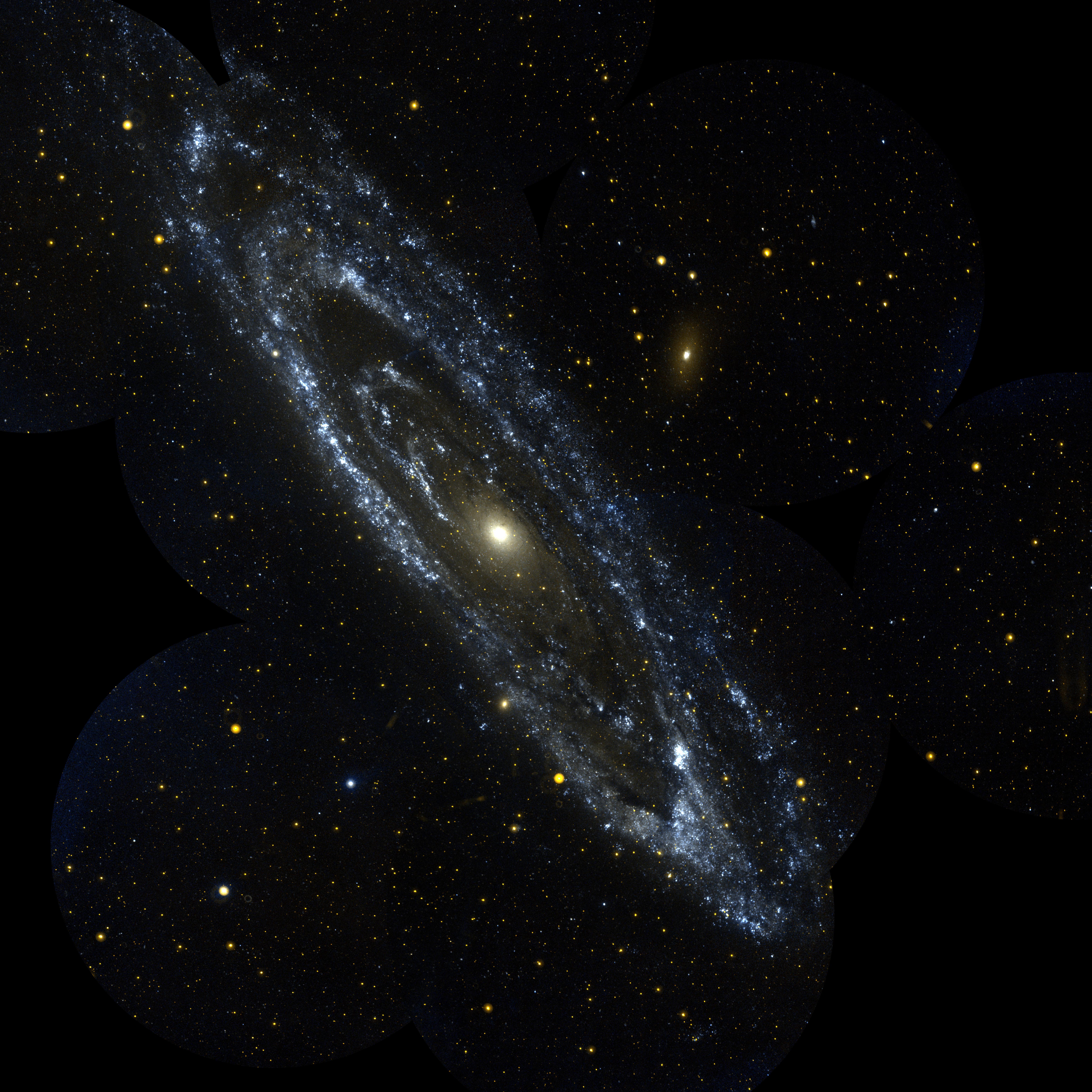
This is the most important section of this guide, because Andromeda looks nothing like the NASA photos. Every published image of M31 is a long-exposure stacked composite that reveals colors, dust lanes, and spiral structure our eyes cannot see in real-time. Managing expectations is the difference between being underwhelmed and being genuinely awestruck.
Naked Eye (dark skies)
A fuzzy, elongated smudge about the apparent size of your thumb at arm's length. It genuinely looks like a small cloud — soft-edged, clearly non-stellar. On excellent nights from Bortle 2–3 skies, the outer halo extends surprisingly far. This is the most distant object you will ever see with your unaided eye — worth pausing to reflect on.
Binoculars (10×50 or 15×70)
A soft, bright oval core surrounded by a large, dim halo. The two companion galaxies M32 (a compact elliptical just 0.4° south) and M110 (a larger diffuse elliptical 0.7° northwest) become obvious. The overall view is beautiful — a classic galaxy trio in one field. This is arguably the best view of M31 available.
Telescope (4–12 inch)
Paradoxically, M31 can be harder to appreciate through a telescope than binoculars. Its angular size (6°) exceeds most telescope fields of view, so you see only the bright central core — bright, oval, structureless at low power. At higher magnification and larger aperture (8-inch+), subtle dust lane structure along the edge becomes hintable under excellent seeing.
The paradox of M31 with a telescope
Because M31 spans roughly 6° × 1.5° in the sky — much larger than most telescope eyepiece fields — a wide-field instrument with the lowest possible magnification gives the best view. The ideal M31 telescope is a rich-field refractor with a wide 2" eyepiece at 20–30×, or more practically, a pair of 10×50 or 15×70 binoculars. Traditional high-magnification planetary telescopes (long focal lengths, SCTs, Maksutovs) are the worst tools for M31 because they show only the core with no context. Short-focal-length Dobsonians and rich-field refractors are best.