
How to See the Pinwheel Galaxy (M101) Through a Telescope — Complete Guide
Telescope Advisor Logo Telescope Advisor
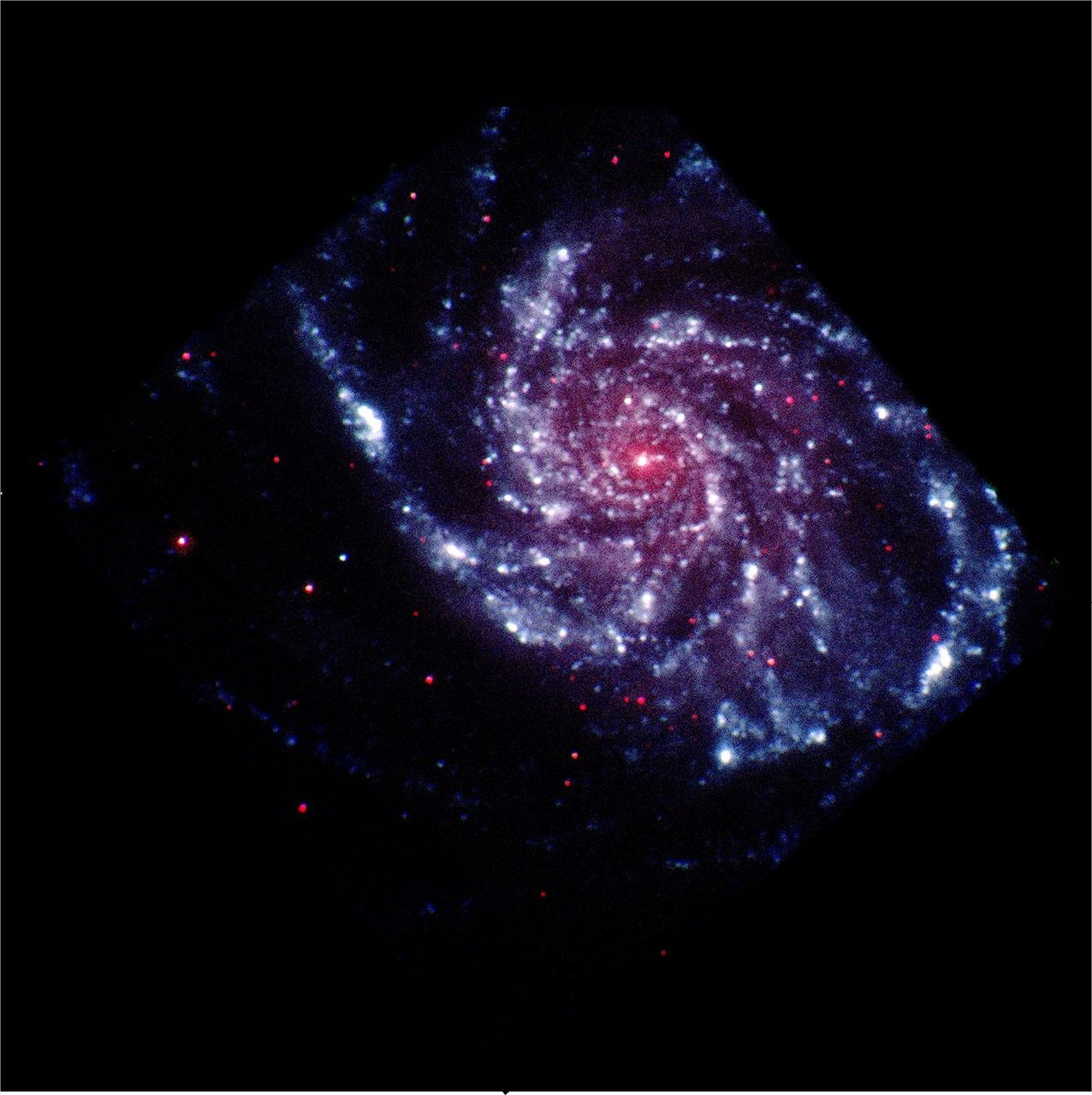
The Pinwheel Galaxy M101 captured by the Swift observatory — a large face-on spiral galaxy near the Big Dipper

Observing Guide · Spiral Galaxy

How to See the Pinwheel Galaxy (M101) Through a Telescope

M101, the Pinwheel Galaxy, is one of the largest and brightest face-on spiral galaxies in the northern sky — spanning 27 arcminutes, nearly the size of the full Moon. Discovered by Pierre Méchain in 1781, this beautiful galaxy in Ursa Major is a showcase of spiral structure, with well-defined arms traced by bright star-forming regions. This guide covers everything you need to observe M101.

Object typeFace-on spiral galaxy
Apparent magnitude7.9
Best seasonMarch – August
Min. aperture80mm sees the core
By Elena ReyesPublished: Updated: Reviewed & approved by Juhi Sahni, Senior Editor Editorial Standards

Quick Answer: What Telescope Do I Need for the Pinwheel Galaxy?

The Pinwheel Galaxy is visible in any telescope with at least 80mm (3-inch) aperture under dark skies, and its bright core is detectable in 15×70 binoculars. At magnitude 7.9, M101 is one of the brighter Messier galaxies, but its large size (27 arcminutes) spreads its light over a wide area, giving it a low surface brightness. Through a 100mm refractor at 40–50×, M101 appears as a large, diffuse glow with a slightly brighter centre. A 150mm (6-inch) scope at 60–80× reveals the galaxy's circular shape and hints of patchy structure. An 8-inch (200mm) Dobsonian at 80–100× shows the bright core and the beginnings of spiral arms as arcs of uneven brightness around the nucleus.


🔭

Not sure which telescope actually fits your goals?

Answer 5 quick questions about your budget, observing targets, and experience level — our Telescope Finder Tool recommends a specific model in under 2 minutes.

Find My Telescope →

How to Find M101 in Ursa Major

M101 is located in the constellation Ursa Major, about 5.5 degrees east-northeast of the star Alkaid (Eta Ursae Majoris), which marks the end of the Big Dipper's handle. The easiest approach: find the Big Dipper high overhead in spring and summer evenings, locate Alkaid at the tip of the handle, then sweep about 5.5 degrees east (away from the handle). In a finder scope at low power, M101 appears as a large, diffuse patch of light — notably larger and fainter than nearby M51.

M101 is best observed from March through August, when Ursa Major is high overhead for northern hemisphere observers. The constellation culminates around midnight in April. Because of its low surface brightness, M101 is strongly affected by light pollution — it is a completely different object under Bortle 3 skies than Bortle 5. For the best view, observe on a moonless night from the darkest sky you can reach.

What M101 Looks Like Through Different Apertures

InstrumentBest MagnificationWhat You'll See
15×70 binoculars15×Large, faint, diffuse glow. Requires dark skies. No detail, but position confirmed.
100mm (4") refractor40–50×Large diffuse oval glow with a brighter centre. Very low contrast. Averted vision essential.
150mm (6") reflector60–80×Large round glow with uneven brightness. Core distinctly brighter. Hints of spiral arms.
200mm (8") Dobsonian80–100×Bright core with spiral arms visible as arcs. Star-forming regions (HII knots) detectable as tiny bright patches along arms.
300mm (12")+100–150×Spiral arms well-traced. Multiple HII regions visible as distinct knots. Arms show mottled structure.

The Science of M101

M101 is a giant face-on spiral galaxy 21 million light-years away, spanning 170,000 light-years in diameter — making it nearly as large as the Milky Way. It is a member of the M101 Group, a small galaxy group within the larger Virgo Supercluster. The galaxy's prominent spiral arms are unusually rich in star-forming regions (H II regions), which glow brightly in photographs and give the galaxy a distinctly patchy, knotty appearance in large amateur telescopes.

M101 has hosted several supernovae in recent decades — including SN 2011fe, a Type Ia supernova that reached magnitude 9.9 and was visible in 4-inch telescopes at its peak. The supernova was one of the closest and best-studied Type Ia events in modern astronomy. Because M101 is face-on and actively forming stars, it is a popular target for both amateur and professional observations of stellar evolution and galactic structure.

Best Telescopes for M101

The Pinwheel Galaxy rewards aperture and dark skies. An 8-inch Dobsonian under Bortle 3–4 skies provides the best balance, showing the spiral arms as subtle arcs around the bright core. A wide-field eyepiece (40–50×) is essential due to M101's large apparent size. For telescope recommendations, see our best Dobsonian telescopes guide.


Frequently Asked Questions

What telescope do I need for the Pinwheel Galaxy?

An 80mm scope shows the core under dark skies. An 8-inch Dobsonian reveals spiral arms as arcs around the bright centre. Low power (40–50×) is essential due to M101's large size.

How do I find M101?

Start from Alkaid at the end of the Big Dipper's handle. Sweep about 5.5 degrees east. M101 appears as a large, diffuse patch — bigger and fainter than nearby M51.

When is M101 best visible?

From March through August, when Ursa Major is high overhead. Moonless nights and dark skies are essential due to M101's low surface brightness.

Can I see M101 in binoculars?

Yes — 15×70 binoculars under dark skies show M101 as a large, faint diffuse glow. No detail is visible, but the galaxy's position can be confirmed.

How large is the Pinwheel Galaxy?

M101 spans 27 arcminutes — nearly the diameter of the full Moon. In real terms, it is 170,000 light-years across, making it one of the largest galaxies in the Messier catalogue.

Has M101 hosted any supernovae?

Yes — several, most notably SN 2011fe (Type Ia, reached mag 9.9, visible in 4-inch scopes). SN 2023ixf also recently occurred (2023, Type II, bright enough for 6-inch scopes).