Best Smart Telescope 2026: All 5 Brands Ranked and Compared
Telescope Advisor Logo Telescope Advisor
Smart telescope imaging deep-sky objects automatically — 2026 smart telescope comparison guide

Smart Telescope Buyer's Guide · 2026

Best Smart Telescope 2026: All 5 Brands Compared

Five brands, eight models, one definitive guide. We compare every major 2026 smart telescope — Celestron Origin, Unistellar eVscope 2, Vaonis Vespera II, ZWO Seestar S50, and DWARFLAB Dwarf 3 — across aperture, image quality, portability, app, battery, and price tier.

Brands Compared5 (8 models total)
Price RangeEntry to Premium
Best Budget PickDWARFLAB Dwarf 3
Best Deep-SkyCelestron Origin
By Telescope Advisor Editorial Team Published: Updated: Editorial Standards

The 30-Second Summary: Which Smart Telescope Should You Buy?

Best overall deep-sky imaging

Celestron Origin — 6-inch RASA f/2.2, fastest focal ratio, best results from suburbs. Premium tier.

Best for nebulae, mid-range budget

Vaonis Vespera II — widest FOV (2.5°), 8.3MP, filter slot. Best nebula images at its price tier.

Best entry-tier value

ZWO Seestar S50 — ultra-portable (2.2 lbs), 4.5-hour battery. The telescope that made smart scopes mainstream.

Only with physical eyepiece

Unistellar eVscope 2 — OLED eyepiece, 9-hour battery, SETI citizen science. Premium tier.

Best entry value (dual camera)

DWARFLAB Dwarf 3 — wide + telephoto dual camera, surprisingly capable at its entry price.

Most portable

DWARFLAB Dwarf Mini — 1.1 lbs, fits in a jacket pocket. For travel and casual casual observers.


🔭

Not sure which telescope actually fits your goals?

Answer 5 quick questions about your budget, observing targets, and experience level — our Telescope Finder Tool recommends a specific model in under 2 minutes.

Find My Telescope →

What Is a Smart Telescope? (2026 State of the Market)

A smart telescope combines four components that would normally be separate purchases into a single unit: a motorized GoTo mount, a digital camera sensor, an onboard computer running stacking algorithms, and a smartphone app for control. You tap a deep-sky object on your phone's sky map; the telescope finds it, tracks it, and begins stacking exposures automatically. The result appears on your screen — no eyepiece technique, no polar alignment, no star-hopping, no dark adaptation required.

Between 2022 and 2026, smart telescopes went from a niche curiosity to one of the fastest-growing segments in amateur astronomy. ZWO's Seestar S50 proved that a sub-$500 smart telescope was commercially viable, triggering a price war that brought multiple manufacturers to market and drove the entire category downmarket. Five brands now compete across four distinct price tiers.

Smart telescopes excel at:

  • ✓ Beginners who want results fast
  • ✓ Urban / light-polluted skies
  • ✓ Push-button deep-sky imaging
  • ✓ Gifting to non-astronomers
  • ✓ Space-limited setups (apartment, balcony)

Smart telescopes struggle with:

  • ✗ Planet detail (focal lengths too short)
  • ✗ Aperture-per-dollar vs Dobsonians
  • ✗ The visual "eye to the sky" experience
  • ✗ Very faint targets at the edge of sky limits

Consider traditional instead if:

  • → Planets are your primary interest
  • → Dark-sky observing from rural sites
  • → You want the observing experience itself
  • → Budget is a hard constraint

One risk worth naming: all smart telescopes depend on smartphone apps and manufacturer infrastructure. If a company shuts down or abandons its app, the telescope's functionality may be severely impaired. This is not hypothetical — Orion Telescopes, which had manufactured traditional telescopes since 1975, closed operations in 2024. For smart telescopes from smaller manufacturers, app longevity is a genuine consideration. See our guide to orphaned telescope brands for context.

The 2026 Smart Telescope Contenders

Five companies produce the smart telescopes worth considering in 2026. Here is what you need to know about each before looking at the numbers.

Celestron Origin Mark II smart telescope

Celestron Origin / Origin Mark II

Premium tier Edison Award 2026

Celestron's flagship smart telescope uses a 6-inch (154mm) Rowe-Ackermann Schmidt Astrograph at f/2.2 — the fastest focal ratio and largest aperture of any smart telescope. The RASA design gathers light roughly 5× faster than an f/5 competitor, dramatically shortening the time needed to reveal faint deep-sky objects. The Origin runs on AC mains power (no battery), weighs ~15 lbs, and has no eyepiece — it is a dedicated imaging device. The Mark II (early 2026) adds an improved sensor, stiffer base, native EQ mode, and StarSense autoguider support. Full Celestron Origin review →

Unistellar eVscope 2 smart telescope with physical eyepiece

Unistellar eVscope 2 / eQuinox 2

Premium tier Only eyepiece model

Unistellar (San Francisco / Marseille) builds the only smart telescope with a physical eyepiece — a Samsung OLED display at the eyepiece position that shows real-time stacked images as you look through the telescope. The 114mm f/4 Newtonian gives it the second-largest aperture in the class. The 9-hour battery (eVscope 2) or 11-hour battery (eQuinox 2, which lacks the eyepiece) handles all-night sessions. The SETI Institute citizen science program lets users contribute real data to published asteroid, exoplanet, and variable star research — unique in the consumer category. Full Unistellar eVscope 2 review →

Vaonis Vespera II smart telescope with 8.3MP sensor

Vaonis Vespera II

Mid-range Widest FOV

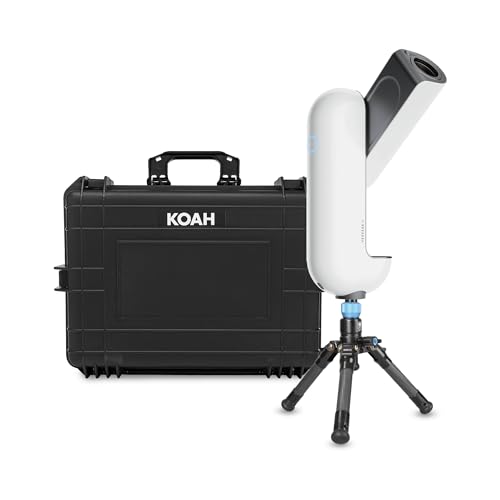
French manufacturer Vaonis built the Vespera II around the widest field of view of any portable smart telescope: 2.5° × 1.4°, compared to the Seestar S50's 1.29° × 0.73°. The sensor upgrade from the original Vespera is substantial — 8.3MP (vs the original's 2MP), meaning 4× more pixels across that wider field. A built-in filter slot accepts 1.25" filters including the optional Vaonis dual narrowband filter for light-polluted skies and solar filter for Sun observing. Folds flat for transport. Full Vaonis Vespera II review →

ZWO Seestar S50 smart telescope — best value entry tier

ZWO Seestar S50

Entry tier Best value

ZWO's Seestar S50 is the telescope that democratized smart telescopes. At 2.2 lbs and entry-tier pricing, it removed every barrier to entry: no alignment skill, no transport hassle, no steep learning curve, no large financial commitment. The 50mm f/5 refractor with built-in filter slot (including solar) captures emission nebulae and bright galaxies in 5–15 minutes. The 4.5-hour battery covers shorter sessions. The limitation vs Vaonis: smaller FOV (1.29° × 0.73°) and 2MP sensor vs the Vespera II's 8.3MP. Note: the original Seestar S50 was discontinued in late 2025 with stock still available; ZWO announced the Seestar S50 Pro for late 2026.

DWARFLAB Dwarf 3 smart telescope with dual wide and telephoto cameras

DWARFLAB Dwarf 3 / Dwarf Mini

Entry tier Dual camera

DWARFLAB differentiates with a dual-camera system: a wide-angle camera (for full context) and a telephoto camera (24mm f/1.25 for the main imaging). The Dwarf 3's telephoto delivers a surprisingly wide 2.2° × 1.6° field at entry pricing. The Dwarf Mini strips the design down to 1.1 lbs — the most portable smart telescope made, fitting in a jacket pocket. Both models work with the DWARFLAB app and continue receiving firmware updates that improve their deep-sky stacking performance. Full Dwarf 3 review →

Complete 2026 Smart Telescope Specification Comparison

All models available new as of June 2026. Price tier: Entry / Mid-range / Premium.

Specification Origin Mark II eVscope 2 eQuinox 2 Vespera II Seestar S50 Dwarf 3 Dwarf Mini
Brand Celestron Unistellar Unistellar Vaonis ZWO DWARFLAB DWARFLAB
Aperture 154mm (6") 114mm 114mm 50mm 50mm 24mm 24mm
Focal Ratio f/2.2 f/4 f/4 f/5 f/5 f/1.25 f/1.25
Focal Length 340mm 450mm 450mm 250mm 250mm 30mm 30mm
Sensor IMX-class CMOS Sony IMX347 7.7MP Sony IMX347 7.7MP Sony IMX585 8.3MP Sony IMX462 2MP 2.1MP 2.1MP
Field of View 1.7° × 1.7° 0.57° × 0.76° 0.57° × 0.76° 2.5° × 1.4° 1.29° × 0.73° 2.2° × 1.6° 2.2° × 1.6°
Battery Mains power 9 hours 11 hours 4 hours 4.5 hours 3 hours 3 hours
Weight ~15 lbs ~13 lbs ~11 lbs 11 lbs 2.2 lbs 3.5 lbs 1.1 lbs
Physical Eyepiece No Yes (OLED) No No No No No
Filter Slot No No No Yes (1.25") Yes (built-in) No No
Citizen Science No Yes (SETI) Yes (SETI) No No No No
FITS Export Yes Yes Yes Yes No No No
Price Tier Premium Premium Premium Mid-range Entry Entry Entry

Category-by-Category Winners

Each category has a clear winner based on measurable specifications and real-world performance.

Deepest Reach (Faintest Targets)

🏆 Celestron Origin

154mm aperture + f/2.2 = 5× more light per exposure than f/5 competitors. Reaches objects that are marginal or invisible on any other smart telescope.

Best Nebula Images (Per Dollar)

🏆 Vaonis Vespera II

Widest FOV captures full nebulae; 8.3MP sensor at mid-range price. Entire Orion Nebula complex fits in one frame. No other mid-range smart telescope matches its nebula coverage.

Best Battery Life

🏆 Unistellar eQuinox 2 (11 hrs)

11 hours covers the longest astronomical nights. The eVscope 2 at 9 hours is runner-up. All other models require a power bank for all-night summer sessions.

Most Portable

🏆 DWARFLAB Dwarf Mini (1.1 lbs)

The Dwarf Mini genuinely fits in a jacket pocket and weighs less than a water bottle. For travel, camping, or balcony use, nothing else comes close.

Best Value (Entry Tier)

🏆 ZWO Seestar S50

The telescope that made smart scopes accessible. Ultra-portable, reliable app, built-in solar filter, 4.5-hour battery. The starting point for anyone new to smart telescopes.

Only Physical Eyepiece

🏆 Unistellar eVscope 2

The only smart telescope where you press your eye to an eyepiece and look up at the sky. OLED display shows real-time stacked views. Unique in the entire category.

Citizen Science

🏆 Unistellar (eVscope 2 / eQuinox 2)

The only smart telescope connected to real science. SETI Institute campaigns for asteroid occultations, exoplanet transits, and variable stars. Your data appears in published papers.

Best App Experience

🏆 Vaonis (Singularity) — tied with Celestron

Vaonis's Singularity app and Celestron's Origin app both earn high marks for interface polish, catalogue depth, and real-time stacking preview. Unistellar's app is strong too, especially for citizen science.

Best Planet Performance

🏆 Unistellar eVscope 2 / eQuinox 2

At 114mm aperture, Unistellar models deliver the most detail on planets of any smart telescope. Honest caveat: still substantially inferior to a traditional 8" Dobsonian at 200× for planetary work.

Best for Beginners (First Smart Scope)

🏆 ZWO Seestar S50

Lowest barrier to entry: price, weight, setup time, and learning curve all favor the Seestar. If you've never used a smart telescope and want to try the category, start here.

Choosing a Smart Telescope by Budget

Entry Tier — Best for First-Timers and Gift Buyers

The entry tier is dominated by ZWO Seestar S50 and the DWARFLAB Dwarf 3 / Dwarf Mini. Both are the right starting point for someone who has never used a smart telescope and wants to experience the category before committing more. The Seestar S50 is the safer recommendation for most beginners: larger community, more tutorials available, better-documented performance. The Dwarf 3 wins if a wide field of view and dual cameras are priorities. The Dwarf Mini wins if portability is the only constraint.

Expect: good emission nebula images in 5–15 minutes, bright galaxy cores, star clusters. Don't expect: planetary detail, very faint targets, ultra-wide field.

Mid-Range Tier — Serious Observers Who Want More

The Vaonis Vespera II currently occupies the mid-range tier alone. It delivers the widest field of view available in any portable smart telescope and the highest sensor resolution at its price class. The upgrade from entry tier is most visible on large targets: the full Andromeda Galaxy, complete Orion Nebula complex, and wide emission nebulae that appear cropped on entry-tier scopes. If you've already used a Seestar and found yourself wanting wider coverage or more detail in your nebula images, the Vespera II is the logical next step.

Expect: entire nebulae in frame, more fine detail, filter compatibility for city skies, solar observing. Trade-offs: 4-hour battery, 11-lb weight.

Premium Tier — For Serious Astrophotographers and Enthusiasts

The premium tier splits across two distinct use cases. The Celestron Origin is for backyard deep-sky imaging: it produces the deepest, most detailed images of any smart telescope, but requires mains power and doesn't travel. The Unistellar eVscope 2 / eQuinox 2 is for observers who value the eyepiece experience, citizen science participation, and long battery life over maximum imaging depth. Choose Origin if imaging results are paramount. Choose Unistellar if the complete observing experience — including looking through an eyepiece and contributing to science — matters alongside imaging quality.

Expect (Origin): best-in-class deep-sky imaging, faintest reachable objects, FITS workflow support. Expect (Unistellar): eyepiece experience, SETI science, 9–11 hour battery, good globular and galaxy detail.

Which Smart Telescope Is Right for You? Decision Guide

Answer these five questions to find your match:

Is this your first smart telescope?

Yes: Start with the ZWO Seestar S50 (entry tier, largest community, lowest risk). If budget is very tight: DWARFLAB Dwarf Mini.

No, I want to upgrade from entry tier: Vaonis Vespera II (wider FOV, more detail) or Unistellar eQuinox 2 (more aperture, longer battery, citizen science).

Do you want to look through an eyepiece?

Yes, the eyepiece experience matters: Only the Unistellar eVscope 2 has one. No other smart telescope offers this.

No, phone screen is fine: Any other model.

Is portability a hard constraint?

Must fit in a bag / travel with me: DWARFLAB Dwarf Mini (1.1 lbs) or ZWO Seestar S50 (2.2 lbs).

Backyard or car transport is fine: Any model, including Celestron Origin (best results).

Is maximum image quality your priority?

I want the deepest, most detailed images possible: Celestron Origin — no competition at any price.

Best nebula images at mid-range budget: Vaonis Vespera II (widest FOV, 8.3MP).

Does citizen science matter?

Yes, I want to contribute to real scientific research: Any Unistellar model — the only brand with a genuine citizen science program (SETI Institute).

No, imaging enjoyment is the goal: Any brand based on other priorities.


All Smart Telescopes: Buy Links

Premium Tier

Editor's Pick — Best Deep-Sky Smart Telescope
Celestron Origin Mark II

Celestron Origin Mark II

6" RASA · f/2.2 · 154mm · Premium tier · Best deep-sky results of any smart telescope

The definitive smart telescope for serious backyard astrophotographers. Full review →

Unistellar eVscope 2

Unistellar eVscope 2

114mm · Eyepiece · 9hr · SETI

Only smart scope with eyepiece. Full review →

Unistellar eQuinox 2

Unistellar eQuinox 2

114mm · No eyepiece · 11hr · SETI

Same optics as eVscope 2, longer battery.

Mid-Range Tier

Vaonis Vespera II

Vaonis Vespera II

50mm · f/5 · 8.3MP · 2.5° FOV · Filter slot · 4hr battery

Best nebula images at mid-range price. Widest FOV of any portable smart telescope. Captures full nebulae that other scopes crop. Full review →

Entry Tier

ZWO Seestar S50

ZWO Seestar S50

50mm · 2.2 lbs · 4.5hr · Solar

Best first smart telescope

DWARFLAB Dwarf 3

DWARFLAB Dwarf 3

24mm dual · 2.2°×1.6° · 3.5 lbs

Best value dual-camera

DWARFLAB Dwarf Mini

DWARFLAB Dwarf Mini

24mm · 1.1 lbs · Ultra-portable

Most portable smart telescope made

All affiliate links. Prices change frequently — use the Amazon links for current pricing. See our editorial standards.

Smart Telescope vs Traditional Telescope: Which Should You Choose?

Smart telescopes and traditional telescopes are not competing for the same buyer. They're different tools for different goals. Here's the honest side-by-side:

Factor Smart Telescope Traditional Telescope
Setup time2–5 minutes5–30 minutes (varies)
Skill requiredNone — press and tapModerate — star-hopping, collimation, polar alignment
Planet detailPoor — all models limitedExcellent — Dobsonian or SCT
Deep-sky imaging (light polluted)Excellent — stacking overcomes light pollutionDifficult without dedicated astrophotography rig
Aperture per dollarPoor — 50mm for mid-range priceExcellent — 8" Dobsonian costs less than Seestar S50
Visual experienceNone (except eVscope 2 OLED)Full — eye to eyepiece, real photons
Gift-friendlinessHigh — works immediately for non-astronomersLower — learning curve can frustrate beginners
Long-term dependencyApp-dependent (company risk)No software dependency — works forever

For an 8-inch Dobsonian vs a Seestar S50 specifically: the Dobsonian delivers dramatically better planetary views, costs less, and operates without software. The Seestar wins on ease-of-use from light-polluted skies, automation, and push-button deep-sky imaging. Neither is objectively better — they serve different observers. See our full smart vs traditional telescope comparison for the complete analysis.

What Smart Telescopes Cannot Do

No smart telescope review is complete without an honest accounting of the category's genuine limitations. These are structural — no firmware update or price point change will fix them.

Planet detail: All smart telescopes produce weak planetary results. The focal lengths required for push-button wide-field imaging (250–450mm) are fundamentally incompatible with the high magnification (150–300×) needed for planetary detail. A 6-inch Dobsonian at 200× shows more Jupiter detail than any smart telescope at any price.
Visual observing: Except for the Unistellar eVscope 2, smart telescopes have no eyepiece. The experience of looking up and seeing photons that have traveled billions of years arrive at your eye is not replicated by a phone screen — and many veteran astronomers consider this experience irreplaceable.
App longevity: Every smart telescope depends on a smartphone app for basic operation. If the manufacturer closes, is acquired, or stops app support, the telescope's utility may be severely impaired. This is not hypothetical — the collapse of Orion Telescopes in 2024 left owners of app-dependent GoTo mounts in difficult situations. Consider the financial health of the company you're buying from.
Very faint extended objects: Objects fainter than about 12th–13th magnitude per square arcsecond (the Horsehead Nebula, most reflection nebulae, distant galaxy halos) are marginal or inaccessible on 50mm smart telescopes and challenging even on the Celestron Origin without 30+ minutes of integration.
Learning astronomy: Smart telescopes don't teach you the sky. Many experienced astronomers value the process of finding objects manually — learning constellations, star-hopping, reading the night sky. A smart telescope short-circuits that learning process entirely. If building astronomical knowledge is a goal, a manual telescope is a better teacher.

Smart Telescope Comparison 2026 — FAQ

What is the best smart telescope to buy in 2026?

There is no single "best" — it depends on budget and use case. For best deep-sky imaging with no budget limit: Celestron Origin Mark II. For best nebula images at mid-range price: Vaonis Vespera II. For best value at entry price: ZWO Seestar S50. For the only physical eyepiece + citizen science: Unistellar eVscope 2. For maximum portability: DWARFLAB Dwarf Mini. Answer the decision guide questions above to find your specific match.

Can smart telescopes see planets?

All smart telescopes produce limited planetary results. The Unistellar eVscope 2 and eQuinox 2 — with their 114mm aperture — perform best, showing Jupiter's cloud bands and Saturn's rings with some detail. 50mm smart telescopes (Seestar, Vespera II) show planet disks but with minimal detail. No smart telescope matches a traditional 6-inch or 8-inch telescope at 150–200× for planetary work. If planets are your primary interest, see our planet telescope guide.

Do smart telescopes work from light-polluted cities?

Yes — this is the category's core strength. Real-time exposure stacking builds signal-to-noise faster than light pollution can wash it out for bright targets like emission nebulae, bright galaxies, and star clusters. From a Bortle 7–8 urban sky, most smart telescopes will show M42 Orion Nebula, M31 Andromeda (core region), and numerous Messier objects within 5–15 minutes of stacking. The Vaonis Vespera II with its optional dual narrowband filter is the most effective tool for light-polluted nebula imaging in its price tier.

What is the cheapest smart telescope worth buying?

The ZWO Seestar S50 is the entry-level smart telescope with genuinely satisfying results at entry-tier pricing. Below the Seestar's price point, the DWARFLAB Dwarf Mini is available at a lower price and produces acceptable deep-sky images for casual observers. We would not recommend smart telescopes priced significantly below the Dwarf Mini — at those price points, image quality drops to the point where a traditional manual telescope would deliver more satisfaction per dollar.

Celestron Origin vs Unistellar eVscope 2 — which is better?

They serve different needs. The Celestron Origin produces substantially better deep-sky images — its 154mm aperture at f/2.2 outperforms the eVscope 2's 114mm at f/4 on faint targets. The eVscope 2 wins on: physical eyepiece experience (looking through the telescope), 9-hour battery (vs Origin's AC-only), SETI citizen science, and portability. If maximum imaging depth is the goal, choose the Origin. If the eyepiece experience and science participation matter, choose the eVscope 2.

Do smart telescopes need home WiFi to work?

No. Every smart telescope in this comparison creates its own WiFi hotspot — you connect your smartphone directly to the telescope's network without a home router or internet connection. This makes them fully functional at dark-sky sites, in rural fields, camping, or anywhere you have power for the telescope. An internet connection may be needed initially to download the app and update the target catalogue, but after that initial setup, all models operate fully offline.

Which smart telescope is best for a gift?

For a gift to someone new to astronomy: ZWO Seestar S50 — works in 5 minutes, produces beautiful results, and won't frustrate a non-astronomer with setup complexity. For a gift to a serious enthusiast or astrophotographer: Celestron Origin Mark II (premium tier) if they have a backyard with power access, or Unistellar eQuinox 2 if they'll use it in multiple locations. For a portable gift for a traveller: DWARFLAB Dwarf Mini. See our full telescope gift guide for the complete breakdown.

Is a smart telescope worth it vs a traditional telescope?

Smart telescopes are worth it for: beginners who want immediate results, observers in light-polluted urban areas, people who want push-button deep-sky imaging, and anyone who lacks the time or patience to learn traditional telescope operation. Traditional telescopes are worth it for: planet viewing, aperture-per-dollar value, the visual observing experience, and observers who want to develop astronomical skill. Neither is universally better — they serve different goals. The full smart vs traditional telescope comparison covers this in detail.

Are smart telescopes good for astrophotography?

Yes — astrophotography is their primary purpose. Smart telescopes automate the entire imaging workflow: alignment, tracking, stacking, and processing. The Celestron Origin (FITS export, EQ mode, autoguider support) and Unistellar models (FITS export) offer the most capability for serious imagers who want to process data in PixInsight or Siril. Entry-tier models like the Seestar S50 output JPEG only and are less suited to deep post-processing workflows. See our full astrophotography telescope guide to see how smart telescopes compare to dedicated imaging rigs.


Related Guides