
Best Telescope Christmas Gift Guide 2026: Every Budget Covered
Telescope Advisor Logo Telescope Advisor
Starry night sky — best telescope Christmas gift guide 2026

Christmas Gift Guide · 2026

Best Telescope Christmas Gift Guide 2026: For Every Budget and Every Astronomer

A telescope is one of the best gifts you can give — and one of the easiest to get wrong. We cut through the noise: the picks that will actually get used, the traps to avoid, and exactly what to buy based on who you're gifting.

Picks Reviewed25+ telescopes tested
Budget RangeUnder $100 to Premium
Top Beginner PickStarSense Explorer LT 114AZ
Top Smart GiftDWARFLAB Dwarf 3
By Telescope Advisor Editorial Team Published: Updated: Editorial Standards

Before You Buy: 5 Rules for Telescope Gift Shopping

Most bad telescope purchases share a common cause: the buyer chose by price tag and box art rather than by the recipient's experience level and how the telescope will actually be used. Five minutes with these rules will save weeks of disappointment.

Rule 1: Ignore magnification claims

A telescope box that advertises "675× magnification!" is almost certainly selling frustration. High magnification is useless on an unstable mount with poor optics. The only number that matters is aperture (the size of the lens or mirror in millimetres). Bigger aperture = more light = better views.

Rule 2: Mount stability matters more than aperture

A wobbly tripod makes even a large telescope frustrating to use. Every time you touch the eyepiece, the view shakes for seconds. Buy from reputable brands (Celestron, Sky-Watcher) where mounts are designed to work with the optical tube, not thrown in as an afterthought.

Rule 3: Ease of use determines whether it gets used

The best telescope for a beginner is the one they'll actually take outside. A complex setup that requires 30 minutes to align will end up in a closet. Prioritize: quick setup, intuitive mount, clear instructions.

Rule 4: Buy from telescope specialists

Telescopes sold in toy stores, department stores, and unbranded Amazon listings at very low prices are almost universally poor quality. Stick to established astronomy brands: Celestron, Sky-Watcher, Meade (limited), and Explore Scientific.

Rule 5: Match the scope to the recipient

A 10-year-old, a retirement-age parent, and a university student who wants to photograph galaxies need different telescopes. Age, patience level, physical strength, and long-term ambitions all matter. Use our recipient guide below.

The minimum budget for real astronomy

Below the $100–$150 range, you're buying severely limited capability. Saturn's rings are visible at this entry point, but barely. From the $150–$250 range, things improve dramatically: clearer rings, Jupiter's moons, globular clusters. Don't be pushed below this without knowing the limitations.


🔭

Not sure which telescope actually fits your goals?

Answer 5 quick questions about your budget, observing targets, and experience level — our Telescope Finder Tool recommends a specific model in under 2 minutes.

Find My Telescope →
🎁 Best Telescope Gifts Under $100

Genuine astronomy starts to work at around $80–$100, but expectations need calibrating. At this budget, Saturn's rings are visible as a separate structure from the planet, the Moon shows extraordinary crater detail, and Jupiter appears as a disk with its four Galilean moons. For anything fainter — nebulae, galaxies — you're mostly looking at blobs. For a child aged 5–12 who is curious about space but may not have the patience for a more complex instrument, this is a reasonable entry point.

Top Pick Under $100 — Best for Kids
Celestron FirstScope 76mm tabletop reflector — best telescope gift under $100 for kids

Celestron FirstScope 76mm Tabletop Reflector

76mm aperture Tabletop — no unstable tripod Under $100 Ages 6+

The FirstScope is the right answer for children who want their first real telescope. Its tabletop design eliminates the tippy tripod problem that ruins most cheap telescopes — it sits solidly on any flat surface. The 76mm Newtonian reflector is large enough to show the Moon's craters in detail, Saturn's rings as a clear oval band, Jupiter's disk, and the Milky Way's star fields. It's also essentially indestructible for normal childhood use.

What it won't do: detailed views of planets (fine at this price), or reveal faint nebulae and galaxies beyond a gray smudge. Set those expectations clearly with the recipient. See all kids' telescope picks →

Honest note on sub-$100 telescopes: If you can stretch to $150–$200, the quality improvement is dramatic. The Celestron AstroMaster 70AZ in the next tier below shows noticeably clearer views and comes with a more functional mount. If the sub-$100 budget is truly fixed, the FirstScope is the best choice. But don't buy a sub-$60 department store telescope — those invariably disappoint.
🎁 Best Telescope Gifts $100–$300: The Sweet Spot for Real Astronomy

This is the range where beginner astronomy genuinely works. From $150 upward, you can see Saturn's rings clearly, Jupiter's four Galilean moons, the Andromeda Galaxy as a distinct smudge, hundreds of star clusters, and the Moon in breathtaking detail. These are gifts that will be used for years.

Editor's Pick $100–$300 — Best Beginner Telescope 2026
Celestron StarSense Explorer LT 114AZ — best beginner telescope Christmas gift 2026

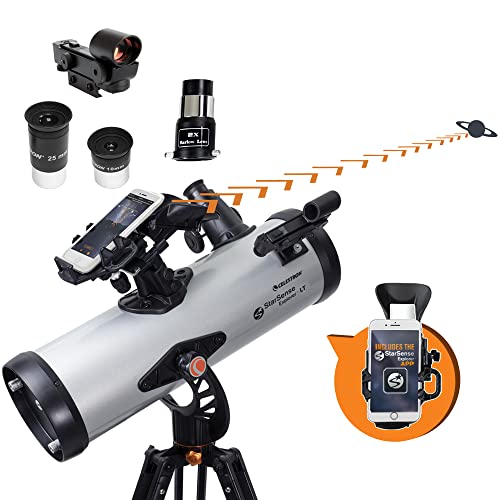
Celestron StarSense Explorer LT 114AZ

114mm reflector Smartphone star-finder No knowledge needed

The StarSense Explorer LT 114AZ is the best beginner telescope for Christmas 2026 because it removes the biggest barrier to first-time astronomy: finding objects in the sky. The dock clips to the telescope tube, you hold your phone in it, and the StarSense app uses your camera to analyze the star field, work out exactly where the telescope is pointing, and then arrow-guide you to any target in its catalogue. No star chart knowledge needed, no manual alignment. It works immediately, for anyone.

The 114mm aperture is large enough to show Saturn's rings clearly, Jupiter's cloud bands, 60+ Messier objects, and the Andromeda Galaxy. For a complete beginner, this is the gift we'd give.

Sky-Watcher Heritage 130P tabletop Dobsonian — excellent Christmas gift telescope

Sky-Watcher Heritage 130P — Best pure value, no tech required

The Sky-Watcher Heritage 130P is the aperture champion at its price point: 130mm (5.1 inches) of light-gathering power on a compact tabletop Dobsonian mount. No smartphone required, no alignment procedure — unfold, point, look. The collapsible tube design means it stores in a remarkably small space. For a recipient who wants a tactile, manual observing experience, the Heritage 130P is the most satisfying optical value available in the $150–$200 range. Full review →

Celestron AstroMaster 70AZ refractor telescope — good beginner Christmas gift

Celestron AstroMaster 70AZ — Best refractor for beginners

The AstroMaster 70AZ is a classic first telescope: a 70mm refractor on a stable alt-az tripod. It's light, the tripod extends to comfortable heights, and setup takes under 5 minutes. Views are sharp and bright on the Moon and planets. At this aperture, deep-sky objects are limited, but it's a capable, frustration-free instrument for anyone just starting out. A particularly good gift for someone who wants a clean optical instrument without the "reflector smell" of a Newtonian (some people simply prefer refractors).

🎁 Best Telescope Gifts $300–$600: For the Seriously Curious

This tier covers equipment that serious hobbyists use for years. In the $300–$600 range, you can reveal the Andromeda Galaxy's core, dozens of open and globular clusters, nebulae with visible structure, and detailed planetary views. These are real telescopes for real astronomy — gifts that grow with the recipient's interest.

Editor's Pick $300–$600 — Best Telescope at This Price
Celestron StarSense Explorer DX 130AZ — best telescope gift in $300-600 range

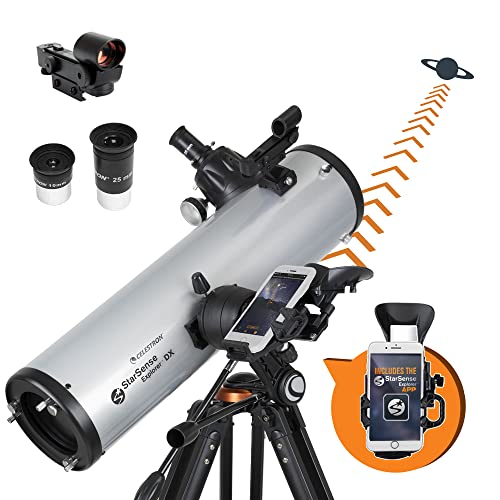
Celestron StarSense Explorer DX 130AZ

130mm reflector Smartphone-guided ~$350

The best telescope for the money in 2026 at the $300–$400 mark. The StarSense DX 130AZ combines 130mm of aperture (enough for genuine deep-sky observing) with Celestron's StarSense app guidance — which means your recipient can be looking at a specific galaxy or nebula within seconds of setup, without needing to know the sky. Saturn's rings, Jupiter's cloud bands, the Orion Nebula, globular clusters, and dozens of galaxies are all accessible. For teens and adults who want serious capability with modern accessibility, this is the standout recommendation in its tier. See all picks under $500 →

Celestron NexStar 4SE computerized GoTo telescope

Celestron NexStar 4SE — GoTo computerized, finds objects automatically

For a recipient who wants full automation without the smartphone-dock approach: the NexStar 4SE has a built-in hand controller that guides the mount to find and track any object from its 40,000-object database. Align on two stars, enter your target, and the motor drives it there. The 102mm Maksutov-Cassegrain optic delivers excellent planetary views — Saturn's Cassini Division, Jupiter's cloud bands, and lunar craters are all superb. An excellent gift for someone who wants push-button GoTo without the smartphone dependency. Full review →

Sky-Watcher Heritage 150P 6-inch tabletop Dobsonian

Sky-Watcher Heritage 150P — 6-inch for serious visual astronomy

The Heritage 150P packs a 150mm (6-inch) mirror into a collapsible tabletop Dobsonian design. Six inches of aperture is a serious jump from the 130mm range — globular clusters like M13 begin to resolve individual stars, faint nebulae show structural detail, and the Virgo Galaxy Cluster becomes explorable. For someone who wants maximum visual astronomy capability in a budget-friendly, compact package, this is a significant telescope. Full review →

🎁 Best Telescope Gifts $600–$1,500: For the Dedicated Astronomer

This tier covers serious equipment that will last decades. These telescopes reveal detailed galaxy structure, rich globular clusters with individually resolved stars, complex planetary detail, and faint deep-sky objects. They're gifts for people who are committed to astronomy as a long-term hobby.

Editor's Pick $600–$1,500 — The Ideal Step-Up Telescope
Celestron NexStar 6SE computerized 6-inch SCT telescope — premium Christmas gift

Celestron NexStar 6SE

150mm (6") Schmidt-Cassegrain GoTo computerized 40,000-object database

The NexStar 6SE is the telescope that serious beginners and experienced observers both recommend as the "one instrument I'd own if I could only own one." The 150mm Schmidt-Cassegrain delivers superb planetary detail — Saturn's Cassini Division is cleanly split, Jupiter's Great Red Spot and cloud belt detail are clearly visible, and Mars shows polar ice caps at opposition. The GoTo computerized mount finds any of its 40,000+ objects automatically after a two-star alignment. It's versatile enough for visual observing and capable enough for beginner astrophotography. Full review →

Sky-Watcher Classic 200P 8-inch Dobsonian — best aperture Christmas gift telescope

Sky-Watcher Classic 200P Dobsonian (8-inch) — Maximum aperture for the money

For a recipient who wants pure aperture above everything else — and doesn't need computerized GoTo — the 200P Dobsonian delivers 8 inches (203mm) of light-gathering power on a rock-solid manual mount. This is the telescope that veteran observers call the "astronomer's workhorse." With 8 inches, globular clusters resolve completely, galaxy pairs show interacting arms, and the Veil Nebula's filamentary structure becomes visible. Manual operation (no motors) means learning to find objects by star-hopping — which many observers consider the best way to actually learn the sky. See all Dobsonian picks →

Celestron NexStar 8SE 8-inch computerized SCT telescope

Celestron NexStar 8SE — The premium GoTo pick

The 8SE upgrades the 6SE's optics to an 8-inch (203mm) SCT. That extra aperture is meaningful: fainter targets become accessible, planet detail is richer, and long-exposure astrophotography of faint galaxies becomes realistic. At this price tier, it's the telescope for someone who knows exactly what they want and plans to photograph the night sky as well as observe. Full review →


🎁 Best Smart Telescope Gifts 2026: Push-Button Astronomy

Smart telescopes are the fastest-growing gift category in astronomy because they remove every barrier between a beginner and a beautiful nebula image. No star charts, no manual alignment, no eyepiece technique. You tap a target, and within minutes a colorful deep-sky object appears on your phone screen. For gifting to non-astronomers — partners, parents, siblings who are curious about space — a smart telescope is often the better choice over a traditional telescope.

Editor's Smart Telescope Pick — Best Smart Gift for Beginners
DWARFLAB Dwarf 3 smart telescope — best value smart telescope gift 2026

DWARFLAB Dwarf 3

Dual camera (wide + tele) 2.2° wide field Entry tier

For anyone who wants a smart telescope gift at the entry price tier, the DWARFLAB Dwarf 3 is the pick to beat in 2026. Its dual-camera system captures both a wide-angle sky view and a tighter deep-sky telephoto image simultaneously — a unique feature at the entry level. The telephoto's 2.2° × 1.6° field is wider than the ZWO Seestar S50's, meaning large objects like the Orion Nebula fit in frame with more context. Works from a balcony, backyard, or dark-sky site. Full review →

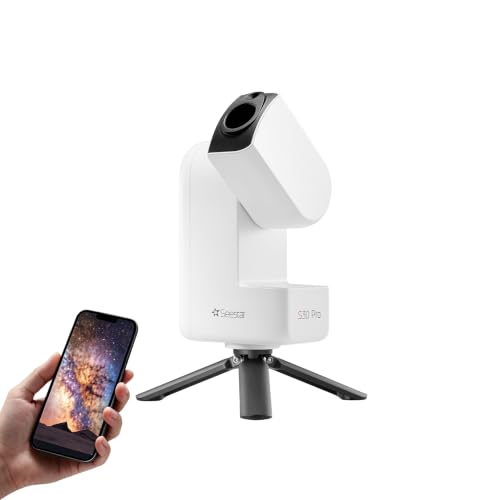
ZWO Seestar S50 smart telescope gift

ZWO Seestar S50

Entry · 2.2 lbs · Solar filter

Best-known smart telescope. Ultra-portable, reliable. Best gift for travel or balcony use.

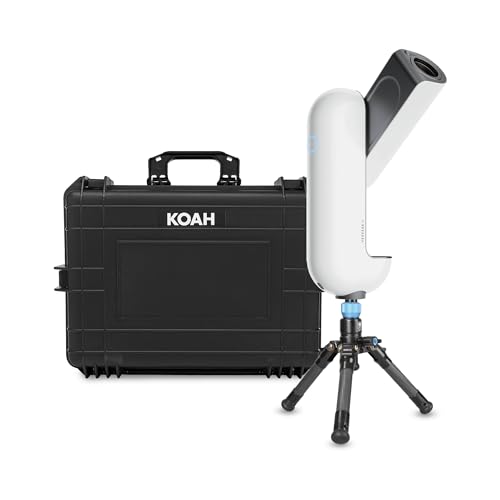
Vaonis Vespera II smart telescope gift mid-range

Vaonis Vespera II

Mid-range · 8.3MP · Widest FOV

Best nebula gift. Widest field of view for capturing complete nebulae. For serious space enthusiasts.

Celestron Origin smart telescope premium gift

Celestron Origin

Premium · 6-inch RASA · f/2.2

Best astrophotography gift. For the serious space enthusiast who wants the best possible images from their backyard.

For smart telescopes, also see our complete 2026 smart telescope comparison covering all brands side by side.

🎁 Telescope Accessories: Stocking Stuffers for Existing Telescope Owners

If the recipient already has a telescope, accessories can transform their experience for a fraction of the cost of a new instrument. These picks work with virtually any telescope made in the last 30 years that has a standard 1.25" focuser.

Celestron SkyMaster 15x70 astronomy binoculars — great stocking stuffer gift

Celestron SkyMaster 15×70 Binoculars

For someone without a telescope, or as a complement

These are the best astronomy binoculars under the $100 mark. Resolves Jupiter's four moons, shows star clusters richly, and scans the Milky Way beautifully. Great standalone astronomy gift, or complement to any telescope. Full binoculars guide →

Celestron X-Cel LX 9mm eyepiece — great telescope accessory gift

Celestron X-Cel LX 9mm Eyepiece

For existing telescope owners — planetary detail upgrade

A quality 9mm eyepiece is the single most impactful upgrade for any beginner telescope. It replaces the stock eyepiece with sharper optics, more comfortable eye relief, and the right magnification for planetary detail. Works with any 1.25" focuser. Full eyepiece guide →

Celestron NexYZ smartphone adapter for telescope photography

Celestron NexYZ 3-Axis Smartphone Adapter

For anyone with a telescope who also has a smartphone

Lets you photograph the Moon and planets through any existing eyepiece with a smartphone. Three-axis adjustment locks the phone perfectly centered over the eyepiece. The Moon through a telescope photograph is one of the most shareable images in amateur astronomy — this makes it easy.

Celestron UpClose G2 10x50 binoculars — affordable astronomy binoculars gift

Celestron UpClose G2 10×50 Binoculars

Entry binoculars — for anyone starting out

The classic handheld astronomy binoculars. At 10× and 50mm objectives, they show Jupiter's Galilean moons, the Pleiades richly, Andromeda as a definite oval, and scan comets beautifully. Excellent value and easy to use without a tripod.

Other great stocking stuffers (no affiliate link needed — buy anywhere):

  • Red LED flashlight — essential for astronomy; white light destroys dark adaptation for 20+ minutes
  • SkySafari app subscription — the best astronomy app for iOS and Android
  • A physical star atlas (Sky & Telescope Pocket Sky Atlas) — for learning the sky without a phone
  • Turn Left at Orion (book) — widely considered the best practical beginner astronomy guide ever written

Quick Match: Telescope Gift by Recipient Type

Recipient Best Pick Why
Child aged 5–10Celestron FirstScope 76mmDurable tabletop design; no tippy tripod; under $100
Child aged 10–14StarSense Explorer LT 114AZSmartphone guidance removes the hardest barrier; 114mm for real astronomy
Teen (14–18)StarSense DX 130AZ or NexStar 4SETech appeal, serious capability, grows with interest
Adult beginnerStarSense Explorer LT 114AZWorks immediately without prior knowledge; satisfying views from night one
Adult who wants automationDWARFLAB Dwarf 3 or Seestar S50Smart telescope = push-button; no skill required
Senior / older adultNexStar 4SE or DWARFLAB Dwarf 3GoTo automation; minimal physical setup; comfortable use
Serious enthusiast (experienced)NexStar 6SE or 8-inch DobsonianMeaningful aperture upgrade; serious visual and imaging capability
AstrophotographerCelestron Origin or NexStar 8SEPremium imaging capability; long-exposure astrophotography capable
Traveller / apartment dwellerDWARFLAB Dwarf Mini or Seestar S50Ultra-portable; works from balcony or on travel

What to Avoid: Common Christmas Telescope Mistakes

Cheap department store telescopes: Any telescope under $60 from Walmart, Target, or unbranded Amazon listings is almost certainly a poor experience. Plastic eyepieces, unstable tripods, and imprecise focusers combine to produce frustrating views that discourage continued use.
"675× magnification!" boxes: Advertised magnification on the box is meaningless and is used to sell cheap telescopes to uninformed buyers. As described above, aperture is what matters, not the theoretical maximum magnification number.
Plastic mounts: Any telescope where the tripod or mount is made primarily of plastic will shake whenever you touch the eyepiece. This makes high-magnification viewing miserable. Celestron and Sky-Watcher consistently use metal where it matters.
Accessories bundles from unknown brands: Many cheap telescopes come "bundled" with a set of additional eyepieces, a Barlow lens, and colored filters. These accessories are typically poor quality and the telescope itself is the real problem. A genuine quality telescope from Celestron or Sky-Watcher with two eyepieces is better than a cheap scope with ten.
Books and charts without a telescope: Astronomy books and planispheres make great supplementary gifts but are useless without a telescope. Never give these alone — they need an instrument to go with them.

When to Order for Christmas Delivery

Telescopes are bulky and occasionally ship from third-party astronomy distributors rather than Amazon's warehouses directly. Check estimated delivery dates carefully before ordering, especially for models from Sky-Watcher and Vaonis.

Prime models (same-day to 2-day shipping)

Celestron AstroMaster 70AZ, StarSense Explorer LT 114AZ, NexStar 4SE, 6SE, 8SE, FirstScope — available for fast shipping from Amazon. Safe to order up to December 22–23 in most US locations.

Standard shipping (4–7 days)

Sky-Watcher Heritage 130P, Heritage 150P, Classic 200P — these often ship via standard ground from telescope distributors. Order by December 14–16 to be safe. Check the "Arrives before Christmas" date on the product page.

Premium / Specialty (7–21 days)

Vaonis Vespera II, Celestron Origin, Unistellar models — some of these ship directly from the manufacturer or European distributors. Order by December 1–7 to guarantee Christmas delivery. Check stock status before ordering.

Always check the specific "Arrives by" estimate on the Amazon product page for your delivery address before ordering. Delivery times vary by warehouse location and your region.

Telescope Gift Guide — FAQ

What is the best telescope for a complete beginner for Christmas 2026?

The Celestron StarSense Explorer LT 114AZ is our top recommendation for most beginners in 2026. It uses your smartphone to guide you to any target in the sky — no prior astronomy knowledge needed. The 114mm aperture is large enough for Saturn's rings, Jupiter's moons, the Orion Nebula, and dozens of star clusters. At its price point, it offers more beginner-friendliness than anything else on the market. See our full beginner telescope guide for the complete comparison.

What telescope should I buy a child for Christmas?

Age matters significantly. For ages 5–10: Celestron FirstScope 76mm (tabletop, durable, no tippy tripod). For ages 10–14: Celestron StarSense Explorer LT 114AZ (smartphone-guided, serious aperture). For teens 14+: StarSense Explorer DX 130AZ or NexStar 4SE (more capable, grows with their interest). See our dedicated kids' telescope guide and teen telescope guide.

Is a smart telescope a good Christmas gift?

Smart telescopes are excellent Christmas gifts for people who want to experience space photography without learning traditional astronomy. They work immediately — plug in, power on, tap a target, and within 5 minutes a nebula or galaxy appears on screen. For gifting to complete non-astronomers (a curious partner, parent who mentioned space, sibling who watches astronomy content), a smart telescope like the ZWO Seestar S50 or DWARFLAB Dwarf 3 will produce more immediate "wow" moments than a traditional telescope that requires some skill to use.

What's the best telescope gift under $200?

At under $200, the Celestron StarSense Explorer LT 114AZ and the Sky-Watcher Heritage 130P are the strongest picks. The StarSense wins if ease-of-use is the priority (smartphone guidance removes the hardest learning curve). The Heritage 130P wins if maximum optical performance matters — 130mm of aperture is impressive at this price. Both show Saturn's rings, Jupiter's cloud bands, and hundreds of star clusters clearly. See our full under-$200 guide.

Can you buy a decent telescope for under $100?

Yes — with calibrated expectations. The Celestron FirstScope 76mm is a genuine telescope that shows Saturn's rings and the Moon's craters at under $100. What it won't do: detailed planetary views, faint deep-sky objects (nebulae appear as faint blobs), or any astrophotography. If the recipient is a young child who wants to see the Moon and learn what a telescope is, this is appropriate. If the recipient is an adult who wants meaningful astronomy, budget to $150+ where the experience improves dramatically. See our under-$100 telescope guide for the full picture.

What telescope accessories make good Christmas gifts?

For someone who already owns a telescope: a quality eyepiece (the Celestron X-Cel LX 9mm works with virtually any telescope), a smartphone adapter (Celestron NexYZ) for Moon photography, or a set of astronomy binoculars (Celestron SkyMaster 15×70). For complete beginners without a telescope: binoculars make a better standalone gift than a cheap telescope — 10×50 binoculars show more in the sky than a sub-$60 toy store telescope. Non-physical gifts: the SkySafari app subscription, or a subscription to Sky & Telescope magazine.

What do I need to know before buying a telescope as a gift?

Three questions determine the right choice: (1) How old is the recipient and how patient are they likely to be with a learning curve? (2) What is the budget? (3) Do they already have any astronomy experience? Never buy by magnification claims — buy by aperture and brand reputation. Stick to Celestron, Sky-Watcher, and reputable smart telescope brands (ZWO, DWARFLAB, Vaonis). Avoid department store telescopes and unknown brands regardless of price. If in doubt, the complete telescope buying guide covers every decision point in detail.

When should I order a telescope to get it by Christmas?

For Prime-eligible Celestron models (AstroMaster, StarSense, NexStar), you can typically order up to December 22–23 in the US for guaranteed Christmas delivery. For Sky-Watcher models and specialty/international items (Vaonis, Unistellar), order by December 1–10 to be safe. Always check the "Arrives by" date on the Amazon product page for your specific address before purchasing. If ordering internationally or from a telescope specialist (not Amazon), add another 3–5 business days buffer.


Related Guides