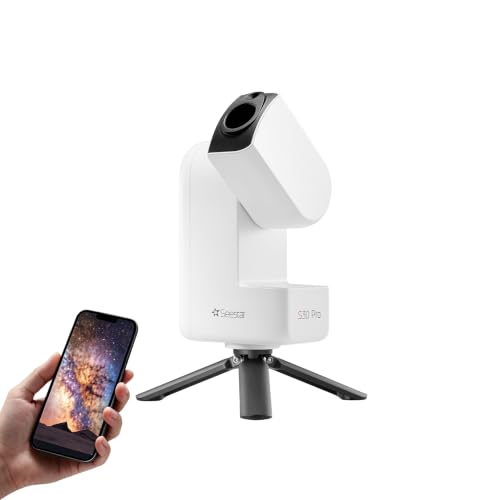
What is the Seestar S30 Pro's key advantage over the Seestar S50?
The S30 Pro's primary advantage is its field of view: 4.6° × 2.6° vs the S50's 1.29° × 0.73° — an 11× wider coverage area. This means large nebulae like the full Orion Nebula complex (M42+M43+NGC 1977) and the complete Andromeda Galaxy M31 (with companions M32 and M110) fit in a single S30 Pro frame, where the S50 shows only a central crop. The S30 Pro also has a significantly better sensor (8.3MP IMX585 vs 2MP IMX462) and dual cameras. The S50's advantage is its larger aperture (50mm vs 30mm) which gathers ~2.8× more light per exposure on faint, compact targets.
Is the Seestar S30 Pro worth upgrading from the original Seestar S30?
Yes — unambiguously. The S30 Pro's improvements over the original S30 are substantial rather than incremental: 4× more sensor pixels (8.3MP vs 2MP), 5× wider coverage area (4.6° vs ~2.0° telephoto FOV), nearly 2× battery life (6 hrs vs 3.5 hrs), improved optics (quadruplet vs triplet), and added solar observing capability. If you observe frequently and found the original S30's coverage limiting, the S30 Pro is a meaningful upgrade. The original S30 is discontinued and no longer sold new.
Can the Seestar S30 Pro see planets?
Poorly. The S30 Pro's 30mm aperture and relatively short focal length produce small, low-detail planetary images. Jupiter's disk and Saturn's rings are identifiable, but detail is minimal. No smart telescope in the entry-tier class performs well on planets — this is a fundamental limitation of small-aperture, short-focal-length optics optimized for wide deep-sky imaging. For planets, a traditional telescope with 80mm+ aperture at 100–200× magnification is required. See our best telescopes for planets guide.
Does the Seestar S30 Pro need internet to work?
No. The S30 Pro creates its own WiFi hotspot — you connect your phone directly to the telescope's network without a home router or internet connection. This makes it fully functional at dark-sky sites, camping, or anywhere without WiFi. Initial app installation and catalogue updates require internet, but once set up, the telescope operates entirely offline.
How does the S30 Pro compare to the DWARFLAB Dwarf 3?
Both offer dual cameras and similar price points, making them direct competitors. The S30 Pro wins on optical quality — its 30mm quadruplet APO produces sharper, better-corrected stars across the sensor than the Dwarf 3's telephoto lens. The S30 Pro also has a wider telephoto field (4.6° vs Dwarf 3's 2.2°) and a better telephoto sensor (8.3MP IMX585 vs 2.1MP). The Dwarf 3 wins on software — its mosaic mode and Stellar Studio processing pipeline are more capable. For pure optical image quality and field of view, the S30 Pro is the stronger instrument. See our detailed S30 Pro vs S50 vs Dwarf 3 comparison.
What deep-sky objects can the Seestar S30 Pro image well?
The S30 Pro excels on large, bright targets that benefit from its wide field: the full Orion Nebula complex (M42, M43, NGC 1977) in one frame; the complete Andromeda Galaxy M31 with M32 and M110; the Pleiades (M45) with surrounding reflection nebulosity; the Lagoon Nebula (M8) and Trifid Nebula (M20) together in one frame; the Rosette Nebula; the Double Cluster (NGC 884/869); and wide Milky Way star fields. It is less effective on small, faint targets like globular cluster resolution, distant galaxy clusters, or planetary nebulae where the Seestar S50's aperture advantage shows clearly.
Can the Seestar S30 Pro observe the Sun?
Yes — the S30 Pro includes a built-in solar filter. When solar mode is activated in the Seestar app, the filter deploys automatically, making it safe to observe the Sun's disk, sunspot groups, and surface detail through the app. This is the same capability as the Seestar S50 and is not available on the DWARFLAB Dwarf 3. For eclipse observation, the built-in filter is an excellent addition — you can watch the Moon's disk cross the Sun during the partial solar eclipse on August 12, 2026 safely through the S30 Pro.
What is the S30 Pro battery life in practice?
ZWO rates the S30 Pro at approximately 6 hours — significantly longer than the original S30 (3.5 hours) and the Seestar S50 (4.5 hours). Real-world battery life varies with temperature: expect 5–6 hours in moderate temperatures (15–20°C) and 3.5–4.5 hours in cold conditions (below 5°C). The scope charges via USB-C and can be powered from an external USB-C power bank during use for indefinite runtime. A 20,000 mAh USB-C power bank is recommended for all-night dark-sky sessions.