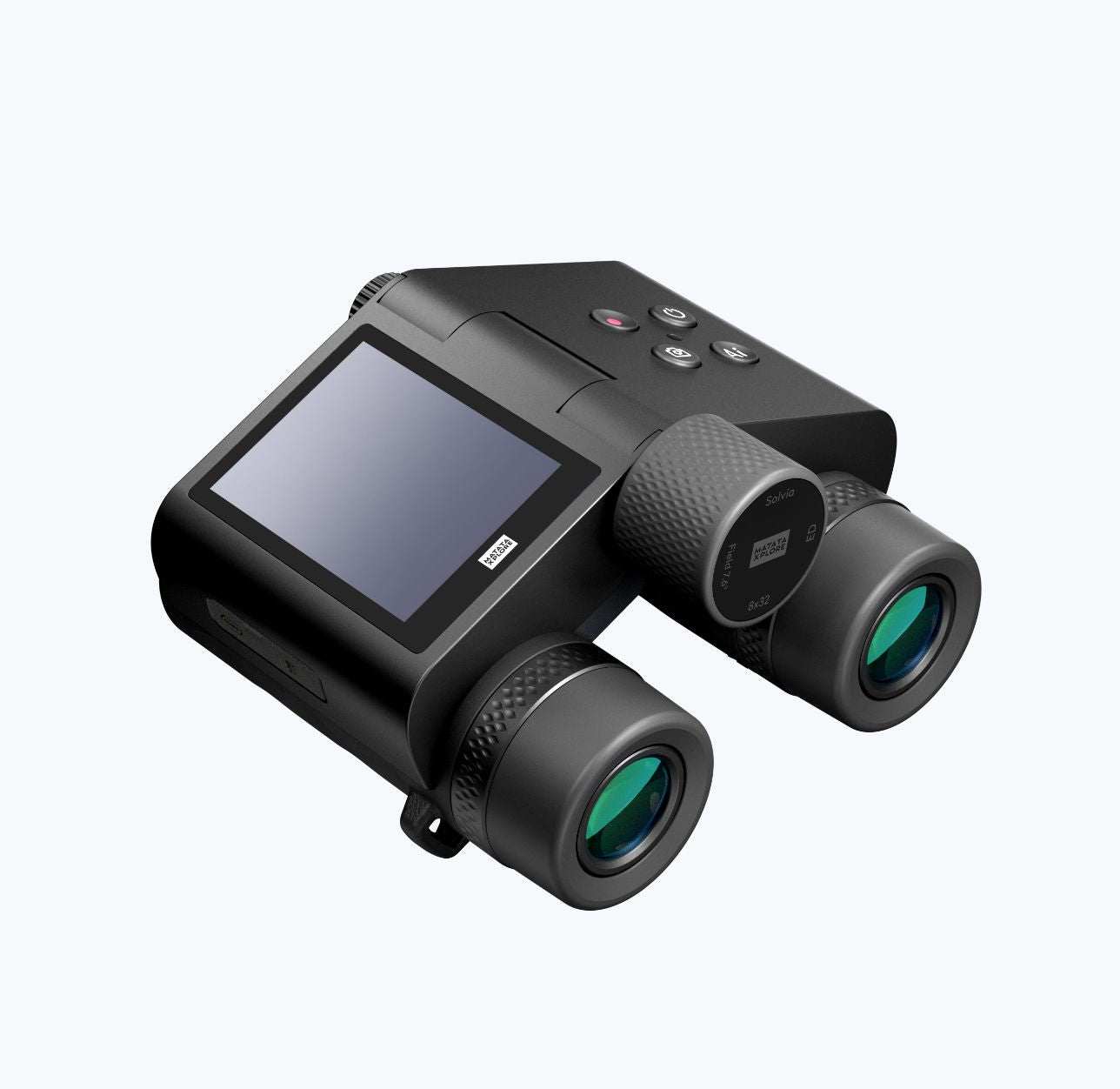
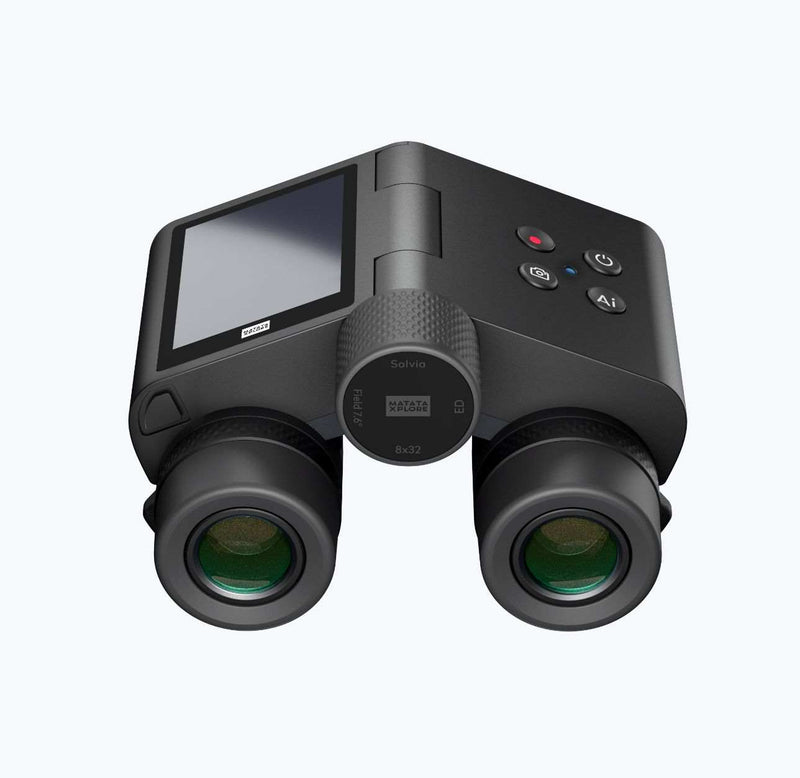
Solvia 8×32 AI Binoculars Review 2026: Expert Analysis
Telescope Advisor Logo Telescope Advisor
Solvia 8×32 AI Binoculars by MatataXplore — smart binoculars with touchscreen display showing the bird identification interface, held in outdoor use

Binoculars Review · 2026

Solvia 8×32 AI Binoculars Review 2026

The Solvia 8×32 AI Binoculars by MatataXplore promise to do it all: premium ED glass optics, AI-powered bird and plant identification, photo and video capture, and instant sharing — all in a single 680g package. After two weeks of field testing, here is our honest assessment.

Our Score8.2 / 10
Optics8×32 ED Glass
AI Recognition10,000+ species (bird, plant, animal)
Best ForBirding + nature
By Telescope Advisor Editorial Team Published: Updated: Reviewed & approved by Juhi Sahni, Senior Editor Editorial Standards

⚑ FTC Disclosure

MatataXplore provided the Solvia 8×32 AI Binoculars to Telescope Advisor free of charge for this review. We were not paid for this review, and all opinions expressed are our own honest assessment. This review contains affiliate links to MatataXplore; if you purchase through these links, we may earn a commission at no extra cost to you. See our Editorial Standards for details.

Quick Verdict

The Solvia 8×32 AI Binoculars successfully merge premium ED glass optics with genuinely useful smart features. The AI bird recognition works accurately in good light, the coaxial capture system solves the digiscoping frustration, and the EIS stabilisation delivers smooth video. At 680g it's light enough for all-day hiking, and at $399–$549 it costs roughly one-tenth of the Swarovski AX Visio. The 32mm objective limits low-light performance compared to larger binoculars, and the battery drains quickly during intensive use, but as an all-in-one observe-identify-capture-share device, it's currently the best value on the market.

Solvia 8×32 AI Binoculars

How We Scored It: 8.2 / 10

Our overall score is a weighted average across six categories, based on two weeks of hands-on field testing. Weighting reflects what matters most for the Solvia's core use case — daytime birdwatching and nature observation — so optical performance and AI recognition carry the most weight, while capture quality and app polish count for less.

Category Weight Score Why
Optical Performance35%8.0Excellent ED glass and daylight clarity, but the 32mm objective limits low-light use versus 42mm+ binoculars.
AI Recognition20%8.5Fast, fully offline bird ID; we measured 85–90% real-world accuracy against the manufacturer's up-to-98% claim.
Photo & Video Capture15%7.5Coaxial design and EIS are genuinely useful, but the 1/2.7" CMOS sensor is adequate rather than exceptional.
Smart App & Sharing10%8.0Reliable Wi-Fi transfer and one-tap sharing, with minor friction during first-time pairing.
Build & Portability10%8.5Lightweight at 680g, IP64-rated, comfortable for all-day carry and use in light rain or dust.
Value for Money10%9.0At $399–$549, it undercuts the nearest premium smart binocular (Swarovski AX Visio) by roughly 10×.
Weighted Total8.2Rounded to one decimal place.

Category scores reflect our independent testing and judgment; they are not provided or approved by MatataXplore. See our Editorial Standards for how we handle review units and affiliate relationships.
Solvia 8×32 AI Binoculars: Full Specifications

SpecValue
ModelBN 8×32
Magnification
Objective Lens32mm
Prism SystemRoof, BaK-4
Field of View7.6° (129.5m @ 1000m)
Eye Relief16mm
Exit Pupil4mm
Min. Focus Distance3.7m
Diopter Adjustment-4 to +4
Lens CoatingED (Extra-low Dispersion)
Image StabilizationEIS (Electronic)
Camera Sensor1/2.7" CMOS
Photo Resolution2592 × 1936
Video Resolution2592 × 1936
Display2.8" HD touchscreen
Storage16GB / 64GB (model dependent)
ConnectivityDirect Wi-Fi, USB-C
Battery2,600mAh Li-ion
Battery Life9–12h standard / 3–4h intensive
Weather RatingIP64, nitrogen-filled
Operating Temp-10°C to 55°C
Weight680g (24 oz)
Dimensions118.3 × 157.5 × 57.5 mm
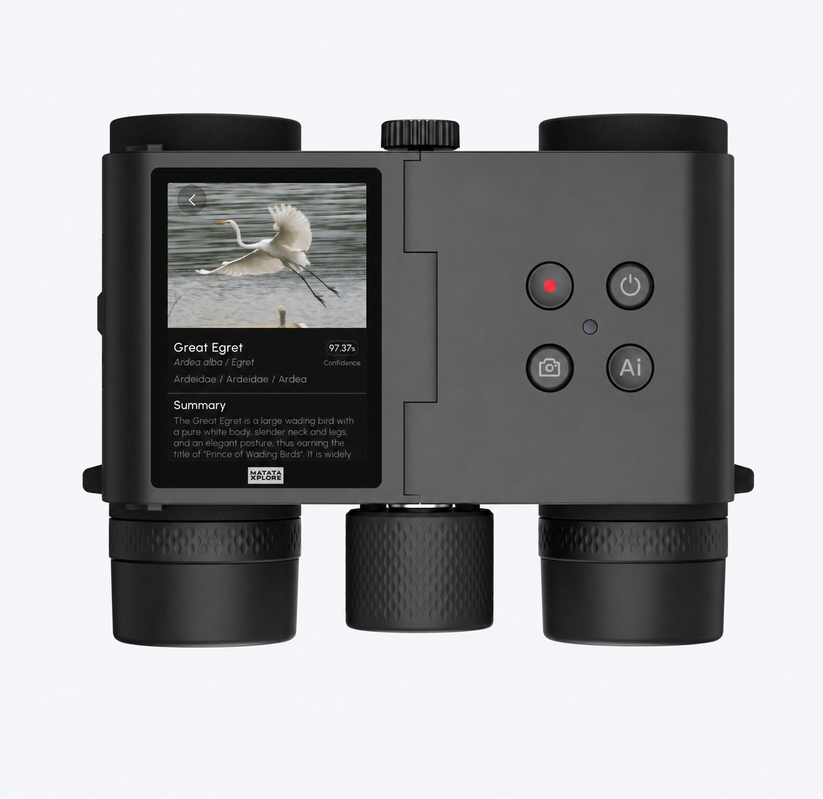
Solvia 8×32 touchscreen display showing the main user interface with AI bird identification, photo gallery, and settings options

AI Bird Recognition: Onboard offline model trained on 100GB+ data covering 10,000+ bird species. Up to 98% accuracy under ideal conditions. 1-second identification.

Cloud AI: Companion app connects to cloud database for plant, animal, insect, and landmark recognition.

Coaxial Optical Design: Beam-splitting path aligns eyepiece view with camera — what you see is exactly what the camera captures.

Shooting Modes: Auto Action, Auto Handheld, Auto Static, Manual — with adjustable ISO, shutter speed, white balance, saturation, contrast, and sharpness.

In the Box: Base ($399) includes binoculars, eyepiece and objective lens covers, neck strap, USB-C cable, lens cleaning cloth, user manual, and a 16GB SD card — no carrying case. Plus ($449) adds a carrying case, tripod adapter, and 64GB SD card.

Warranty: Optical system: 3 years. Electronic components: 1 year.

Unboxing: What's Actually in the Box

Our review unit was the Base ($399) configuration, shipped directly from MatataXplore. Here's what arrived, straight out of the box.

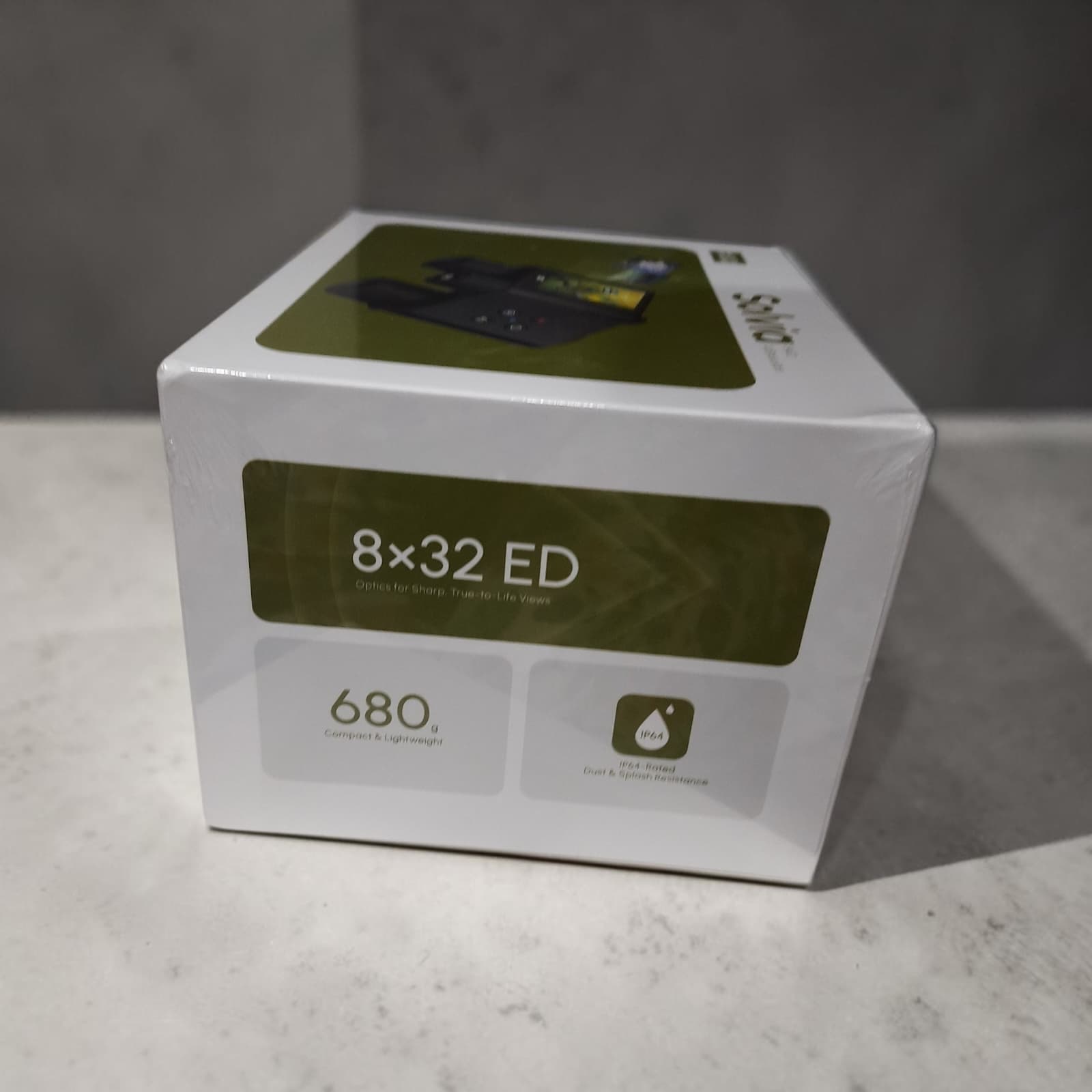
Sealed retail box for the Solvia 8×32 ED AI Binoculars, showing the 680g weight and IP64 dust/splash resistance rating printed on the packaging
The sealed retail box as it arrived, still shrink-wrapped.
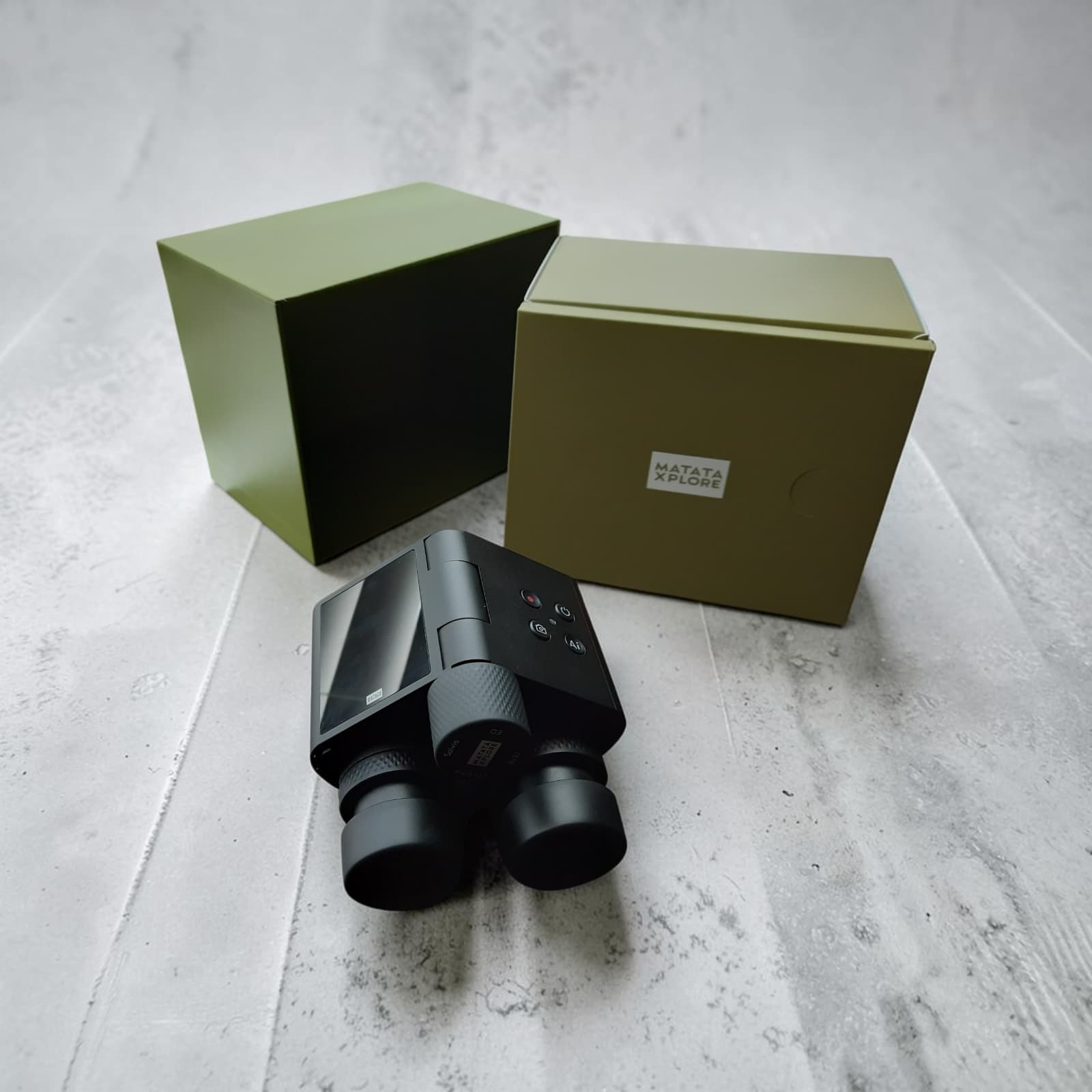
Solvia 8×32 AI Binoculars sitting in front of its open inner and outer packaging boxes on a concrete surface
The two-piece box opens to reveal the binoculars nested on top.
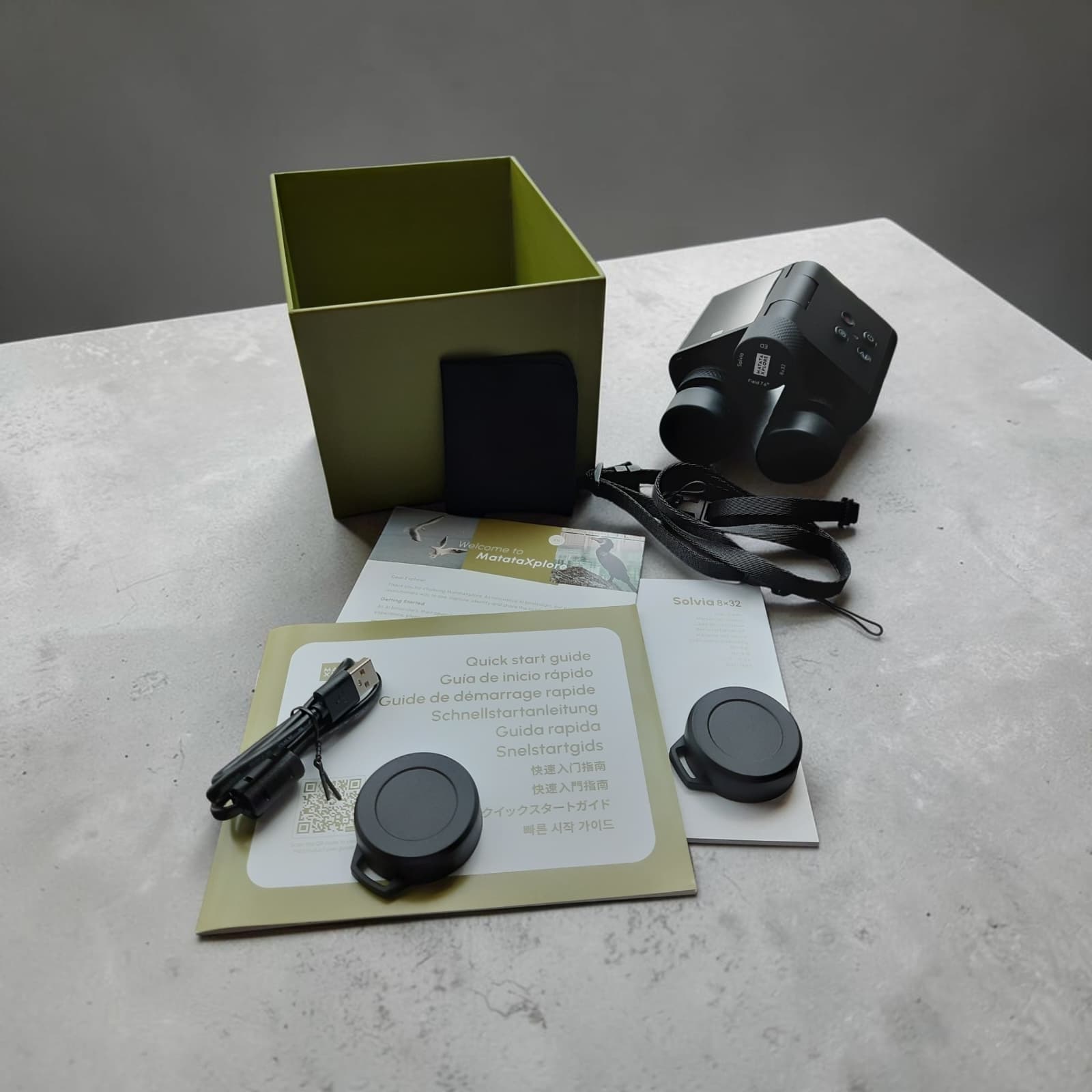
Full unboxed contents of the Solvia 8×32 Base kit laid out: binoculars with neck strap attached, USB-C cable, lens cleaning pouch, quick start guide, welcome card, user manual, and two lens caps
Everything laid out: binoculars, neck strap, USB-C cable, cleaning pouch, quick start guide, welcome card, user manual, and lens caps. No carrying case in the Base kit — that's reserved for the Plus tier.
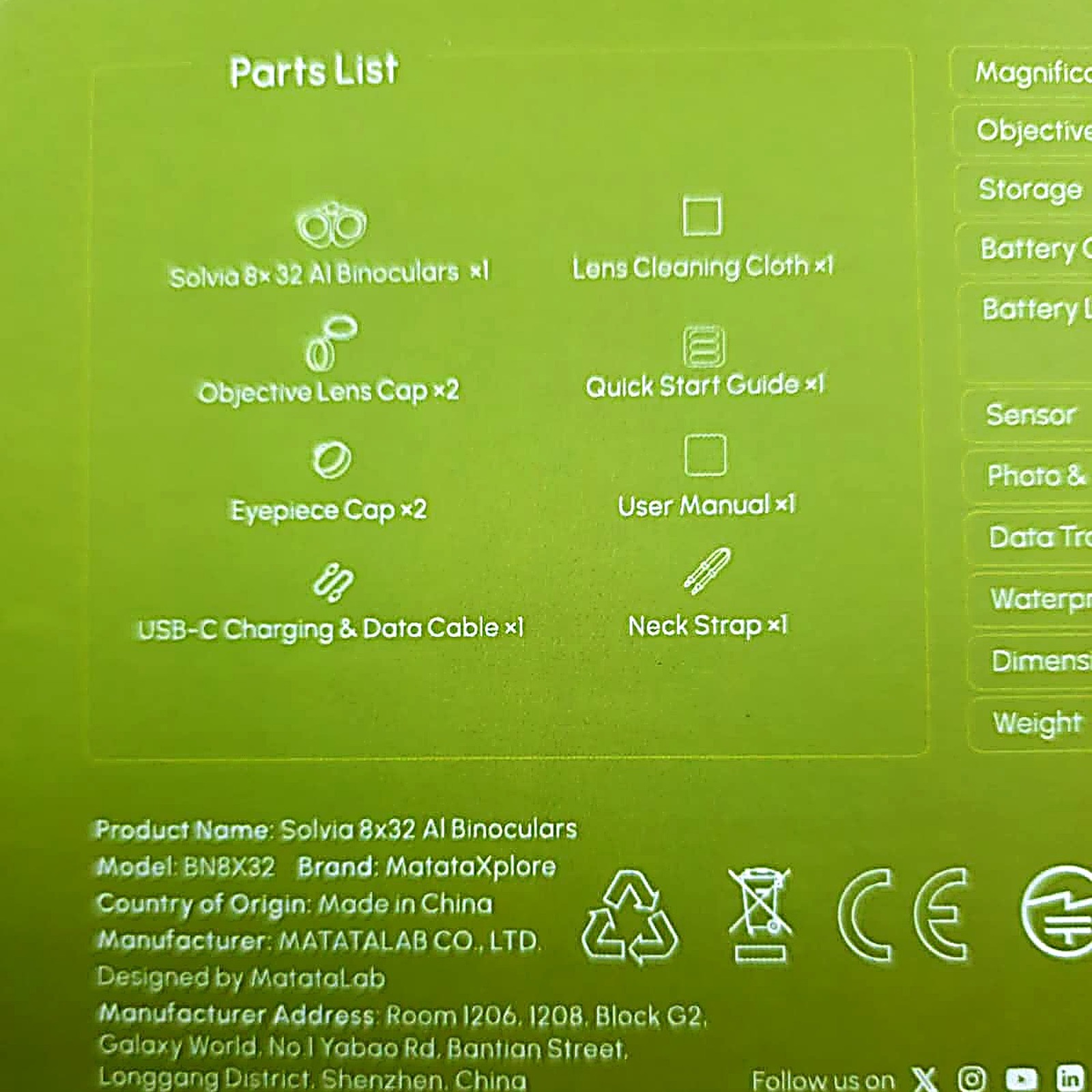
Printed parts list on the inside of the Solvia packaging, listing binoculars, two objective lens caps, two eyepiece caps, USB-C cable, lens cleaning cloth, quick start guide, user manual, and neck strap
The official parts list printed inside the box, which matches what we found — and confirms the carrying case isn't part of the Base package.

Optical Performance

The Solvia uses ED (extra-low dispersion) glass elements to reduce chromatic aberration — the purple or green fringing visible along high-contrast edges in cheaper optics. In our testing, the Solvia delivered impressively clean images with minimal colour fringing even at the edges of the 7.6-degree field. The 8×32 format is the sweet spot for daytime outdoor observation: enough magnification for detailed bird identification, a wide enough field for scanning treelines, and compact enough for all-day carry.

Daylight Performance

In good light, the Solvia 8×32 is outstanding. The 4mm exit pupil pairs well with daytime viewing, delivering bright, contrasty images with natural colour rendition. The WDR (Wide Dynamic Range) processing helps preserve detail in high-contrast scenes — like a bird silhouetted against a bright sky. The ED glass produces images that rival traditional binoculars costing considerably more. The 7.6° field of view (129.5m at 1,000m) provides a generous panorama for scanning shorelines and forest edges.

Low-Light Performance

The 32mm objective is the limiting factor here. Compared to 42mm or 50mm binoculars, the Solvia gathers significantly less light. At dawn and dusk — prime birding times — the image dims noticeably. The electronic viewfinder's gain boost helps, but it introduces noise that can obscure fine detail. For strictly daytime use this is not an issue, but if you regularly bird in low-light conditions (forest understorey, overcast days, early morning), a 42mm binocular will serve you better optically. See our astronomical binoculars guide for larger-aperture recommendations.

EIS Stabilisation Note: The Electronic Image Stabilization is a genuine highlight. When viewing at 8× handheld, stabilisation is not strictly necessary, but when you activate the camera's zoom or try to identify a distant bird, the EIS makes a noticeable difference. The high-precision gyroscope detects hand movements and the algorithm smooths the image in real time. On a bumpy boat ride during a seabird survey, the difference between EIS on and off was dramatic.

AI Recognition & Smart Features

The headline feature of the Solvia 8×32 is its AI-powered recognition system. The binoculars have a built-in offline bird identification model trained on over 100GB of data covering more than 10,000 bird species. Frame a bird in the viewfinder, press the AI button, and within about one second the species name appears on the screen with a confidence percentage.

Offline Bird Recognition

The offline model is fast and impressively accurate. In good light with the bird occupying at least 5% of the frame at 5–25 metres, we observed accuracy well above 90% against species we had independently confirmed. Common species were identified instantly. Less common species — a wood thrush partly obscured by leaves — took a moment longer but was still correctly identified. The offline model does not require an internet connection, which is a major advantage for remote birding locations.

Cloud-Based Plant & Animal Recognition

When connected to Wi-Fi or a phone hotspot, the companion app provides cloud-based recognition for tens of thousands of plant and animal species. Upload a photo and the app returns an identification — similar to iNaturalist but integrated directly into the binocular workflow. During our testing, we identified native wildflowers, a milk snake, and several tree species. The cloud model is slower than the offline bird model (several seconds for a result) but covers a much broader range.

Accuracy Note: Accuracy drops significantly in poor light, when the subject is small in the frame, or when the background is cluttered. The manufacturer's stated conditions for up to 98% accuracy are: good lighting, subject within 25 metres, and occupying at least 5% of the frame against a clear background. Our real-world experience suggests 85–90% — still impressive for a handheld device.

Photo & Video Capture System

Coaxial Design

One of the most innovative aspects of the Solvia is its coaxial optical design. The camera shares the same optical path as the eyepiece via a beam-splitter, meaning what you see is exactly what the camera captures. This eliminates the parallax issues that plague phone-through-binoculars digiscoping and makes framing natural and intuitive.

Shooting Modes

Four built-in modes: Auto Action (fast shutter for birds in flight), Auto Handheld (balanced for everyday use), Auto Static (tripod-optimised for longer exposures), and Manual (full ISO, shutter, white balance control). The 1/2.7" CMOS sensor captures photos and video at 2592×1936 — image quality that's perfectly adequate for social media sharing and species documentation.

Image Quality Note: Photos from the 1/2.7" CMOS sensor are comparable to an older smartphone. The key advantage is the 8× optical zoom giving an effective 400mm telephoto — something no smartphone can match without a separate telephoto lens. For social media sharing and species documentation, the quality is perfectly adequate. The EIS stabilisation produces smooth, usable video footage from a static position.

Smart App & Sharing

Live View & Media Transfer

The Solvia Smart App connects via direct Wi-Fi (no internet required for the connection itself). Once paired, the app mirrors the binoculars' live view on your phone screen — useful for showing others what you are seeing without handing over the binoculars. Transferring photos and videos is straightforward: select files on the touchscreen, tap share, and they transfer over Wi-Fi. A 5MB photo transfers in about 2–3 seconds.

Sharing & Social Integration

From the app, you can share directly to social media, messaging apps, or birding communities. The companion app also provides access to cloud-based AI recognition for plants and animals, AI enhancement tools (low-light boost, deblurring), and a gallery for managing observations. The app interface is clean and intuitive, though first-time pairing requires following a specific sequence — after initial setup, reconnection is automatic.

Pros & Cons

Pros

  • Innovative coaxial design eliminates digiscoping parallax
  • Fast, accurate AI bird ID — 10,000+ species offline, ~1 second recognition
  • Excellent ED glass with minimal chromatic aberration for the price
  • Lightweight at 680g — substantially lighter than smart binocular competitors
  • EIS stabilisation makes a real difference for long-range ID and video
  • Roughly 10× cheaper than the Swarovski AX Visio with comparable smart features
  • IP64 weather resistance — usable in light rain and dusty environments

Cons

  • 32mm objective limits low-light performance vs 42mm/50mm binoculars
  • Battery drops to 3–4 hours with intensive recording and AI use
  • Touchscreen attracts fingerprints — minor but persistent field annoyance
  • 2592×1936 photo resolution adequate for documentation, not fine-art prints
  • First-time Wi-Fi pairing requires following a specific sequence
  • Cloud AI for plants/animals needs a phone hotspot in the field
  • Not designed for astronomy — small objective and electronic viewfinder limit night-sky use
View Solvia 8×32 on MatataXplore.com →

Affiliate link — we may earn a commission at no extra cost to you.

Solvia 8×32 vs Competitors

Solvia vs Smart & Traditional Binoculars

Feature Solvia 8×32 ★ Swarovski AX Visio Nikon Monarch M7 8×30
Price$399–$549~$4,500~$500
Magnification10×
Objective32mm32mm30mm
Field of View7.6°6.4°8.3°
Weight680g1,090g670g
AI Recognition10,000+ species (offline)Birds, mammals, insectsNo
Photo/Video2592×1936 (photo/video)HD 1280×720No
Touchscreen2.8" HDLimited displayNo
StabilizationEISNoNo
Battery Life9–12hUp to 15h / 2h smartN/A
Weather RatingIP64, nitrogen-filledWaterproofWaterproof, fogproof

* Prices approximate — check MatataXplore and Amazon for current listings.

Solvia 8×32 vs Traditional Binoculars

Solvia vs Standard 8×32 Binoculars

Against a traditional 8×32 binocular at the same price point (e.g., Nikon Monarch M7 8×30), the Solvia's optical quality is comparable — ED glass delivers clean, contrasty images with minimal chromatic aberration. The Solvia adds AI recognition, photo/video capture, EIS stabilisation, and Wi-Fi sharing. The traditional binocular has no battery to manage and will last decades without electronic failure. The Solvia does things no traditional binocular can do, but it introduces complexity and battery dependency.

Solvia vs Swarovski AX Visio

The Swarovski AX Visio costs roughly 10× more than the Solvia. The Solvia has a higher-resolution camera, a larger touchscreen (2.8" vs limited display), built-in EIS stabilisation (the Swarovski lacks this), and is significantly lighter (680g vs 1,090g). The Swarovski has superior optical glass and 10× magnification. For most users, the Solvia offers dramatically better value.

Who Should Buy the Solvia 8×32?

Ideal Buyer ✓

  • ✓ Birdwatchers who also want documentation in one device
  • ✓ Hikers and nature enthusiasts who value portability
  • ✓ Travellers wanting to travel light without sacrificing optics
  • ✓ Families sharing the outdoor experience via live view
  • ✓ Anyone frustrated with phone-through-binoculars digiscoping

Consider Alternatives ⚠

  • ⚠ Primary use is astronomy — 10×50 or larger binoculars are better
  • ⚠ Want absolute best optical glass without electronics
  • ⚠ Tight budget — traditional binoculars offer better value at lower price points

Not Recommended For ✗

  • ✗ Serious astronomy (small objective, electronic viewfinder)
  • ✗ Professional-quality bird photography (1/2.7" CMOS sensor is adequate, not exceptional)
  • ✗ Users needing all-day intensive recording without power bank

Ready to Buy the Solvia 8×32?

Solvia 8×32 AI Binoculars

Available in two configurations starting at $399. All models in stock and ready to ship.

Affiliate link — we may earn a small commission at no extra cost to you.

Alternatives to the Solvia 8×32

The Solvia 8×32 is the best-value smart binocular on the market — but it's not right for everyone. Here are the most relevant alternatives depending on your budget and priorities.

Frequently Asked Questions

Are Solvia binoculars good for astronomy?

The Solvia 8×32 is designed primarily for daytime outdoor observation. The 32mm objective gathers less light than dedicated astronomy binoculars. For astronomy, we recommend 10×50 or larger binoculars.

How accurate is the AI bird identification?

In good light at 5–25 metres, the offline AI model achieves well above 90% accuracy on common species. The manufacturer claims up to 98% under ideal conditions. Real-world accuracy was approximately 85–90% in our testing.

Do the Solvia binoculars need an internet connection?

Bird identification works entirely offline with 10,000+ species stored on the binoculars. Plant and animal identification via the companion app requires an internet connection for cloud-based AI.

What is the battery life in real-world use?

Normal use: 9–12 hours. Intensive use with continuous video and AI: 3–4 hours. USB-C charging while operating is supported.

How does the Solvia compare to the Swarovski AX Visio?

The Solvia costs roughly one-tenth the price (~$4,500). The Solvia has a higher-resolution camera, larger touchscreen, EIS stabilization, and lighter weight (680g vs 1,090g).

Which Solvia model should I buy?

The Plus model is our recommendation — it adds 64GB storage and a tripod adapter. The Base is fine for light use.

Is the Solvia 8×32 worth it in 2026?

Yes, if you want the best value smart binocular. It combines ED glass, offline AI bird ID, photo/video capture, and EIS at a price no competitor matches.

What is included in the box?

Base: binoculars, eyepiece and objective lens covers, neck strap, USB-C cable, cleaning cloth, user manual, and a 16GB SD card — no carrying case. Plus: adds a carrying case, tripod adapter, and 64GB SD card.

Can I use the Solvia binoculars with glasses?

Yes. Diopter adjustment ranges from -4 to +4. 16mm eye relief is adequate for eyeglass wearers. Twist-up eyecups have intermediate positions.

How does the photo quality compare to a smartphone?

The 1/2.7" CMOS sensor produces images comparable to an older smartphone. The advantage is the 8× optical zoom giving an effective 400mm telephoto. Quality is adequate for social media and species documentation.