Telescope Accessories: Prime Big Deal Days 2026 Deals
Telescope Advisor Logo Telescope Advisor
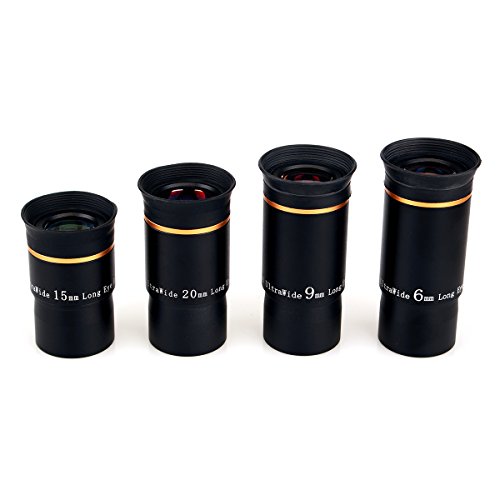
Telescope eyepieces and accessories laid out — accessory deals for Amazon Prime Big Deal Days on October 6-7, 2026

Deals Guide · Accessories · October 6–7, 2026

Telescope Accessory Deals: Prime Big Deal Days 2026

If you already own a telescope, this sale matters more to you than to anyone buying their first one. Accessories are where percentage discounts run deepest and where a single purchase can transform an instrument you have owned for years. And because October is the start of the observing season, everything you buy now gets used within days.

Sale windowOct 6–7, 2026
Typical discount20–35% off
Deepest cutsEyepieces, filters, Barlows
Worth waiting for Nov?No — buy in October
By Telescope Advisor Editorial Team Published: Updated: Reviewed & approved by Juhi Sahni, Senior Editor Editorial Standards

Quick Answer: What Should You Actually Buy in This Sale?

Buy in this order of impact: a Barlow lens, a moon filter, then one genuinely good wide-field eyepiece. Those three purchases improve almost any telescope more than anything else you can add, and together they usually cost less than a single mid-range eyepiece.

  • A Barlow lens doubles the magnification of every eyepiece you already own. It is the cheapest way to extend what your current set can do, and it is the single highest-value accessory in amateur astronomy.
  • A moon filter makes high-power lunar viewing comfortable. The Moon at 150x is genuinely painful to look at without one. This is the accessory people most often skip and most often regret skipping.
  • One good wide-field eyepiece transforms the experience. A wider apparent field makes objects easier to find and far more pleasant to look at, which matters most for anyone still learning the sky.
  • A red-dot finder fixes the most common entry-level frustration. Factory finder scopes that never quite align with the main tube are the single biggest cause of a first session ending in nothing found.
  • Accessories do not get deeper discounts in November. The categories below discount at similar percentages at both events, and buying now means using them through the autumn season rather than storing them.

Everything on this page was verified as in stock and purchasable on September 17, 2026. Live prices shown are timestamped at page load.


🔭

Not sure which telescope actually fits your goals?

Answer 5 quick questions about your budget, observing targets, and experience level — our Telescope Finder Tool recommends a specific model in under 2 minutes.

Find My Telescope →

Why Accessories Are the Real Deal in This Sale

Discount depth in astronomy retail runs inversely to the price of the item. Expensive instruments carry thin margins and steady year-round demand, so they get modest reductions. Low-cost accessories carry wide margins and are used to build bundles, so they get cut freely. During a Prime event, eyepieces, filters, and Barlows routinely see reductions of 20–35% while telescopes in the same catalogue see 10–20%.

There is a second, less obvious reason to buy accessories in October specifically. A telescope purchase is a commitment you may want to research for weeks. An eyepiece is not. The downside risk of buying a 30-dollar filter on impulse is close to zero, and the upside is a better observing session on the next clear night — of which October offers a good number.

The October timing advantage

Accessory purchases in December often sit in a box until spring. The same purchase in early October is used within a week: Saturn is past opposition on October 4 and still well placed, the Orionids peak on October 21–22, and the autumn deep-sky catalogue is at its best. There is no price advantage to waiting for November, and there is a real usage advantage to buying now.


Next Best Step

Need the fastest next step?

Pick the path that matches where you are right now: get a recommendation, compare buyer guides, or narrow by budget.

Open Finder Tool →

🎄 Holiday season: Telescope Christmas Gift Guide 2026 · Smart telescope Black Friday deals

Eyepieces and Barlows

These four purchases cover the range from "extend what you have" to "genuinely upgrade your view". If you only buy one thing in this sale, buy the Barlow.

Buy This First — Highest Value Accessory
Celestron Omni 1.25 inch 2x Barlow lens for telescope eyepieces

Celestron Omni 2x Barlow Lens

2x magnification1.25-inch barrelFully multi-coatedWorks with most eyepieces

A Barlow lens sits between your eyepiece and the telescope and doubles the effective magnification. That means every eyepiece you own now covers two magnifications instead of one — a three-eyepiece collection behaves like six. It is the cheapest meaningful upgrade in amateur astronomy, and it is the accessory that most often turns a disappointing high-power view into a usable one. The Omni is fully multi-coated glass rather than a plastic spacer, which matters: a poor Barlow adds glare and softens the image, and there is no point saving a few dollars to make your telescope worse.

Pros

  • Doubles the usable magnification range of your existing eyepieces
  • Cheapest meaningful upgrade available for any telescope
  • Fully multi-coated optics — not a plastic spacer
  • Fits any telescope accepting 1.25-inch eyepieces

Cons

  • Adds glass to the light path, so contrast drops very slightly
  • Doubling magnification also doubles the effect of poor seeing
  • Not a substitute for a dedicated high-power eyepiece

Our Verdict

If you own a telescope and you buy nothing else in this sale, buy this. It costs very little, it is discounted at both sales events at similar rates, and it improves every session from the night it arrives. There is no argument for waiting until November.

Price: $29.99 · Sep 17, 2026

Affiliate link — we may earn a commission at no extra cost to you.

Celestron X-Cel LX 7mm telescope eyepiece with wide apparent field
2Best High-Power Eyepiece

Celestron X-Cel LX 7mm Eyepiece

7mm focal lengthWide apparent fieldLong eye relief1.25-inch barrel

A 7mm eyepiece is the high-power workhorse of a typical amateur setup — enough magnification to show Saturn's rings and Jupiter's cloud belts clearly, without pushing past what the atmosphere will support on an average night. The X-Cel LX line is well regarded for genuinely comfortable eye relief, which is the specification nobody mentions until they have used an eyepiece that has none. If you wear glasses while observing, that matters more than any other number on the box.

Pros

  • Excellent eye relief — comfortable and usable with glasses
  • Wide apparent field makes high-power viewing less claustrophobic
  • A focal length that suits planetary and lunar work on most telescopes

Cons

  • High power demands decent atmospheric conditions to pay off
  • Overkill on a very small telescope with a short focal length

Our Verdict

The eyepiece to buy if planetary viewing is what you care about. Pair it with the Barlow above and you have coverage from medium to high power for very little money.

Price: $93.00 · Sep 17, 2026

Affiliate link — we may earn a commission at no extra cost to you.

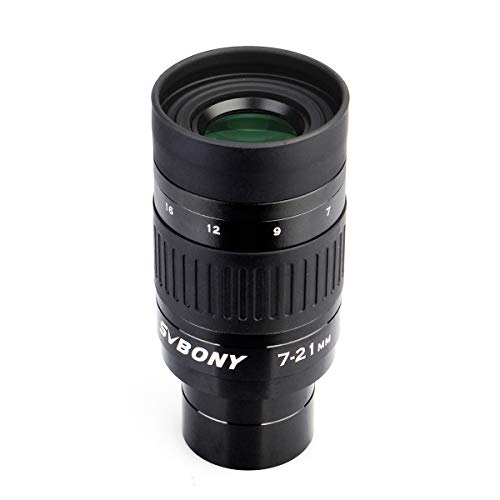
SVBONY SV135 7 to 21mm zoom telescope eyepiece
3Best for Finding Objects

SVBONY SV135 7-21mm Zoom Eyepiece

7–21mm rangeZoom1.25-inch barrelReplaces several eyepieces

A zoom eyepiece replaces several fixed eyepieces with one barrel and a twist ring. The practical advantage is not convenience for its own sake — it is that you can start at low magnification to find an object, then dial up gradually to the highest power the night will actually support, without swapping eyepieces and losing your target in the process. For beginners this is a genuinely useful learning tool, because it shows you directly how an object changes across the magnification range.

Pros

  • Find an object, then zoom in without losing it
  • One barrel instead of three or four in the case
  • Teaches you what your telescope can actually resolve

Cons

  • Narrower apparent field than good fixed eyepieces
  • Zoom mechanisms add moving parts that can wear
  • Optical quality is good rather than excellent

Our Verdict

The best single purchase for someone who is still learning to find things. If you already have a settled eyepiece collection and know your preferred magnifications, buy fixed eyepieces instead.

Price: $47.49 · Sep 17, 2026

Affiliate link — we may earn a commission at no extra cost to you.

Eyepiece Sets: Value or Trap?

Eyepiece sets get some of the deepest discounts in any astronomy sale, often 25–35%, because they are the classic bundle filler. The honest answer about whether to buy one depends entirely on what you already own.

Buy a set if…

  • You have one or two eyepieces and no real coverage of the magnification range
  • You are outfitting a second telescope or a travel kit
  • The set includes a Barlow, which is worth having on its own
  • You are buying for a beginner who needs options to experiment with

Skip the set if…

  • You already own good eyepieces at the focal lengths the set covers
  • The set duplicates focal lengths rather than filling gaps
  • You would rather have one excellent eyepiece than four adequate ones
  • The accessories bundled in (filters, cases) are things you would not buy deliberately

Two sets worth looking at during the sale, both verified in stock: the SVBONY SV131 Plossl 32mm as a single wide-field addition rather than a set, and the Alstar three-piece eyepiece and Barlow set as a genuinely low-cost way to fill out a beginner kit.

Celestron Omni 1.25 inch 32mm Plossl telescope eyepiece

Celestron Omni 32mm Plossl Eyepiece

A long-focal-length Plossl that gives the widest, brightest view a 1.25-inch barrel can deliver. The right eyepiece for finding objects and for large targets like the Pleiades and the Andromeda Galaxy.

Price: $49.99 · Sep 17, 2026

SVBONY SV131 32mm Plossl telescope eyepiece with 19mm eye relief

SVBONY SV131 Plossl 32mm Eyepiece

Comfortable eye relief at a wide field of view, which makes it a good match for observers who wear glasses. A sensible low-cost wide-field option.

Price: $30.99 · Sep 17, 2026

Alstar three piece telescope eyepiece set with Barlow lens

Alstar 3-Piece Eyepiece and Barlow Set

A complete low-cost spread of magnifications with a Barlow included. Best value for someone starting from a single factory eyepiece with no coverage of the range.

Price: $67.99 · Sep 17, 2026

SVBONY Gold Line wide angle telescope eyepiece set

SVBONY Gold Line Eyepiece Set

A step up in apparent field of view over basic Plossls. Worth the extra if you find narrow eyepieces fatiguing, or want a wider view at high magnification.

Price: $124.99 · Sep 17, 2026

Filters: Lunar, Colour, and Solar

Filters are the most misunderstood accessory category, largely because they are oversold. A filter will not turn a small telescope into a large one, and colour filters that promise to reveal detail on Jupiter rarely deliver much on an average night. Two filters, however, are genuinely worth owning, and one is a safety item rather than an accessory.

Celestron variable polarising moon filter for telescope eyepieces
1Best Filter Purchase

Celestron Variable Moon Filter

Variable polarisingAdjustable brightness1.25-inch barrelThreads onto eyepiece

The Moon at moderate to high magnification is genuinely uncomfortably bright — bright enough that your eye cannot adapt and surface detail washes out into glare. A variable polarising filter lets you dial the brightness down to whatever is comfortable for the current phase, which is what actually makes lunar detail visible. This is the accessory people most often leave out of their first order and most often buy later, wondering why nobody told them. It changes every lunar session you will ever have.

Pros

  • Adjustable, so it works across the whole lunar cycle
  • Transforms lunar observing from glare to visible surface detail
  • Threads directly onto standard 1.25-inch eyepieces
  • Cheap, and one of the few filters that reliably delivers

Cons

  • Only useful on the Moon and bright planets
  • Adds another glass surface to clean

Our Verdict

Buy it in the same order as any telescope or Barlow. If you observe the Moon at all — and everyone does — this is the accessory that most improves the experience for the least money. Discounted at both sales events at similar rates, so there is nothing to gain by waiting.

Price: $42.95 · Sep 17, 2026

Affiliate link — we may earn a commission at no extra cost to you.

Filters to think twice about

  • Colour filter sets. Inexpensive and frequently bundled, but they do very little on a small telescope. On a 70mm or 90mm instrument, the light you lose is more damaging than any contrast the filter adds.
  • Light-pollution filters. These can help on emission nebulae, but they are not a substitute for dark skies and do almost nothing on galaxies or stars. Worth owning if you observe nebulae from a city; oversold otherwise.
  • Any solar filter that attaches at the eyepiece. These are dangerous and must never be used. See the section below.

Solar Safety — Read Before Buying Any Solar Filter

Solar observing is one of the most rewarding parts of the hobby, and it is the only part that can cause permanent injury in under a second. The rules are simple, absolute, and worth reading before you spend anything:

  • Only ever use a full-aperture filter that fits over the front of the telescope. It blocks the sunlight before it enters the optics, which is the only safe place to block it.
  • Never use a filter that screws onto the eyepiece. These were sold historically and are dangerous. The concentrated sunlight and heat can crack the filter, and the eye behind it takes the full beam with no warning.
  • Never use solar filters on a finderscope unless it is capped or removed. A finder left uncovered will burn through or injure.
  • Inspect the filter film before every session. Look for pinholes, scratches, creases, and lifted edges by holding it up to a bright light. Any damage means the filter is finished — replace it, do not patch it.
  • Secure the filter so it cannot be blown or knocked off. A filter that comes off a telescope pointed at the Sun is the single most dangerous failure mode in amateur astronomy.
  • Supervise children at all times. Never leave a child alone with a telescope aimed anywhere near the Sun.

Eclipse glasses and handheld solar viewers are a separate product and are not a substitute for a telescope filter — they are worn on the face for naked-eye viewing. Do not look through a telescope, binoculars, or a camera viewfinder while wearing eclipse glasses on a telescope; the glasses are not rated for the magnified beam.

Celestron EclipSmart full aperture solar filter for telescope

Celestron EclipSmart Solar Filter

A correctly designed front-mounted solar filter that blocks sunlight before it enters the telescope. Fits the corresponding Celestron models — check the fitment list before ordering.

Price: $26.95 · Sep 17, 2026

Celestron EclipSmart universal full aperture solar filter

Celestron EclipSmart Universal Solar Filter

A front-mounted universal solar filter that fits a range of objective diameters, with securing straps. Never use any solar filter that attaches at the eyepiece.

Price: $21.95 · Sep 17, 2026

Celestron EclipSmart 12x50 solar binoculars with built-in filters

Celestron EclipSmart 12x50 Solar Binoculars

Binoculars with solar filters built in at the factory rather than added as an accessory, which removes the risk of fitting one incorrectly. A good option for anyone wanting a simple, safe way to observe the Sun.

Price: $99.99 · Sep 17, 2026

Solar observing rules vary by jurisdiction and by product certification. Always follow the manufacturer’s instructions and check the safety certification marking on any solar product before use.

Finders and Phone Adapters

These are the small purchases that solve specific irritations. A replacement finder fixes the most common problem with entry-level telescopes, and a phone adapter is what turns an evening’s observing into something you can show someone else.

Celestron StarPointer red dot finderscope for telescopes
1Best Small Fix

Celestron StarPointer Red Dot Finderscope

Red dot projectionTool-free alignmentFits most telescopesWide field

A red-dot finder projects a small illuminated dot onto a window so that wherever the dot appears, the telescope is pointing. Unlike a magnifying finder scope, both eyes stay open and you see the whole sky, which makes aiming instinctive rather than a process of trial and error. Most entry-level telescopes ship with a finder that struggles to hold alignment; replacing it costs very little and removes the single biggest cause of a beginner session ending with nothing found.

Pros

  • Aiming becomes intuitive — no squinting through a tiny inverted view
  • Both eyes open, so you keep your bearings in the sky
  • Inexpensive fix for the most common entry-level frustration

Cons

  • Not usable in bright daylight
  • Alignment drifts and needs occasional re-setting
  • Requires a dovetail or bracket compatible with your telescope

Our Verdict

If your current finder never quite lines up with the main tube, this is the fix and it costs less than a couple of eyepiece caps. One of the highest satisfaction-per-dollar purchases in astronomy.

Price: $23.95 · Sep 17, 2026

Affiliate link — we may earn a commission at no extra cost to you.

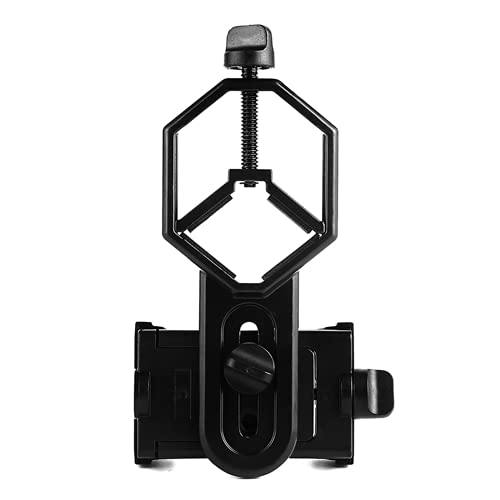
SVBONY universal smartphone adapter for telescope eyepieces

SVBONY Universal Phone Adapter

A low-cost clamp that holds a phone over the eyepiece so you can photograph what you are looking at. The cheapest way to find out whether you enjoy astrophotography before investing in a dedicated camera.

Price: $10.99 · Sep 17, 2026

GOSKY universal smartphone adapter for telescope and spotting scope

GOSKY Universal Phone Adapter

A more adjustable adapter that also fits spotting scopes and binoculars. Worth the small premium if you want finer control over alignment when framing a shot.

Price: $22.99 · Sep 17, 2026

Mounting, Carry, and Storage

The least exciting category on this page, and the one that determines how often you actually use the telescope. A tripod that is quick to deploy, and a bag that makes carrying everything in one trip possible, are what turn a telescope from an occasional undertaking into a habit.

Amazon Basics 60 inch lightweight tripod

Amazon Basics 60-inch Lightweight Tripod

A general-purpose lightweight tripod that works well for mounting heavy astronomy binoculars — which is the single biggest improvement you can make to a 15x70 pair.

Price: $32.99 · Sep 17, 2026

Dwarflab mini tripod with hydraulic head for smart telescopes

Dwarflab Mini Tripod with Hydraulic Head

A compact tripod designed for smart telescopes, with a hydraulic head that makes fine framing adjustments smooth. Frequently discounted alongside the Dwarf models during Prime events.

Price: $89.00 · Sep 17, 2026

Celestron 40 inch protective telescope carrying bag

Celestron 40-inch Protective Carrying Bag

A padded bag sized for full-length refractors and tripods. The practical benefit is being able to carry the whole setup in one trip, which is what determines how often it gets used.

Price: $104.99 · Sep 17, 2026

Hard travel case for Dwarflab Dwarf Mini smart telescope

Hard Travel Case for Dwarf Mini

A rigid case with fitted foam for the Dwarf Mini. Worth buying if the telescope travels in a pack or a car, where a soft bag offers limited protection.

Price: $28.99 · Sep 17, 2026

Astromania 2 inch planetary colour filter for telescopes

Astromania 2-inch Planetary Filter

A 2-inch planetary filter for use on larger telescopes. Be realistic about what colour filters deliver on a small instrument — they matter most where there is enough aperture to spare the light.

Price: $31.99 · Sep 17, 2026

Availability and prices change without notice. Live prices shown on the cards are timestamped at page render. All product links are affiliate links — see our editorial standards for how we select products.

The Right Order to Buy In

If you are building up an accessory collection rather than buying everything at once, this order gives the most improvement per purchase. It is the sequence we would follow ourselves.

1

Barlow lens

Doubles the range of everything you own. Buy this before any additional eyepiece.

2

Variable moon filter

The Moon is the object you will look at most often. Make looking at it comfortable.

3

A red-dot finder, if yours struggles

Fixes the most common reason a session ends without finding anything.

4

One good wide-field eyepiece

The purchase that changes how viewing feels, not just how much you can see.

5

Phone adapter

Only once the above are sorted. Photographing a view you are not yet enjoying gets the priority backwards.


Continue Exploring

Keep the session going with the next useful answer

Choose the next page based on whether you need a recommendation, a comparison, or a practical observing plan.

Use Finder Tool →

🎄 Holiday season: Telescope Christmas Gift Guide 2026 · Black Friday deal tracking

Frequently Asked Questions

Do telescope accessories go on sale during Prime Big Deal Days?

Yes, and more deeply than telescopes do. Eyepieces, filters, and Barlows typically see 20–35% off during Prime events, compared with 10–20% on the telescopes themselves. Accessories carry wider retail margins and are used to build bundles, which is why retailers discount them freely.

Should I buy accessories in October or wait for Black Friday?

Buy in October. Eyepiece, filter, and Barlow discounts land in the same range at both events, so waiting gains you very little, while buying now means using the accessories through the autumn observing season — Saturn past opposition, the Orionids in late October, and the best of the autumn deep sky.

What is the single best accessory to buy first?

A Barlow lens. It doubles the effective magnification of every eyepiece you already own, which makes it the cheapest meaningful upgrade available. It is also among the least expensive items in any astronomy catalogue, so the risk of buying one is essentially nil.

Are eyepiece sets worth buying on sale?

They are good value if you currently have little magnification coverage, and poor value if you already own decent eyepieces at those focal lengths. Check whether the set fills gaps in what you own or duplicates it. A set that includes a Barlow is more defensible, because you would want the Barlow anyway.

Is a solar filter a safe purchase?

A full-aperture filter that fits over the front of the telescope is safe when used correctly and inspected before every session. Never use a solar filter that screws onto the eyepiece — those are dangerous and should not be used at all. Always cap or remove the finderscope, secure the filter so it cannot be knocked off, and supervise children at all times.

Do I need a moon filter if I only observe occasionally?

Yes — the Moon is the one object almost everyone looks at, and it is the object that benefits most from a filter. At moderate to high magnification the Moon is bright enough to be uncomfortable and to wash out surface detail. A variable filter solves it for very little money.

Will accessories work with any telescope?

Most eyepieces, Barlows, and filters use standard 1.25-inch or 2-inch barrels and fit almost any telescope that accepts those sizes. Mount-specific items, solar filters, and carrying cases are usually model-specific, so check the fitment list carefully. If you are unsure of your barrel size, measure the eyepiece holder or check the telescope specification before ordering.