Prime Big Deal Days vs Black Friday: Buy a Telescope?
Telescope Advisor Logo Telescope Advisor
A star-filled night sky — deciding between Prime Big Deal Days in October and Black Friday in November for a telescope purchase

Deals Guide · October 6–7 vs November 27

Buy on Prime Big Deal Days, or Wait for Black Friday?

Two sales, seven weeks apart, and a genuinely different answer depending on what you are buying. This page gives you the verdict for your category, the observing you forfeit by waiting, and the cases where waiting is simply the wrong call.

October windowOct 6–7 — nearer
November windowNov 27–30 — deeper
Buy in OctoberAccessories, smart scopes, entry & mid-range
Wait for NovemberLarge SCTs, premium mounts, cameras
By Telescope Advisor Editorial Team Published: Updated: Reviewed & approved by Juhi Sahni, Senior Editor Editorial Standards

Quick Answer

Buy in October if you are shopping accessories, a smart telescope, or an entry-level or mid-range instrument. Wait for Black Friday if you are buying a large Schmidt-Cassegrain, a premium mount, or dedicated astrophotography gear.

Buy on Oct 6–7

  • Eyepieces, filters, Barlows
  • Smart telescopes
  • Beginner kits and tabletop Dobs
  • Binoculars
  • Anything you want to use this autumn

Either is fine

  • Mid-range GoTo telescopes
  • Large Dobsonians (8-inch and up)
  • Gift purchases for December

Wait for Nov 27

  • Large Schmidt-Cassegrains
  • Premium equatorial mounts
  • Astrophotography cameras and filters
  • Anything where 5–10% more off matters

The reasoning behind each verdict is below, along with the part most buying guides skip: what you actually give up by waiting seven weeks, which in October is more than you might expect.


🔭

Not sure which telescope actually fits your goals?

Answer 5 quick questions about your budget, observing targets, and experience level — our Telescope Finder Tool recommends a specific model in under 2 minutes.

Find My Telescope →

How the Two Events Actually Differ

People often assume the later sale is simply the better version of the earlier one. That is true for retail in general and false for telescopes in particular. The two events differ in three ways that matter:

Depth is not uniform across categories

Black Friday is deeper on average, but the average hides the useful detail. Deep cuts concentrate in high-value instruments with holiday gift appeal. Accessories, meanwhile, are the item retailers use to pad out bundles, and they get discounted aggressively at both events — frequently at identical percentages.

Stock behaves differently

October offers a wide selection. By late November, popular models are being bought for Christmas and the good listings start selling through. A deeper discount is worth nothing if the model you researched for three weeks is out of stock, which is a real risk in the final days of November.

Only one of them lands in observing season

This is the difference no price table captures. October 6 sits in the middle of the best observing week of the autumn. November 27 sits in a period of long nights, frequent cloud, and cold — good for astronomy in principle, harder in practice. Buy in October and you have eight usable weeks before the holidays. Buy in November and your first light may be a Christmas morning.

Category-by-Category Verdict

Find your category and take the verdict. The reasoning column is the part worth reading — the verdict without the reason is just a guess somebody else made.

What You Are Buying Verdict Why
Eyepieces, filters, Barlows Buy in October Discount rates match November, the items are cheap enough that the difference is trivial, and having them on hand improves every session from October onward.
Smart telescopes Buy in October The most competitive category in astronomy right now, and Prime events are where brands push hardest. October cuts are frequently as deep as November cuts.
Beginner refractors and tabletop Dobs Buy in October These are the models that sell out before Christmas. Buying now means choosing from full stock rather than from what is left in December.
Binoculars Buy in October Same discount depth either way, and binoculars are the single best autumn purchase on this list — they suit the season better than any telescope.
Mid-range GoTo telescopes Either — lean October Discount percentages are close between the events. October wins on stock and on the weeks of use you gain; November wins slightly on price.
Large Dobsonians (8-inch and up) Either — take a real cut if you see one Discounts are inconsistent at both events. If a genuine reduction appears in October, take it; waiting seven weeks for an uncertain one is not a strategy.
Large Schmidt-Cassegrains Wait for November The clearest case on this page. These instruments see their deepest annual cuts during Black Friday week, and the extra discount usually exceeds anything October offers.
Premium equatorial mounts Wait for November Heavy, expensive, and usually bought as part of a planned imaging setup rather than on impulse. Neither event cuts them dramatically, but November cuts them more.
Astrophotography cameras Wait for November The electronics-heavy end of the hobby follows consumer-electronics discount cycles more than telescope cycles, and that cycle peaks in late November.


Next Best Step

Need the fastest next step?

Pick the path that matches where you are right now: get a recommendation, compare buyer guides, or narrow by budget.

Open Finder Tool →

🎄 Holiday season: Telescope Christmas Gift Guide 2026 · Smart telescope Black Friday deals

The Real Cost of Waiting Seven Weeks

Waiting is usually framed as free. It is not. Between October 7 and November 27 the sky offers a specific set of things, and none of them come back this year:

Saturn’s best apparition of the year

Saturn reached opposition on October 4 — at its closest, brightest, and visible all night. By late November it is still observable but noticeably past its peak, and the window after sunset is shorter. This is the single most rewarding first target in amateur astronomy, and you would be buying the telescope immediately after its best month.

A lunar occultation of Jupiter

On the morning of October 6 the Moon passed in front of Jupiter and hid it for roughly an hour. Occultations of bright planets are uncommon and this one fell on the first morning of the sale. If you were watching for it without a telescope, that is a genuine cost of having waited.

The Orionid meteor shower

Peaking October 21–22 from Halley’s Comet debris. A naked-eye event, but meteor watching is far more enjoyable with binoculars or a wide-field telescope pointed at the radiant region between bursts.

Eight weeks of autumn deep-sky observing

The Andromeda Galaxy, the Pleiades, the Double Cluster, the Orion Nebula rising late, and the whole autumn Milky Way. These are the objects that make people stay in the hobby. Waiting until late November to buy means losing most of that window to the shorter, colder nights that follow.

Putting a number on it: if October saves you nothing at all and November saves you 5–10% more, you have traded roughly eight weeks of observing for a modest percentage on a telescope you will own for a decade. For premium instruments where the difference is larger and the season matters less, that trade is worth it. For a first telescope or an accessory, it usually is not.

Buy Now: Our October Picks

These are the purchases where the October window is the right call — either because the discount is as good as November’s, or because the season matters more than the last few percent. All verified in stock as of September 17, 2026.

Buy in October — Best First Telescope
Sky-Watcher Heritage 130P collapsible tabletop Dobsonian telescope

Sky-Watcher Heritage 130P Tabletop Dobsonian

130mm parabolic mirror650mm focal lengthCollapsible tubeTabletop base

The telescope to buy now if you want to observe this autumn. A 130mm parabolic mirror is enough to resolve Saturn's rings cleanly, show Jupiter's cloud belts, split the Double Cluster, and reveal the bright galaxies in the Virgo cluster — and it collapses into a package small enough to store in a cupboard. Buying it in October rather than November means eight extra weeks with exactly the targets this instrument handles best.

Pros

  • Best aperture-per-cost in its class, with a parabolic mirror
  • Collapses for storage and travel
  • Nothing electronic to fail, charge, or update
  • Ready for Saturn tonight with no extras

Cons

  • Needs a genuinely stable tabletop surface
  • Open tube admits stray light
  • Manual push-to, so you must learn to star-hop

Why buy now

Entry and mid-range telescopes sell through before Christmas, and this is the model that disappears first. The October discount is competitive with November, and every clear night between now and December is one you would otherwise spend waiting.

Price: $305.00 · Sep 17, 2026

Affiliate link — we may earn a commission at no extra cost to you.

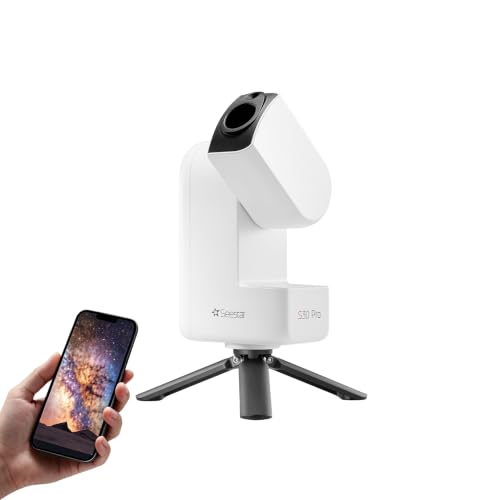
ZWO Seestar S30 Pro app-controlled smart telescope
2Buy in October

ZWO Seestar S30 Pro Smart Telescope

App-controlledGoTo and live stackingPortable all-in-oneNo astronomy experience needed

Smart telescopes are the strongest October recommendation on this page for a simple reason: it is the one high-cost category where October discounts are consistently as deep as November ones. The market is crowded, brands are competing for the same buyers, and Prime events are the moments they push hardest on price. This one finds objects, tracks them, and stacks the exposures into a finished image you can look at immediately — no polar alignment, no guiding, no processing.

Pros

  • Produces real deep-sky images with no experience
  • Works from light-polluted suburban skies
  • No alignment routine to learn
  • Set it running and check back on your phone

Cons

  • You are imaging, not looking through an eyepiece
  • Small aperture for the money
  • Software quality varies between firmware releases

Why buy now

Because October is the one premium-adjacent category where waiting has no clear payoff. If a smart telescope is on your list, the strongest argument for waiting seven weeks does not exist here.

Price: $699.00 · Sep 17, 2026

Affiliate link — we may earn a commission at no extra cost to you.

Celestron Omni 1.25 inch 2x Barlow lens for telescope eyepieces
3Buy in October

Celestron Omni 2x Barlow Lens

2x magnification1.25-inch barrelFully multi-coatedFits most eyepieces

The highest-value accessory purchase in amateur astronomy, and the clearest example of why waiting is pointless. A 2x Barlow doubles the effective magnification of every eyepiece you own, so a modest collection suddenly covers twice the range. It costs very little, it is discounted aggressively at both October and November events, and the difference between the two sales amounts to pocket change.

Pros

  • Doubles the usable range of every eyepiece you already own
  • Cheapest meaningful upgrade available for any telescope
  • Fully multi-coated glass, not a plastic spacer

Cons

  • Adds glass to the light path, so contrast drops slightly
  • Not a substitute for a genuinely high-power eyepiece

Why buy now

Because the amount you might save by waiting is measured in a couple of dollars, while the number of sessions it improves between October and November is not. If you buy a telescope in this sale, add this to the same order.

Price: $29.99 · Sep 17, 2026

Affiliate link — we may earn a commission at no extra cost to you.

Wait: What November Does Better

Being honest about when waiting wins matters as much as the rest of this page. There is a real category of purchase where the seven-week wait is correct, and pretending otherwise sends people to buy the wrong thing at the wrong time.

Wait for Black Friday — Deepest Cuts Land in November
Celestron NexStar 8SE computerized Schmidt-Cassegrain telescope

Celestron NexStar 8SE Schmidt-Cassegrain

203mm aperture2032mm focal lengthGoTo alt-az mount40,000+ object database

Large Schmidt-Cassegrains are the clearest case for waiting. They carry thin margins, their demand is steady year-round, and they are exactly the sort of high-value item retailers discount hardest during Black Friday week. October cuts on this class of instrument have historically been shallower than what November delivers. The counter-argument is real but weaker than it looks: an 8-inch telescope has a learning curve, and starting that learning in December rather than October costs you little, because you will be spending the first weeks learning the alignment routine rather than chasing objects.

Pros

  • 203mm of aperture in a tube that fits in a cupboard
  • GoTo tracking keeps objects centred automatically
  • Strong on both planets and deep-sky objects
  • Huge ecosystem of accessories

Cons

  • Expensive, and worth optimising the purchase timing for
  • Needs external power in cold weather
  • Requires learning an alignment routine

Why wait

Because on this category the November discount is genuinely larger, and the seasonal argument that justifies buying entry-level gear in October is much weaker here. Set a price alert and let November do the work. If October produces a reduction of 15% or more, take it — but do not expect one.

Price: $1,499.00 · Sep 17, 2026

Affiliate link — we may earn a commission at no extra cost to you.

Also worth waiting for in November

  • Premium equatorial mounts — rarely discounted dramatically at either event, but consistently cheaper in late November than early October.
  • Dedicated astrophotography cameras — these track consumer-electronics discount cycles, which peak on Black Friday and Cyber Monday.
  • Narrowband and light-pollution filters — the pricier end of the filter market, where Cyber Monday has historically outperformed October.

Full coverage: Black Friday telescope deals and the Cyber Monday accessories guide.

Who Should Not Wait At All

There are cases where waiting for Black Friday is straightforwardly the wrong decision, regardless of what the price table says:

  • You want to observe this autumn. Saturn is past its opposition peak by late November, the Orionids are gone, and the temperature at 9pm has dropped considerably. Gear bought on October 6 gets used immediately and often.
  • You are buying for a child or a beginner. Enthusiasm has a shelf life. A telescope that arrives in October, when it is being used weekly, does far more good than one that arrives on December 20 and competes with every other Christmas gift.
  • You need it before a specific date. A birthday, a trip to a dark-sky site, a club star party — if there is a date attached, the arithmetic of waiting changes entirely.
  • The model is already scarce. If a listing is showing limited stock in October, assume it will be gone in November. Popular beginner telescopes routinely sell through before mid-December.
  • The October discount is already close to the historical low. Check the 90-day average. If October lands below it, the remaining upside from waiting is small and uncertain.

The general principle: treat the discount as one input, not the only input. A telescope bought at a good price that gets used for eight weeks is a better purchase than the same telescope bought cheaper and left in its box until spring.


Continue Exploring

Keep the session going with the next useful answer

Choose the next page based on whether you need a recommendation, a comparison, or a practical observing plan.

Use Finder Tool →

🎄 Holiday season: Telescope Christmas Gift Guide 2026 · Black Friday deal tracking

Frequently Asked Questions

Is Prime Big Deal Days as good as Black Friday for telescopes?

It depends entirely on the category. For accessories, eyepieces, filters, and smart telescopes, October discounts match November’s. For large Schmidt-Cassegrains, premium mounts, and astrophotography cameras, Black Friday week is consistently deeper. On average November wins; on the specific things most people buy, October is competitive.

How much more do telescopes drop on Black Friday?

For premium instruments the November event typically adds several percentage points of discount over October, which can be a meaningful absolute amount on an expensive telescope. For sub-200 accessories the gap is negligible. Mid-range models sit between the two, with the difference usually small enough that stock availability matters more than price.

Will the telescope I want be in stock in November?

Not guaranteed. Popular beginner models and smart telescopes routinely sell through in the run-up to Christmas, and limited-stock listings can vanish within days in late November. If a model you have researched is showing limited availability in October, treat that as a warning rather than a reason to keep waiting.

Should I buy a telescope as a Christmas gift in October?

If the recipient is a beginner or a child, yes — buy in October and either gift it early or hold it. You get full stock selection, you avoid December’s shipping risk, and you can verify the telescope works before the day. If the recipient is experienced and wants something specific, waiting for the deeper November discount is reasonable.

What if I miss both sales?

You have two remaining windows. Early December prices often hold close to Black Friday levels before demand pushes them up, and the post-Christmas clearance from December 26 into mid-January produces the steepest reductions of the cycle on outgoing models — at the cost of a much narrower selection. Our telescope sales calendar lays out the full sequence.

Is it worth buying accessories now if I plan to buy a telescope later?

Only if you know what you are buying. Eyepieces and Barlows are broadly compatible with most telescopes, so a Barlow, a moon filter, and a mid-power eyepiece are safe purchases. Anything mount-specific or scope-specific should wait until you have chosen the telescope, because incompatible accessories are money wasted regardless of the discount.