
Prime Big Deal Days 2026: Telescope Deals for Oct 6-7
Telescope Advisor Logo Telescope Advisor
The Milky Way arching across a dark autumn sky — Prime Big Deal Days telescope deals land on October 6-7, 2026

Deals Guide · Prime Big Deal Days · October 6–7, 2026

Prime Big Deal Days 2026: Telescope Deals for October 6–7

Amazon's second Prime event of the year falls in the middle of the best observing week of the autumn. Saturn reaches opposition on October 4, the Moon occults Jupiter before dawn on October 6, and the sale opens the same day. Here is what actually discounts, what to skip, and how to tell a real markdown from an inflated one.

Sale windowOct 6–7, 2026
Typical discount10–25% off
Discounts hardestSmart scopes, eyepieces, filters
Beats waiting forNothing — Nov 27 is deeper
By Telescope Advisor Editorial Team Published: Updated: Reviewed & approved by Juhi Sahni, Senior Editor Editorial Standards

Quick Answer: Is Prime Big Deal Days Worth It for a Telescope?

Yes — but with one honest caveat. Amazon Prime Big Deal Days runs October 6–7, 2026, and telescope discounts typically land in the 10–25% range. That is a real saving, and it arrives seven weeks before Black Friday, which usually cuts deeper on premium gear. So the right call depends entirely on what you are buying:

  • Buy in October if you are shopping entry-level or mid-range, or buying accessories, eyepieces, filters, or a smart telescope. These are the categories where October discounts are deepest, and buying now means using the gear through the best observing stretch of the autumn.
  • Wait for Black Friday if you want a large Schmidt-Cassegrain, a premium astrophotography rig, or a very high-end smart telescope. Premium instruments get their steepest annual cuts in late November, and the extra seven weeks rarely changes your season — a large SCT needs time to learn anyway.
  • Do not expect doorbuster pricing. A 25% cut on a telescope is an excellent deal. If a listing claims dramatically more than that against its recent price, the "original" figure is usually inflated. Check the 90-day average before you believe any percentage on a red badge.
  • The observing calendar is unusually favorable. Saturn is at opposition on October 4, Jupiter is occulted by the Moon on the morning of October 6, and the Orionids peak October 21–22. Anything you buy on October 6 or 7 gets used within days, not stored until spring.

This guide covers the deal patterns by category, our picks at every budget, the pre-sale checklist that stops you buying the wrong thing at a discount, and how the October window compares to Black Friday.


🔭

Not sure which telescope actually fits your goals?

Answer 5 quick questions about your budget, observing targets, and experience level — our Telescope Finder Tool recommends a specific model in under 2 minutes.

Find My Telescope →

What Is Amazon Prime Big Deal Days?

Prime Big Deal Days is Amazon's autumn Prime-member sale — a 48-hour event in October that mirrors the format of the summer Prime Day. Amazon now runs two Prime-exclusive sales each year: Prime Day in July, and Prime Big Deal Days in October. For 2026 the October event is confirmed for Tuesday, October 6 and Wednesday, October 7.

Both events share the same mechanics. Prices are Prime-exclusive, so a membership is required to see and buy the discounted listings. Discounts appear as limited-inventory "Lightning Deals" that can expire within hours, alongside longer-running price reductions on larger items. Some listings also carry early-access windows for members before the general start.

For astronomy buyers, the important distinction is what each event is for. Prime Day in July lands during the short, bright nights of midsummer, when many Northern Hemisphere observers are barely observing at all. Prime Big Deal Days lands in early October, when darkness returns at a reasonable hour, the autumn deep-sky targets are climbing, and Saturn is at its annual best. The discount format is similar. The usefulness of what you buy is not.

Prime Day vs Prime Big Deal Days — at a glance

Feature Prime Day (July) Prime Big Deal Days (October)
Length48 hours48 hours
EligibilityPrime membersPrime members
Typical telescope discount15–25% off10–25% off
Observing seasonShort summer nightsPrime autumn season
Best forEntry and mid-range scopesSmart scopes, accessories, entry and mid-range scopes

Why October 6–7 Is an Unusually Good Week to Buy a Telescope

Most sale events are just a date on the retail calendar. This one lands in the middle of a genuinely exceptional stretch of sky, which changes the value calculation for anyone who intends to actually use the telescope.

Oct 4

Saturn at opposition

Saturn rises at sunset, transits around midnight, and sets at dawn — it is at its closest and brightest for the year, and it is visible for the whole night rather than a hurried hour. It is the single most rewarding first target in amateur astronomy. Full details: Saturn opposition 2026 viewing guide.

Oct 6

The Moon occults Jupiter, before dawn

On the same morning the sale opens, the Moon passes in front of Jupiter and hides it for roughly an hour. It is visible to the naked eye, but a telescope turns it into something memorable — you can watch the planet wink out behind the unlit lunar limb. Times by time zone: Moon occults Jupiter October 6.

Oct 8

Draconid meteor shower

A minor shower with a brief peak near dusk — a naked-eye event, but a good excuse to be outside on the night the sale closes.

Oct 21–22

Orionid meteor shower peak

Debris from Halley's Comet produces one of the year's more reliable showers. Two weeks from the sale, which is still inside the window where a new telescope feels like a purchase you are using, not one you are storing.

The practical consequence: autumn is when the hobby actually happens. A telescope bought on October 6 has Saturn, Jupiter, Uranus, the Orionids, the Pleiades, the Andromeda Galaxy, and the whole autumn deep-sky catalogue available within weeks. A telescope bought in a July sale often sits unused until September. If you are weighing a modest October discount against waiting seven weeks for a possibly deeper November one, the observing calendar is the argument for October.

Full month-by-month detail: Night sky in October 2026 and what to see with a telescope in October.

Deal Patterns by Category

These ranges come from tracking telescope pricing across previous Prime events. They are patterns, not promises — which categories get cut, and how deeply, has been remarkably consistent:

Category Typical October Discount How Reliable Buy Now or Wait for Nov 27?
Eyepieces, filters, Barlows 20–35% off Very reliable Buy in October — deepest cut of the two events
Smart telescopes 10–25% off Reliable and competitive Buy in October — brands fight hardest here
Beginner refractors and tabletop Dobs 15–25% off Reliable October is fine; November is similar
Binary eyepiece and accessory kits 20–30% off Reliable Buy in October — these are the classic bundle filler
Binoculars 15–25% off Usually Either event works
Mid-range GoTo telescopes 10–20% off Usually Roughly even between the two events
Large Dobsonians (8-inch and up) 10–15% off Sometimes Lean November, but buy October if a real cut appears
Large Schmidt-Cassegrains 10–15% off Sometimes Wait for Black Friday
Astrophotography cameras and mounts 10–20% off Variable Wait for Black Friday week

The pattern worth internalising: the discount depth runs inversely to the price of the item. Cheap, high-margin accessories get cut hardest because retailers bundle them freely. Expensive instruments with thin margins get modest cuts because demand holds steady all year. If you want the largest percentage saving, shop the bottom of the list. If you want the largest absolute saving, shop the top — but plan to do it in November.


Next Best Step

Need the fastest next step?

Pick the path that matches where you are right now: get a recommendation, compare buyer guides, or narrow by budget.

Open Finder Tool →

🎄 Holiday season: Telescope Christmas Gift Guide 2026 · Smart telescope Black Friday deals

Best Value: Entry-Level Picks

This is the band where an October discount most often decides whether someone buys at all. Every pick below is a telescope we would recommend at full price — the sale is a bonus, not a rescue. All four were re-verified as in stock and purchasable on September 17, 2026.

Gskyer 70mm aperture AZ mount refractor telescope
1Best First Telescope

Gskyer 70mm AZ Refractor Telescope

70mm aperture400mm focal lengthAlt-az mountCarry bag included

A complete beginner kit that gets the fundamentals right: a 70mm refractor on a stable alt-az mount, a carry bag, a phone adapter, and a wireless shutter remote. The short 400mm focal length gives wide, forgiving views that make the Moon, Saturn's rings, and the brighter open clusters easy to find — which matters far more for a first telescope than raw magnification. The phone adapter is the quietly valuable part: being able to photograph what you just found keeps beginners interested through the first frustrating weeks of learning the sky.

Pros

  • Genuinely usable out of the box — no extra purchases required
  • Phone adapter and remote included, so you can shoot what you find
  • Wide field makes objects easy to locate for a first-timer
  • Light enough to carry outside in one trip

Cons

  • 70mm aperture limits deep-sky performance to the brightest objects
  • Not a long-term instrument if the hobby takes hold
  • Mount is adequate rather than solid — expect some wobble at high power

Our Verdict

The sensible default for a first telescope, and one of the few sub-200-dollar kits we recommend without reservation. It will show you Saturn's rings and the Moon's craters on the first clear night, which is exactly what a first telescope needs to do. If you already know you want to go further, skip to the mid-range picks below — you will outgrow this in a season.

Price: $96.99 · Sep 17, 2026

Affiliate link — we may earn a commission at no extra cost to you.

Celestron Travel Scope 70 portable refractor telescope with backpack
2Best for Travel

Celestron Travel Scope 70

70mm aperture400mm focal lengthBackpack includedUnder 4 lbs

A genuinely portable 70mm refractor that packs into its own backpack and sets up in about two minutes. The appeal is not optical superiority — it is that a telescope you can take to a dark site beats a better telescope left at home under city light. If you travel, camp, or want something that lives in the car, this is the practical choice, and it is the cheapest thing on this page that we would still call a real telescope rather than a toy.

Pros

  • Packs into a backpack that is included in the price
  • Sets up in minutes with no tools
  • Light enough to take anywhere, which is most of the battle

Cons

  • Small aperture rules out most faint deep-sky objects
  • Included tripod is the weakest part of the kit
  • Chromatic aberration is visible on bright objects at high power

Our Verdict

Buy this if portability is your binding constraint, not if optical quality is. Pair it with one better eyepiece and it punches well above its price for lunar, planetary, and wide-field work.

Price: $89.99 · Sep 17, 2026

Affiliate link — we may earn a commission at no extra cost to you.

Celestron AstroMaster 70AZ refractor telescope for Moon and planet viewing
3Best for Moon and Planets

Celestron AstroMaster 70AZ Refractor

70mm aperture900mm focal lengthAlt-az mountTwo eyepieces included

Where the Gskyer is wide and forgiving, the AstroMaster 70AZ is narrow and specific. A 900mm focal length stretches the view further, which makes Saturn's rings and Jupiter's cloud bands noticeably larger than on a short-tube 70mm. The trade-off is a narrower field, so locating objects takes a little more patience. If your goal is planets and the Moon rather than sweeping star fields, this is the better instrument of the two.

Pros

  • High power per dollar — gets real detail on Saturn and Jupiter
  • Ships with two eyepieces, so you can compare magnifications immediately
  • Simple alt-az mount with no electronics to fail

Cons

  • Narrow field makes finding objects slower for beginners
  • Small aperture, so stay realistic about deep-sky targets
  • Tripod is functional rather than rigid

Our Verdict

The pick to choose if planetary viewing is your motivation and you already know which direction is south. Add a Barlow lens and a moon filter during the same sale and you have a complete planetary starter kit for a modest total.

Price: $169.95 · Sep 17, 2026

Affiliate link — we may earn a commission at no extra cost to you.

Celestron SkyMaster 15x70 astronomy binoculars for stargazing and deep-sky viewing
4Best Non-Telescope Buy

Celestron SkyMaster 15x70 Astronomy Binoculars

15x magnification70mm objective lensesPorro prismTripod adaptable

The case for starting with binoculars is stronger than it sounds. Two 70mm objectives gather roughly as much light as a 100mm telescope, and because you use both eyes you see more detail than the numbers suggest. There is no setup, no alignment, and no image inversion to learn — you simply look up. The 15x magnification is the practical ceiling for handheld use, though mounting them on a tripod transforms them for deep-sky work. Andromeda, the Pleiades, the Beehive Cluster, and the Milky Way star fields around Cygnus are all rewarding through these.

Pros

  • No setup, no alignment, no learning curve — just point and look
  • Two-eyed viewing is comfortable and shows more than the aperture suggests
  • Deep-sky performance that rivals a larger telescope on wide objects
  • Useful for terrestrial viewing too, so it never sits idle

Cons

  • 15x is the limit for steady handheld use
  • Needs a tripod to get the best from it on deep-sky targets
  • Heavy for binoculars — you will feel them after a few minutes

Our Verdict

If you are undecided between a first telescope and binoculars, buy these and a tripod during the sale. It is less money, it is more forgiving, and it teaches you the constellations properly — which makes you a better observer when you do graduate to a telescope.

Price: $89.00 · Sep 17, 2026

Affiliate link — we may earn a commission at no extra cost to you.

Mid-Range: Where the Discounts Bite

Move up a tier and the discounts get slightly shallower but the absolute savings get larger. This is also the band where the October window makes the strongest case for itself: these are the telescopes people use every clear night, and October is when the clear nights are worth using.

Editor's Pick — Best Value in the Sale
Sky-Watcher Heritage 130P collapsible tabletop Dobsonian telescope

Sky-Watcher Heritage 130P Tabletop Dobsonian

130mm parabolic mirror650mm focal lengthCollapsible tubeTabletop base

The Heritage 130P is the telescope this site recommends more often than any other in its class, and the reason is straightforward: it is the cheapest way to get a 130mm parabolic mirror, which is the component that actually determines image quality. Its 650mm focal length and 130mm aperture give it roughly triple the light-gathering area of the 70mm refractors above, enough to resolve Saturn's rings cleanly, show Jupiter's equatorial bands, split the Double Cluster, and pick out the brighter galaxies in the Virgo cluster. The tube collapses into a short package that fits in a bag, and the base sits on any sturdy tabletop — a genuine advantage for small flats and balconies.

Pros

  • Parabolic primary mirror at a price where many rivals ship spherical ones
  • Collapses into a package you can actually store and transport
  • Roughly triple the light grasp of a 70mm refractor
  • No electronics to fail — nothing to break and nothing to charge
  • Excellent planetary and bright deep-sky performance for the money

Cons

  • Tabletop base needs a stable surface — a wobbly garden table ruins it
  • Open-tube design lets in stray light from neighbours
  • Manual push-to — you must learn to star-hop
  • Needs occasional collimation

Our Verdict

If a single recommendation had to be made from this page, this is it. It is the telescope we would hand to someone who wants to see Saturn's rings and the Orion Nebula properly for the first time without spending a fortune, and it holds its value well if you later upgrade. In previous Prime events this model has seen discounts on top of an already-low price, which makes it the single strongest buy on this page.

Price: $305.00 · Sep 17, 2026

Affiliate link — we may earn a commission at no extra cost to you.

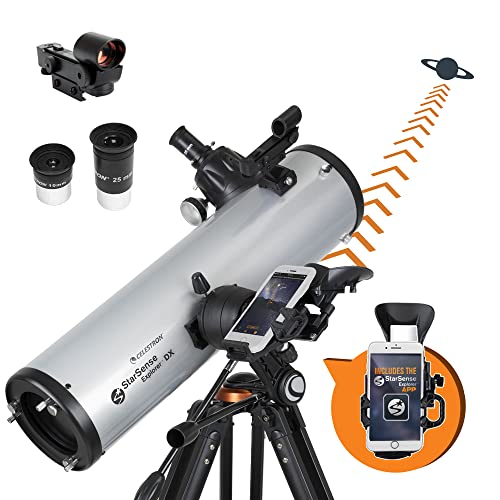
Celestron StarSense Explorer DX 130AZ smartphone-guided reflector telescope
2Best Phone-Guided

Celestron StarSense Explorer DX 130AZ

130mm aperture650mm focal lengthStarSense app guidanceAlt-az mount

This is the Heritage 130P's aperture in a different wrapper — and the wrapper is the point. The StarSense system uses your phone's camera and motion sensors to work out exactly where the telescope is pointing, then guides you to any object with on-screen arrows. No alignment, no star-hopping, no finding things by trial and error. For anyone who has ever taken a new telescope outside, failed to locate anything, and quietly gone back indoors, that is the feature that decides whether the hobby sticks.

Pros

  • Phone guidance removes the biggest cause of beginner frustration
  • 130mm aperture is a genuine step up from entry-level refractors
  • Push-to rather than GoTo — no power supply and no alignment routine
  • Works in light-polluted skies where star-hopping is nearly impossible

Cons

  • Depends on your phone — battery and screen glare are real annoyances
  • The mount is the weak link; expect some shake at high magnification
  • Costs more than a manual scope of the same aperture

Our Verdict

Worth the premium over a purely manual telescope if you are buying for someone who is new to the sky, or if you observe from a town where you cannot see enough stars to star-hop reliably. Pair it with a dark-sky trip and the difference is striking.

Price: $414.99 · Sep 17, 2026

Affiliate link — we may earn a commission at no extra cost to you.

Celestron AstroMaster 130EQ equatorial reflector telescope for deep-sky viewing
3Best for Learning Equatorial Mounts

Celestron AstroMaster 130EQ Reflector

130mm aperture650mm focal lengthGerman equatorial mountTwo eyepieces

A 130mm Newtonian on a German equatorial mount, which is the classic configuration for anyone who eventually wants to try imaging. The equatorial mount tracks objects by turning a single slow-motion control, so whatever you are looking at stays in the eyepiece instead of drifting out of view. That sounds like a small thing until you are trying to show Saturn to three people in a row. Be warned that setting up an equatorial mount for the first time is fiddly, and this is a telescope that rewards reading the manual.

Pros

  • Equatorial mount keeps objects centred as the sky turns
  • A 130mm aperture on a tracking-capable mount is a strong combination
  • The right platform if astrophotography is your eventual goal

Cons

  • Equatorial mounts have a genuine learning curve
  • Heavier and slower to set up than a tabletop Dobsonian
  • The included eyepieces are basic; budget for one upgrade

Our Verdict

Buy this if you want to learn the equatorial mount properly now rather than later. If you just want to look at things with the least possible fuss, the Heritage 130P gives you the same aperture for less money and less homework.

Price: $289.97 · Sep 17, 2026

Affiliate link — we may earn a commission at no extra cost to you.

Premium: Worth Buying Now, or Wait for Black Friday?

This is where the October-versus-November question has a real answer, and it is not the same answer as the tiers above. Premium instruments carry thinner margins and steady year-round demand, so Prime Big Deal Days tends to produce modest cuts — while Black Friday week consistently produces the deepest discounts of the year on exactly these models.

Our honest recommendation for this tier

If a premium model gets a real reduction of 15% or more during the October sale, take it — that is near the top of what these instruments ever see. If the cut is smaller than that, wait. Seven weeks is a short time to hold out for a meaningfully better price on a telescope you will own for a decade.

Celestron NexStar 8SE computerized Schmidt-Cassegrain telescope on GoTo mount
1Best Premium All-Rounder

Celestron NexStar 8SE Schmidt-Cassegrain

203mm aperture2032mm focal lengthGoTo alt-az mount40,000+ object database

The NexStar 8SE is the telescope most people picture when they imagine a serious amateur setup, and it earns that position. It pairs a 203mm Schmidt-Cassegrain optical tube — a design that folds a long focal length into a short, storable tube — with a GoTo mount that finds and tracks objects automatically after a three-star alignment. The result is genuinely large aperture in a package one person can carry outside and set up in ten minutes. It is not just a planetary instrument: the 8-inch mirror shows structure in dozens of galaxies and resolves globular clusters into individual stars in a way smaller apertures simply cannot.

Pros

  • 203mm of aperture in a tube that stores in a cupboard
  • GoTo tracking means objects stay centred while you observe
  • Serious deep-sky capability alongside excellent planetary performance
  • Huge aftermarket ecosystem of accessories and adapters

Cons

  • Expensive, and the discount will be modest rather than dramatic
  • Needs external power — batteries drain quickly in the cold
  • The single-arm mount is adequate but not rock-solid for imaging
  • Requires learning an alignment routine before it does anything

Our Verdict

A buy-it-for-life telescope for a visual observer. We would still lean toward waiting for Black Friday pricing on this specific model — but if you want it for the October skies and the discount is real, the difference over seven weeks is unlikely to be large enough to regret.

Price: $1,499.00 · Sep 17, 2026

Affiliate link — we may earn a commission at no extra cost to you.

Celestron NexStar 6SE Schmidt-Cassegrain GoTo telescope
2Best Step-Up GoTo

Celestron NexStar 6SE Schmidt-Cassegrain

150mm aperture1500mm focal lengthGoTo alt-az mountPortable single-arm fork

The 6SE is the sensible answer for someone who wants GoTo convenience without the 8SE's price or weight. The 150mm aperture is a real instrument — it shows the Cassini Division in Saturn's rings on a steady night, resolves the brighter globular clusters, and reveals the Trapezium stars in the Orion Nebula — and the whole assembly is light enough to carry outside in one trip, mount included. It uses the same GoTo handset and object database as its larger sibling, so there is nothing to relearn when you eventually upgrade.

Pros

  • GoTo convenience at a much friendlier price than the 8SE
  • Light enough to be carried out in one trip, mount and all
  • Same object database and handset as the larger NexStar models
  • Refractor-like sharpness on the Moon and planets

Cons

  • 150mm aperture limits how far you can push faint deep-sky targets
  • Shares the single-arm mount's slight flex with the 8SE
  • You will want the 8-inch eventually if aperture fever strikes

Our Verdict

The most consistently discounted telescope in this tier across previous sale events, which makes it a strong October candidate. If you want GoTo now and cannot stretch to the 8-inch, this is the pick — and it holds its value if you trade up later.

Price: $1,049.00 · Sep 17, 2026

Affiliate link — we may earn a commission at no extra cost to you.

Prices and availability change without notice. Live prices shown above are timestamped at page render. All product links are affiliate links — see our editorial standards for how we choose what to recommend.

Smart Telescopes: The Category That Fights Hardest

Smart telescopes are the one category where October discounts can beat November. The market is crowded, several brands are fighting for the same buyers, and Prime events are where they push hardest on price. A smart telescope also happens to suit October particularly well: it images galaxies and nebulae automatically, needs no dark sky, and can be left running unattended while you do something else.

Sharpest Deal Likelihood — Smart Telescope Pick
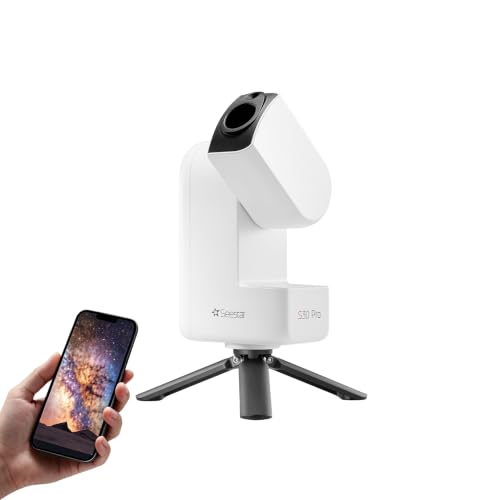
ZWO Seestar S30 Pro app-controlled smart telescope imaging a deep-sky object

ZWO Seestar S30 Pro Smart Telescope

App-controlledGoTo and live stackingPortable all-in-oneDeep-sky and planetary modes

The Seestar line is the reason smart telescopes became mainstream, and the S30 Pro sits at the top of it. You place it on a table, connect your phone, choose an object from a list, and the scope finds it, tracks it, and stacks successive exposures into a finished image you can look at on screen while it is still capturing. No polar alignment, no guiding, no post-processing required to get something you are happy to show someone. The Pro version adds aperture and image refinement over the standard S30, which matters most on the fainter nebulae.

Pros

  • Produces genuine deep-sky images with no prior experience
  • No alignment or polar setup — genuinely plug-and-play
  • Works under light-polluted suburban skies where visual observing struggles
  • Portable enough to take to a dark site and light enough to leave set up

Cons

  • It is imaging, not looking — the eye-to-eyepiece experience is not there
  • Small aperture compared with a conventional telescope at the same price
  • Depends on software that is updated frequently, warts and all

Our Verdict

The best choice on this page for someone who observes from a city, has limited time, or wants to capture images rather than squint at faint grey smudges. Smart telescopes have seen some of the steepest Prime-event discounts of any astronomy category, so this is the one premium-adjacent purchase where October is genuinely as good as November.

Price: $699.00 · Sep 17, 2026

Affiliate link — we may earn a commission at no extra cost to you.

Dwarflab Dwarf 3 portable dual-camera smart telescope
2Best Portable Smart Scope

Dwarflab Dwarf 3 Smart Telescope

Dual-camera system8.3MP main sensorUnder 4 lbsApp-controlled

The Dwarf 3 is the smart telescope for people who will actually carry one. At under two kilograms it fits in a daypack, and its dual-camera arrangement is genuinely useful rather than a marketing line: a wide-field camera shows you the surrounding sky on your phone so you can see where the scope is pointing, while the main camera captures the image. The larger sensor means more detail in finished frames than the entry-level smart scopes, at the cost of a smaller aperture that shows up on faint targets.

Pros

  • Light enough to genuinely take hiking or travelling
  • Wide-field finder camera makes framing intuitive
  • Higher-resolution sensor than most smart scopes at this size

Cons

  • Smaller aperture means fainter targets need longer total exposure
  • App and firmware have matured unevenly across updates
  • Less polished overall experience than the Seestar ecosystem

Our Verdict

Buy the Dwarf 3 for portability and the Seestar for polish. Both are frequent discount targets when Prime events run, and neither will disappoint someone who wants images of galaxies and nebulae without learning traditional astrophotography first.

Price: $549.00 · Sep 17, 2026

Affiliate link — we may earn a commission at no extra cost to you.

We cover the full range — including Vaonis, Unistellar, and Celestron Origin — in our dedicated smart telescope deals guide for Prime Big Deal Days.

Accessories: The Real Sweet Spot of This Sale

If you already own a telescope, this event matters more to you than to anyone buying their first one. Eyepieces, filters, and Barlows are low-cost, high-margin items that retailers discount freely during Prime events — and a single good eyepiece can transform a telescope you have owned for years. Percentage cuts of 20–35% on a 30-dollar eyepiece are common, and there is no meaningful advantage in waiting seven weeks for what is likely to be a similar price.

The four purchases that most reliably improve a telescope you already own, in order of impact:

  • A Barlow lens. Doubles the effective magnification of every eyepiece you own, which is the cheapest way to extend what your current set can do. Highest value per dollar of anything on this list.
  • A moon filter. The Moon at high magnification is uncomfortably bright. A variable filter lets you dial the brightness down to where surface detail becomes visible rather than painful. Under 50 dollars and it changes every lunar session.
  • One genuinely good wide-field eyepiece. Wide apparent fields make objects easier to find and far more pleasurable to look at, especially for anyone still learning to star-hop.
  • A red-dot finder. Cheap, and it replaces the most common frustration with entry-level telescopes: the factory finder that never quite lines up with the main tube.

Our complete accessory playlist, with picks and current prices, is in the telescope accessories guide for Prime Big Deal Days.

How to Shop the Sale Without Regret

Flash sales are designed to compress your decision-making, and telescopes are the wrong thing to buy in a hurry — the wrong choice sits in a cupboard for years. Five habits cover almost everything:

1. Check the 90-day average before you believe a discount

Price-history tools exist for exactly this reason. Some listings rise in the fortnight before a sale so that the inevitable reduction looks larger than it is. If the pre-sale price was itself inflated, the discount is fiction. If the sale price is below the true 90-day low, it is a genuine deal and you should move.

2. Decide the model before the sale starts, not during it

This is the single most important item here. The best deals are limited-inventory Lightning Deals that expire in hours, and the worst telescope decisions are made by people comparing listings under time pressure. Pick your shortlist now, verify it is in stock, then wait.

3. Optimise for aperture, not magnification

Boxes advertising hundreds of times magnification are describing a number that is meaningless in practice. Useful magnification is capped at roughly 50x per inch of aperture, and only under perfect seeing. Aperture is what determines how much you can actually see. Our guide to magnification claims explains the arithmetic.

4. Treat the mount as half the telescope

A good optical tube on a shake-prone mount is a bad telescope. This is why the tabletop Dobsonian recommendations above beat physically larger refractors at similar prices — the mount is stable, and stability is what lets you actually see detail.

5. Buy accessories in the same order

If you buy a telescope in this sale, buy the Barlow and the moon filter in the same order. They are cheapest here, and having them on hand on the first clear night is what turns a nervous first session into a good one.


Continue Exploring

Keep the session going with the next useful answer

Choose the next page based on whether you need a recommendation, a comparison, or a practical observing plan.

Use Finder Tool →

🎄 Holiday season: Telescope Christmas Gift Guide 2026 · Black Friday deal tracking

Live Deal Tracking

Tracking begins October 4, 2026. From then through the end of the sale we check every model on this page against its 90-day price history and update this section, so you can see which reductions are genuine and which are inflated baselines. Discounts are always reported as a percentage against the 90-day average rather than a fixed figure, because Amazon prices move constantly.

Bookmark this page and return on the morning of October 6 — the deepest cuts on limited-stock items historically appear in the first few hours. In the meantime, our telescope sales calendar shows how this window sits between the summer Prime Day and Black Friday.

Related Guides

Frequently Asked Questions

When is Amazon Prime Big Deal Days in 2026?

Prime Big Deal Days runs for 48 hours on October 6 and 7, 2026. It is Amazon's autumn Prime-member sale, and it is separate from the summer Prime Day event, which runs in July. Both events are Prime-exclusive, so a membership is required to see the discounted prices.

Are telescopes actually discounted during Prime Big Deal Days?

Yes, though less dramatically than accessories. Telescope discounts in this event have typically run 10 to 25 percent off, with the deepest cuts on smart telescopes, mid-range GoTo models, and beginner kits. Large Schmidt-Cassegrains and astrophotography mounts see smaller reductions because their margins are thinner and demand is steady all year.

Should I buy on Prime Big Deal Days or wait for Black Friday?

Buy in October for accessories, eyepieces, filters, smart telescopes, and entry-level or mid-range instruments — those categories discount as deeply in October as they do in November, and you get to use the gear through the autumn observing season. Wait for Black Friday if you want a large Schmidt-Cassegrain, a premium mount, or an astrophotography camera. Our full comparison breaks this down category by category.

How do I tell whether a sale price is a real discount?

Compare the sale price against the 90-day average rather than against the crossed-out figure on the listing. Some prices rise in the two weeks before a sale so the reduction looks bigger than it is. If the sale price is below the genuine 90-day low, the deal is real. If it is only below an inflated recent price, it is not.

What is the best telescope to buy in this sale?

For most first-time buyers, a 130mm tabletop Dobsonian offers the best combination of aperture, optical quality, and price — and it is small enough to store. If you observe from a light-polluted town or want images rather than visual views, a smart telescope is the better answer. If you already own a telescope, buy a Barlow lens, a moon filter, and one good wide-field eyepiece instead of replacing the scope.

Do I need a Prime membership to shop the sale?

Yes. Prime Big Deal Days pricing is exclusive to Prime members, which is what distinguishes it from a general seasonal sale. If you are not a member, the same telescopes are still available at their regular prices, and the Black Friday event in November is the next window where non-members also see broader retail discounts across many retailers.

Will telescope stock last through the two days?

Not always. The deepest reductions are limited-inventory deals that can sell out within hours, and popular models sometimes sell through on the first morning. If a model on your shortlist drops meaningfully below its recent average, buy it then rather than waiting for a better price that may not arrive — or for the listing to disappear entirely.