Philadelphia Stargazing: Dark Skies Near Philly
Telescope Advisor Logo Telescope Advisor
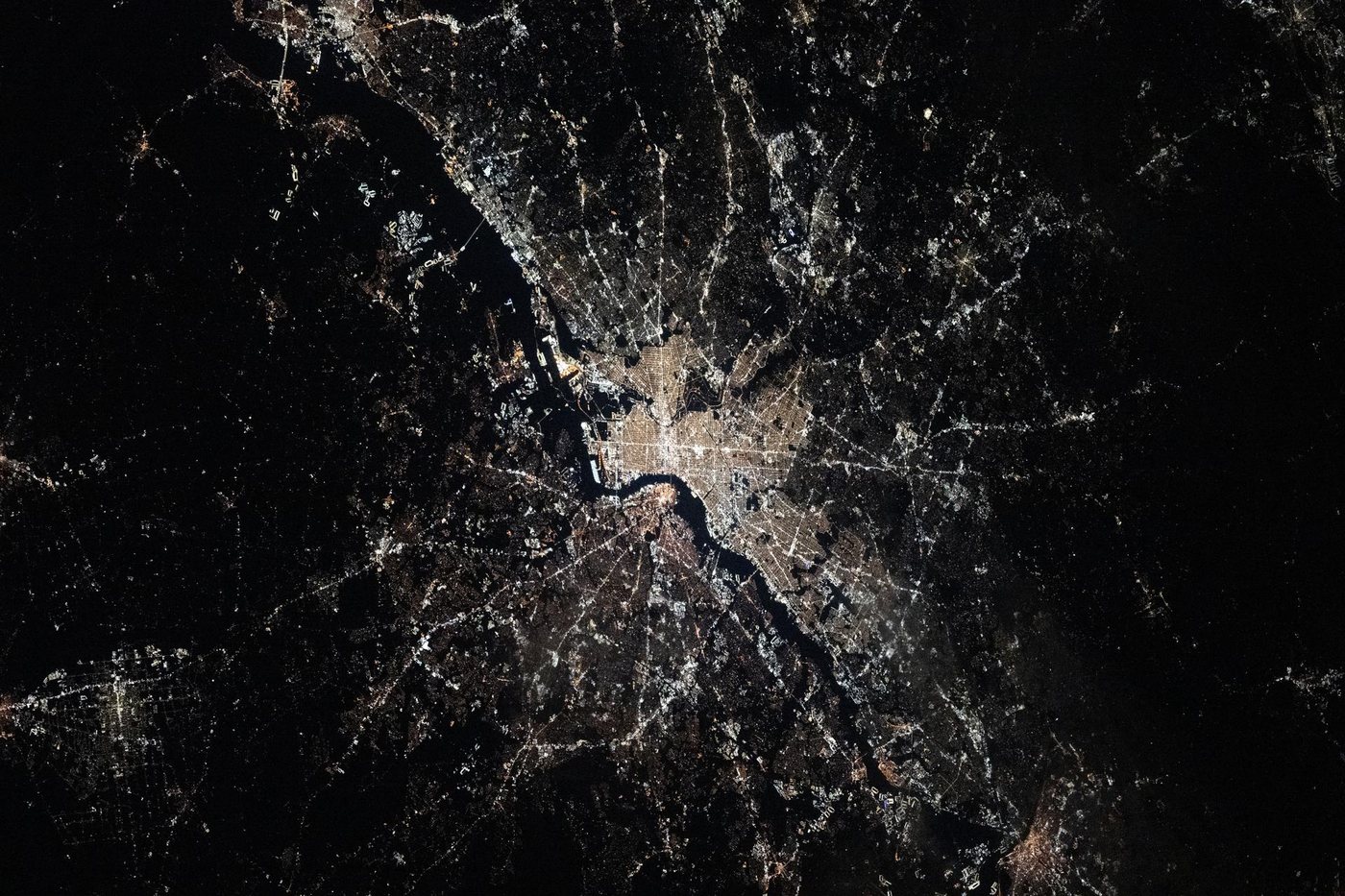
Philadelphia at night from the International Space Station, the gold grid of Center City beside the dark curve of the Delaware River with New Jersey across the water

Stargazing Destination Guide · Philadelphia and the Delaware Valley

Philadelphia Stargazing: Dark Skies Within Two Hours of Philly (2026)

Philadelphia sits in the middle of the most continuously lit stretch of the East Coast, and on a typical night Center City shows a handful of stars at best. Yet an hour across the Delaware River lies the largest block of open space between Richmond and Boston, and the clubs of the Delaware Valley run free telescope nights from Valley Forge to the Pine Barrens. This guide covers where to go from Philadelphia, Camden, Wilmington and the Lehigh Valley, which public nights are worth the drive, and what to expect from a humid mid-Atlantic sky.

Sky in Center CityBortle 8–9
Darkest Within ~1.5 HoursBortle 3–4, South Jersey
Free Telescope NightsValley Forge and Batsto
Best SeasonSeptember to November

Photo: Philadelphia and the Delaware River from the International Space Station, December 2025. NASA, Expedition 74

By Telescope Advisor Editorial TeamPublished: Updated: Reviewed & approved by Juhi Sahni, Senior Editor Editorial Standards

Philadelphia Stargazing at a Glance

Drive times assume you leave Center City outside rush hour. From Camden or Cherry Hill, the South Jersey sites are 15 to 20 minutes closer; from Wilmington, Mount Cuba is a short hop; from Allentown or Reading, the Lehigh Valley and Lancaster County observatories are next door. Bortle numbers are our estimates from light-pollution maps and observing reports, not official ratings. No place in this table holds a DarkSky International certification: the nearest certified park is Cherry Springs, in northern Pennsylvania.

LocationBortleFrom Center CityWho Runs the NightsBest For
Holt & Miller Observatory, The Franklin Institute9In the cityFranklin InstituteSafe daytime views of the Sun on weekends
Valley Forge National Historical Park6–735 min north-westDelaware Valley Amateur AstronomersFree star watches with club telescopes
Mount Cuba Astronomical Observatory645 min south-westMount Cuba ObservatorySmall-group lectures and research telescopes
French Creek State Park51 hr north-westPennsylvania State ParksA campsite in the biggest forest near the city
Batsto Village, Wharton State Forest41 hr south-eastWest Jersey Astronomical SocietyFree star watches in the Pine Barrens
South Mountain, Allentown61 hr 10 min northLehigh Valley Amateur Astronomical SocietyMonthly star parties with a planetarium
Delaware Bay shore, Cumberland County3–41 hr 15 min southOpen sites used by the DVAAThe darkest horizon in the region
Ryan Observatory, Muddy Run Park4–51 hr 30 min westRittenhouse Astronomical SocietyMonthly open houses in Lancaster County
UACNJ Observatory, Jenny Jump State Forest41 hr 45 min northUnited Astronomy Clubs of New JerseyFree Saturday programmes, April to October

One Glowing Corridor, One Big Dark Gap

Seen from orbit at night, Philadelphia is a bright knot where the Schuylkill meets the Delaware, with spokes of light running out along the old turnpikes and rail lines to King of Prussia, Norristown, Trenton and Wilmington. It is one link in the chain of cities that runs unbroken from Washington to Boston, and from almost anywhere in the metro the glow of a neighbouring city fills part of the horizon. Driving north or west does help, but the suburbs thin out slowly along those corridors, and the Lehigh Valley and Lancaster each add their own domes.

The exception is south-east. Cross the Walt Whitman or Ben Franklin bridge and keep going, and within an hour you are in the New Jersey Pinelands, which the federal government made the country’s first National Reserve in 1978. The reserve covers about 1.1 million acres of pitch pine, cedar swamp and cranberry bog, roughly 22 percent of the state, and New Jersey describes it as the largest body of open space on the Mid-Atlantic seaboard. South of the pines, the farms and salt marshes of Cumberland County run down to Delaware Bay, where a wide stretch of water separates you from any city at all. Those two areas hold the darkest skies a Philadelphian can reach in an evening.

The other limit here is moisture rather than light. Summer air off the Atlantic and the bays is hazy, and on a muggy July night the sky can look milky even at a dark site. The crisp, dry nights after an autumn cold front are when the region’s skies are at their best.

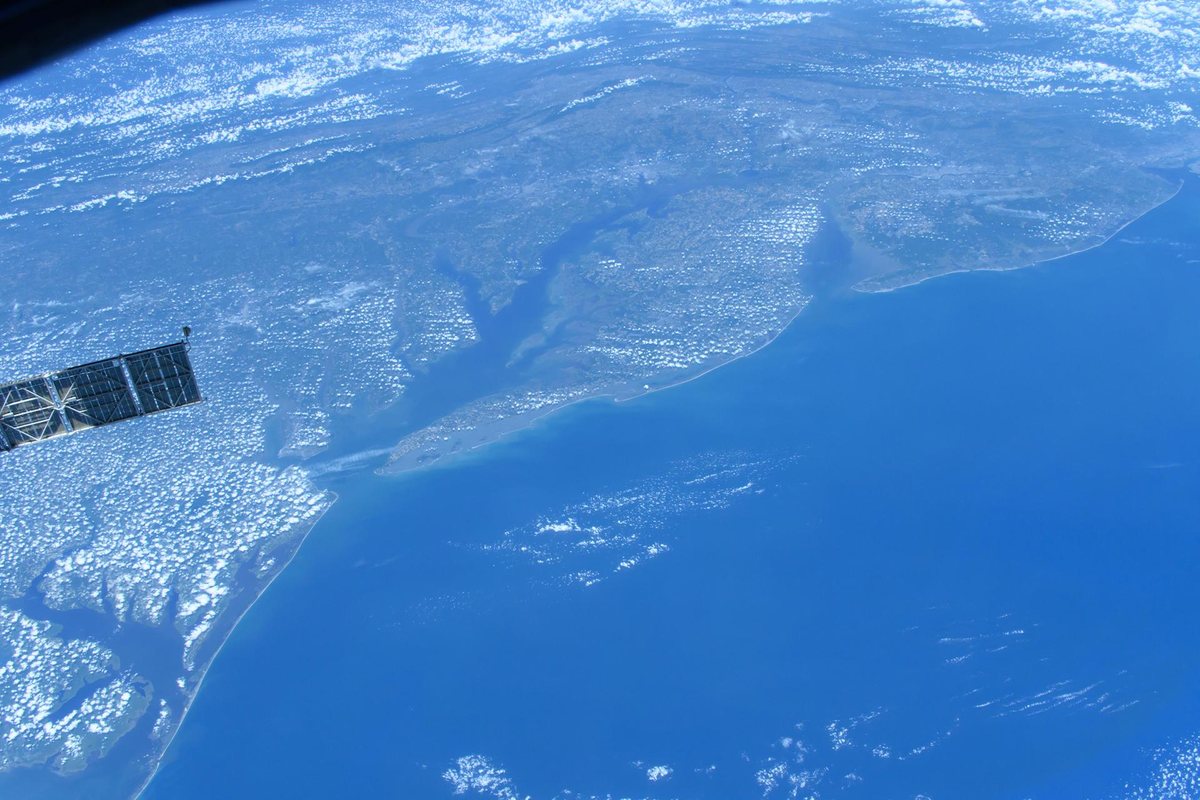
Delaware Bay and the Chesapeake Bay on either side of the Delmarva Peninsula, with the forests of southern New Jersey across the bay, photographed from the International Space Station

The Delmarva Peninsula between the Chesapeake Bay and Delaware Bay, with southern New Jersey across the mouth of Delaware Bay at upper right, photographed from the International Space Station in June 2024. The marshes and pine forests on the New Jersey side are the darkest land within reach of Philadelphia. Photo: NASA, Expedition 71.

Telescopes in and Around the City

Philadelphia was home to David Rittenhouse, one of colonial America’s leading astronomers, and the region still has an unusual number of places to look through someone else’s telescope.

The Franklin Institute: Holt & Miller Observatory and Fels Planetarium

On the museum roof, the Holt & Miller Observatory houses a 10-inch Carl Zeiss refractor that has been there since the observatory opened in 1934; the Institute says only one other telescope of this model survives, at Griffith Observatory in Los Angeles. It is used in daylight. On Saturdays and Sundays from 12 to 3 pm, staff run guided sessions that show sunspots and prominences safely through the telescope, subject to weather and staffing. Downstairs, the 60-foot dome of the Fels Planetarium runs a live presentation of the sky over the city that night, a good way to learn what to look for before a trip to darker ground.

Delaware Valley Amateur Astronomers at Valley Forge

The DVAA, formed in 1976, holds free public star watches on the Model Airplane Field off Route 252 in Valley Forge National Historical Park, about 35 minutes from Center City. In 2026 they ran from spring into the autumn, with another session listed on the club’s Night Sky Network page for November 14. Members bring a range of telescopes and binoculars, beginners can bring their own instrument for help setting it up, and anyone who registers gets an email or text if the weather cancels the evening. The park sky is suburban, so the targets are the Moon, planets, double stars and bright clusters.

Mount Cuba Astronomical Observatory, Wilmington

In the woods outside Wilmington, Mount Cuba Astronomical Observatory, founded in 1958 as a nonprofit for education and research, runs Public Nights at 8 pm on selected Mondays and Family Nights on selected Fridays. Each pairs a talk with telescope viewing when the sky allows, and the evening goes ahead under cloud. Admission is $10 for adults and $5 for children, and every seat must be reserved: Public Nights take only 28 guests, requests close at 1 pm on the day, attendance is limited to adults and students in 5th grade and up, and children at Family Nights must be at least eight.

Rittenhouse Astronomical Society in South Philadelphia

Founded in 1888, the Rittenhouse Astronomical Society is one of the oldest astronomy clubs in the country. Inside the city it brings telescopes to the Columbus Recreation Center for evenings such as its spring City Telescope Night and International Observe the Moon Night in September, proof that Saturn and the Moon look superb even under a Bortle 9 sky.

Top Pick: Stars Over the Pine Barrens

Batsto Village, Wharton State Forest

Batsto, an iron-making village with roots in 1766, sits in the south-central Pinelands about an hour from Center City, and it is the easiest place for a Philadelphian to see a genuinely dark sky with expert help. The open field beside the visitor centre, at 31 Batsto Road near Hammonton, has pine forest in most directions, and the city glow is confined to the north-west. On a clear, dry night the sky overhead reaches about Bortle 4, and in late summer the Milky Way stands out above the trees.

The West Jersey Astronomical Society holds free public star watches on that field through the warmer months; in 2026, Wharton State Forest’s events listings showed sessions starting at 7:30 pm in August, on September 12 and on October 3, with a comet demonstration in the visitor centre auditorium and a laser-guided constellation tour. They depend on the weather: on cloudy days the society posts its decision on its website after 1 pm. On other nights, the wider forest has campgrounds for those who want to stay after dark. Bring insect repellent and check for ticks; the pines are famous for both.

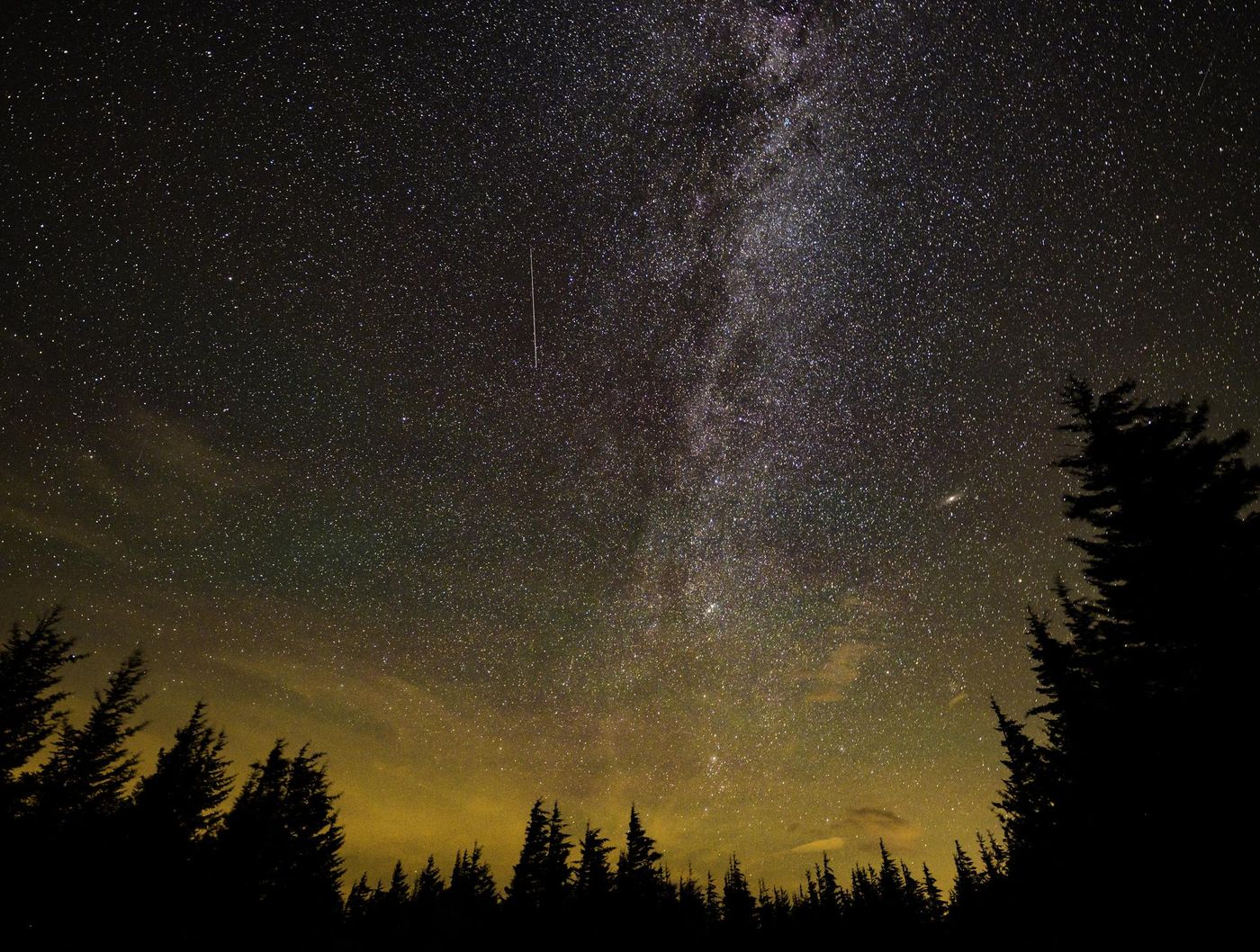
The Milky Way and a Perseid meteor above a dark forested horizon, the kind of view the Pine Barrens give on a clear moonless night

Photo: NASA/Bill Ingalls

South Jersey: The Pinelands and the Delaware Bay Shore

Beyond Batsto, the New Jersey Pinelands National Reserve spreads across parts of seven counties, and much of it is state forest crossed by sand roads. Any clearing well away from Route 206 and the Atlantic City Expressway gives a sky far better than the suburbs, though the casinos of Atlantic City throw a dome on the south-eastern horizon. Stay on roads you know, since the sugar-sand tracks swallow ordinary cars, and keep to the parts of the forests that are open after dark.

For the darkest horizon in the region, keep driving to the Delaware Bay shore in Cumberland County. The DVAA lists three public observing spots on the bay: East Point Lighthouse, Thompsons Beach and Turkey Point. With miles of marsh and open water to the south and west, the sky in those directions has almost no artificial light, which makes this the place for the summer Milky Way core, low southern objects and meteor showers. East Point’s 1849 lighthouse reopened on a limited basis in October 2026 after two years closed, inside the state’s Heislerville Wildlife Management Area. Expect mosquitoes and biting flies on the marsh in early summer, and dew on everything by midnight.

North and West: Clubs With Their Own Observatories

North and west of the city the sky does not get as dark as the bay shore, but three clubs have built proper observatories there and open them to the public.

South Mountain, Allentown. The Lehigh Valley Amateur Astronomical Society, founded in 1957, holds a public star party once a month from March to November at its South Mountain headquarters, 620 East Rock Road. A typical evening has a children’s planetarium show at 6 pm, a talk or video at 7, a second planetarium show at 8, and the observatories open for viewing from 7 when the weather allows. The suggested donation is $5 per adult, and the last star party of 2026 falls on November 14. It is the obvious first stop for anyone living in Allentown, Bethlehem or Easton.

Ryan Observatory, Lancaster County. The Rittenhouse society’s dark-sky home is the Ryan Observatory at Muddy Run Park in Holtwood, south of Lancaster, about 90 minutes from Philadelphia. Its open houses, roughly monthly on Saturday evenings from spring through December in 2026, go ahead in any weather, with a presentation each time and, when the sky is clear, a laser-guided star tour for visitors with binoculars. Camping and sleeping in cars at the observatory are not allowed; the nearby Muddy Run campground is the place to stay.

Jenny Jump State Forest, New Jersey. The United Astronomy Clubs of New Jersey run an observatory complex in Jenny Jump State Forest near Hope, in Warren County. Its free public programmes run every Saturday evening from April through October: a talk outdoors at 8 pm, then the observatory telescopes until 10:30. Arrive from 7:30 to claim a spot and bring your own chairs or blankets. If the weather forces a cancellation, booked visitors hear by 3 pm and the talk is streamed online instead.

French Creek State Park. For a night under the trees on your own, French Creek in Berks and Chester counties is the closest large wild area to the city: 7,730 acres that the state calls the largest block of contiguous forest between Washington and New York. Day-use areas close at dusk, so the way to stargaze there is to book an overnight stay in the park.

Worth the Drive: Cherry Springs

For a sky that no site in the Delaware Valley can match, Cherry Springs State Park in Potter County is Pennsylvania’s certified International Dark Sky Park, about four and a half hours north-west of Philadelphia. It is a weekend trip rather than an evening one, best planned around a new Moon in summer or early autumn. Our New York City stargazing guide covers the park, its observing fields and the rules for visitors in detail.

When to Go: The Delaware Valley Year

The region’s skies change more with humidity than with the calendar. Clear, dry air after a cold front beats any particular month.

MonthsConditionsWhere to GoWhat to See
September – NovemberThe clearest, driest nights of the year; fewer bugs; the club seasons closeBatsto, the bay shore, South Mountain, Valley ForgeSaturn, the Andromeda Galaxy, the Orionids in late October
December – FebruaryCold, transparent air between storms; most outdoor programmes pauseMount Cuba, Ryan Observatory open houses, your own backyardOrion, the Pleiades, the Geminids December 13–14
March – MayChangeable weather; club seasons reopen; muddy fieldsSouth Mountain, Jenny Jump, Valley ForgeGalaxies in Leo and Virgo, the Moon at first quarter
June – AugustHazy, humid nights with thunderstorms; mosquitoes, ticks and biting fliesThe bay shore and the Pinelands on the clearest nightsThe Milky Way core low in the south, the Perseids August 12–13

Choose a night near new Moon with our 2026 astronomy events calendar, and in summer check the dew point as well as the cloud forecast: below about 60°F, the haze usually clears.

What to Bring From Philadelphia

  • Repellent and a tick check for the Pinelands and the bay marshes from May to September.
  • A dew shield or hair dryer and spare towels. Humid nights coat lenses and eyepieces within an hour.
  • Folding chairs or a blanket for the outdoor talks at Jenny Jump and the Batsto field.
  • A reservation for Mount Cuba, made before 1 pm on the day, and cash for the suggested $5 donation at South Mountain.
  • A red flashlight only. Every club here asks visitors to keep white light and headlights off near the telescopes.
  • Warm layers in every season. Open fields and the bay shore cool quickly after sunset, even in September.

Best Telescopes and Binoculars for Philadelphia Skies

Most Philadelphia observing happens in a bright backyard, with an occasional run to the Pinelands. That favours equipment that is quick to set up, tolerant of dew, and small enough to throw in the car on a whim.

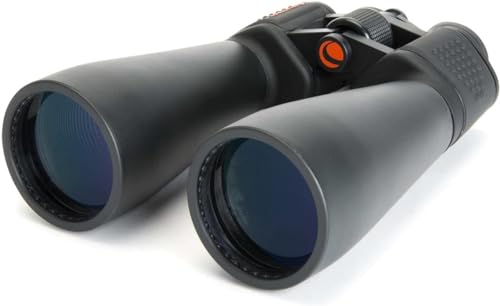
Celestron SkyMaster 15x70 binoculars

Celestron SkyMaster 15x70

For the bay shore

Scan the star clouds of Sagittarius over Delaware Bay, then use them for a guided tour at Batsto while the club scopes are busy.

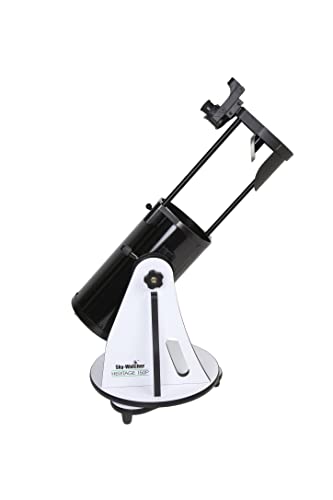
Sky-Watcher Heritage 130P tabletop Dobsonian

Sky-Watcher Heritage 130P

For rowhouse roofs and patios

A 5-inch tabletop Dobsonian that sets up in two minutes on a roof deck in Fishtown and collapses small enough for a commuter car.

Sky-Watcher Classic 200P 8-inch Dobsonian

Sky-Watcher Classic 200P (8")

For the Pinelands

Under a Bortle 4 sky in the pines, an 8-inch mirror turns faint smudges into galaxies and globular clusters into swarms of stars.

If nearly all your viewing will be from South Philly or a Main Line backyard, our urban stargazing telescope picks are chosen for a Bortle 8 to 9 sky.


🔭

Which telescope fits a Philadelphia backyard and a Pinelands weekend?

Tell the Finder Tool your budget, how much you will drive to dark skies, and what you most want to see. It recommends a specific model in under two minutes.

Find My Telescope →

Astronomy Clubs Across the Delaware Valley

The Delaware Valley Amateur Astronomers run the Valley Forge star watches and hold free monthly meetings, usually on Friday evenings at the Radnor Township Building; members also observe from Green Lane Park, French Creek and the bay shore. The Rittenhouse Astronomical Society runs city telescope nights at the Columbus Recreation Center and open houses at Ryan Observatory. In South Jersey, the West Jersey Astronomical Society, which meets in Moorestown and was called the Willingboro Astronomical Society until 2015, organises the Batsto star watches. The Lehigh Valley Amateur Astronomical Society covers Allentown, Bethlehem and Easton, and Mount Cuba Astronomical Observatory serves northern Delaware. To find a club near Reading, Trenton or the shore, use our astronomy club directory, and if your society is missing, please submit its details.


Continue Exploring

Keep the session going with the next useful answer

Choose the next page based on whether you need a recommendation, a comparison, or a practical observing plan.

Use Finder Tool →

🎄 Holiday season: Telescope Christmas Gift Guide 2026 · Black Friday deal tracking

Philadelphia Stargazing FAQ

Where can I see stars near Philadelphia?

The New Jersey Pine Barrens, about an hour south-east, are the closest truly dark area, and the free West Jersey Astronomical Society star watches at Batsto Village are the easiest way to enjoy them. For the darkest horizon, continue to the Delaware Bay shore in Cumberland County. Closer to home, Valley Forge hosts free club star watches under a suburban sky.

Are there free telescope nights in the Philadelphia area?

Yes. The Delaware Valley Amateur Astronomers hold free star watches at Valley Forge National Historical Park, the West Jersey Astronomical Society runs free star watches at Batsto Village, and the United Astronomy Clubs of New Jersey open their Jenny Jump observatory free on Saturday evenings from April to October. The Lehigh Valley society asks a suggested $5 donation at its monthly star parties in Allentown.

Can you see the Milky Way from the Pine Barrens?

Yes, on clear, dry, moonless nights. Away from the main roads the Pinelands reach about Bortle 4, enough to show the summer Milky Way overhead and towards the south, although Atlantic City adds a glow to the south-east. Late summer and early autumn, after a cold front has cleared the haze, give the best views.

Is the Franklin Institute observatory open at night?

Not as a regular programme. The Holt & Miller Observatory on the museum roof is open on Saturdays and Sundays from 12 to 3 pm for guided views of the Sun through its 1934 Zeiss refractor, depending on weather and staffing. For the night sky, the Fels Planetarium shows what is overhead that evening.

How far is Cherry Springs State Park from Philadelphia?

About four and a half hours by car, in Potter County in northern Pennsylvania. It is the state’s certified International Dark Sky Park and the darkest sky within a day’s drive, so most Philadelphians treat it as an overnight or weekend trip timed for a new Moon.

What is the darkest place within two hours of Philadelphia?

The Delaware Bay shore of Cumberland County, New Jersey, around East Point, Thompsons Beach and Turkey Point, about an hour and a quarter south. Open marsh and water to the south and west leave those horizons almost free of artificial light, at about Bortle 3 to 4.

Related Guides