Best Stargazing Near You: Dark Sky Sites by US City
Telescope Advisor Logo Telescope Advisor
The United States at night from the Suomi NPP satellite, the cities glowing against the dark land between them

Stargazing Destination Guides · United States

Best Stargazing Near You: Dark Sky Sites by US City (2026)

Four out of five Americans live under a sky too bright to show the Milky Way, and nearly all of them live within a two-hour drive of one that does. This page is the index to our city-by-city stargazing guides. Pick the metro you live in or near, and the guide behind it names the darkest sky within an evening's drive, the free telescope nights inside the city, the clubs that run them and the month to go, with the Bortle rating and the drive time for every site.

City Guides22 metros, 190+ suburbs covered
State Guides10 states, Hawaii to New York
Named Dark SitesMore than 100, all with Bortle ratings
Free Telescope NightsIn every one of the 22 metros

Photo: the United States at night, a composite of Suomi NPP satellite passes from April and October 2012. NASA Earth Observatory/NOAA NGDC

By Telescope Advisor Editorial TeamPublished: Updated: Reviewed & approved by Juhi Sahni, Senior Editor Editorial Standards

How to Use This Page

Every guide listed below was written for one metropolitan area, not one city limit. If you live in Plano, Mesa, Oakland or Yonkers, the guide you want is the Dallas-Fort Worth, Phoenix, Bay Area or New York one, and each row below names the suburbs it covers so you can find yours without guessing. We do not publish separate pages for suburbs: a dark-sky drive from Fremont and a dark-sky drive from San Jose end at the same hills, and one thorough guide beats five thin ones. The state guides take over where the metro guides stop, at the two-hour line, and cover the national parks and certified dark-sky places worth a weekend.

Each city guide follows the same test. The sites are rated on the Bortle scale, from a class 9 downtown to the class 2 and 3 deserts, and the drive time is measured from a named downtown landmark, not from the city edge. Every guide includes at least one place inside the metro where you can look through a large telescope for free, because for most beginners that is a better first night than a long drive, and every guide names the club that runs it. The satellite image at the top of this page is the whole argument in one frame: the glow is where people live, the dark is where they should go, and the two are closer together than the glow suggests.
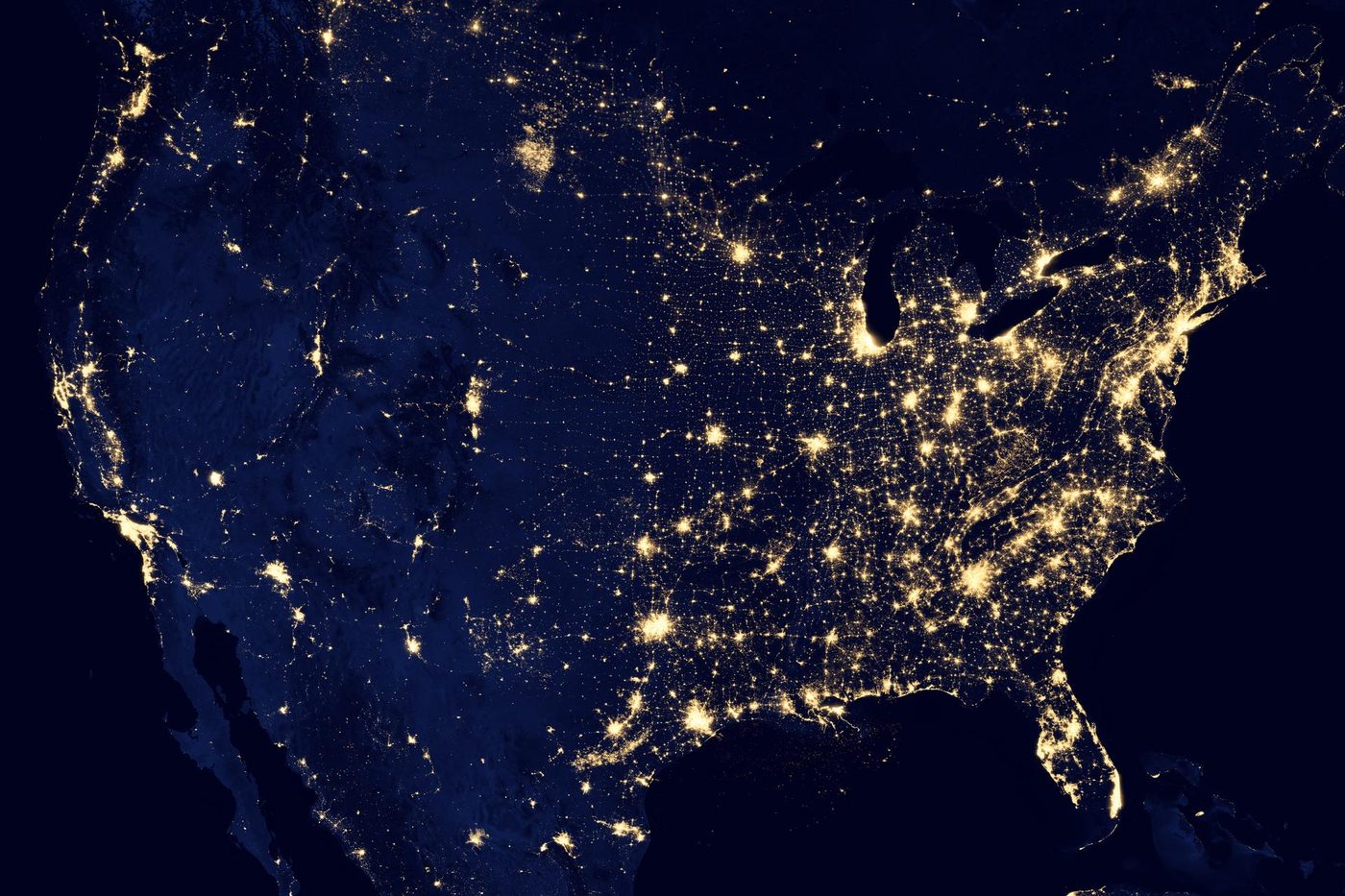
Night-lights composite of the United States from the Suomi NPP satellite

The pattern that shapes every guide here: the eastern half of the country glows almost without a break, while the West is dark between its cities, which is why a Denver or Las Vegas observer reaches a Bortle 2 sky in two hours and a New York observer settles for Bortle 4. Image: NASA Earth Observatory, Suomi NPP VIIRS data courtesy of NOAA NGDC.

The West: Deserts and Mountains Two Hours from the City

The western metros have the brightest downtowns in the country and the darkest countryside, often in the same hour's drive. These are the guides where the Milky Way is a realistic weeknight target.

Los Angeles California

Covers Long Beach, Anaheim, Santa Ana, Irvine, Glendale, Huntington Beach, Santa Clarita, Lancaster, Palmdale, Pasadena, Burbank, Riverside and San Bernardino

Downtown Bortle 9. Darkest within reach: Joshua Tree and the Mojave at Bortle 2 to 3. Free public telescopes at Griffith Observatory most nights; Mount Wilson tours.

San Diego California

Covers Chula Vista, Oceanside, Escondido, Carlsbad, El Cajon, La Mesa, Poway and Encinitas

Downtown Bortle 8. Darkest within two hours: Blair Valley in Anza-Borrego at Bortle 2 to 3. Free club star parties at Mission Trails; Mount Laguna Observatory nights.

San Francisco Bay Area California

Covers San Jose, Oakland, Fremont, Hayward, Sunnyvale, Santa Clara, Concord, Berkeley, Richmond, Vallejo, Antioch, Daly City, San Mateo, Palo Alto, Walnut Creek and Santa Rosa

City Bortle 8 to 9. Darkest within two hours: Pinnacles and the Henry Coe backcountry at Bortle 3. Free telescope nights every Friday and Saturday at Chabot; Lick Observatory on Mount Hamilton.

Las Vegas Nevada

Covers Henderson, North Las Vegas, Boulder City and Summerlin

Strip Bortle 9. Darkest within two hours: the Mojave National Preserve and Death Valley at Bortle 2 to 3. Red Rock Canyon star parties and the College of Southern Nevada planetarium inside the valley.

Denver Colorado

Covers Aurora, Lakewood, Thornton, Arvada, Westminster, Centennial, Boulder, Longmont, Broomfield, Castle Rock, Parker and Golden

Downtown Bortle 8. Darkest within two hours: the Pawnee National Grassland at Bortle 2 to 3. Public nights at the University of Denver's Chamberlin Observatory and its 1894 refractor.

Phoenix Arizona

Covers Mesa, Chandler, Gilbert, Scottsdale, Glendale, Tempe, Peoria, Surprise, Goodyear, Buckeye, Avondale and Fountain Hills

Valley Bortle 8 to 9. Darkest within two hours: Painted Rock west of Gila Bend at Bortle 3. Public viewing every Friday and Saturday at the Gilbert observatory; Fountain Hills is a certified dark sky community.

Colorado Springs Colorado

Covers Pueblo, Fountain, Monument, Woodland Park and Manitou Springs

City Bortle 7 to 8. Darkest within an hour: Florissant Fossil Beds, a certified Dark Sky Park open 24 hours, at Bortle 3. Free club star parties at Cheyenne Mountain State Park.

Seattle Washington

Covers Bellevue, Tacoma, Kent, Renton, Everett, Redmond, Kirkland, Shoreline, Federal Way and Auburn

City Bortle 8 to 9. Darkest within three hours: Sunrise and Paradise at Mount Rainier at Bortle 2 to 3, often above the cloud. Free telescope nights at the UW Jacobsen Observatory and monthly club star parties.

Portland Oregon and Washington

Covers Vancouver WA, Gresham, Hillsboro, Beaverton, Salem, Lake Oswego, Tigard and Oregon City

City Bortle 8. Closest legal dark site: Stub Stewart State Park, 45 minutes west, open after hours with a free stargazing permit. Free viewings through the 24-inch telescope at Haggart Observatory; Cottonwood Canyon Dark Sky Park under three hours east.

Salt Lake City Utah

Covers West Valley City, West Jordan, Sandy, Ogden, Provo, Orem, Layton and Park City

Valley Bortle 8. Five certified dark sky parks within about an hour, from Antelope Island in the Great Salt Lake to East Canyon, Jordanelle, Rockport and North Fork. Free University of Utah star parties every clear Wednesday.

Tucson Arizona

Covers Marana, Oro Valley, Sahuarita, Green Valley, Vail, Catalina Foothills and South Tucson

City Bortle 7, under outdoor lighting rules that date to 1972. Oracle State Park, a Dark Sky Park, is an hour north, with SkyNights on Mount Lemmon and nightly programmes at Kitt Peak.

Albuquerque New Mexico

Covers Rio Rancho, Los Lunas, Bernalillo, Corrales, Belen, Placitas and the East Mountains

City Bortle 7 to 8. Four certified Dark Sky Parks within a day's drive, led by Valles Caldera about 1 hr 50 min north-west, plus Valle de Oro, the world's first Urban Night Sky Place, in the South Valley. Free Friday telescope nights at the UNM Observatory during the semester.

For the weekend trips beyond these cities, the Arizona, Colorado, Washington, Oregon and Utah state guides cover the national parks and certified dark sky places further out.

Texas: Three Metros, One Hill Country

Texas has three of the ten largest metros in the country and a state dark-sky programme that has certified more communities than any other. The three guides share the Hill Country as a destination but approach it from different directions, and the Gulf Coast and the Panhandle sites belong to one metro each.

For Big Bend, the McDonald Observatory star parties and the full list of Texas Dark Sky Communities, read the Texas stargazing guide; San Antonio is next on the Texas list.

The East and Midwest: Finding Dark Gaps in the Glow

East of the Mississippi the night-lights map shows almost no black, and the honest ceiling for a two-hour drive is Bortle 3 to 4 rather than 2. These guides are about where the gaps are, which parks stay open after dark, and how to get the most from a sky that will never be a desert sky.

New York City New York, New Jersey and Connecticut

Covers Yonkers, White Plains, Long Island, Newark, Jersey City, Paterson, Elizabeth, Edison, Woodbridge, Lakewood and Stamford

Manhattan Bortle 9. Darkest within two hours: Jenny Jump in New Jersey and the Shawangunk ridge at Bortle 4. Free star parties on the East River at Carl Schurz Park; Harriman State Park reachable by train.

Chicago Illinois

Covers Aurora, Naperville, Joliet, Elgin, Evanston and Schaumburg

Loop Bortle 8 to 9. Darkest within three hours: the Middle Fork River Forest Preserve, a certified dark-sky park, at Bortle 3 to 4. Adler Planetarium on the lakefront; star parties at Indiana Dunes.

Atlanta Georgia

Covers Sandy Springs, South Fulton, Marietta, Alpharetta and Athens

Downtown Bortle 8 to 9. Darkest in the state: Stephen C. Foster State Park in the Okefenokee, a certified dark-sky park, at Bortle 3. Fernbank Science Center observatory nights in Decatur; Brasstown Bald and Cloudland Canyon in the mountains.

Indianapolis Indiana

Covers Carmel, Fishers, Greenwood and Noblesville

Downtown Bortle 8. Darkest within 90 minutes: Brown County State Park and the Hoosier National Forest at Bortle 3 to 4. The Indiana Astronomical Society runs the public nights; the guide also lists what is visible from the city tonight.

Boston Massachusetts

Covers Cambridge, Worcester, Lowell, Brockton, Quincy, Lynn, New Bedford, Providence RI and Manchester NH

City Bortle 8 to 9, with free telescope nights at Boston University most clear Wednesdays and at Harvard's Center for Astrophysics. The darkest legal spot within an evening's drive is the outer Cape, where Cape Cod National Seashore beach lots stay open until midnight.

Philadelphia Pennsylvania, New Jersey and Delaware

Covers Camden NJ, Cherry Hill NJ, Trenton NJ, Wilmington DE, King of Prussia, Reading and Allentown

City Bortle 8 to 9. The Pine Barrens and the Delaware Bay shore, an hour or so south-east, are the darkest skies in reach, with free club star watches at Batsto Village and Valley Forge.

Miami Florida

Covers Hialeah, Fort Lauderdale, Pembroke Pines, Hollywood, Miramar, Coral Springs, Boca Raton and West Palm Beach

City Bortle 8 to 9. The nearest dark sky is in the Everglades pinelands at Long Pine Key, about 75 minutes away, and Big Cypress is a certified Dark Sky Park on the Tamiami Trail. Free Saturday star parties at Bill Sadowski Park in Palmetto Bay and Fox Observatory in Sunrise.

Florida has no metro guide yet; the Florida stargazing guide covers Kissimmee Prairie, the Keys and the Everglades from Miami, Orlando and Tampa.

State Guides: The Weekend Trips

When the drive is longer than an evening, the state guides take over. Each one covers the national parks, the certified International Dark Sky Places and the observatories with public programmes, and each links down to the metro guides for its cities.

For the whole country in one place, the best national parks for stargazing ranks the parks by sky, and the USA dark sky map explains how to read a light-pollution map for any address.

Before You Drive

Three Rules That Hold in Every City

Start at the free telescope. Every metro guide names a place where a club or an observatory puts a large telescope in front of the public at no charge, usually on a fixed weeknight or weekend. A first look at Saturn through a 20-inch instrument inside the city teaches more than a first drive to a dark field with a small one, and it is where you meet the people who know the local sites.

Check the gate before the sky. The single most common failed stargazing trip in the eastern United States is a state park that locked its gate at sunset. The guides mark which sites stay open, which need a campsite or a permit, and which are only open on a club's star-party night. In the West the equivalent trap is a mountain road that closes for snow or fire.

Pick the Moon, then the month. A Bortle 3 site under a full Moon shows less than a Bortle 6 suburb under a new one. Plan the trip from the 2026 astronomy events calendar first, then use the month-by-month table in your metro guide, because the best season varies from the Bay Area's autumn to Houston's winter to Denver's late summer.


🔭

Which telescope suits your sky?

Tell the Finder Tool your budget, whether you observe from a city balcony or drive to a dark site, and what you most want to see. It recommends a specific model in under two minutes.

Find My Telescope →


Continue Exploring

Keep the session going with the next useful answer

Choose the next page based on whether you need a recommendation, a comparison, or a practical observing plan.

Use Finder Tool →

🎄 Holiday season: Telescope Christmas Gift Guide 2026 · Black Friday deal tracking

Stargazing Near Me: Common Questions

How do I find the best stargazing near me?

Start with the metro guide for the city you live in or nearest to; each one lists the darkest sites within about two hours with Bortle ratings, drive times and whether the site is open after dark. If your city is not covered yet, use the state guide for the weekend sites and the USA dark sky map to read a light-pollution map for your own address.

My suburb is not listed. Which guide do I use?

The guide for the metro your suburb belongs to. Each city row on this page names the suburbs it covers, and the drive times inside the guide are measured from a downtown landmark, so add or subtract your own distance from downtown. We fold suburbs into one metro guide rather than publishing thin separate pages, because the dark-sky destinations are the same.

How dark does a site need to be to see the Milky Way?

Bortle 4 shows the Milky Way clearly from the summer core to the winter band; Bortle 5 shows it as a faint band on good nights; Bortle 6 and brighter hides it. Western metros reach Bortle 2 and 3 within two hours. From New York, Chicago, Atlanta or Houston, Bortle 3 to 4 is the realistic best within an evening's drive.

Which US city has the best stargazing nearby?

Of the twenty-two covered here, Las Vegas, Denver, Los Angeles, San Diego and Phoenix reach the darkest skies fastest: Bortle 2 to 3 deserts or grasslands inside two hours, and Colorado Springs has a certified Dark Sky Park 50 minutes away. For free public telescopes inside the city, the San Francisco Bay Area is hard to beat, with observatory nights every Friday and Saturday.

Are the free telescope nights really free?

Yes. The club star parties and the observatory public nights named in the guides charge nothing, though some ask you to reserve a place, some require a park entry fee for the car, and ticketed special events such as summer lecture series are marked as such in each guide.

When will my city get a guide?

Twenty-two metros are covered so far, and more, including San Antonio, Orlando and the largest metros of the Midwest, are being added through 2027. We publish a few at a time so that each is researched and reviewed properly. Until then, the state guides and the club directory cover every state we have written about.

Related Guides