
ESO News · Stellar Astronomy · July 2026
Betelgeuse Has a Companion Star: ESO's VLT Captures Clearest Image of Betelgeuse B
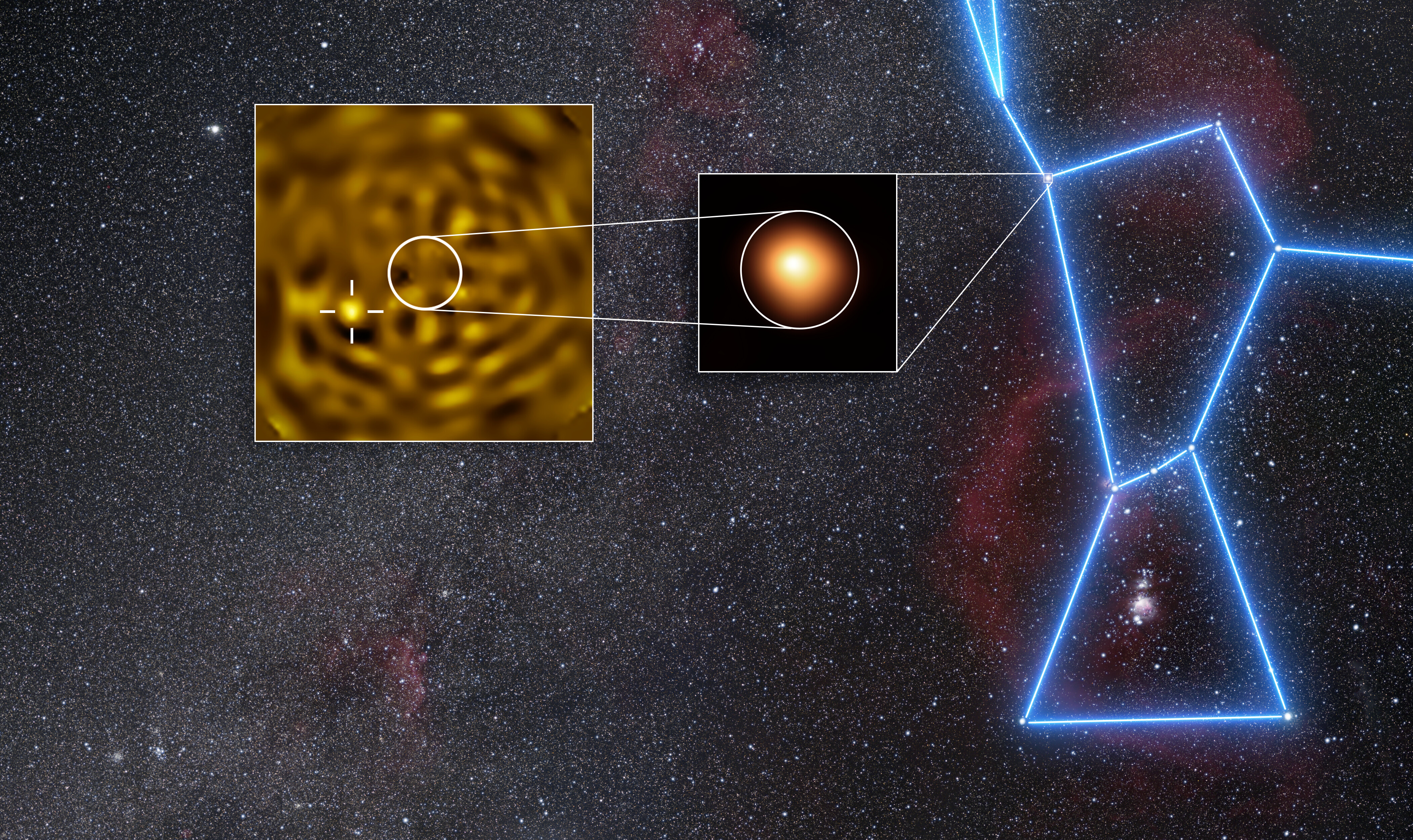
For a century, astronomers suspected Betelgeuse might not be alone. Now, using the European Southern Observatory's Very Large Telescope, a team led by Miguel Montargès has obtained the clearest image ever of Betelgeuse B — a companion star orbiting the famous red supergiant. "This is the conclusion of a century-long quest," Montargès says.
Companion Mass2-3× the Sun
InstrumentESO VLT / SPHERE
Distance~500-650 light-years
StatusPublished in A&A
By Telescope Advisor Editorial Team
|
Published:
|
Updated:
|
Reviewed & approved by Juhi Sahni, Senior Editor
Editorial Standards

Elena Reyes
Senior Science Editor
Covers NASA missions, space science discoveries, and astronomical events for Telescope Advisor. Translates complex astrophysical research into practical insights for backyard observers. Based in the San Francisco Bay Area.
Content reviewed by our editorial team. Research and drafting assisted by AI to ensure unbiased, data-driven analysis. Learn more about our editorial process.
The Discovery: Betelgeuse Has a Companion Star
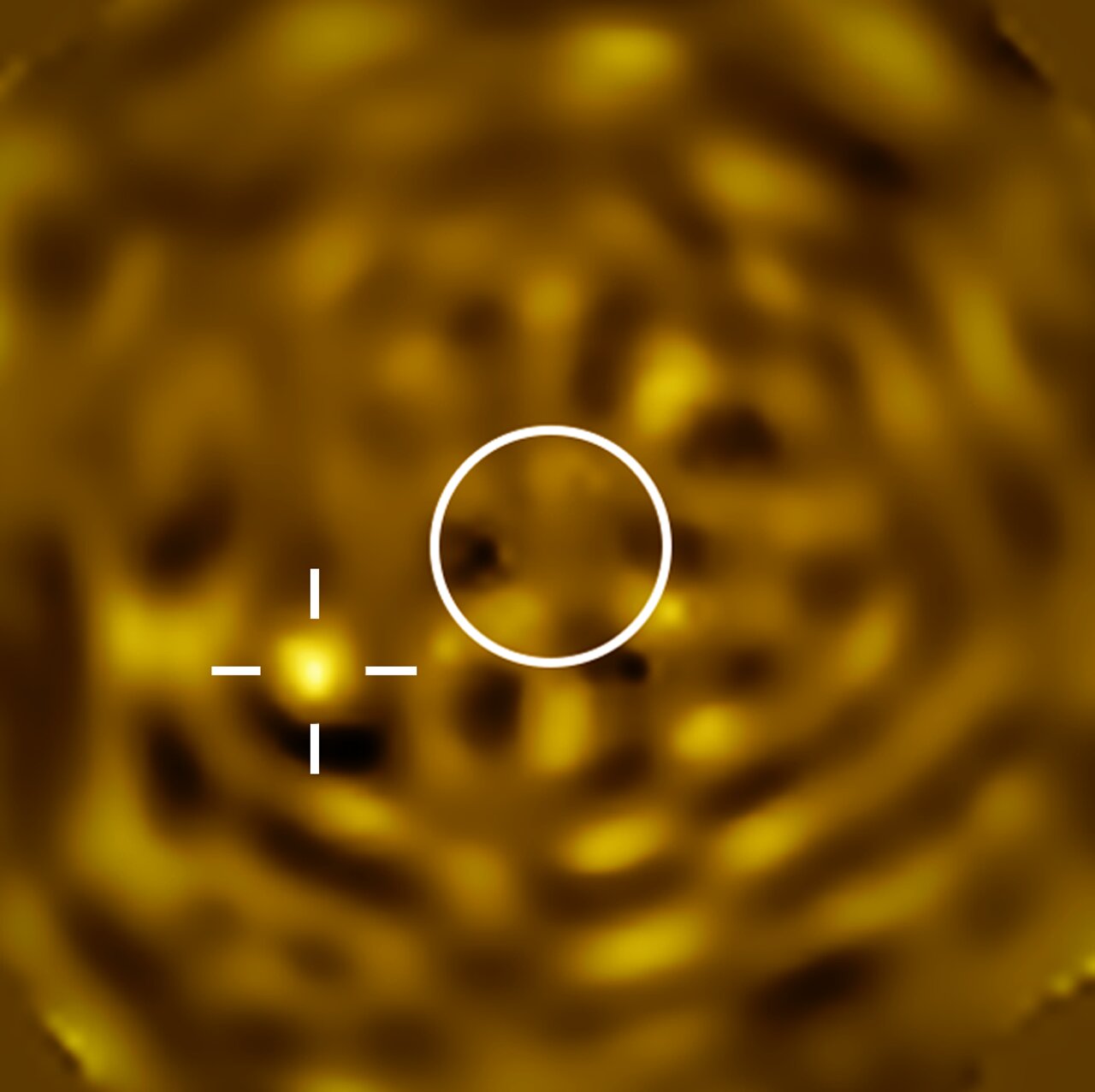
At long last, astronomers have firm evidence that Betelgeuse, one of the most famous stars in the night sky, is not alone. Using the European Southern Observatory's Very Large Telescope (ESO's VLT), a team led by French researcher Miguel Montargès has obtained the clearest image ever of what likely is Betelgeuse B, the star orbiting Betelgeuse. The findings, published today in Astronomy & Astrophysics, represent the culmination of a search that has spanned generations of astronomers.
"We have shown that Betelgeuse is not single — it is accompanied by a faint stellar companion," says Montargès, astronomer at the Observatoire de Paris - PSL, France, and lead author of the study. "This is the conclusion of a century-long quest."
Betelgeuse — a reddish star in the Orion constellation that is easily visible with the naked eye and known to change in brightness — has been observed for millennia. But it still surprises astronomers. The newly imaged companion, Betelgeuse B, has around two to three times the mass of the Sun, making it significantly more massive than originally predicted. Earlier estimates had suggested a companion roughly the mass of our Sun, but the new observations reveal a far more substantial stellar partner.
"The fact that we can still discover a nearby companion, more massive and brighter than the Sun, around such a well-studied star is remarkable," says Montargès. "These are among the best moments in science: seeing something new, unexpected."
A Century-Long Search — Finally Resolved
Astronomers have suspected that Betelgeuse might have a companion for nearly a hundred years. The star's well-documented brightness variations — it periodically dims and brightens — had long led scientists to wonder whether a partner star was influencing its behavior. But despite decades of searching with increasingly powerful telescopes, the companion remained elusive.
The breakthrough came from a series of predictions. Two studies published in 2024 robustly forecasted that in December 2024, the hypothetical companion would be at its greatest apparent separation from Betelgeuse as seen from Earth — making it the best time in decades to attempt a detection. Montargès and his team seized the opportunity, observing the star with ESO's VLT in December 2024 and spending several months painstakingly processing the data.
"I jumped from my chair when I saw the processed images," recalls Montargès. The team had initially doubted they had the sensitivity to detect Betelgeuse B. But because the companion turned out to be more massive — and therefore brighter — than predicted, it appeared clearly in the data.
While there was previous evidence for the existence of this companion star — including a possible direct detection with the Gemini North Telescope in Hawaiʻi, USA — this new observation is the strongest evidence yet and the clearest image ever obtained of Betelgeuse B.
How ESO's VLT and SPHERE Captured Betelgeuse B
Betelgeuse B was directly imaged, meaning the light from the star itself was detected — not inferred through gravitational effects or brightness dips. The detection was made using the SPHERE instrument (Spectro-Polarimetric High-Contrast Exoplanet Research) on ESO's VLT in Chile's Atacama Desert.
ESO's Very Large Telescope (VLT)
Located at the Paranal Observatory in Chile's Atacama Desert, the VLT is one of the world's most advanced optical telescopes. Its four 8.2-meter Unit Telescopes can work together or independently. The observations of Betelgeuse B used UT3 (Melipal), one of the four main telescopes.
The SPHERE Instrument
SPHERE was originally designed for exoplanet direct imaging — detecting planets orbiting other stars. Its extreme adaptive optics system corrects for atmospheric turbulence, while coronagraphs block the blinding light of the host star. The same technology that finds exoplanets proved perfectly suited to detecting a companion around a massive, evolved star like Betelgeuse.
Advanced Post-Processing
"It is remarkable to see how SPHERE and advanced post-processing techniques, originally developed to find exoplanets, also excel at detecting a companion around a massive, evolved star like Betelgeuse," says co-author Anthony Boccaletti of Observatoire de Paris. The team spent months processing the data to extract the faint signal of Betelgeuse B from the overwhelming glare of the red supergiant.
The Great Dimming and What It Revealed
This is not the first time Montargès and Betelgeuse have made headlines. In 2019-2020, the star experienced an unprecedented dimming event that caught the attention of astronomers and the public worldwide. The "Great Dimming" saw Betelgeuse drop to roughly 40% of its normal brightness, sparking speculation that the star might be about to explode in a supernova.
A team led by Montargès studied the star with ESO's VLT and published results in Nature in 2021, finding that the dimming was caused by a cloud of dust — material ejected from Betelgeuse's surface that cooled and condensed, temporarily obscuring part of the star's light. Rather than a sign of impending doom, the Great Dimming turned out to be a massive stellar burp.
The discovery of Betelgeuse B adds an intriguing new dimension to the Great Dimming story. Could the companion star have played a role in triggering the dust ejection? The question remains open, but the presence of a nearby stellar companion provides a new variable for scientists to consider when modeling Betelgeuse's behavior.
What Betelgeuse B Means for the Future Supernova
As an evolved red supergiant, Betelgeuse is expected to die in a spectacular supernova explosion — an event that could happen anytime within the next 100,000 years. The discovery of a companion star raises fascinating new questions about how that explosion might unfold.
Could the Companion Trigger the Supernova?
In some binary systems, a companion star can accelerate the evolution of its partner by stripping away material through gravitational interaction. Whether Betelgeuse B is massive enough and close enough to influence the red supergiant's final stages is now a key question. "The question is truly opened whether this companion is going to have an impact on the evolution of the red supergiant," concludes Montargès.
A Binary Supernova?
When Betelgeuse eventually explodes, the presence of Betelgeuse B could affect how the supernova looks to Earth. Depending on the binary orbit, the companion could influence the distribution of ejected material, potentially creating asymmetries in the expanding debris. The companion star itself might survive the explosion, or it could be stripped of its outer layers by the blast wave.
Has the Companion Shaped Betelgeuse's Evolution?
The discovery prompts astronomers to investigate how the companion could have affected Betelgeuse throughout its life. Binary interactions can dramatically alter stellar evolution — transferring mass between stars, spinning up their rotation, and even changing their ultimate fate. Understanding whether Betelgeuse and its companion have interacted over their lifetimes will be a priority for follow-up studies.
What About Us on Earth?
Regardless of Betelgeuse B, a Betelgeuse supernova will be the most spectacular astronomical event in human history. The star is roughly 500-650 light-years away — close enough to appear as bright as the full Moon and visible in daytime, but far enough that it poses no threat to Earth. The companion's presence may simply add another layer of scientific richness to an already unmissable cosmic event.
How to See Betelgeuse for Yourself
While you won't be able to see Betelgeuse B with a backyard telescope, the star Betelgeuse itself is one of the easiest and most rewarding targets in the night sky. Here's how to observe it:
Finding Betelgeuse in the Night Sky
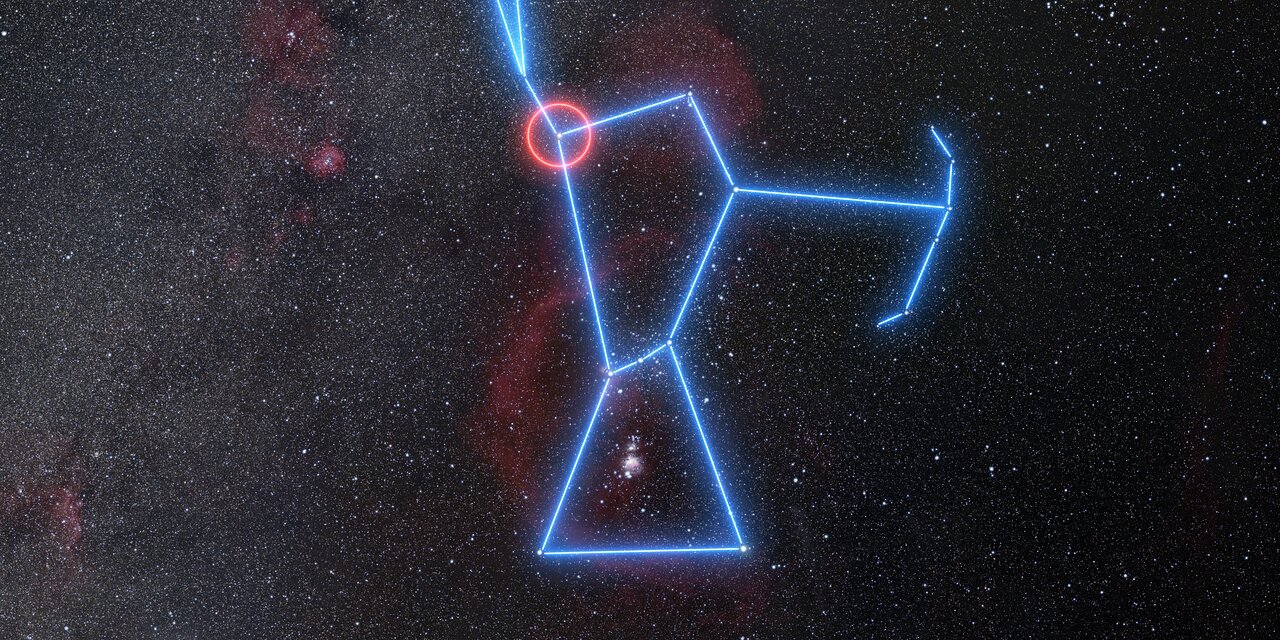
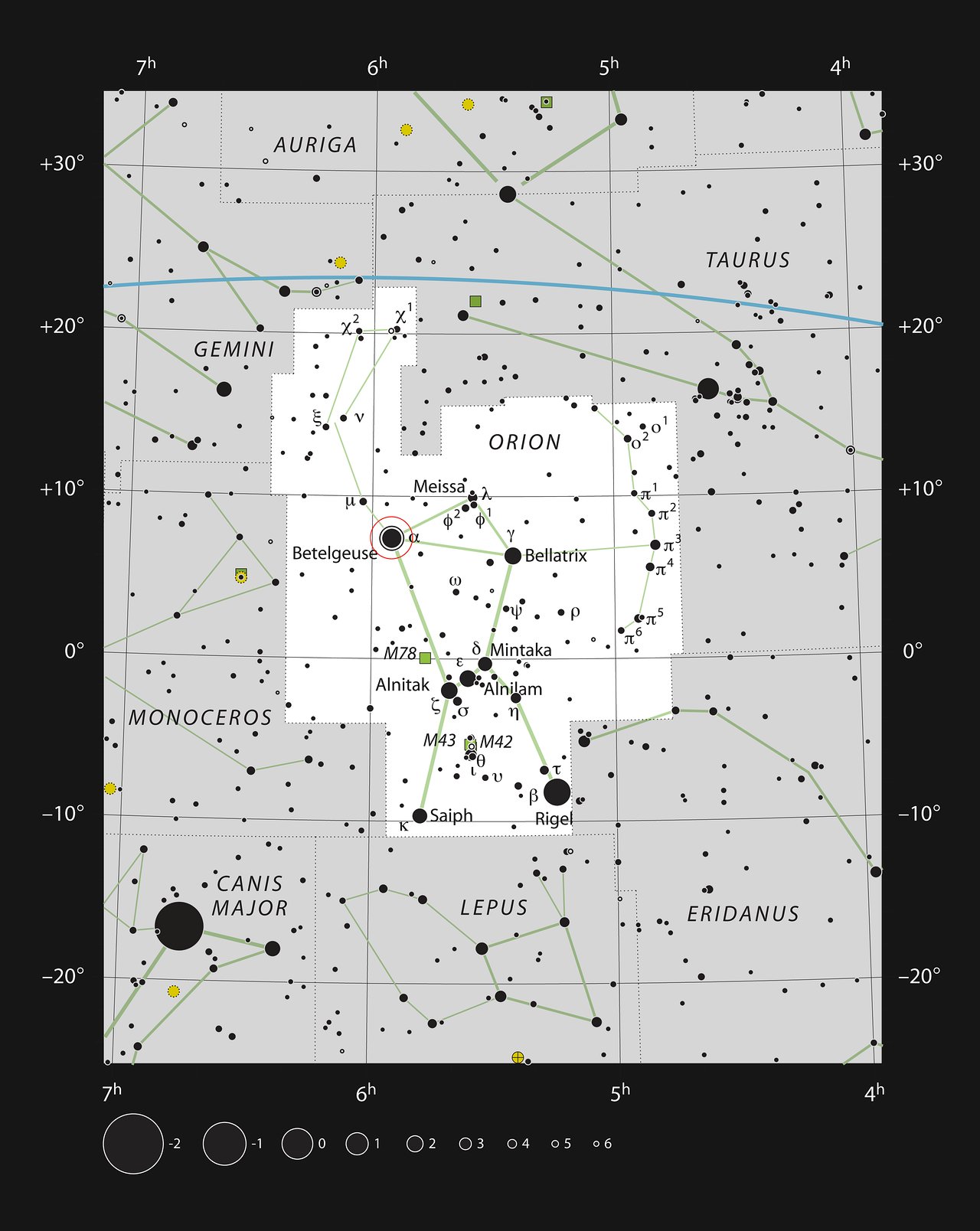
Betelgeuse is the brightest star in the constellation Orion, the Hunter. Look for Orion in the evening sky during winter months (November through March in the Northern Hemisphere). The constellation is unmistakable — three closely spaced stars (Orion's Belt) form a straight line. Betelgeuse is the bright reddish star above and to the left of the Belt, marking Orion's eastern shoulder. From the Southern Hemisphere, the constellation appears upside down but is equally easy to find.
What You'll See
To the naked eye, Betelgeuse appears as a distinctly orange-red star — one of the few stars in the sky where the color is obvious without optical aid. Through binoculars, the color becomes even more vivid. A small telescope will show Betelgeuse as a brilliant orange point, though its surface is too far away to resolve as a disk in most amateur instruments. What you're seeing is a red supergiant roughly 760 times the diameter of our Sun — if placed at the center of our solar system, it would extend past the orbit of Jupiter.
Track Its Brightness Changes
Betelgeuse is a semi-regular variable star, meaning its brightness changes over time. Amateur astronomers can contribute to science by comparing Betelgeuse's brightness to nearby stars of known magnitude (like Rigel, Bellatrix, and Aldebaran). The American Association of Variable Star Observers (AAVSO) welcomes visual estimates from beginners — your observations could help scientists understand the star's behavior in light of the new companion discovery.
Best Equipment for Viewing Orion
For the best views of Orion and its treasures (including the Orion Nebula M42, just below the Belt), a 6-inch or 8-inch Dobsonian telescope is ideal. For a complete guide to the constellation, visit our Orion constellation guide.
Watch: ESO Announcement Video
ESO has released a video announcing this groundbreaking discovery. The video explains the century-long search for Betelgeuse's companion and shows the new VLT/SPHERE images of Betelgeuse B.
ESO finds Betelgeuse's companion star | ESO News — This ESO video explains the century-long search for Betelgeuse's companion and the new VLT/SPHERE images that finally confirmed Betelgeuse B. Credit: ESO.
Frequently Asked Questions
Does Betelgeuse have a companion star?
Yes. Using ESO's Very Large Telescope, astronomers have obtained the clearest image yet of Betelgeuse B, a companion star orbiting Betelgeuse. The discovery was published in Astronomy & Astrophysics on July 28, 2026, by a team led by Miguel Montargès of the Observatoire de Paris - PSL.
What is Betelgeuse B and how big is it?
Betelgeuse B is a stellar companion orbiting the red supergiant Betelgeuse. It has around two to three times the mass of the Sun, making it more massive and brighter than originally predicted. Earlier estimates had suggested a companion roughly the mass of the Sun.
How was Betelgeuse's companion discovered?
The companion was directly imaged using the SPHERE instrument on ESO's Very Large Telescope in Chile. Two 2024 studies predicted that in December 2024 the companion would be at its greatest separation from Betelgeuse as seen from Earth. The team observed the star at that time and processed the data over several months to reveal the faint companion.
Was Betelgeuse's companion predicted before this discovery?
Yes. Astronomers had suspected Betelgeuse might have a companion for about a century, originally proposed to explain the star's brightness variations. Two 2024 studies robustly predicted that the companion would be furthest from Betelgeuse in December 2024, making it detectable. There was also a possible prior detection with the Gemini North Telescope in Hawaiʻi.
Will Betelgeuse B affect Betelgeuse's supernova?
"The question is truly opened whether this companion is going to have an impact on the evolution of the red supergiant," says lead author Miguel Montargès. The companion could affect the supernova's symmetry, the distribution of ejected material, and possibly even the timing — though Betelgeuse is not expected to explode anytime soon on human timescales.
Is Betelgeuse about to explode as a supernova?
No. Betelgeuse is a red supergiant nearing the end of its life and will eventually explode as a supernova, but this is expected to happen within the next 100,000 years — not tomorrow. The famous "Great Dimming" of 2019-2020 was caused by a dust cloud, not an imminent explosion. When it does happen, it will be spectacular but poses no threat to Earth at 500-650 light-years away.
Can I see Betelgeuse B with my telescope?
No. Betelgeuse B is far too faint and close to the glare of Betelgeuse to be visible with amateur telescopes. However, Betelgeuse itself is one of the easiest stars to find. Look for the Orion constellation in winter evenings — Betelgeuse is the bright orange-red star at Orion's eastern shoulder, easily visible to the naked eye.
Who led the discovery of Betelgeuse B?
The discovery was led by Miguel Montargès, an astronomer at the Observatoire de Paris - PSL, France. The co-authors include Anthony Boccaletti (also at Observatoire de Paris), along with researchers from institutions across France, the Netherlands, Germany, the United States, Belgium, and Chile. The study was published in Astronomy & Astrophysics on July 28, 2026.
Sources
- ESO — Astronomers find strongest evidence yet that Betelgeuse has a companion (eso2611)
- Montargès et al. — "VLT/SPHERE images the candidate companion of Betelgeuse" — Astronomy & Astrophysics (2026)
- 2024 study predicting companion's position (Astrophysical Journal)
- Second 2024 study predicting companion's position (Astrophysical Journal)
- Previous possible detection with Gemini North Telescope
- Montargès et al. (2021) — Nature — The Great Dimming of Betelgeuse explained by a dust cloud
Related Articles
🌟
🌌
☀️
🔭
📅
📅
Orion Constellation Guide
Complete guide to Orion — how to find Betelgeuse, Rigel, and M42.
Beginners' Constellation Guide
How to identify the key constellations visible from your backyard.
How Big Is the Sun?
Betelgeuse would swallow Jupiter if placed in our solar system.
Best Dobsonian Telescopes
Top picks for deep-sky observing, including Orion's winter treasures.
Night Sky December 2026
Orion dominates the winter sky — what to see this month.
Astronomy Events Calendar 2026
All the key sky events this year.