
NASA Webb · Planetary Nebula · August 2026
Lion Nebula Roars to Life With NASA's Webb
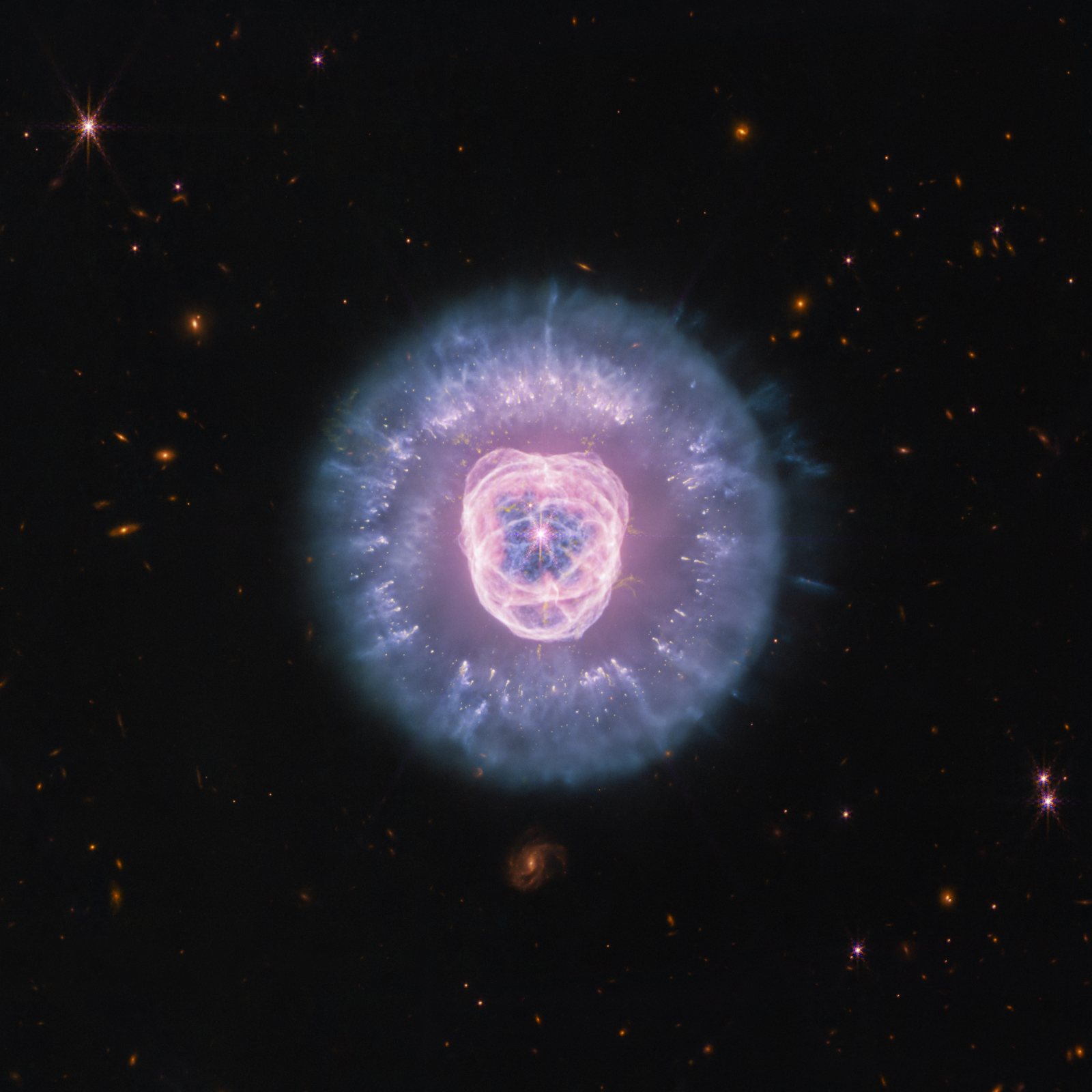
NASA's James Webb Space Telescope has captured stunning new infrared images of NGC 2392 — the planetary nebula nicknamed the Lion Nebula. Webb's NIRCam and MIRI instruments reveal a lion-shaped bubble of glowing gas and dust, sculpted from the inside by a dying white dwarf star that will one day scatter this celestial lion to the cosmos.
ObjectNGC 2392 — Lion Nebula
ConstellationGemini
InstrumentsNIRCam + MIRI
ReleaseAugust 10, 2026
By Telescope Advisor Editorial Team
|
Published:
|
Updated:
|
Reviewed & approved by Juhi Sahni, Senior Editor
|
Editorial Standards

Elena Reyes
Senior Science Editor
Covers NASA missions, space science discoveries, and astronomical events for Telescope Advisor. Translates complex astrophysical research into practical insights for backyard observers. Based in the San Francisco Bay Area.
Content reviewed by our editorial team. Research and drafting assisted by AI to ensure unbiased, data-driven analysis. Learn more about our editorial process.
The Discovery: Webb Reveals the Lion Nebula in New Detail
On August 10, 2026, NASA unveiled new images of NGC 2392, a planetary nebula nicknamed the Lion Nebula, captured by the James Webb Space Telescope. Sweeping across a star-filled stretch of the galaxy, Webb pointed its Near-Infrared Camera (NIRCam) and Mid-Infrared Instrument (MIRI) at the nebula, resolving a round, face-like structure that bears an uncanny resemblance to a male lion's head — complete with ears, a button-like nose, and a flowing mane.
The Lion Nebula is no stranger to space telescopes. NASA's Hubble Space Telescope first imaged it back in 2000, catching the nebula's lion-like face in visible light and picking out the "mane" — a haze of elongated, comet-shaped structures. Now, more than a quarter-century later, Webb has returned to the same target with its powerful infrared vision — producing a clearer, more detailed view that reveals structure Hubble simply couldn't see.
The NASA team notes that at a glance the nebula "may look quite similar" to Hubble's earlier view, yet Webb's infrared vision exposes "compact clumps of dust" plus a soft haze of glowing gas that visible light cannot reach. These structures have been slowly assembling over thousands of years, and the nebula's appearance continues to evolve even as we watch.
What Is a Planetary Nebula?
Despite the name, planetary nebulae have nothing to do with planets. The term is a historical leftover — when early astronomers saw these glowing, round objects through small telescopes, they thought they looked like the disks of planets. In reality, a planetary nebula is the expanding shell of gas and dust ejected by a dying, Sun-like star in the final stages of its life.
The story begins with the vast majority of stars in the Universe — those with masses similar to, or less than, our Sun. Massive stars die dramatically in supernova explosions, but these events are few and far between. Most of the Universe's stars are lower-mass, and their deaths are far more graceful. When a low-mass star runs out of fuel for nuclear fusion in its core, it grows unstable, begins to pulse, and gradually casts off its outer layers.
Those shed outer layers turn into shells of gas and dust — a planetary nebula. Radiation from the exposed stellar core then pushes the expelled material outward, leaving behind an intensely hot remnant called a white dwarf. Planetary nebulae are genuinely important to the chemistry of the cosmos: dying Sun-like stars are the Universe's great dust-makers, generating much of the dust we can observe and providing the raw material from which future generations of stars and planets will form.
NGC 2392
Also catalogued as the Eskimo Nebula, NGC 2392 is a planetary nebula in the constellation Gemini, roughly 4,200 light-years from Earth. It's the remains of a dying Sun-like star.
A Dying Sun-Like Star
The Lion Nebula's central star was oxygen-rich and similar in mass to our Sun. When it could no longer sustain nuclear fusion in its core, it shed its outer layers, creating the nebula we see today.
~10,000 Years to Disappear
The lion won't last forever — astronomers calculate its features will fade away in about 10,000 years, a blink in cosmic time, as the nebula's gas and dust stream away from the stellar remnant.
The White Dwarf at the Lion's Heart
Everything about the Lion Nebula — its constant evolution and its unmistakable face — traces back to a single compact object at its center: the smoldering core of a star that has run out of fuel. In Webb's images it masquerades as the lion's button nose, but this unassuming point of light is the powerhouse behind the entire nebula, its relentless energy driving every structure in the picture.
For NGC 2392, the departed oxygen-rich star bequeathed a white dwarf that is now reheating and irradiating everything around it from within. That radiation inflates a bubble of ionized gas — the glowing shell we read as the lion's face — and this bubble is steadily enlarging, annihilating the dust it sweeps through.
White dwarfs are extraordinarily dense objects — a teaspoon of white dwarf material would weigh several tons on Earth. They are the cooling embers of stars, glowing with leftover heat rather than nuclear fusion. In NGC 2392, the white dwarf's intense ultraviolet radiation strips electrons from the surrounding gas, creating the glowing ionized bubble that gives the lion its fierce, luminous face.
The Face, the Mane, and the Cometary Tufts
Webb's infrared images resolve the Lion Nebula into a rich tapestry of features, each tracing a different physical process at work. The nebula's anatomy reads almost like a wildlife portrait — face, mane, and tufts of hair — but every feature is a window into stellar death.
The Lion's Face
The lion's face is a bubble of ionized gas being produced by the central white dwarf's radiation. This expanding bubble forms the cavernous, shell-like structures around the star, giving the impression of a face with two wide arcs near the top that look like ears. Exactly why the gathered gas arranges itself into such elaborate rings and shells — a hallmark of planetary nebulae — remains an open question researchers are still working to answer.
The Mane
What we perceive as the mane is actually the inner wall of a spherical dust shell, glowing because the white dwarf at the center is shining directly onto it. In Webb's images this appears as a thick ring of purple-blue (NIRCam) or cyan (MIRI) material with a consistent width, surrounding the face like a regal collar of light.
The Cometary Tufts
Along the edges of the mane, the dust breaks into what look like tufts of hair — clumps of dust with comet-like tails. These dense nuggets have withstood the white dwarf's withering radiation, sheltering the material trailing behind each one like a shield.
Dust Destruction and Survival
Webb's MIRI mid-infrared image highlights the varying fate of dust in the nebula. Some dust is being destroyed by the dying central star's radiation, while some dust filaments manage to survive. This ongoing battle between creation and destruction is a central theme in understanding how planetary nebulae disperse their material into the galaxy.
Hubble vs Webb: A Sharper Look in Infrared
The Lion Nebula offers a perfect illustration of how Webb builds on Hubble's legacy. Hubble imaged NGC 2392 in 2000, capturing the lion face-shaped nebula in visible light — the same wavelengths our eyes can see. That image became famous for revealing the nebula's unusual structure, including the mane-like collection of comet-shaped objects.
Webb, observing at infrared wavelengths, sees through the wisps of dust and gas that partially obscure the nebula's structure in visible light. Its high-resolution imaging brings out the compact dust clumps and the soft haze of glowing gas that stayed hidden in Hubble's view. The result is a more detailed and complete picture of the nebula — one that shows not just what the nebula looks like, but how it is actively changing.
This is a recurring theme in Webb's mission: the telescope frequently revisits targets first studied by Hubble, using its infrared sensitivity to peel back layers of cosmic dust and reveal the hidden structure within. For planetary nebulae like NGC 2392, that infrared vision is especially powerful, since these objects are composed of exactly the kind of dust that blocks visible light.
Why Planetary Nebulae Matter to Astronomers
Planetary nebulae might be beautiful, but they're also scientifically crucial. They represent the fate that awaits our own Sun — and studying them tells us what will happen to the solar system billions of years from now. When the Sun exhausts its nuclear fuel in roughly 5 billion years, it will swell into a red giant, shed its outer layers, and eventually leave behind a white dwarf surrounded by a planetary nebula, much like NGC 2392.
Beyond that existential connection, planetary nebulae are key to understanding the chemical evolution of the Universe. These objects are responsible for producing a large fraction of the observable dust in the cosmos. When their material disperses into space, it enriches the interstellar medium with heavier elements — the raw ingredients for future stars, planets, and ultimately life.
Webb's observations of the Lion Nebula add to this picture by revealing the detailed interplay between the dying star's radiation and the surrounding dust. The MIRI image, in particular, shows which dust structures survive and which are destroyed — information that helps astronomers model how stellar material cycles through the galaxy. NASA's team describes the new imagery as effectively holding this planetary nebula in a freeze-frame for detailed study — even while the star's drawn-out death and its turbulent aftermath continue.
How to Observe NGC 2392 Yourself
While you won't see the lion's mane and face in Webb-level detail, NGC 2392 is a genuinely rewarding target for backyard observers — and a reminder that the objects dominating the news headlines are within reach of modest equipment.
Finding NGC 2392 in Gemini
The Lion Nebula sits in the constellation Gemini, the Twins, near the bright stars Castor and Pollux. It lies roughly midway between these two stars and the bright star Procyon, and is best viewed from the Northern Hemisphere during winter and early spring evenings (December through April). At magnitude ~9.9, it's visible in telescopes of about 100mm aperture and up, though dark skies help.
What You'll See
Through a small telescope, NGC 2392 appears as a small, bluish-gray disk — a distinct "fuzzy star" that stands out against the background. With 150mm+ of aperture and higher magnification, you may glimpse its bright central star surrounded by a faint ring-like halo. The object's other nickname, the Eskimo Nebula, comes from this classic telescopic view, which resembles a face in a fur parka.
Best Equipment
A 6-inch or 8-inch Dobsonian telescope is ideal for planetary nebulae like NGC 2392. Use moderate magnification (100-150×) to split the central star from the surrounding nebula. A UHC or O-III filter can enhance the nebula's faint glow, though NGC 2392's small size means high magnification matters more than light-gathering for this one.
See It, Then Understand It
Knowing what you're looking at transforms the view: that faint disk of gas is a dying star's last gift to the galaxy — material that will one day seed new stars and planets. For help navigating to Gemini and its treasures, see our best astronomy apps guide for finding objects in the sky.
Frequently Asked Questions
What is the Lion Nebula?
The Lion Nebula (NGC 2392) is a planetary nebula in the constellation Gemini, roughly 4,200 light-years from Earth. It's the remains of a dying Sun-like star that shed its outer layers, creating a glowing shell of gas and dust that looks like a lion's head. It's also known by its older nickname, the Eskimo Nebula.
What did NASA's Webb telescope discover about the Lion Nebula?
Webb captured new infrared images of NGC 2392 using its NIRCam and MIRI instruments, revealing the planetary nebula in unprecedented detail. The images bring out dense dust clumps, a soft haze of glowing gas, and the elaborate structure of the lion-shaped bubble powered by the white dwarf at its center. The images were released August 10, 2026.
What is at the center of the Lion Nebula?
At the center of the Lion Nebula sits a white dwarf — the dense, fading core of a star that has ended its life. In the image it appears as the lion's tiny nose, yet this small object is what powers the nebula's elaborate structures, inflating the expanding bubble of ionized gas we recognize as the lion's face.
How does Webb's image of the Lion Nebula differ from Hubble's?
Hubble imaged NGC 2392 in 2000 in visible light. Webb observes at infrared wavelengths, which allows it to see through dust and reveal features hidden from Hubble, including dense dust clumps and a faint glow of ionized gas. The overall lion-head structure looks similar, but Webb's view is clearer and more detailed.
What is a planetary nebula?
A planetary nebula is an expanding shell of gas and dust ejected by a dying Sun-like star. When a low-mass star can no longer sustain nuclear reactions in its core, it becomes unstable, pulsates, and sheds its outer layers, which form the nebula. The term is a historical misnomer — these objects have nothing to do with planets.
What will happen to the Lion Nebula?
The lion won't stay put forever: astronomers calculate its features will fade away in roughly 10,000 years — the blink of an eye in cosmic terms. The nebula's gas and dust will continue to stream away from the stellar remnant, enriching the surrounding galaxy with heavier elements that will help form future stars and planets.
Is the Lion Nebula related to our Sun?
In a sense, yes. The Lion Nebula was created by a dying star similar in mass to our Sun. It's a preview of the Sun's ultimate fate: in roughly 5 billion years, the Sun will swell into a red giant, shed its outer layers, and leave behind a white dwarf surrounded by a planetary nebula, just like NGC 2392.
Can I see the Lion Nebula with my telescope?
Yes. NGC 2392 is visible in telescopes of about 100mm aperture and up, appearing as a small bluish-gray disk with a bright central star. It's located in the constellation Gemini and is best viewed from the Northern Hemisphere during winter and early spring. Higher magnification (100-150×) reveals more detail.
Sources
Also popular on Telescope Advisor
🎄 Telescope Christmas Gift Guide 2026
Every budget and recipient covered
Telescope Black Friday Deals 2026
Live deal tracking from Nov 20
How to Choose a Telescope
7-step buyer’s framework
Best Telescopes for Beginners 2026
13 reviewed & ranked picks
How Much Does a Telescope Cost?
Price guide: $80 → $2,500+
Best Telescopes 2026
Our complete annual rankings
Continue Exploring
Keep the session going with the next useful answer
Choose the next page based on whether you need a recommendation, a comparison, or a practical observing plan.
Get a Telescope Recommendation
Fastest path if you want one model instead of another long guide.
Use the Buyer Framework
See the decision order that matters before you buy.
Plan Your Next Session
Turn your gear into a concrete observing list for tonight.
🎄 Holiday season: Telescope Christmas Gift Guide 2026 · Black Friday deal tracking
Related Guides
🌌
🔭
🔭
📷
♊
📱
What Is a Nebula?
Planetary, emission, reflection — the different types explained.
Best Telescope for Viewing Nebulae
Top scopes for seeing nebulae like NGC 2392 in detail.
Best Dobsonian Telescopes
Large aperture, affordable — ideal for deep-sky observing.
Astrophotography for Beginners
Learn to photograph nebulae, star clusters, and more.
Gemini Constellation Guide
Find Castor, Pollux, and the Lion Nebula in Gemini.
Best Astronomy Apps
Locate NGC 2392 and other deep-sky gems in the night sky.