
NASA Webb · Star Formation · October 2026
Webb Captures Commotion From a Nebula's Stellar Jets
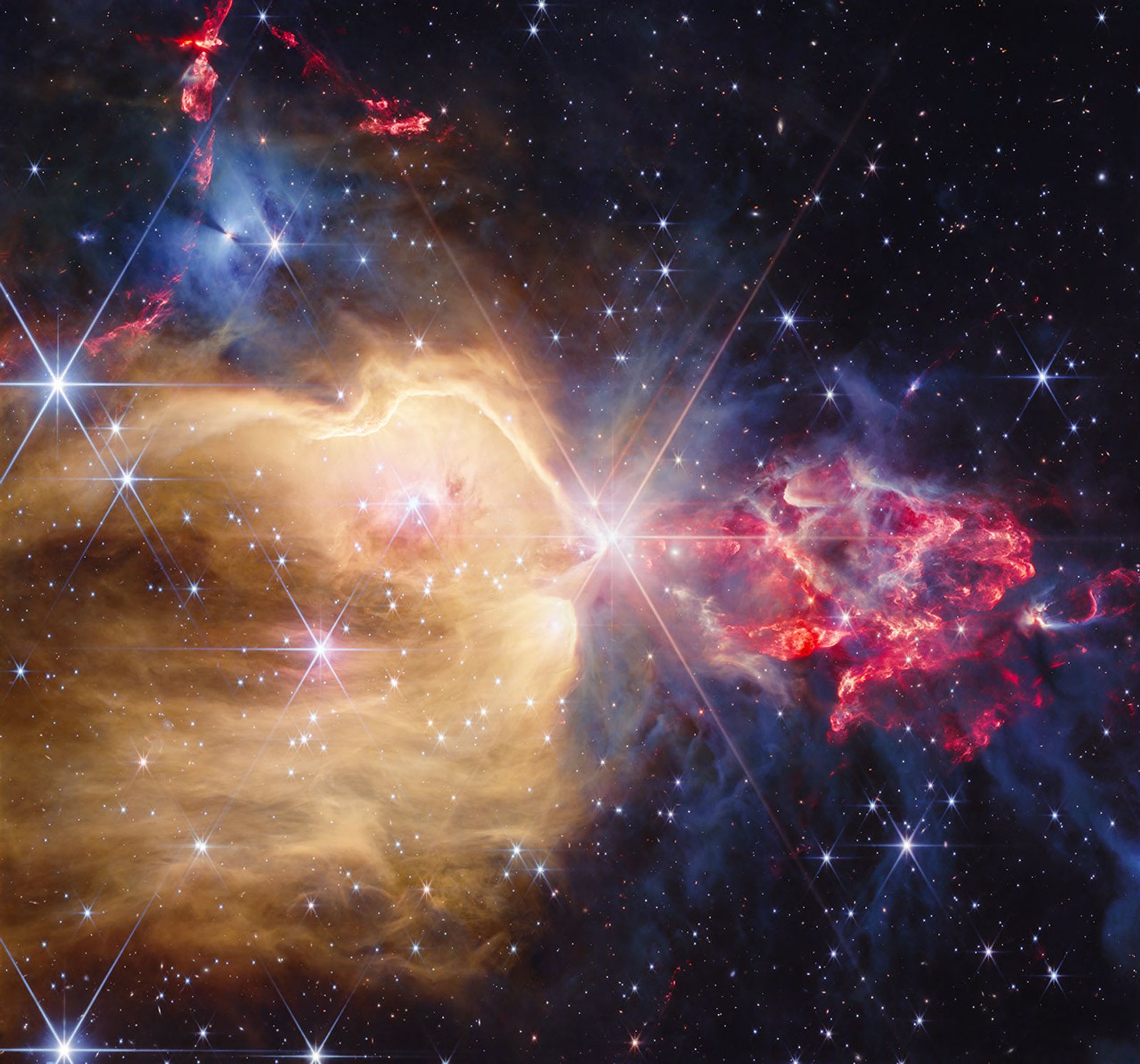
A chaotic stellar nursery comes into focus in Webb's newest image. Peering through the dust of NGC 7129, the telescope has exposed dozens of newborn stars that were previously invisible — and the violent, glowing jets they fire into the clouds around them.
ObjectNGC 7129
Distance~3,300 light-years
InstrumentWebb NIRCam
ReleaseOctober 6, 2026
By Telescope Advisor Editorial Team
|
Published:
|
Updated:
|
Reviewed & approved by Juhi Sahni, Senior Editor
|
Editorial Standards

Elena Reyes
Senior Science Editor
Covers NASA missions, space science discoveries, and astronomical events for Telescope Advisor. Translates complex astrophysical research into practical insights for backyard observers. Based in the San Francisco Bay Area.
Content reviewed by our editorial team. Research and drafting assisted by AI to ensure unbiased, data-driven analysis. Learn more about our editorial process.
The Discovery: Webb Opens Up NGC 7129
Published on October 6, 2026, NASA's latest Webb release focuses on a star-forming region called NGC 7129, a busy cluster of infant stars roughly 3,300 light-years from Earth. What makes the new image remarkable isn't just its beauty — it's the sheer number of stars that have suddenly become visible. Where earlier views showed a soft, hazy glow, Webb's Near-Infrared Camera (NIRCam) resolves a dense scattering of newborn suns, each marked by the telescope's signature eight-pointed diffraction spikes.
The reason those stars were hidden is straightforward: young stars are born wrapped in the very material that created them. A dense, cold blanket of dust and gas surrounds each one, and that blanket is remarkably good at blocking starlight. Telescopes that only collect visible light see the blanket, not what's inside it. Infrared light, however, slips through dust far more easily — and Webb was built specifically to capture it. The result is a portrait of a stellar nursery with its nursery curtains pulled back.
NGC 7129 sits in the constellation Cepheus, the King, and is sometimes nicknamed the Rosebud Nebula for its soft, petal-like glow in visible-light photographs. It's a relatively nearby laboratory for watching stars assemble themselves — close enough to study in detail, yet busy enough to contain stars at several distinct stages of formation all at once. That combination is exactly what makes the new Webb image scientifically valuable.
What Is a Stellar Nursery?
Stars don't appear from nothing. They condense out of gigantic clouds of cold, sparse gas and dust — the molecular clouds that thread through every galaxy. Inside these clouds, gravity slowly pulls clumps of material together. As a clump contracts, it grows denser and hotter, and its center begins to glow as a protostar — a star in the making that has not yet switched on nuclear fusion.
The protostar stage is the messiest part of a star's life. A growing protostar doesn't just sit quietly; it actively gathers material while simultaneously throwing some of it back out in powerful, narrow jets of superheated gas. Those jets slam into the surrounding cloud at high speed and light it up. The result is the chaotic, textured look that gives NGC 7129 its turbulent appearance.
Eventually, the protostar finishes collecting mass and enters the pre-main-sequence stage. It is now a genuine star — a sphere of hot plasma — but it isn't yet stable. It continues to shrink under its own gravity, which raises its internal temperature. When that temperature finally climbs high enough, the star ignites hydrogen fusion in its core and joins the main sequence, where it will spend the vast majority of its life. Everything in NGC 7129 is somewhere along this timeline.
Stage 1 — Protostar
A collapsing clump of gas and dust, still buried in its birth cloud and still gathering mass. It fires outflows of superheated material that create shocks in the cloud around it.
Stage 2 — Pre-Main-Sequence
The star has finished forming but is still contracting and heating up. It shines, but by gravitational energy rather than hydrogen fusion. NGC 7129's central star is at this stage.
Stage 3 — Main Sequence
Hydrogen fusion ignites in the core, and the star settles into a long, stable adulthood — the phase our Sun has occupied for about 4.6 billion years.
LkHα 234: The Heavyweight at the Center
Every family photo needs a focal point, and in Webb's NGC 7129 image it's the brilliant yellow-white star dominating the frame. Its name is LkHα 234 — pronounced "Lick-H-alpha 234" — and it is the most massive and most evolved member of the cluster.
LkHα 234 is a pre-main-sequence star tipping the scales at an estimated 5–8 solar masses — several times heavier than our Sun. That mass matters enormously. Massive stars burn brighter, live faster, and mature sooner than their lightweight siblings, which is why LkHα 234 has already pulled ahead of the rest of the cluster. While its neighbors are still gathering themselves, it has largely finished forming and is well on its way to igniting fusion in its core. One day it will shine the way our Sun does, but on a far grander scale — and it will burn out in a matter of tens of millions of years rather than billions.
The star's influence extends well beyond its own surface. Radiation and outflows pouring off LkHα 234 have hollowed out a vast cavity of glowing gas roughly 3.5 light-years across — the golden expanse that fills the left two-thirds of the image. For scale, that single cavity is comparable to the entire distance between our Sun and its nearest stellar neighbor, Proxima Centauri. One young star has carved a structure that big out of the surrounding cloud.
Why the spikes? The eight-pointed starbursts around bright points in Webb's images aren't real features of the stars — they're an optical artifact called a diffraction pattern, produced as light bends around the struts supporting the telescope's secondary mirror. Webb's honeycomb of 18 hexagonal mirror segments gives it a distinctive six-pointed pattern with two fainter horizontal flares, for eight spikes in total. Astronomers use the spikes as a signature to identify which points are genuinely bright stars in the foreground and which are distant galaxies.
Reading Webb's Colors: Gold, Red, and Blue
Webb's images aren't photographs in the ordinary sense. The telescope records infrared light — wavelengths our eyes cannot see — and each filter is then assigned a visible color so the data can be presented as a picture. In NGC 7129, those color assignments encode real physics, and once you know the code, the image becomes a map of what's happening inside the nebula.
Gold — Hot Atomic Hydrogen
The broad golden sweep on the left is hydrogen gas that has been broken apart into individual atoms and heated to high temperatures by the radiation of the young stars. It marks the cavity that stellar outflows and starlight have excavated out of the cloud. Its sharp upper edge is a boundary where the hot, ionized interior meets the cold, dense molecular cloud beyond.
Red — Shocked Molecular Hydrogen
The clumpy, flame-like plume on the right is cooler hydrogen that is still bound up in molecules. It glows red because it has been violently disturbed — struck by outflows blasting out of the protostars buried within it. Whenever you see red molecular hydrogen in a star-forming region, you're looking at gas that has been hit by something moving very fast.
Blue — Protostars Lighting Their Surroundings
In the upper-left portion of the image, a cluster of bright protostars illuminates the gray gas around them, giving the region a diffuse blue cast. These are among the youngest objects in the frame — stars so recently formed that they are still sealed inside their dusty wrappers.
Stellar Jets, Bow Shocks, and Shadow Play
The real story in NGC 7129 isn't the light — it's the motion. Everything glowing in this image is being pushed, compressed, or battered by something else, and Webb's sharp resolution exposes several distinct kinds of cosmic collision.
Stellar Jets and Outflows
As a protostar pulls in material, it also ejects a fraction of it at high speed along its poles. These outflows — narrow, fast-moving streams of superheated gas — plough into the surrounding cloud and generate shock fronts. In NGC 7129, several protostars are firing jets simultaneously, and because we view the nebula from a particular angle, their outflows overlap and interleave on the sky. That stacking is what makes this region look so frenetic.
Bow Shocks
Some of the smaller stars in the golden cavity are also throwing off stellar winds — steadier streams of particles moving outward. Where those winds run into the energetic gas already present, they bend and pile up, forming curved arcs called bow shocks. The name is apt: they look exactly like the standing wave that forms in front of a ship's hull as it pushes through water. Each bow shock carves its own tiny cavity in the gas.
The Photodissociation Ridge
Along the upper edge of the golden cavity runs a bright, sharp ridge. This is a photodissociation region — a frontier where ultraviolet radiation from the cluster is energetic enough to tear hydrogen molecules apart into individual atoms, but not energetic enough to fully ionize them. It's a transition zone between the hot, processed interior and the cold, untouched cloud outside. Watching these boundaries tells astronomers how quickly the cloud will be worn away.
A Shadow Like a Bat
Near the top-left of the image, within the blue haze, sits a protostar encircled by a flat, donut-shaped disc of material. Because the disc is tilted relative to us, it blocks some of the light streaming off the star and casts a dark shadow onto the nebula behind it. The structure closely resembles a famous feature Hubble photographed in another nebula, nicknamed the "Bat Shadow." Seeing the same phenomenon in a different region confirms it's a common consequence of how young stars and their discs are oriented.
Spitzer vs Webb: Why Resolution Matters
NGC 7129 is not a new target. NASA's retired Spitzer Space Telescope — an infrared observatory that operated for more than 16 years — also studied the gas and dust in this region, and its observations laid the groundwork for today's Webb image. NASA has released the two views side by side, and the comparison is striking.
Spitzer's picture is softer and less defined. It captures the broad regions correctly — the bright star, the two lobes of gas — but the details blur together. Webb's version resolves filaments, knots, and fine structure that Spitzer simply could not separate. More strikingly, Webb's improved sharpness and sensitivity also pull out a crowd of background galaxies scattered behind NGC 7129, most of them visible only in the gaps between the nebula's clouds.
The difference comes down to aperture and resolution. Webb's 6.5-meter mirror is far larger than Spitzer's 0.85-meter mirror, and its instruments were designed with sharper optics. For a target like NGC 7129, where dozens of jets, winds, and shocks are all tangled together in a small area of sky, that extra sharpness is the difference between seeing a nebula and understanding one. Astronomers will keep mining this dataset to work out precisely how the stars and protostars here are shaping — and eroding — the cloud they were born in.
How to Observe NGC 7129 Yourself
NGC 7129 is faint, small, and easy to miss — but it is reachable with amateur equipment, which makes it a satisfying challenge target for anyone who wants to see a star-forming region with their own eyes rather than through a telescope image.
Finding NGC 7129 in Cepheus
The nebula lies in northern Cepheus, the King, close to the constellation's border with Draco. It sits in a fairly empty stretch of sky, so a star-hopping chart or planetarium app is essential — following bare stars by memory is unreliable here. From mid-northern latitudes Cepheus is circumpolar, meaning it never sets, which gives you year-round opportunities. Late summer and autumn evenings offer the most comfortable viewing, when the constellation is high and well placed.
What You'll Actually See
Set expectations carefully: this is a dim, low-contrast object. Through a small telescope it typically shows as a small, hazy patch of light surrounding a faint star — not the swirling gold and red of Webb's infrared portrait. The nebula's overall glow is faint enough that dark skies really are the deciding factor, more so than aperture. Don't expect the image on this page; expect a modest grey smudge that tells you a nursery full of baby stars is sitting right there.
Equipment That Works
A 6-inch or 8-inch Dobsonian is a good match — enough light grasp to detect the nebulosity while staying simple to use. Use a moderate-to-high magnification to darken the background sky and improve contrast, and try an O-III or UHC filter to tease out the brightest portions. Because the object is small, magnification frequently buys you more than extra aperture does.
Why It Rewards the Effort
Most "famous" nebulae are bright and immediately gratifying. NGC 7129 is the opposite: it asks for dark skies, patience, and averted vision. In return, you get to look at a genuine stellar nursery — the very clouds, jets, and infant stars that Webb travelled 1.5 million kilometres from Earth to photograph. Knowing what's inside that faint smudge changes how it looks. For help navigating, see our best astronomy apps guide.
Frequently Asked Questions
What is NGC 7129?
NGC 7129 is a young star-forming region roughly 3,300 light-years from Earth in the constellation Cepheus. It contains a cluster of newborn stars still embedded in the cloud of gas and dust they formed from. It's sometimes called the Rosebud Nebula. A particularly massive young star, LkHα 234, dominates the cluster.
What did NASA's Webb Telescope reveal about NGC 7129?
Webb's NIRCam instrument exposed many stars previously hidden behind the region's dust, including numerous protostars and pre-main-sequence stars. The image also shows stellar jets and outflows colliding with surrounding gas, bow shocks formed by stellar winds, a photodissociation region at the edge of a large cavity, and a shadow cast by a protostar's disc. The images were released October 6, 2026.
Why couldn't other telescopes see the stars in NGC 7129?
Young stars are enclosed in dense cocoons of dust and gas left over from their formation. That dust blocks visible light effectively, so telescopes that observe only in visible wavelengths see the cloud rather than the stars inside it. Webb is highly sensitive to infrared light, which passes through dust far more readily, allowing it to reveal what's hidden within.
What is LkHα 234?
LkHα 234 (pronounced "Lick-H-alpha 234") is the most massive and most evolved star in the NGC 7129 cluster, estimated at 5 to 8 times the mass of the Sun. It is a pre-main-sequence star, meaning it has largely finished forming but has not yet ignited hydrogen fusion in its core. Its radiation and outflows have carved out a cavity roughly 3.5 light-years across.
What causes the red glow in Webb's NGC 7129 image?
The red structures are cooler molecular hydrogen gas that has been shocked by outflows from embedded protostars. When fast-moving jets from young stars plough into surrounding material, they generate shock fronts that heat and excite the gas, causing it to glow. The gold region, by contrast, is hotter hydrogen that has been broken into individual atoms.
What is a photodissociation region?
A photodissociation region is a boundary zone where ultraviolet radiation from nearby hot stars is strong enough to break hydrogen molecules apart into individual atoms, but not strong enough to strip those atoms of their electrons entirely. In NGC 7129, this boundary appears as a sharp bright ridge along the top of the golden cavity. Studying these zones helps astronomers understand how quickly star-forming clouds are eroded.
How does Webb's image compare to Spitzer's?
NASA's retired Spitzer Space Telescope also observed NGC 7129, but its view is softer and less detailed. Webb's much larger mirror and sharper optics resolve gas and dust filaments, fine structures, and many background galaxies that Spitzer could not separate. NASA released both images side by side to illustrate the improvement.
Can I see NGC 7129 with my telescope?
Yes, but it's a challenge object. NGC 7129 is faint and small, appearing as a hazy patch around a dim star through a small telescope under dark skies. A 6-inch or larger telescope helps, as does high magnification and dark-sky location. It's located in northern Cepheus, which is circumpolar from mid-northern latitudes and therefore visible year-round.
Sources
Also popular on Telescope Advisor
⚡ Prime Big Deal Days Telescope Deals
Oct 6–7 — what to buy this week
🎄 Telescope Christmas Gift Guide 2026
Every budget and recipient covered
Telescope Black Friday Deals 2026
Live deal tracking from Nov 20
How to Choose a Telescope
7-step buyer’s framework
Best Telescopes for Beginners 2026
13 reviewed & ranked picks
How Much Does a Telescope Cost?
Price guide: $80 → $2,500+
Continue Exploring
Keep the session going with the next useful answer
Choose the next page based on whether you need a recommendation, a comparison, or a practical observing plan.
Get a Telescope Recommendation
Fastest path if you want one model instead of another long guide.
Use the Buyer Framework
See the decision order that matters before you buy.
Plan Your Next Session
Turn your gear into a concrete observing list for tonight.
⚡ On sale now: Prime Big Deal Days telescope deals · or wait for Black Friday?
🎄 Holiday season: Telescope Christmas Gift Guide 2026 · Black Friday deal tracking
Related Guides
🌌
🔭
🔭
🌃
📷
📱
What Is a Nebula?
Emission, reflection, planetary — the different types explained.
Best Telescope for Viewing Nebulae
Top scopes for seeing star-forming regions in detail.
Best Dobsonian Telescopes
Large aperture, affordable — ideal for deep-sky observing.
Deep-Sky Viewing From the City
What's still visible under light-polluted skies.
Astrophotography for Beginners
Learn to photograph nebulae and star clusters.
Best Astronomy Apps
Star-hop to NGC 7129 and other deep-sky targets.