Unistellar eQuinox 2 Review 2026: Is It Still Worth $2,899?
Telescope Advisor Logo Telescope Advisor
The Orion Nebula, a showpiece deep-sky target for the Unistellar eQuinox 2 smart telescope

Smart Telescope Review · 2026

Unistellar eQuinox 2 Review: Is It Still Worth It in 2026?

The eQuinox 2 has a 114mm mirror, more than twice the aperture of most smart telescopes, plus a citizen-science program run with the SETI Institute. But it costs $2,899 and newer rivals are cheaper, lighter and wider-field. Here's who it still makes sense for.

Aperture114mm, 450mm f/4
List price$2,899
BatteryUp to 11 h (claimed)
Our rating4.0 / 5
By Telescope Advisor Editorial Team Published: Updated: Reviewed & approved by Juhi Sahni, Senior Editor Editorial Standards
Elena Reyes — Senior Science Editor

Elena Reyes

Senior Science Editor

Covers NASA missions, space science discoveries, and astronomical events for Telescope Advisor. Translates complex astrophysical research into practical insights for backyard observers. Based in the San Francisco Bay Area.

Content reviewed by our editorial team. Research and drafting assisted by AI to ensure unbiased, data-driven analysis. Learn more about our editorial process.

How we reviewed it: we haven't tested the eQuinox 2 ourselves. This review combines Unistellar's published specifications with independent reviews (BBC Sky at Night Magazine, Space.com) and owner reports, following our review method. Every spec was checked against at least two sources.

Quick Verdict

★★★★☆ 4.0 / 5

The eQuinox 2 is still the most aperture you can get in a portable, fully automatic smart telescope. Its 114mm mirror reaches faint galaxies that 30–50mm smart scopes struggle with, the battery lasts all night, and the citizen-science program is unique. It is held back by its age: a 6.2MP image, a field of view under one degree, 9kg of weight, and a $2,899 price that newer refractors such as the Vespera 3 now undercut.

Buy it if: you want maximum light grasp without assembling a rig, love galaxies and globular clusters, or want to contribute to real science.
Skip it if: you want big nebulae in one frame, need something light for travel, or are buying your first telescope on a budget.
Unistellar eQuinox 2 smart telescope on its tripod

Quick Summary

Pros

  • 114mm aperture, the largest in a portable all-in-one smart telescope
  • Fast f/4 optics
  • Battery rated up to 11 hours
  • SETI Institute and NASA citizen-science campaigns
  • Fully automatic: no polar alignment or collimation in normal use

Cons

  • 6.2MP images look dated next to 8.3MP rivals
  • Field under 1°, so big nebulae need mosaics
  • 9kg with tripod
  • $2,899 list price
  • No eyepiece (that costs $4,999 in the eVscope 2)

Bottom line

Buy it for aperture and citizen science, ideally on sale. If you mainly want beautiful pictures of big, bright nebulae, a Vespera 3 or a Seestar S30 Pro does that for less.

Full Specifications

Optical designReflector
Aperture114mm (4.5″)
Focal length450mm, f/4
SensorSony IMX347 (per independent reviews; not published by Unistellar)
Image resolution6.2MP
Field of view34.2′ × 45.6′
Limiting magnitude18.2 (Unistellar's claim)
MountMotorized alt-azimuth with automatic alignment
BatteryUp to 11 hours claimed (Sky at Night: 9 hours)
Storage64GB
Weight7kg telescope + 2kg tripod (9kg)
Object database5,000+ objects
US list price$2,899

What the numbers mean

  • Light grasp: about 5.2× a 50mm smart telescope and 14× a 30mm one.
  • Resolution: the Dawes limit for 114mm is about 1.0 arcsecond, though the sensor's pixel scale and the seeing limit real detail first.
  • Field of view: under 1°, about twice the width of the full Moon. Good for galaxies, globulars and planetary nebulae.
  • Magnification: there's no eyepiece, so "power" depends on how far you zoom on your phone. Detail is set by aperture, pixels and seeing.
  • In the box: telescope, tripod, Bahtinov mask (for focusing), dust cap, charging cable and adjustment tools.
  • Upgrade path: solar observing needs Unistellar's solar filter. If you want an eyepiece, the eVscope 2 uses the same optics.

What You'll See

The narrow field and large aperture favor compact, bright-cored targets. These four play to the eQuinox 2's strengths.

Hubble image of the Whirlpool Galaxy M51
Whirlpool Galaxy (M51). At the eyepiece: after 20–30 minutes of stacking, expect both galaxy cores, the connecting bridge and hints of spiral arms from suburban skies.
Hubble image of the Hercules Globular Cluster M13
Hercules Cluster (M13). At the eyepiece: the 114mm aperture resolves stars well into the core, one of the best targets for this telescope.
Hubble image of the Ring Nebula M57
Ring Nebula (M57). At the eyepiece: a small but clear colored ring. The 450mm focal length gives it more pixels than short-focal-length smart scopes do.
Andromeda Galaxy M31
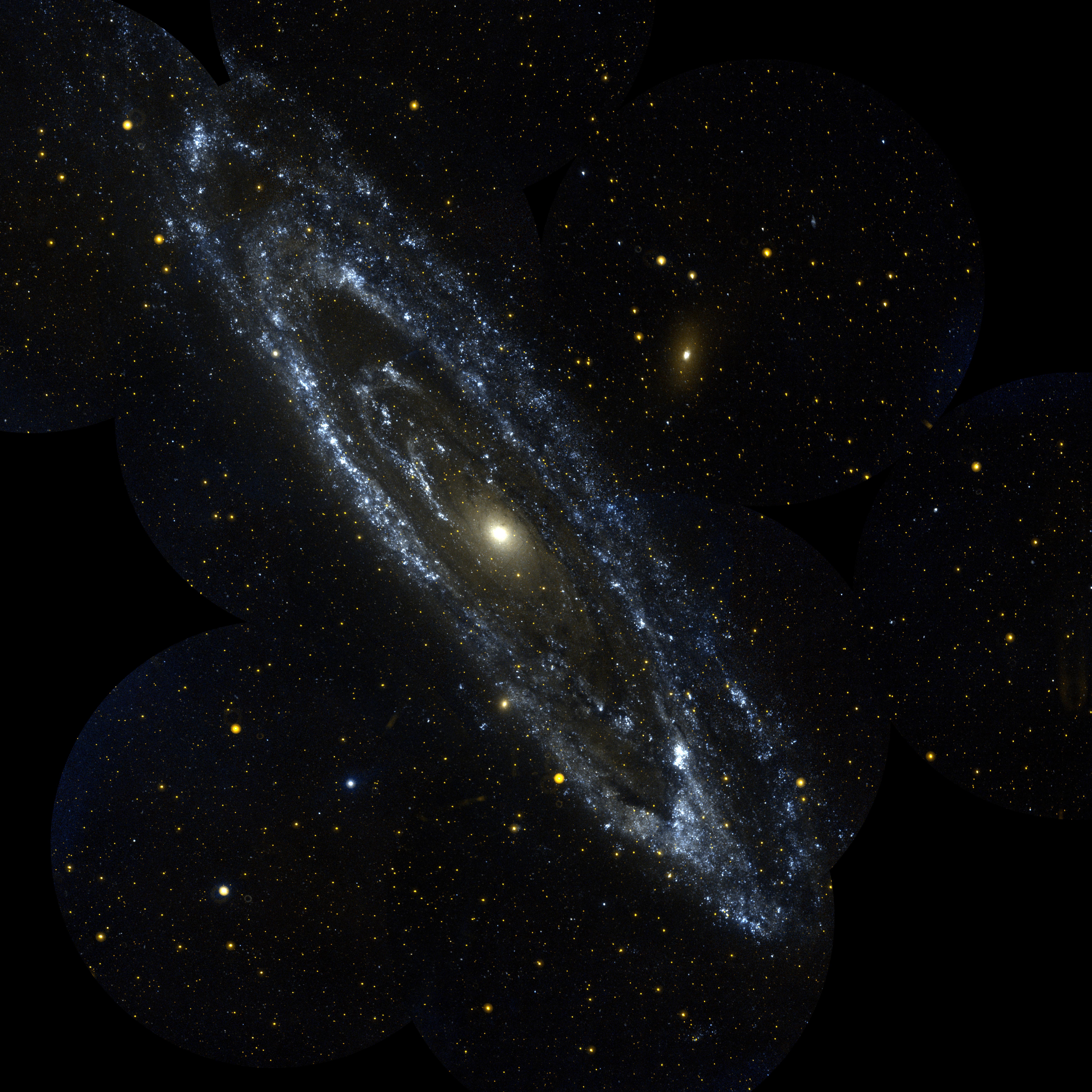
Andromeda Galaxy (M31). At the eyepiece: only the bright core and inner dust lanes fit in the under-1° field. The whole galaxy needs a mosaic.
About these images: these are NASA/Hubble reference photos, not views or images from the eQuinox 2. A smart telescope's stacked image is far less detailed than Hubble's, but it shows color and structure that are invisible to the eye at a traditional eyepiece.

The App and Automation

Everything runs through the Unistellar app on your phone or tablet. The telescope works out where it is pointing by matching the stars it sees (plate solving), so there's no star alignment to do. You pick a target from the catalog of more than 5,000 objects, the telescope slews to it, and the image builds up live as frames are stacked.

  • Enhanced Vision: live stacking and processing that brightens faint detail as you watch.
  • Smart Light Pollution Reduction: processing that suppresses sky glow from suburban skies. Unistellar's current marketing also describes newer processing features for dark-sky detail.
  • Citizen science: campaigns with the SETI Institute and NASA partners. Owners have timed asteroid occultations, followed comets and recorded exoplanet transits.
Practical limits: an alt-azimuth mount struggles to track straight overhead, so targets right at the zenith are best avoided. Field rotation keeps individual exposures short. A reflector also needs to cool to the outside temperature for sharp results, and its collimation can drift. Unistellar includes tools and a Bahtinov mask for adjustment.

Setup and Ease of Use

⏱️ Setup time

Minutes: open the tripod, mount the telescope, connect the app, and let it locate itself. Nothing to assemble or align.

🎒 Portability

9kg total. Fine for a car trip or the backyard, but heavy for hiking. Unistellar sells a backpack as an extra.

🔋 Power and cooling

The internal battery lasts a whole night. Give the mirror 20–30 minutes outside to reach the air temperature.

For beginners: very easy to use. You don't need any astronomy knowledge to get a first image. The barrier is the price, not the learning curve.

Pros and Cons

What we like

  • Aperture: 114mm gathers 5–14 times the light of typical 30–50mm smart telescopes, so faint galaxies build up faster.
  • Fast f/4 optics: combined with the large aperture, each exposure collects a lot of signal.
  • All-night battery: rated up to 11 hours. Independent reviewers report about 9.
  • Citizen science: a real program with the SETI Institute and NASA partners that no other brand matches.
  • Very simple: plate-solving alignment and automatic targeting mean almost no learning curve.
  • Good for outreach: the live, building image on a phone or tablet screen is easy to show to a group.
  • Mature product: on sale since 2022, with a well-established app and a large owner community.

What we don't

  • Dated sensor: 6.2MP output, when 2026 rivals use 8.3MP Starvis 2 sensors.
  • Narrow field: under 1°, so the Pleiades, Andromeda and large nebulae need mosaics.
  • Heavy: 9kg with the tripod, against under 2kg for a Seestar S30 Pro or Dwarf 3.
  • Expensive: $2,899 list. The Vespera 3 costs less with a newer sensor and an apochromatic refractor.
  • No eyepiece: the Nikon eyepiece is only on the $4,999 eVscope 2.
  • Reflector upkeep: mirror cool-down and occasional collimation, which sealed refractors don't need.
  • Not a planet scope: the short focal length and stacking approach suit deep-sky objects, not planetary detail.

Who Should Buy It

✅ Ideal buyer

A deep-sky fan who wants faint galaxies and globular clusters with no technical setup, and likes the idea of contributing data to the SETI Institute and NASA. A teacher, club or outreach volunteer who wants a large-aperture scope that anyone can run.

🤔 Consider alternatives

If you want the newest sensor and sealed refractor optics, the Vespera 3 costs less. If you want an eyepiece, look at the eVscope 2 or Odyssey Pro. For the most light per dollar from a fixed spot, consider the Origin Mark II.

❌ Not recommended for

First-time buyers on a budget, people who travel or hike, anyone mainly after planets, and wide-field imagers who want whole nebulae in one frame.

eQuinox 2 vs eVscope 2 vs Odyssey vs Odyssey Pro

 eQuinox 2eVscope 2OdysseyOdyssey Pro
Aperture114mm114mm85mm85mm
Focal length450mm f/4450mm f/4320mm (~f/3.8)320mm (~f/3.8)
EyepieceNoNikon OLEDNoNikon OLED
Image output6.2MP7.7MP——
Battery (claimed)11 h9 h——
US list price$2,899$4,999$2,599$4,599

The eQuinox 2 is the best-value Unistellar if you don't need an eyepiece: you get the full 114mm aperture for $2,100 less than the eVscope 2, which uses the same optics plus the Nikon eyepiece. The Odyssey is $300 cheaper but has a smaller 85mm aperture. Full eyepiece model review: Unistellar eVscope 2 review.

Price and Where to Buy

Unistellar eQuinox 2 smart telescope

$2,899.00

List price $2,899. It's often discounted during holiday sales, so check the current price before you buy.

Affiliate link: we may earn a commission at no cost to you. Price via Amazon Creators API.

Alternatives to the eQuinox 2

🔭

Vaonis Vespera 3 $2,490.00

50mm apochromatic refractor with an 8.3MP IMX585 sensor and an 11-hour battery. Less aperture, but a newer sensor and a wider field for less money.

🌌

Unistellar Odyssey $2,599.00

Unistellar's 85mm model. It uses the same app and citizen-science program and costs a little less.

👁️

Unistellar Odyssey Pro $4,599.00

85mm with the Nikon electronic eyepiece, for people who want to look into the telescope as well as at a screen.

⭐

Celestron Origin Mark II $4,299.00

A 6-inch f/2.2 RASA with an 8.3MP sensor: much more light, but about 19kg and best set up in one place.

🎒

ZWO Seestar S30 Pro $699.00

30mm apochromat, 4.6° field, 1.65kg. A quarter of the price, and the best choice for big nebulae and travel.

💡

DWARFLAB Dwarf 3 $549.00

35mm apochromat with an 8.3MP IMX678 sensor at 1.3kg. The cheapest serious way into smart-telescope imaging.

Affiliate links: we may earn a commission at no cost to you.


Next Best Step

Need the fastest next step?

Pick the path that matches where you are right now: get a recommendation, compare buyer guides, or narrow by budget.

Open Finder Tool →

🎄 Holiday season: Telescope Christmas Gift Guide 2026 · Smart telescope Black Friday deals

FAQ: Unistellar eQuinox 2

How much does the Unistellar eQuinox 2 cost?

Its list price is $2,899 at Unistellar's US store and on Amazon. It is often discounted during sales, and Unistellar also sells refurbished units for less.

What is the aperture of the eQuinox 2?

114mm (4.5 inches), with a 450mm focal length at f/4. That collects about 5.2 times the light of a 50mm smart telescope and about 14 times that of a 30mm one.

Does the eQuinox 2 have an eyepiece?

No. You view everything on a phone or tablet through the Unistellar app. The eVscope 2 uses the same optics and adds a Nikon OLED electronic eyepiece, for $4,999.

What is the difference between the eQuinox 2 and the eVscope 2?

Both have the same 114mm, 450mm f/4 optics. The eVscope 2 adds the Nikon electronic eyepiece and outputs 7.7MP images instead of 6.2MP, but its battery is rated at 9 hours instead of 11. It costs $4,999 against $2,899 for the eQuinox 2.

How long does the eQuinox 2 battery last?

Unistellar rates it at up to 11 hours. BBC Sky at Night Magazine's review gives 9 hours, so plan on a full night either way.

What sensor does the eQuinox 2 use?

Unistellar doesn't publish the sensor model. Independent reviews identify it as a Sony IMX347, and the telescope outputs 6.2MP images.

How big is the eQuinox 2's field of view?

About 34 by 46 arcminutes, a little under one degree. Galaxies, globular clusters and planetary nebulae fit well. The full Andromeda Galaxy or the whole North America Nebula do not fit in a single frame.

How heavy is the eQuinox 2?

About 9kg in total: 7kg for the telescope and 2kg for the tripod.

Can you do citizen science with the eQuinox 2?

Yes. Unistellar runs observing campaigns with the SETI Institute and NASA partners, covering asteroid occultations, comets and exoplanet transits. Owners can join from the app.

Is the eQuinox 2 good for planets?

It shows the planets, but it isn't the best choice for them. Smart telescopes stack short exposures and are tuned for deep-sky objects. If planets are your priority, a traditional telescope with a longer focal length gives sharper views.

Is the eQuinox 2 better than the Seestar S30 Pro?

It gathers far more light (114mm against 30mm), so faint galaxies come through faster. The S30 Pro costs $699, weighs 1.65kg and has a much wider 4.6-degree field. For most beginners the Seestar is the better value. The eQuinox 2 suits people who want more aperture and the citizen-science program.