

Webb Reveals Dynamic Panorama of Star Formation in IC 348
Telescope Advisor Logo Telescope Advisor
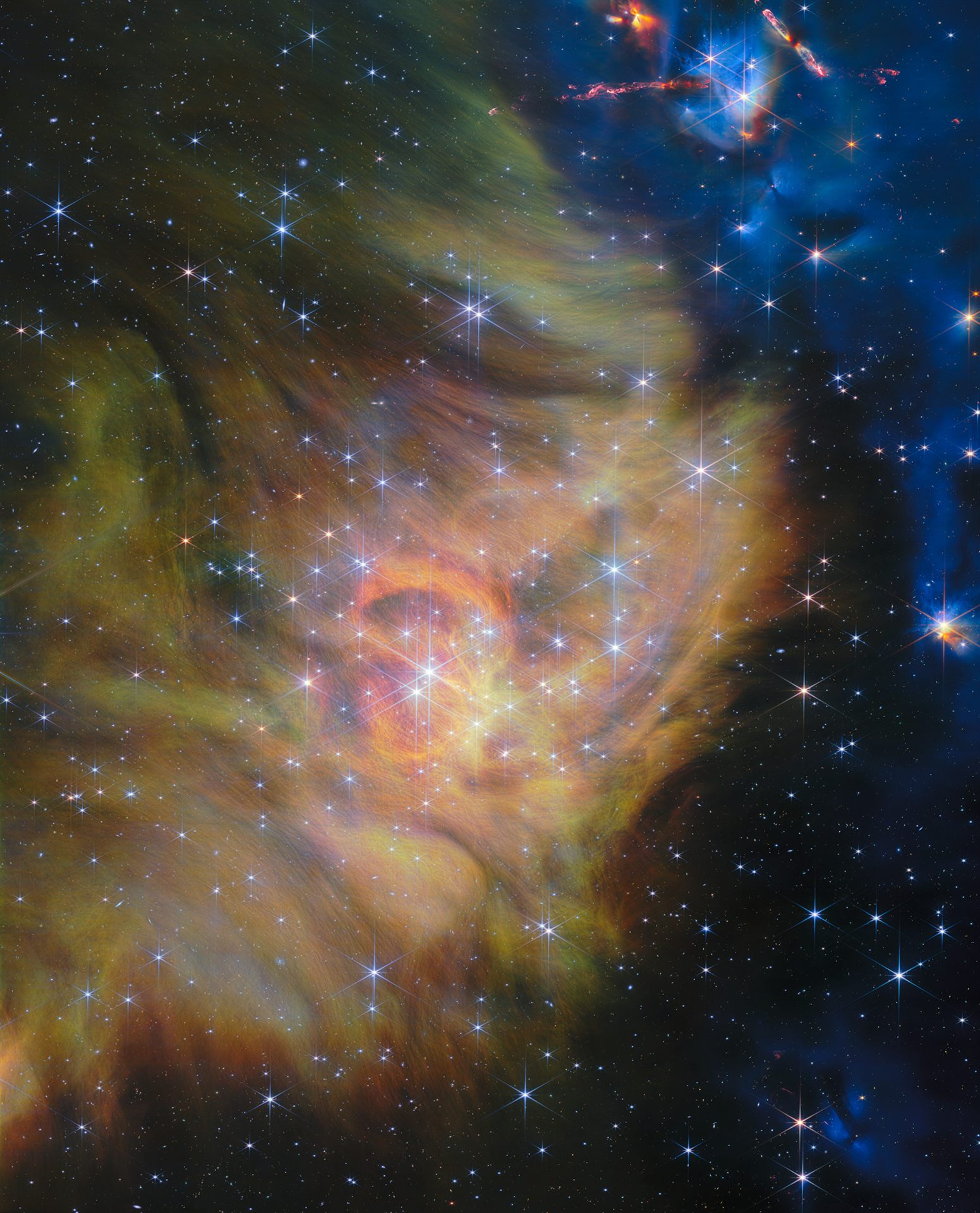
Webb NIRCam image of star-forming region IC 348 — the left two thirds show thick green and yellow clouds of gas and dust, while the right third is black space speckled with stars and galaxies; bright stars crowned with six long diffraction spikes fill the scene, and glowing blue jets shoot from hidden protostars in the upper right

NASA News · Webb Star Formation · September 2026

NASA's Webb Reveals Dynamic Panorama of Star Formation in IC 348

NASA's James Webb Space Telescope has captured one of its largest images yet — a swirling vista of the star-forming region IC 348 — and used it to find the least massive brown dwarfs ever detected, objects just twice the mass of Jupiter that are bending the rules of how stars and planets form.

TargetIC 348 (Perseus)
Distance~1,000 light-years
InstrumentsNIRCam + NIRSpec
Key find2x Jupiter-mass brown dwarfs
By Telescope Advisor Editorial Team Published: Updated: Reviewed & approved by Juhi Sahni, Senior Editor Editorial Standards
Elena Reyes — Senior Science Editor

Elena Reyes

Senior Science Editor

Covers NASA missions, space science discoveries, and astronomical events for Telescope Advisor. Translates complex astrophysical research into practical insights for backyard observers. Based in the San Francisco Bay Area.

Content reviewed by our editorial team. Research and drafting assisted by AI to ensure unbiased, data-driven analysis. Learn more about our editorial process.

Quick Answer: What Did Webb Find in IC 348?

NASA's James Webb Space Telescope has released a vast new infrared image of IC 348 — a star-forming region just 1,000 light-years away in the constellation Perseus. Using the image plus follow-up spectroscopy, astronomers found brown dwarfs as light as about twice the mass of Jupiter (only 0.19% of the Sun's mass). These are the least massive brown dwarfs ever confirmed, and they are far smaller than theories of star formation predict should exist.

The study, led by Kevin Luhman of Penn State and published in The Astrophysical Journal Letters, used Webb's NIRCam to spot candidate brown dwarfs and NIRSpec to weigh them. Along the way the team found two more surprises: one of the lightest objects shows signs of a disk that could be forming small planets, and the data contain a mysterious hydrocarbon feature seen only in the lowest-mass brown dwarfs.

Why it matters: Brown dwarfs sit in the fuzzy gap between stars and planets. Finding them at just two Jupiter masses means the star-formation process can build objects at least an order of magnitude smaller than researchers thought — blurring the line between “failed star” and “free-floating planet.” IC 348 is now the touchstone for how small those objects can get.
IC 348: A Stellar Nursery 1,000 Light-Years Away

IC 348 is an open star cluster and star-forming region located about 1,000 light-years from Earth in the constellation Perseus. In regions like this, cold clouds of molecular hydrogen collapse under gravity to form new stars, sculpting glowing, colourful scenes like the one Webb captured.

The star-formation process produces a wildly varied menagerie of objects. At one extreme are massive stars that burn through their fuel in just a few million years and die as core-collapse supernovae. At the other are the smallest, most common stars — long-lived objects that can unleash powerful stellar storms. Slipping between the two categories are the targets of this study: brown dwarfs.

IC 348 is ideal for this work because it is relatively close, young (its stars are only a few million years old), and largely free of the blistering ultraviolet radiation from massive stars that would otherwise complicate the picture. That gentler environment lets astronomers see the faintest, coolest newborn objects that more violent nurseries like the Orion Nebula would hide. The new image is one of the largest Webb has released to date, spanning roughly 19.1 arcminutes of sky.

Brown Dwarfs: The “Failed Stars” That Never Ignite

The smallest true stars weigh in at around 8 percent of the Sun's mass. Below that threshold lies a strange class of objects called brown dwarfs.

Brown dwarfs form in the same way stars do — through the collapse of molecular clouds — but their cores never become hot enough to fuse ordinary hydrogen into helium. (Many brown dwarfs do briefly fuse deuterium, or “heavy hydrogen,” early in their lives before fading.) Without a steady fusion engine, they slowly cool and dim over billions of years, glowing faintly in the infrared. That is why Webb, which observes in infrared light, is the perfect tool for finding them.

What They Are

Objects more massive than planets but too light to sustain hydrogen fusion. They occupy the gap between the smallest stars and the largest planets — a frontier where “star” and “planet” start to blur.

Why They Matter

How small can the star-formation process go? Brown dwarfs are the probe that answers that question. Their lowest possible mass is one of the most important open questions in star-formation science.

How We Find Them

Webb picks candidates out by their infrared colour and brightness, then splits their light with a spectrograph. Measuring the spectrum reveals temperature and, combined with models, the object's mass.

The Full View: IC 348 Like You Have Never Seen It

Scroll through the full-resolution view below. Webb's NIRCam combined four infrared filters — F162M, F182M, F360M and F444W — assigning blue, green and red to different wavelengths so our eyes can read the physical structure of the cloud.

Full-frame Webb NIRCam image of IC 348 showing swirling green and yellow dust on the left, black starry space on the right, and bright spiked stars throughout, with blue protostellar jets in the upper right

IC 348 (NIRCam) — one of Webb's largest images to date

The left two-thirds of the frame is blanketed in thick green and yellow clouds of gas and dust; the right third opens onto black space speckled with stars and distant galaxies. Each bright star wears Webb's signature six long diffraction spikes and two shorter ones. Credit: Image: NASA, ESA, CSA, Kevin Luhman (PSU), Catarina Alves de Oliveira (ESA), Mahdi Zamani (ESA/Webb).

Green & Yellow Clouds

Dense filaments of gas and dust glowing in the infrared where the molecular cloud is thickest and new stars are buried.

Bright Spiked Stars

Young cluster members and foreground stars. The six-pointed diffraction spikes are produced by Webb's 18-hexagonal-mirror design.

Blue Jets (Upper Right)

Protostars blasting out long, glowing jets of material that crash into surrounding gas — luminous regions called Herbig-Haro objects.

The Tiniest Brown Dwarfs Ever Found

This is not the first time this team has pushed Webb into IC 348. Back in 2022, the same researchers used Webb to study the region and discovered brown dwarfs as light as three to four times the mass of Jupiter. For this new work, they went deeper.

The team used Webb's NIRCam in 2024 to capture the warm glow of young brown dwarfs and newborn stars. After selecting candidate brown dwarfs by their colours and brightness, they followed up with Webb's NIRSpec spectrograph in 2025 to measure the objects' masses directly.

Those deep observations revealed something remarkable: brown dwarfs with masses as low as just twice the mass of Jupiter — merely 0.19 percent of the Sun's mass. These are the least massive brown dwarfs ever confirmed, and their very existence is a challenge to models of how stars form.

How low can star formation go?

The core question behind this research is simple to state and hard to answer: what is the smallest object the star-formation process can build? Until now, the record stood at three to four Jupiter masses. Webb has now cut that in half, and the objects it found are smaller than theory said should form.

Mass comparison at a glance

  • Jupiter — the baseline: 1 Jupiter mass
  • New record brown dwarfs — ~2 Jupiter masses (0.19% of the Sun)
  • Previous record (2022) — ~3 to 4 Jupiter masses
  • Smallest true star — ~80 Jupiter masses (8% of the Sun)

A Disk Around a Planet-Mass Object

The surprises did not stop at mass. One of the lightest newfound brown dwarfs showed signs of a disk of material orbiting it — the same kind of flattened, rotating structure in which planets are born around young stars.

If confirmed, that means small planets could be forming around an object that is itself only the mass of a planet — a planet making planets. It is a striking example of how the boundary between “star system” and “planet” becomes genuinely ambiguous at these extreme low masses.

Why it is a big deal: Planet formation is usually framed as something that happens around stars. Finding a disk around a Jupiter-mass object suggests that world-building can occur even around bodies that never ignited. It reinforces the idea that brown dwarfs are, in many ways, scaled-down star systems.

A Mysterious Hydrocarbon Signature

While inspecting the spectra of IC 348's brown dwarfs, the research team found a feature they attributed to an unidentified hydrocarbon — a molecule made only of hydrogen and carbon atoms.

This particular spectral fingerprint has only ever been seen in the atmospheres of the lowest-mass brown dwarfs. Its appearance here suggests that these extreme objects might occupy a spectral class of their own — a new category in the way astronomers classify brown dwarfs by the molecules in their atmospheres.

The Webb data used for this image come from General Observer Program 4866. Beyond hunting the smallest objects star formation can make, that program also aims to understand how populations of planetary-mass objects like brown dwarfs vary from one star-forming region to another, and where this hydrocarbon feature comes from.

Protostars & Herbig-Haro Outflows

The stars and brown dwarfs are not the only attraction in the image. A brilliantly detailed collection of protostars — stars still forming — occupies the upper-right corner. Several are accompanied by Herbig-Haro objects: luminous knots that form when high-speed jets from growing newborn stars slam into the gas and dust around them.

HH 797 — Two Outflows in Disguise

The long, narrow feature oriented horizontally in that corner is the Herbig-Haro object HH 797. On close inspection, it turns out to be not one but two protostars with nearly parallel outflows — a case where two infant systems are firing jets in almost the same direction from the same neighbourhood.

HH 211 — A Propeller of Jets

Just to the right of HH 797 sits the propeller-shaped source HH 211, which features both narrow jets and broader outflows. Together these objects make IC 348 a compact showcase of the entire early-star lifecycle: collapsing clouds, buried protostars, collimated jets, and the shock fronts where those jets meet the surrounding medium.

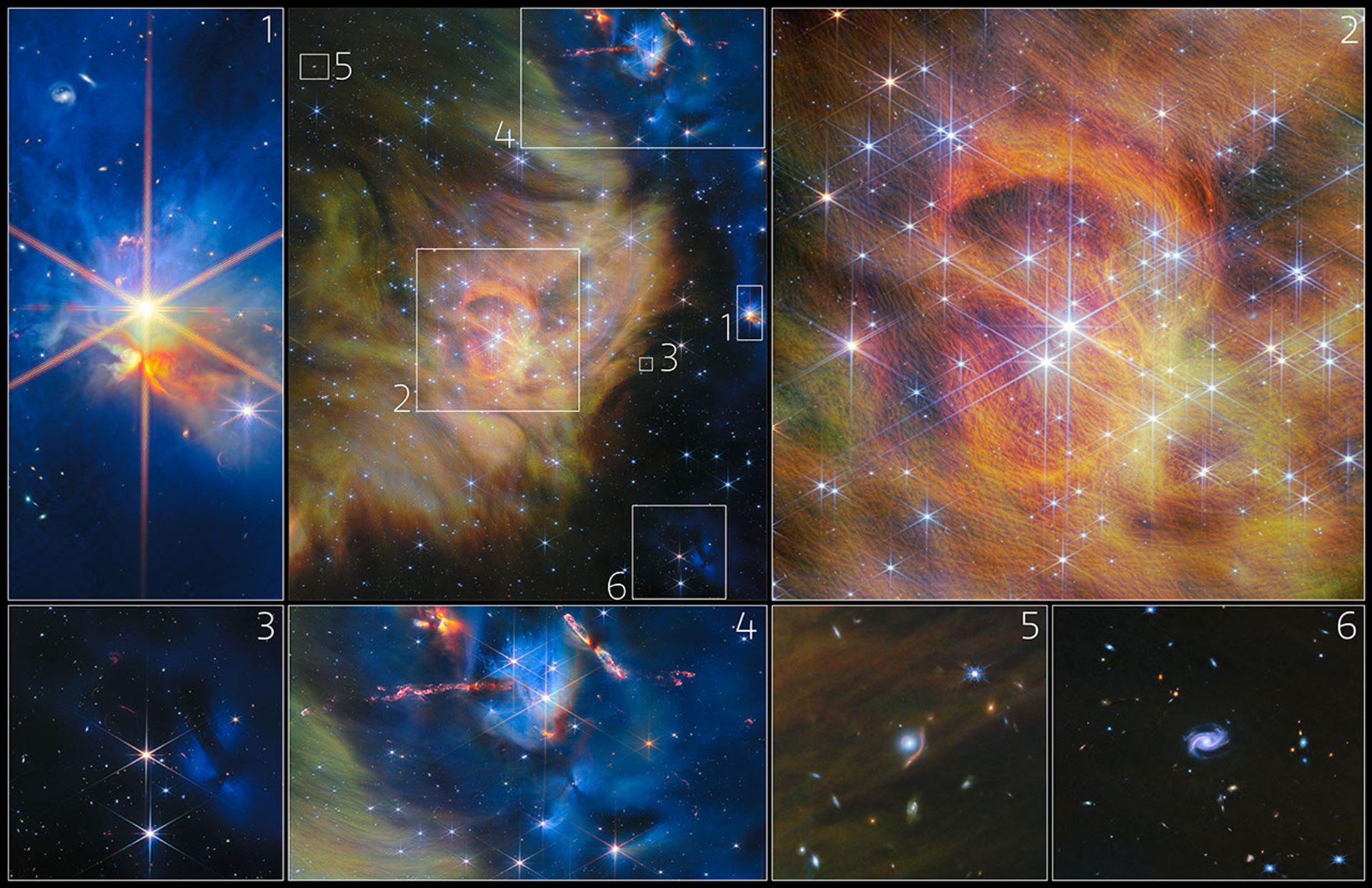
Zooming In: The IC 348 Collage

NASA also released a companion collage that isolates six features from the wide view — from embedded stars and the central cluster to faint outflows, Herbig-Haro objects, and even distant background objects like a gravitational lens and spiral galaxies.

Collage of six numbered insets from Webb's IC 348 image, highlighting embedded stars, the central star cluster, faint outflows, Herbig-Haro objects, a gravitational lens, and spiral galaxies

IC 348 Collage — six highlights from the wide field

Insets call out embedded stars, the central young cluster, faint outflows, Herbig-Haro objects, a gravitational lens, and distant spiral galaxies hiding behind and around the cloud. Credit: Image: NASA, ESA, CSA, Kevin Luhman (PSU), Catarina Alves de Oliveira (ESA), Mahdi Zamani (ESA/Webb).

Why This Matters for the Science of Star Formation

IC 348's record-breaking brown dwarfs are more than a curiosity — they strike at the heart of how we understand star birth.

Testing the Limits of Star Formation

Astronomers want to know whether there is a hard floor on the mass of objects that form like stars. IC 348 suggests the floor is lower than models assumed. Every new record forces theorists to revisit the physics of cloud fragmentation and how small a clump can grow before internal pressure stops it collapsing.

The Star / Planet Boundary

When you can find objects at two Jupiter masses with disks around them, the tidy distinction between “star” and “planet” stops working. IC 348 is helping define where that boundary actually lies — and whether it is a boundary at all.

A Census Across Regions

By comparing IC 348 with other nurseries, researchers can learn whether the population of planetary-mass objects is universal or depends on the local environment. That tells us how typical — or rare — these extreme objects really are.

A New Spectral Clue

The unidentified hydrocarbon feature could become a new diagnostic tool. If it reliably marks the very lowest-mass brown dwarfs, it gives astronomers a fast way to identify them in future surveys — including those planned with the newly launched Roman Space Telescope.

What It Means for Backyard Astronomers

Can you see IC 348 yourself? In a word: barely. IC 348 is a faint reflection nebulosity and open cluster glowing at roughly seventh magnitude, embedded in the dust of Perseus. It is a genuine challenge for visual observers and a rewarding target for astrophotography rather than an easy eyepiece object.

To track it down, look for Perseus high in the autumn and winter sky and locate the bright star Mirfak (Alpha Persei). IC 348 sits a couple of degrees south of Mirfak, in the same rich region of the northern Milky Way. From dark skies, a 6-inch or larger telescope shows the cluster's faint stars and the nebulous haze around them; a nebula filter and long-exposure imaging reveal the cloud structure Webb captured.

Where to Look

Constellation Perseus, ~2° south of the bright star Mirfak. Best placed on autumn and winter evenings from the northern hemisphere.

What Gear

A 6-inch or larger scope, dark skies, and patience. For imaging, a small apochromatic refractor and a cooled camera make the nebulosity far easier to capture.

Nearby Sights

The same Perseus star fields hold the famous Double Cluster (NGC 869 & 884) and the California Nebula — both superb amateur targets on the same night.

The honest takeaway: IC 348 itself is a faint, specialised target, but the region around Mirfak is one of the finest sweeping grounds in the northern sky. You will not see the two-Jupiter-mass brown dwarfs, but you can stand under the same stellar nursery that Webb just probed to its faintest limits.

Frequently Asked Questions

What did NASA's Webb telescope discover in IC 348?

Webb captured one of its largest images to date of the star-forming region IC 348 and found the least massive brown dwarfs ever confirmed — objects as light as about twice the mass of Jupiter, or 0.19 percent of the Sun's mass. The team also found a disk around one planet-mass object and a mysterious hydrocarbon spectral feature.

What is IC 348 and where is it?

IC 348 is an open star cluster and star-forming region about 1,000 light-years away in the constellation Perseus. It is a young stellar nursery where cold molecular clouds are collapsing to form new stars and brown dwarfs.

What is a brown dwarf?

A brown dwarf is an object that forms like a star — through the collapse of a molecular cloud — but never gets hot enough to fuse ordinary hydrogen into helium. Often called "failed stars," they sit in the mass gap between the smallest stars (about 8 percent of the Sun's mass) and the largest planets.

How small are the brown dwarfs Webb found?

The lightest ones weigh about twice the mass of Jupiter — only 0.19 percent of the Sun's mass. That is roughly half the previous record of three to four Jupiter masses, set by the same team using Webb in 2022, and far smaller than theory predicts brown dwarfs should be.

Which instruments did Webb use?

Webb used its NIRCam (Near-Infrared Camera) in 2024 to capture the image and identify candidate brown dwarfs, then its NIRSpec (Near-Infrared Spectrograph) in 2025 to measure their masses spectroscopically. The image combines the F162M, F182M, F360M and F444W filters.

Why do these brown dwarfs challenge star-formation theory?

Models of how stars form set a lower limit on how small a collapsing cloud fragment can become. Webb found brown dwarfs below that limit, meaning the star-formation process can build objects smaller than expected — and forcing astronomers to revise how cloud fragmentation and the star/planet boundary work.

Can I see IC 348 with a backyard telescope?

It is a faint target — roughly seventh magnitude — best suited to astrophotography. Look in Perseus about two degrees south of the bright star Mirfak. A 6-inch or larger telescope under dark skies shows its faint stars and nebulosity. The same region offers the Double Cluster and California Nebula for easier viewing.

Where was this research published?

The findings were published in The Astrophysical Journal Letters by a team led by Kevin Luhman of Penn State, using data from Webb General Observer Program 4866. NASA released the accompanying images on Sept. 15, 2026.

Sources

Image credit: NASA, ESA, CSA, Kevin Luhman (PSU), Catarina Alves de Oliveira (ESA), Mahdi Zamani (ESA/Webb). All NASA/ESA/CSA imagery is public domain per NASA media usage guidelines.


Continue Exploring

Keep the session going with the next useful answer

Choose the next page based on whether you need a recommendation, a comparison, or a practical observing plan.

Use Finder Tool →

🎄 Holiday season: Telescope Christmas Gift Guide 2026 · Black Friday deal tracking