BepiColombo Mercury Orbit Insertion: Nov 21, 2026 Explained
Telescope Advisor Logo Telescope Advisor
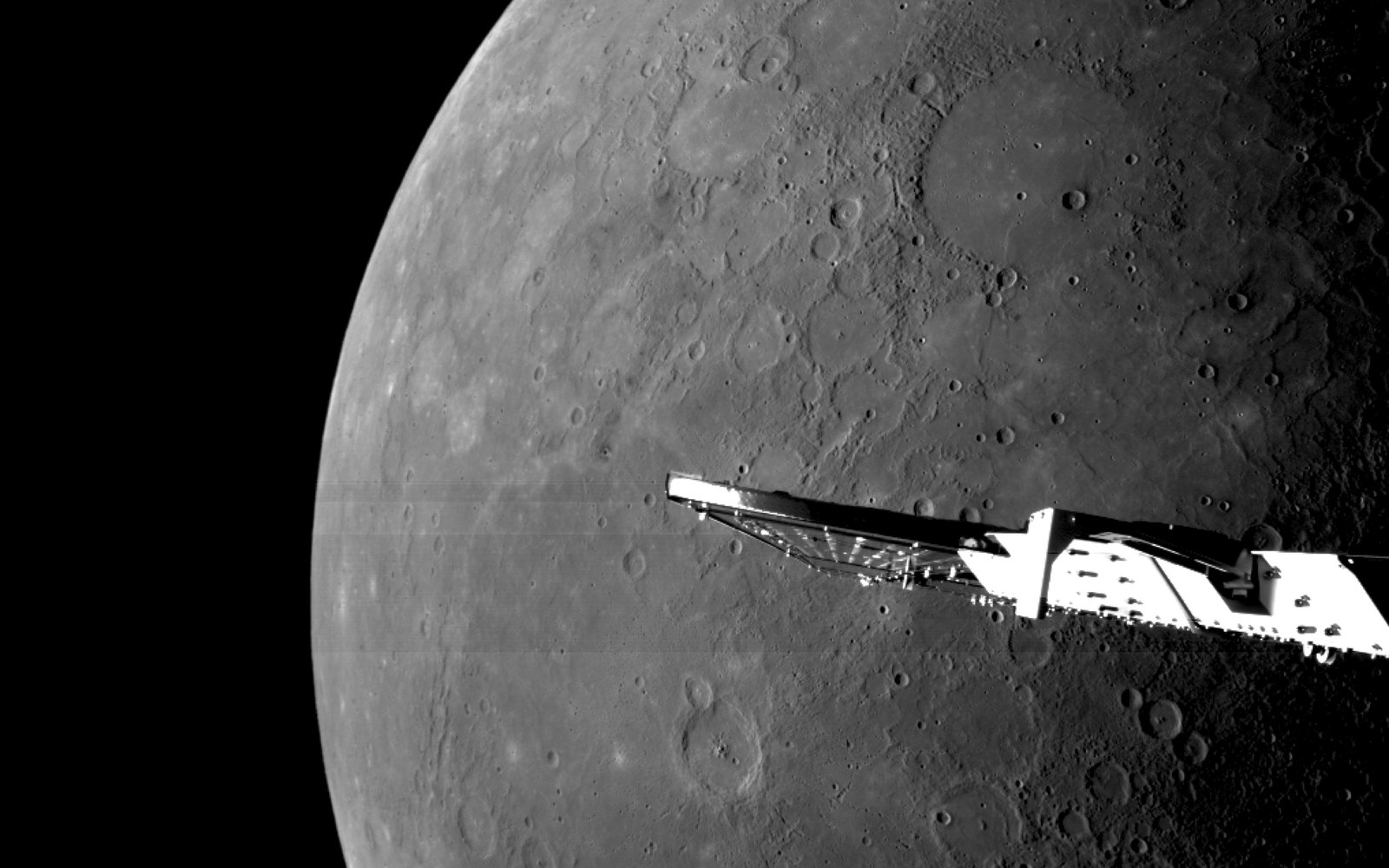
Close-up photograph of Mercury's grey, heavily cratered northern hemisphere filling the frame, with a white boom from the BepiColombo spacecraft crossing the foreground

ESA · JAXA · Space News · November 2026

BepiColombo Mercury Orbit Insertion on November 21, 2026: What Happens, and How to See Mercury Yourself

Eight years after leaving Earth, the European–Japanese BepiColombo mission is scheduled to be captured into orbit around Mercury on Saturday, November 21, 2026. By coincidence, that same week is the best time this year to see Mercury for yourself, low in the east before sunrise. Here is what ESA and JAXA have planned, why the trip took so long, and where to look.

Orbit insertionNov 21, 2026 (ESA plan)
LaunchedOct 20, 2018 (UTC)
Planet flybys9 on the way
Science beginsApril 2027

Mercury’s northern hemisphere from BepiColombo’s final flyby, January 8, 2025. Image: ESA/BepiColombo/MTM, CC BY-SA 3.0 IGO (cropped).

By Telescope Advisor Editorial Team Published: Updated: Reviewed & approved by Juhi Sahni, Senior Editor Editorial Standards

Juhi Sahni — Senior Editor, Space News, Telescope Advisor

Juhi Sahni

Senior Editor, Space News

Telescope Advisor

Senior Editor at Telescope Advisor, overseeing space news coverage and holding editorial responsibility for everything published on the site. Coverage includes NASA and ESA mission updates, JWST and Roman Space Telescope findings, sky-event guides, and equipment analysis that ties space science back to practical observing. Every factual claim is verified against primary sources — NASA/JPL Horizons, the International Meteor Organization, the US Naval Observatory, and mission briefings — before publication. LinkedIn →

The Short Version

  • The milestone: ESA has scheduled BepiColombo’s Mercury orbit insertion for Saturday, November 21, 2026. Two orbiters, ESA’s MPO and JAXA’s Mio, are still joined together for the capture.
  • Not a one-day event: after capture comes a string of further burns, the orbiters split on December 9–10, and ESA plans to start science on April 6, 2027.
  • A long road: launched in October 2018, BepiColombo needed nine planetary flybys to slow down enough for Mercury. A thruster power fault found in 2024 pushed arrival back about a year, from December 2025.
  • Only the second orbiter ever: NASA’s MESSENGER (2011–2015) is the only other spacecraft to have orbited Mercury, and BepiColombo is the first mission to send two.
  • See Mercury yourself: the planet reaches greatest western elongation (19.6°) on November 20, 2026. From the US it stands about 9–10° up in the east-southeast 45 minutes before sunrise, with Venus as a bright pointer above it.

Status as of November 17, 2026: ESA’s most recent arrival update (October 29) keeps orbit insertion on November 21 and reports a successful final rehearsal by the flight control team. ESA cautions that exact dates can change for operational reasons; its live updates page is where confirmation will appear.

What Happens When BepiColombo Reaches Mercury on November 21

For most of its journey BepiColombo flew as a stack of four parts: a propulsion stage called the Mercury Transfer Module (MTM), ESA’s Mercury Planetary Orbiter (MPO), JAXA’s Mio (formally the Mercury Magnetospheric Orbiter), and a sunshade called MOSIF that protects Mio until it is released. The transfer module, whose electric thrusters did the heavy lifting during the cruise, was cast off on September 3, 2026, and ESA’s ground stations in Spain and Argentina confirmed the separation that afternoon, European time.

Since then the MPO has been flying and steering the remaining stack itself. It switched all of its instruments on together in mid-September and fired its own thrusters for a test correction on September 24. ESA’s plan is for the combined MPO–Mio craft to be captured into orbit around Mercury on November 21, 2026.

Capture is the beginning of the arrival, not the end of it. Operations manager Elsa Montagnon told Space.com that the arrival involves “six months of continuous activities” rather than one decisive burn, and Space.com reports that November’s insertion opens a series of 16 manoeuvres that will shrink and reshape the orbit step by step. Bruno Sousa, who leads ESA’s operations definition and engineering, ranked BepiColombo among the most complex missions ESA’s operations teams have handled.

Orbit insertion factDetail
Scheduled dateSaturday, November 21, 2026 (ESA mission timeline)
What enters orbitMPO and Mio, still attached, with Mio’s MOSIF sunshade
Who flies itESA’s mission control in Darmstadt, Germany, with JAXA responsible for Mio
Distance from EarthAbout 1.01 AU (151 million km); signals take about 8.4 minutes each way
Watch forConfirmation on ESA’s BepiColombo live updates page and ESA’s social media channels

Distance and signal time: our calculation (Skyfield, JPL DE421) for November 21, 2026. ESA has not published an exact time for the insertion.

From Capture to Science: BepiColombo’s Next Five Months

Once Mercury has the spacecraft, the team’s job is to split it into two working orbiters and lower each one to its own science orbit. ESA’s published schedule:

DatePlanned step
September 3, 2026Transfer module jettisoned (done)
November 21, 2026MPO and Mio enter orbit around Mercury together
December 9–10, 2026Mio is released into its own long, elliptical orbit
December 16, 2026MPO drops the MOSIF sunshade, then starts lowering its orbit
March 2027MPO reaches its low polar orbit (March 10, according to Space.com)
April 6, 2027Start of science operations for both orbiters

Where the two orbiters end up

OrbiterClosest / farthest from MercuryTime per orbit
MPO (ESA)About 480 km / 1,500 kmAbout 2.3 hours
Mio (JAXA)About 590 km / 11,640 kmAbout 9.3 hours

Both orbits pass over Mercury’s poles and share the same plane. The MPO stays close in to map the ground below it, while Mio swings far out to sample the magnetic bubble around the planet, so the pair can record conditions near the surface and out in space at the same moment.

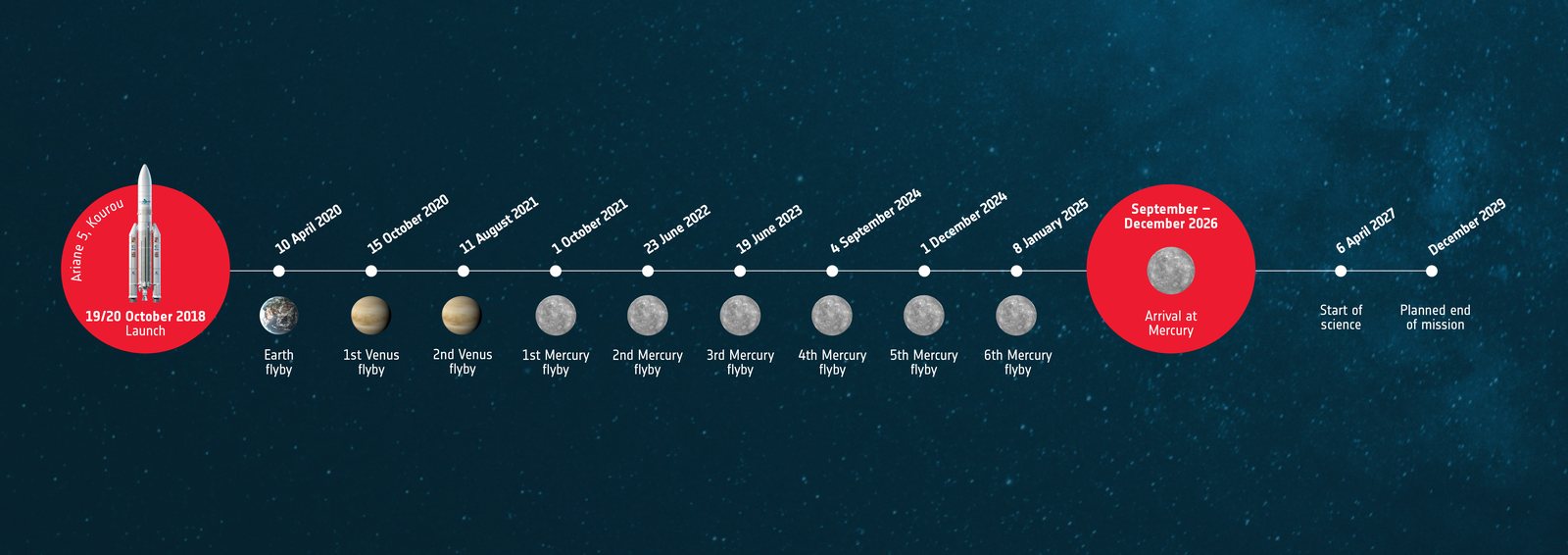
ESA timeline graphic of the BepiColombo mission: launch on Ariane 5 in October 2018, an Earth flyby, two Venus flybys and six Mercury flybys, arrival at Mercury in September to December 2026, start of science on 6 April 2027 and planned end of mission in December 2029
BepiColombo’s journey and arrival timeline. Graphic: ESA (acknowledgement: ATG Europe), CC BY-SA 3.0 IGO (resized).

Two Spacecraft, Two Jobs: MPO and Mio

Mercury Planetary Orbiter (MPO) · ESA

  • Mass about 1,230 kg, with 11 science instruments
  • Three-axis stabilised, so it can keep its cameras and spectrometers pointed at the ground
  • Goals: surface geology and chemistry, the planet’s shape, gravity and interior, and the thin exosphere
  • Also carries a laser altimeter (BELA), which fired more than 700,000 test pulses in September 2026

Mio (Mercury Magnetospheric Orbiter) · JAXA

  • Mass about 255 kg, with 5 science instruments
  • An eight-sided craft that spins about 15 times a minute
  • Goals: Mercury’s magnetic field, the plasma and dust around it, and its faint sodium atmosphere
  • Unfolds long wire antennas and masts once it is in orbit

Mercury is the only rocky planet besides Earth with a global magnetic field, which is surprising for a world so small: its core should have cooled long ago. Measuring that field from two spacecraft at once, one close and one far, is the main reason the mission was designed as a pair. The MPO’s maps should also settle longer-running questions, from the ice that radar suggests is hiding in permanently dark polar craters to the strange shallow pits, called hollows, first spotted by MESSENGER.

Masses, instrument counts and design details: ESA BepiColombo factsheet and JAXA Mio mission page.

Nine Flybys in Eight Years: BepiColombo’s Road to Mercury

BepiColombo lifted off on an Ariane 5 from Kourou, French Guiana, at 01:45 UTC on October 20, 2018, which was still the evening of October 19 in the Americas. Instead of flying straight to Mercury, it used the gravity of three planets as brakes:

DateFlyby
April 10, 2020Earth
October 15, 2020Venus (1st)
August 11, 2021Venus (2nd)
October 1, 2021Mercury (1st)
June 23, 2022Mercury (2nd)
June 19, 2023Mercury (3rd)
September 4, 2024Mercury (4th), just 165 km above the surface, the first leg of the revised route
December 1, 2024Mercury (5th)
January 8, 2025Mercury (6th and final), 295 km from the surface over the night side

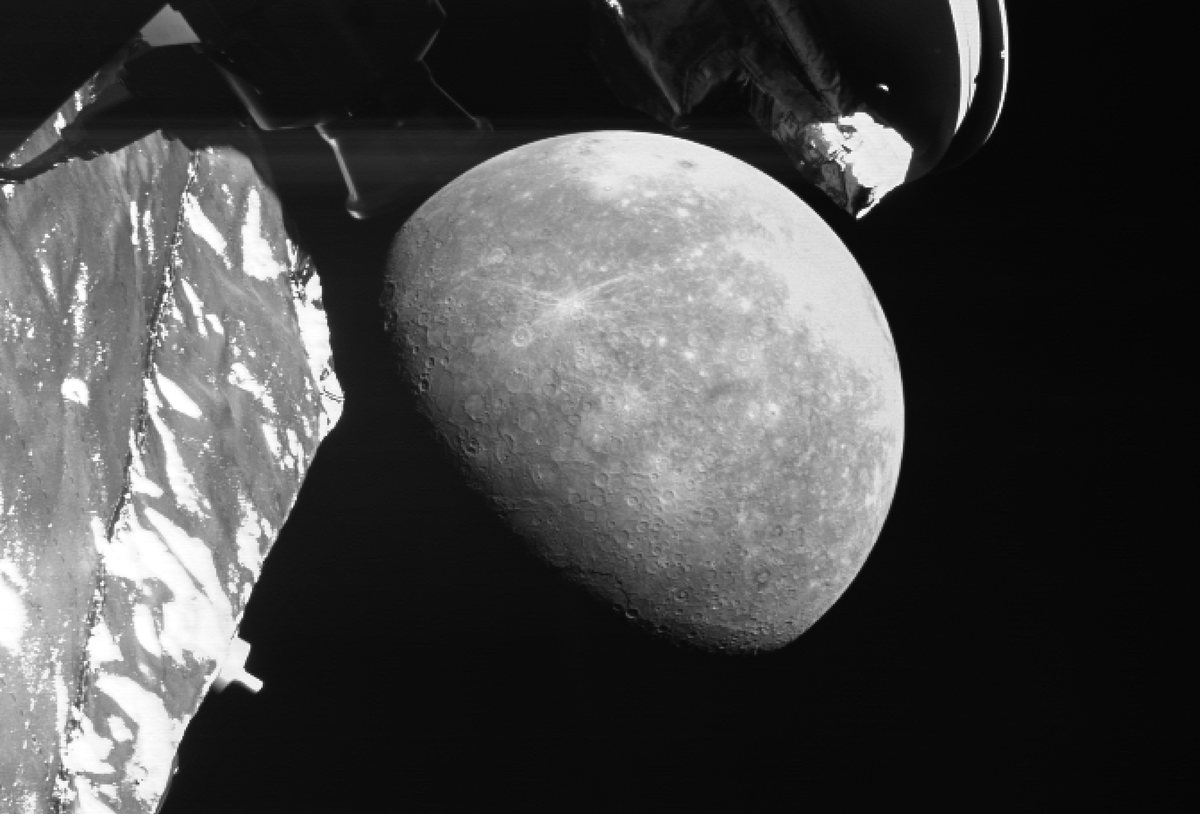
During the Mercury passes the scientific instruments were mostly folded away inside the stack, so the best pictures came from three small black-and-white monitoring cameras on the transfer module. They were meant to check the hardware, but they returned some striking portraits of the planet, including the image at the top of this page.

Black-and-white photo of a half-lit, cratered Mercury framed by parts of the BepiColombo spacecraft: shiny insulation foil on the left and the back of an antenna dish at top right
Mercury framed by parts of BepiColombo during the third flyby, June 19, 2023, seen by monitoring camera 3 from about 11,780 km. Image: ESA/BepiColombo/MTM, CC BY-SA 3.0 IGO (cropped).

The 2024 Thruster Problem and the One-Year Delay

BepiColombo was originally due to enter Mercury orbit in December 2025. In April 2024, the transfer module’s ion engines stopped delivering full thrust. ESA traced the cause to unexpected electrical currents between the module’s solar array and the unit that distributes its power, which left less electricity for propulsion. Engineers found a way to keep the engines running, but only at reduced power, and that was no longer enough to make the December 2025 arrival.

ESA’s flight dynamics specialists redesigned the remaining route instead. The fourth Mercury flyby on September 4, 2024 was moved much closer to the planet, to 165 km, so that Mercury’s gravity would do more of the braking, and the last two flybys steered the spacecraft onto the new path. ESA and JAXA announced the result in early September 2024: arrival in November 2026, about a year late, with the science plan at Mercury unchanged. JAXA said at the time that the delay would not affect Mio’s planned observations.

Why Mercury Is So Hard to Orbit

Of all the planets, Mercury sits nearest the Sun, yet it is among the toughest to reach. Anything that falls inward toward the Sun gains speed, so a spacecraft heading for Mercury arrives far too fast to stay; it has to shed that extra speed before the planet’s weak gravity can hold it. That is why BepiColombo spent eight years and nine flybys losing speed rather than flying straight there.

Heat is the other problem. Sunlight at Mercury is up to about ten times stronger than at Earth, and the planet’s sunlit surface bakes above 400 °C. The MPO carries a large radiator and high-temperature insulation, and Mio rides inside its MOSIF sunshade until it is released.

Only two spacecraft have visited before: NASA’s Mariner 10, which flew past three times in 1974 and 1975, and NASA’s MESSENGER, which orbited from 2011 until it was deliberately crashed into the surface in 2015. The mission’s name honours Giuseppe “Bepi” Colombo, the Italian scientist whose calculations made Mariner 10’s repeat visits possible.

What This Means for Amateur Astronomers: See Mercury the Week BepiColombo Arrives

You won’t see BepiColombo itself; each orbiter is only a few metres across and about 150 million km away. But the timing is perfect for seeing its destination. Mercury reaches greatest western elongation, its widest apparent separation from the Sun on the morning side, at about 23:30 UTC on November 20, 2026 (6:30 p.m. EST that evening), when it stands 19.6° west of the Sun. That makes the mornings of November 18–24 the best of the year for northern-hemisphere observers to catch Mercury before dawn, right as BepiColombo is due to settle into orbit around it.

City (Nov 21, 2026)Mercury risesSunriseBest time (45 min before sunrise)Mercury’s height then
New York (EST)5:07 a.m.6:49 a.m.6:04 a.m.10°, east-southeast
Chicago (CST)5:03 a.m.6:47 a.m.6:02 a.m.10°, east-southeast
Denver (MST)5:09 a.m.6:51 a.m.6:06 a.m.10°, east-southeast
Los Angeles (PST)4:54 a.m.6:31 a.m.5:46 a.m.9.5°, east-southeast
London (GMT)5:31 a.m.7:28 a.m.6:43 a.m.9.5°, southeast

Our calculations (Skyfield, JPL DE421) for a flat horizon. Times change by only a few minutes from November 18 to 24; Mercury stays about 9–10° up at the best time all week, then slips to about 8° by November 28. Elongation date and size cross-checked with Star Walk (23:29 GMT, 19°37′) and EarthSky.

How to find it

  1. Get a low eastern horizon. Mercury is only about two fists above the horizon at arm’s length, so trees and buildings will hide it. A hilltop, beach or open field facing east-southeast is ideal.
  2. Use Venus as your pointer. Venus, at magnitude −4.9 the brightest thing in the dawn sky after the Moon, sits about 16° above and to the right of Mercury on November 21. Look down and to the left of it, toward the brightening horizon, for a steady, pale point of light.
  3. Start about an hour before sunrise. Mercury rises roughly 1¾ hours before the Sun. Around 60–45 minutes before sunrise it is high enough to clear the haze but the sky is still dark enough to show it at magnitude −0.5.
  4. Binoculars help sweep it up in twilight. Then look again with the naked eye; once you know where it is, it is easy.

Safety: Mercury always stays close to the Sun in the sky. Put binoculars and telescopes away at least 20–30 minutes before your local sunrise, and never sweep optics near the Sun’s position. A moment’s view of the Sun through any optical aid can cause permanent eye damage.

What a telescope shows

At this elongation Mercury shows a tiny disk about 6.6 arcseconds across, a little more than half lit, like a miniature gibbous Moon. A small telescope at 100x or more will show that phase on a steady morning, although low altitude means the image will usually shimmer. You will not see surface features from Earth with amateur equipment; that detail is exactly why BepiColombo is going there. Our guide Can you see Mercury with a telescope? explains what to expect, and our November 2026 planet parade guide shows how Mercury, Venus, Mars and Jupiter line up across the dawn sky the same week.

Gear that works for Mercury and the rest of the dawn planets

You need no equipment to see Mercury, but binoculars make it far easier to find, and any small telescope shows its phase and Venus’s shape too. These are the options we suggest most often for planet watching.

Affiliate disclosure: Telescope Advisor earns a commission from qualifying Amazon purchases made through links on this page, at no extra cost to you. It never affects our recommendations.

Celestron SkyMaster 15x70

Celestron SkyMaster 15x70

Large astronomy binoculars for sweeping up Mercury in twilight; steadiest on a tripod.

Gskyer 70mm AZ Refractor

Gskyer 70mm AZ Refractor

Simple, light refractor that is quick to carry to a spot with a low eastern horizon.

Sky-Watcher Heritage 130P

Sky-Watcher Heritage 130P

Compact 130mm tabletop Dobsonian with the aperture to show the phases of Mercury and Venus.

Celestron StarSense Explorer LT 114AZ

Celestron StarSense Explorer LT 114AZ

Beginner reflector with a phone app that guides you to planets, Moon and bright stars.

More help choosing: best telescopes for viewing planets, best binoculars for stargazing and our telescope Black Friday guide.

BepiColombo at Mercury: Frequently Asked Questions

When does BepiColombo enter orbit around Mercury?
ESA's schedule puts BepiColombo's Mercury orbit insertion on Saturday, November 21, 2026. It is the start of an arrival sequence rather than a single moment: further manoeuvres follow, the two orbiters separate on December 9–10, and ESA plans to begin science operations in April 2027. ESA notes that exact dates can shift for operational reasons, so check its live updates page for confirmation.
What is BepiColombo?
BepiColombo is a joint mission of the European Space Agency (ESA) and the Japan Aerospace Exploration Agency (JAXA) to Mercury, the smallest planet and the closest to the Sun. It carries two orbiters: the Mercury Planetary Orbiter (MPO), built by ESA, and Mio, the magnetospheric orbiter built by JAXA. They will study the planet from two different orbits at the same time.
Why did BepiColombo take eight years to reach Mercury?
Falling toward the Sun makes a spacecraft speed up, so reaching Mercury slowly enough to stay there takes a long, indirect route. BepiColombo used nine planetary flybys (one of Earth, two of Venus and six of Mercury) plus years of electric-propulsion thrusting to shed speed. A power problem with its thrusters in 2024 added about a year, moving arrival from December 2025 to November 2026.
Who was BepiColombo named after?
The mission honours Giuseppe “Bepi” Colombo (1920–1984), an Italian mathematician and engineer. His calculations showed NASA how Mariner 10 could return to Mercury for repeated flybys in 1974 and 1975, and he also explained why Mercury spins exactly three times for every two orbits of the Sun.
What will BepiColombo study at Mercury?
The MPO will map the surface and its composition, measure the planet's shape, gravity and interior, and study its thin exosphere, using 11 instruments. Mio, with 5 instruments, will study Mercury's magnetic field, the charged particles around the planet and how the solar wind interacts with them. Together they should explain more about how Mercury formed and why such a small planet still has a magnetic field.
Can I see BepiColombo with a telescope?
No. Each BepiColombo orbiter is only a few metres across, and the pair is around 150 million kilometres from Earth in late November 2026, far too small and faint for any amateur telescope. You can easily see the planet it is orbiting, though: Mercury reaches its greatest distance from the Sun in the morning sky on November 20, 2026, and is visible low in the east-southeast before sunrise for about two weeks.
When is the best time to see Mercury in November 2026?
From about November 16 to 26, 2026, look low in the east-southeast roughly 45 minutes before sunrise. Our calculations put Mercury about 9–10° above the horizon then from New York, Chicago, Denver and Los Angeles, shining at magnitude −0.5. Brilliant Venus, about 16° higher and to the right, makes a good guide. Greatest western elongation, 19.6° from the Sun, falls on the evening of November 20 in US time zones (about 23:30 UTC).
Is it safe to look at Mercury with binoculars or a telescope?
Yes, as long as you finish before sunrise. Mercury always stays close to the Sun in the sky, so never sweep binoculars or a telescope across the eastern horizon after the Sun is up or about to rise; even a brief glimpse of the Sun through optics can cause permanent eye damage. Find Mercury in the dark twilight and stop observing at least 20–30 minutes before local sunrise.
How long will the BepiColombo mission last?
ESA's mission timeline currently shows science operations starting on April 6, 2027 and a planned end of mission in December 2029. From its science orbit, the MPO will pass as low as about 480 kilometres above Mercury's surface.

Sources