Voyager 1 Reaches One Light-Day: Where Is Voyager 1 Now?
Telescope Advisor Logo Telescope Advisor
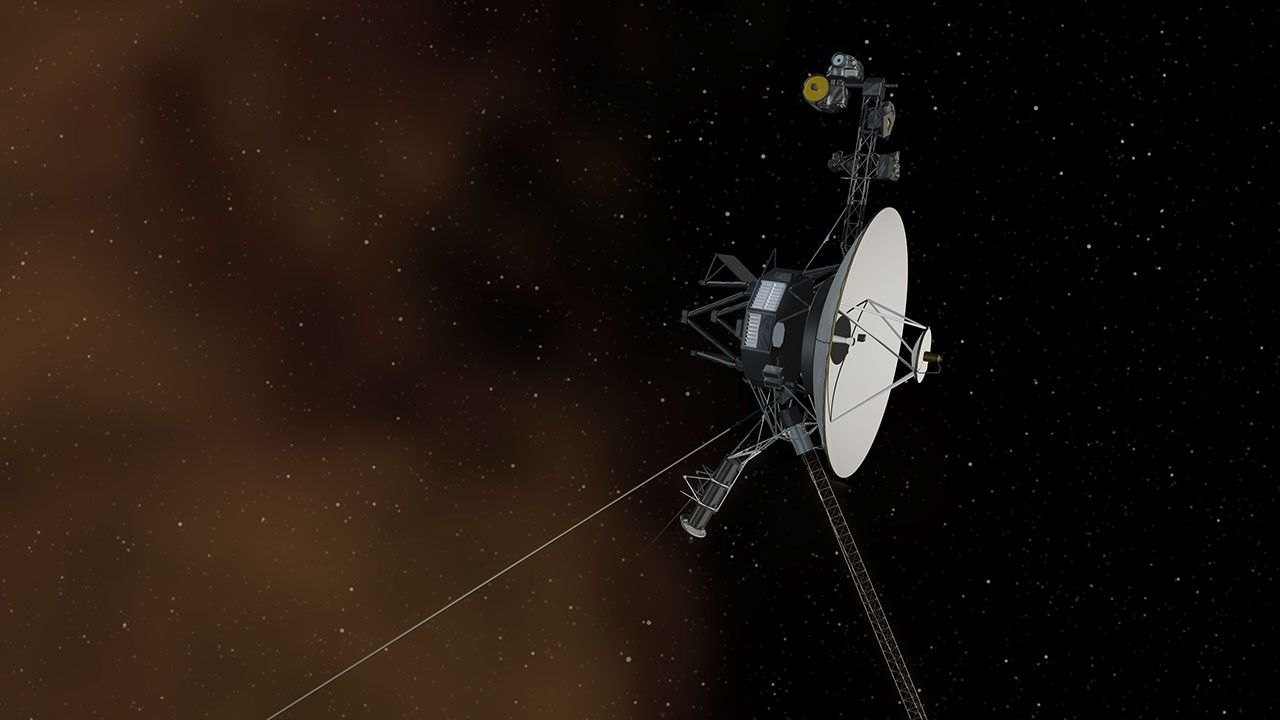
Artist's concept of NASA's Voyager spacecraft, with its large white dish antenna and long boom, flying through golden-tinted space

NASA Voyager · Space News · November 2026

Voyager 1 Reaches One Light-Day From Earth: Where Is Voyager 1 Now?

Almost half a century after it left Florida, NASA’s Voyager 1 is about to become the first human-made object a full light-day from home: so far that a radio message from Earth needs 24 hours to catch up with it. NASA is marking the moment with a worldwide “Shine Bright” light signal tonight and a live event on November 19. Here is exactly when it happens, where Voyager 1 is in your sky, and how to take part.

Distance16.1 billion miles
MilestoneNov 18, 2026
Signal delay24 hours one way
LaunchedSeptember 5, 1977

Illustration: NASA Goddard Space Flight Center / Walt Feimer.

By Telescope Advisor Editorial Team Published: Updated: Reviewed & approved by Juhi Sahni, Senior Editor Editorial Standards

Juhi Sahni — Senior Editor, Space News, Telescope Advisor

Juhi Sahni

Senior Editor, Space News

Telescope Advisor

Senior Editor at Telescope Advisor, overseeing space news coverage and holding editorial responsibility for everything published on the site. Coverage includes NASA and ESA mission updates, JWST and Roman Space Telescope findings, sky-event guides, and equipment analysis that ties space science back to practical observing. Every factual claim is verified against primary sources — NASA/JPL Horizons, the International Meteor Organization, the US Naval Observatory, and mission briefings — before publication. LinkedIn →

The Short Version

  • The milestone: on Wednesday, November 18, 2026, Voyager 1 becomes the first spacecraft one light-day from Earth, about 25.9 billion km (16.1 billion miles). The moment falls at about 10:16 UTC (5:16 a.m. EST) that morning.
  • What it means: a command sent from Earth now takes a full day to arrive, and the answer takes another day to come back.
  • Tonight (November 17): NASA asks everyone to flash Voyager’s call sign, V-G-R, in Morse code at the sky after sunset. We show you where Voyager actually is so you can aim at it.
  • Thursday (November 19): NASA JPL hosts a live Voyager event at 12 p.m. EST on nasa.gov/live.
  • It’s for good: Earth’s orbit will bring us slightly closer to Voyager 1 next spring, but never back inside one light-day.
  • For skywatchers: you can’t see Voyager 1, but you can see Saturn and Jupiter, the two giant planets it explored. Both are well placed this month.

When Voyager 1 Crosses the One Light-Day Line

NASA announced on November 10 that Voyager 1 will have traveled one light-day from Earth on Wednesday, November 18, 2026. A light-day is the distance light covers in 24 hours: at 299,792 kilometers per second, that is about 25.9 billion kilometers, or a little over 16.1 billion miles.

Published calculations put the crossing at about 10:16 UTC on November 18. We checked it ourselves against NASA JPL’s Horizons system, which tracks Voyager 1’s position, and got the same answer to within two minutes:

Time zoneVoyager 1 reaches one light-day
Universal Time (UTC)About 10:16, Wednesday, November 18
Eastern (EST)About 5:16 a.m., November 18
Central (CST)About 4:16 a.m., November 18
Pacific (PST)About 2:16 a.m., November 18
UK (GMT)About 10:16 a.m., November 18
Australia (AEDT)About 9:16 p.m., November 18

Why you may see a later time quoted: the figure above uses Voyager 1’s actual distance at each instant. If you instead track when the radio signal arriving at Earth has been travelling for a full 24 hours, the mark is reached about 16 hours later, around 9:17 p.m. EST the same day. Either way, NASA’s official date is November 18.

A one-way trip: Voyager won’t slip back inside

Because Earth circles the Sun once a year, the gap between Earth and Voyager 1 doesn’t grow smoothly. For a couple of months each year Earth is moving toward the spacecraft faster than Voyager is moving away. Our Horizons check shows that happening again from about late January to late April 2027, but even at its closest, around late April, Voyager 1 stays roughly 26 million kilometers beyond one light-day. Once Voyager 1 crosses the line this week, it stays beyond one light-day.

One more subtlety: NASA’s milestone is measured from Earth. Measured from the Sun, Voyager 1 is still slightly short of a light-day and gets there around February 3–4, 2027, by our calculation.

How Far Is One Light-Day? Putting 16 Billion Miles in Perspective

Miles stop meaning much at this scale, so it helps to measure in light travel time, the way astronomers do:

ObjectLight travel time from Earth
The MoonAbout 1.3 seconds
The SunAbout 8.3 minutes
Saturn (now)About 1.2 hours
NeptuneAbout 4 hours
Voyager 2 (now)About 20.1 hours
Voyager 1 (November 18)24 hours: one light-day
Proxima Centauri, the nearest starAbout 4.24 years (roughly 1,550 light-days)

Put another way: Voyager 1 is now about 173 times farther from Earth than the Sun is. Yet it has covered only a tiny fraction of the way to the nearest star. At its current speed of about 17 kilometers per second, it would need roughly 75,000 years to travel 4.24 light-years, and it isn’t even headed toward Proxima Centauri. It will reach two light-days from the Sun in the mid-2070s, long after its power runs out.

Saturn and Voyager figures are our calculations from JPL ephemerides for November 2026; travel-time and two-light-day estimates assume Voyager 1’s present speed.

Shine Bright for Voyager: How to Join Tonight

NASA is inviting people everywhere to send a symbolic signal after sunset on Tuesday, November 17, creating a wave of golden light around the planet as night falls in each time zone. The message is Voyager’s three-letter mission call sign, VGR, flashed in Morse code.

Gold graphic showing the letters V, G and R with their Morse code patterns underneath: dot-dot-dot-dash, dash-dash-dot and dot-dash-dot
Voyager’s call sign VGR in Morse code. Graphic: NASA/JPL-Caltech.

V

· · · –

Three short flashes, then one long

G

– – ·

Two long flashes, then one short

R

· – ·

Short, long, short

Step by step

  1. Pick any light: a flashlight, phone torch, bike light or lantern works. Switch it on and off, or cover it with your hand.
  2. Keep the rhythm: a short flash is under a second; a long flash lasts about a second. Pause briefly between flashes in a letter and for a second or more between letters.
  3. Repeat V-G-R for about a minute.
  4. Or let NASA do it: open the automated flasher at go.nasa.gov/vgr on a phone or tablet and point the screen skyward. (It flashes, so take care if you are sensitive to flashing light.)
  5. Share it: NASA asks participants to post photos or video tagged @NASA. Full details are on NASA’s event page, go.nasa.gov/shinebright.

Our tip: aim at where Voyager 1 really is

NASA just asks you to point skyward, but you can do better. Voyager 1 sits in the constellation Ophiuchus, low in the west after sunset this week. Find the 2nd-magnitude star Rasalhague, the brightest star in that part of the western sky, and aim about 5° (three finger-widths at arm’s length) to its right.

LocationSunset Nov 17Voyager 1 one hour after sunsetIts direction sets
New York4:36 p.m.28° up, due westAbout 8:09 p.m.
Chicago4:27 p.m.29° up, westAbout 8:05 p.m.
Denver4:42 p.m.28° up, westAbout 8:11 p.m.
Los Angeles4:48 p.m.26° up, westAbout 7:56 p.m.
London4:08 p.m.31° up, west-southwestAbout 8:35 p.m.

Local times; our calculations (Skyfield, JPL DE421, Voyager 1 position from JPL Horizons). A free planetarium app such as Stellarium will show Ophiuchus for your exact location.

Where Is Voyager 1 Now?

Voyager 1

  • About 173.1 AU from Earth on November 18, 2026: 25.9 billion km, 16.1 billion miles
  • Speed: about 17 km/s relative to the Sun, roughly 61,000 km/h (38,000 mph)
  • Sky position: constellation Ophiuchus, near RA 17h 15m, Dec +12°
  • Heading out of the solar system above the plane of the planets, toward the north

Voyager 2

  • About 144.9 AU from Earth: roughly 21.7 billion km, 13.5 billion miles
  • Signal time about 20.1 hours, so it is still inside one light-day
  • Sky position: the far-southern constellation Pavo, near RA 20h 10m, Dec −60°
  • The only spacecraft to have visited Uranus and Neptune

Both probes are in interstellar space, beyond the heliopause, where the Sun’s solar wind gives way to the thin gas between the stars. Voyager 1 crossed that boundary in 2012 and Voyager 2 in 2018. NASA’s live “Where Are the Voyagers” page shows both distances ticking up by the second.

Distances and positions: our calculations from JPL Horizons, November 18, 2026.

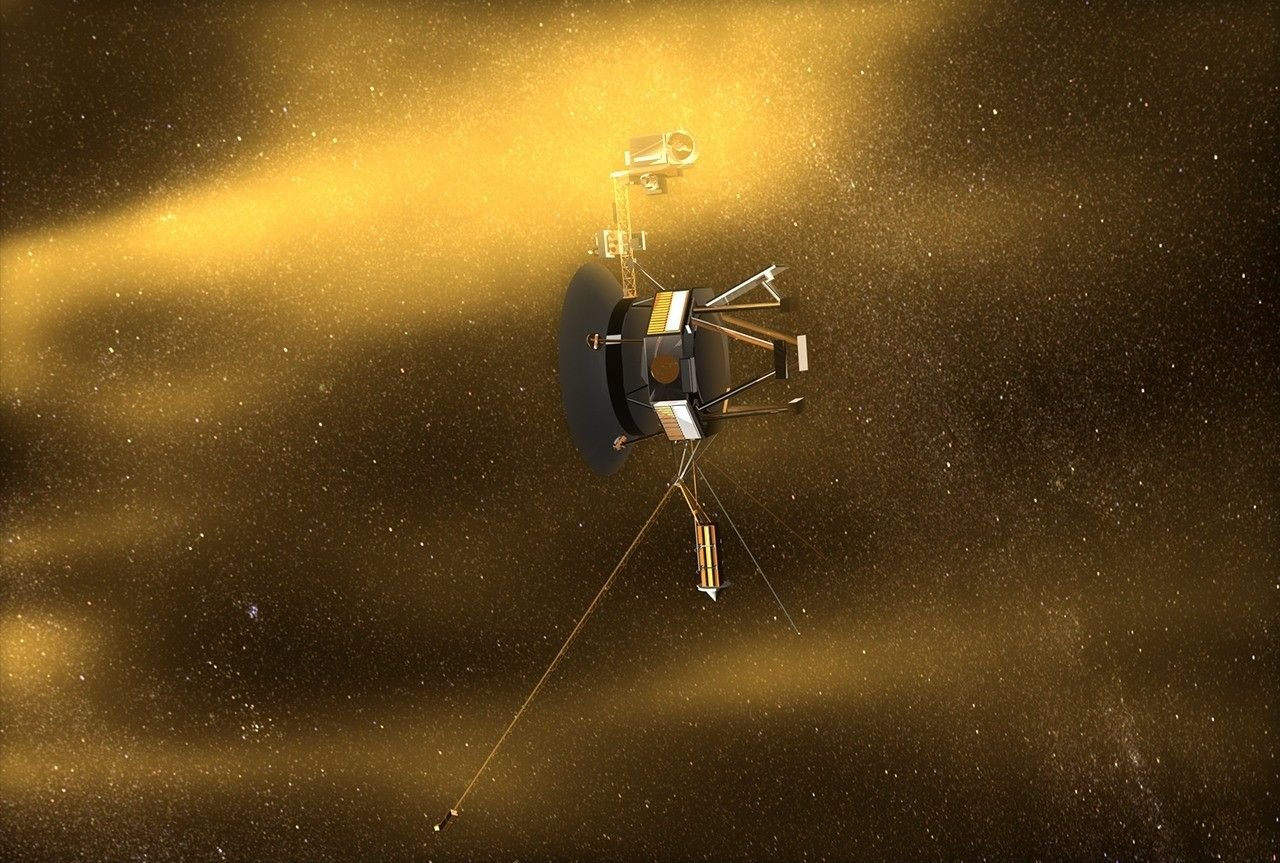
Artist's concept of Voyager 1 in interstellar space, its dish antenna pointed back toward a distant Sun, with a swirl of orange-brown gas behind it
Artist’s concept of Voyager 1 entering interstellar space (PIA17462). Image: NASA/JPL-Caltech.

NASA’s November 19 Voyager Event: How to Watch

On Thursday, November 19, at 12 p.m. EST (9 a.m. PST), NASA’s Jet Propulsion Laboratory hosts a moderated discussion on the state of both Voyagers, the science they still return from interstellar space, and what it takes to keep half-century-old spacecraft talking across such distances. Audience questions follow, along with a first look at a NASA+ Voyager documentary planned for the mission’s 50th anniversary in 2027.

It takes place in JPL’s von Kármán Auditorium, the same room where the Voyager team briefed reporters during the planetary flybys of the 1970s and 1980s. Watch at nasa.gov/live. Scheduled speakers:

  • Nicky Fox, who leads NASA’s Science Mission Directorate
  • Jonathan Lunine, JPL’s chief scientist
  • Suzanne Dodd, who manages the Voyager project
  • Linda Spilker, the mission’s project scientist
  • Kareem Badaruddin, Voyager’s mission manager
  • Jamie Rankin of Princeton University, deputy project scientist

Nearly 50 Years: Voyager 1’s Journey to a Light-Day

The twin Voyagers were built to exploit a lineup of the outer planets that happens only about once every 176 years, letting a spacecraft swing from one giant planet to the next. Voyager 1 took the faster route.

DateMilestone
September 5, 1977Launch from Cape Canaveral, about two weeks after its twin, Voyager 2 (August 20, 1977)
March 5, 1979Closest approach to Jupiter: active volcanoes found on the moon Io, plus a faint ring around the planet
November 12, 1980Saturn flyby and a close pass of Titan, whose surface turned out to be hidden under thick haze
February 14, 1990Takes the “Pale Blue Dot” portrait of Earth from about 6 billion km away
August 25, 2012Crosses the heliopause into interstellar space, the first spacecraft to do so (Voyager 2 follows on November 5, 2018)
2025–2026Instruments switched off to save power; a thruster problem causes about two days of silence in October 2026
November 18, 2026One light-day from Earth
202750th anniversary of both launches; NASA+ documentary planned

How Is Voyager 1 Still Working After Almost 50 Years?

Voyager 1 runs on three radioisotope thermoelectric generators, which turn the heat of decaying plutonium into electricity. They delivered about 470 watts at launch; output falls by roughly 4 watts every year, and the spacecraft now works with a little over 200. Every year the team has to find more to switch off.

  • Still operating (2): the magnetometer and the plasma wave subsystem, which sample magnetic fields and the thin plasma between the stars.
  • Switched off over the years: the plasma science instrument (2007), the planetary radio astronomy instrument (2008) and the ultraviolet spectrometer (2016).
  • Recent shutdowns: the cosmic ray subsystem on February 25, 2025, and the low-energy charged particle instrument on April 17, 2026, earlier than planned after an unexpected drop in power during a February maneuver.
  • A power reprieve: in early September 2026 engineers finished swapping three onboard devices for lower-power alternatives, which should delay the next instrument shutdown.

It hasn’t been smooth. On October 18–19, 2026, Deep Space Network antennas heard nothing from Voyager 1; it reappeared on October 20 without any commands being sent. A set of thrusters had stopped working, backup thrusters took over, and the spacecraft’s fault protection put it into a safe state. As of NASA JPL’s October 29 update, the root cause was still being investigated. Contact runs through the Deep Space Network’s big dishes in California, Spain and Australia, and every exchange now takes about two days round trip.

NASA has not set an end date. Most estimates have the Voyagers continuing to send at least engineering data into the early 2030s, with power, not hardware, the deciding factor.

The Golden Record Already Speaks Morse Code

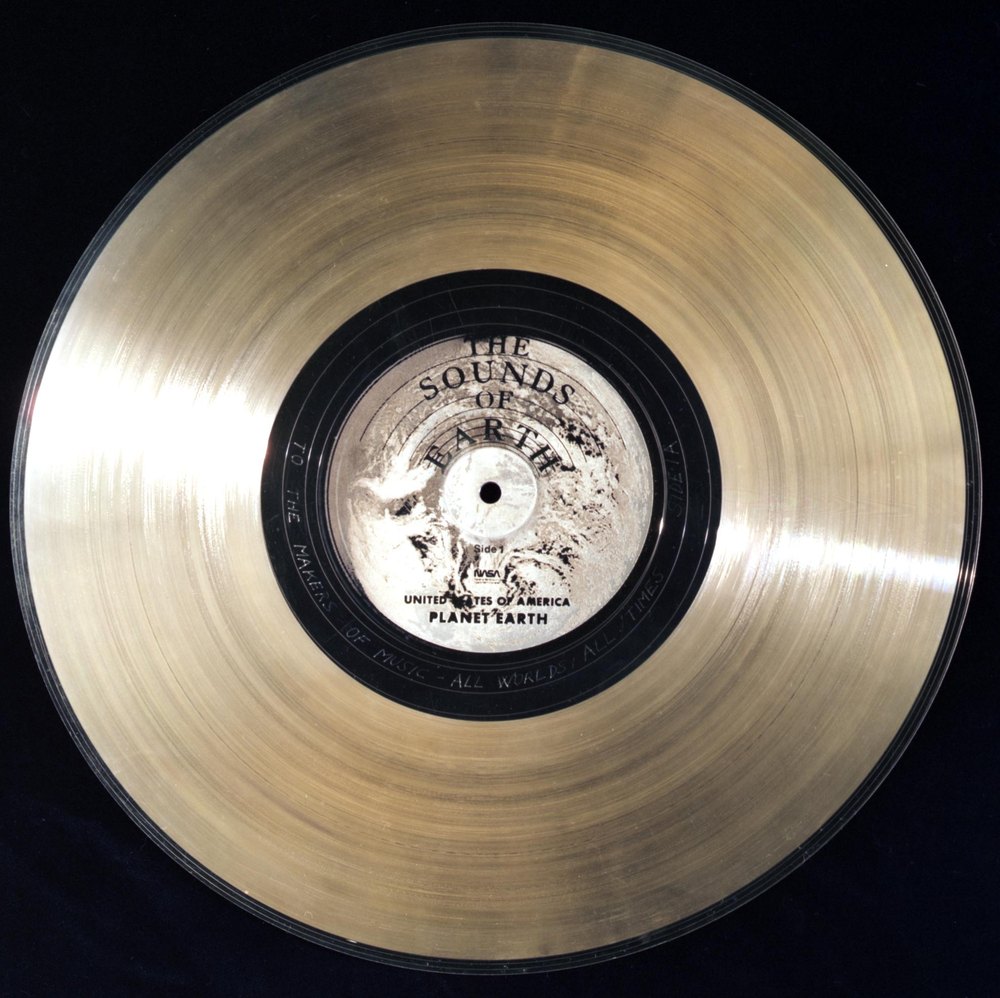
Both Voyagers carry a copy of the Golden Record, a gold-plated copper phonograph disc meant as a message to anyone who might find the spacecraft. It holds greetings in 55 languages, music from around the world, natural and human sounds, and encoded images of life on Earth.

That makes NASA’s Morse-code tribute fitting. Among the record’s sounds is a Morse code message, which NASA gives as “ad astra per aspera”, Latin for “through struggle to the stars.” (Many references reverse the word order to the more familiar “per aspera ad astra”; we follow NASA.) Tonight’s V-G-R flashes are, in a small way, a reply.

The gold-plated Voyager Golden Record, a copper phonograph disc with a label reading The Sounds of Earth, United States of America, Planet Earth
The Voyager Golden Record. Image: NASA/JPL-Caltech.

What This Means for Amateur Astronomers: See Where Voyager Went

No telescope on Earth can show you Voyager 1; it is a car-sized spacecraft 16 billion miles away and only giant radio dishes still hear it. But the two worlds that made it famous are easy targets this month, and seeing them yourself is the best way to appreciate how far it has gone since.

TargetWhen and where (mid-November 2026)What you’ll seeEquipment
SaturnEast-southeast at dusk, about 30° up an hour after sunset and climbing; sets around 2:45 a.m.The ring system and the moon Titan, whose thick atmosphere Voyager 1 studied up close in 1980Any telescope at 50x or more
JupiterRises in the east-northeast around 11 p.m.; best before dawn, and improving toward opposition on February 10–11, 2027Cloud belts and the four Galilean moons, including Io, where Voyager 1 discovered active volcanoesBinoculars show the moons; a telescope shows the belts
The MoonJust past first quarter, about 37° up in the south at duskCraters along the day-night line, the best telescope view of the monthAnything, even steady binoculars
Voyager’s directionOphiuchus, low in the west after sunset, about 5° west of RasalhagueJust stars, but you are looking at the most distant thing humanity has builtEyes or binoculars

Positions and times for mid-northern latitudes (calculated for New York); a planetarium app gives exact times for your location.

Telescopes that show Voyager’s planets

If the Voyager milestone has you wanting your own view of Saturn’s rings and Jupiter’s moons, these are the picks we recommend most often, and Black Friday week is a good time to buy. Every option below shows Saturn’s rings and Jupiter’s cloud belts on a steady night.

Sky-Watcher Heritage 130P

Sky-Watcher Heritage 130P

Compact 130mm tabletop Dobsonian: our favourite first telescope for the planets and the Moon.

Celestron NexStar 6SE

Celestron NexStar 6SE

6-inch computerized telescope that finds and tracks Saturn and Jupiter for you; a classic planetary gift.

Celestron SkyMaster 15x70

Celestron SkyMaster 15x70

Big astronomy binoculars that show Jupiter's four moons and the Moon's craters; best on a tripod.

ZWO Seestar S30 Plus

ZWO Seestar S30 Plus

New smart telescope (November 2026) that photographs the Moon and deep-sky objects from a phone app.

More help choosing: best telescopes for viewing planets, best telescopes for Saturn, our telescope Black Friday guide and the binocular Black Friday guide. Buying for someone else? See our Christmas telescope gift guide.

Affiliate disclosure: we earn a commission from qualifying Amazon purchases made through these links, at no extra cost to you.

Voyager 1 One Light-Day: Frequently Asked Questions

What does it mean that Voyager 1 is one light-day from Earth?
It means Voyager 1 is so far away that light, or a radio signal, needs a full 24 hours to travel between Earth and the spacecraft. A light-day is a distance, not a length of time: about 25.9 billion kilometers or 16.1 billion miles. No other human-made object has ever been that far from Earth.
When does Voyager 1 reach one light-day from Earth?
On Wednesday, November 18, 2026. Published calculations put the moment at about 10:16 UTC, which is 5:16 a.m. EST or 2:16 a.m. PST, and our own check with NASA JPL's Horizons data agrees to within two minutes.
How far away is Voyager 1 right now?
On November 18, 2026, Voyager 1 is about 173.1 astronomical units from Earth, roughly 25.9 billion kilometers or 16.1 billion miles, and it is moving away from the Sun at about 17 kilometers per second. NASA's Where Are the Voyagers page shows the live distance.
Can I see Voyager 1 with a telescope?
No. Voyager 1 is far too small and faint for any optical telescope; only giant radio dishes of NASA's Deep Space Network can still hear it. You can point at its position, though: it lies in the constellation Ophiuchus, about 5 degrees west of the star Rasalhague, low in the western sky after sunset in November.
How do I join Shine Bright for Voyager's Light-Day?
After sunset on Tuesday, November 17, 2026, point a flashlight or phone at the sky and flash Voyager's call sign, V-G-R, in Morse code: three short flashes and one long for V, two long and one short for G, and short-long-short for R. NASA's automated flasher at go.nasa.gov/vgr can do it for you; the event page is go.nasa.gov/shinebright. Share a photo or video tagged @NASA.
How long does it take a signal to reach Voyager 1?
At one light-day, a command from Earth takes about 24 hours to reach Voyager 1, and the reply takes another 24 hours to come back, so engineers wait about two days to learn whether a command worked.
Will Voyager 1 ever be closer than one light-day again?
No. Earth's orbit makes the Earth-to-Voyager distance shrink slightly between late January and mid-April 2027, but according to our calculations with NASA JPL data it never drops back below about 1,441 light-minutes. Voyager 1 stays beyond one light-day from now on.
How can I watch NASA's Voyager event?
NASA's Jet Propulsion Laboratory hosts a Voyager discussion with mission scientists and NASA leadership on Thursday, November 19, 2026, at 12 p.m. EST (9 a.m. PST), streamed at nasa.gov/live. It includes a preview of a NASA+ Voyager documentary planned for the mission's 50th anniversary in 2027.
Is Voyager 1 still working?
Yes, but on a tight power budget. Its nuclear power supply weakens by about 4 watts a year, so the team has switched off instruments one by one. As of November 2026 two science instruments still operate, the magnetometer and the plasma wave subsystem, both measuring the interstellar environment. In October 2026 the spacecraft briefly went silent for about two days after a thruster problem, then resumed contact.

Sources

  • NASA, “Shine Bright for Voyager’s Light-Day”
  • NASA media advisory M26-086 on the Voyager 1 light-day events, November 10, 2026 (updated November 13)
  • NASA JPL Horizons ephemeris system (Voyager 1 and 2 positions and light times), queried November 17, 2026
  • NASA JPL, Voyager mission status updates on instrument shutdowns (2025–2026) and the October 2026 thruster anomaly (October 29, 2026 release)
  • Scientific American, ScienceAlert and BBC Sky at Night Magazine, independent coverage of the one light-day milestone and its timing, November 2026
  • NASA, Voyager mission pages: launch, flyby, interstellar crossing and Golden Record details