
Phobos and Deimos: Can a Telescope Show Mars's Moons?
Telescope Advisor Logo Telescope Advisor
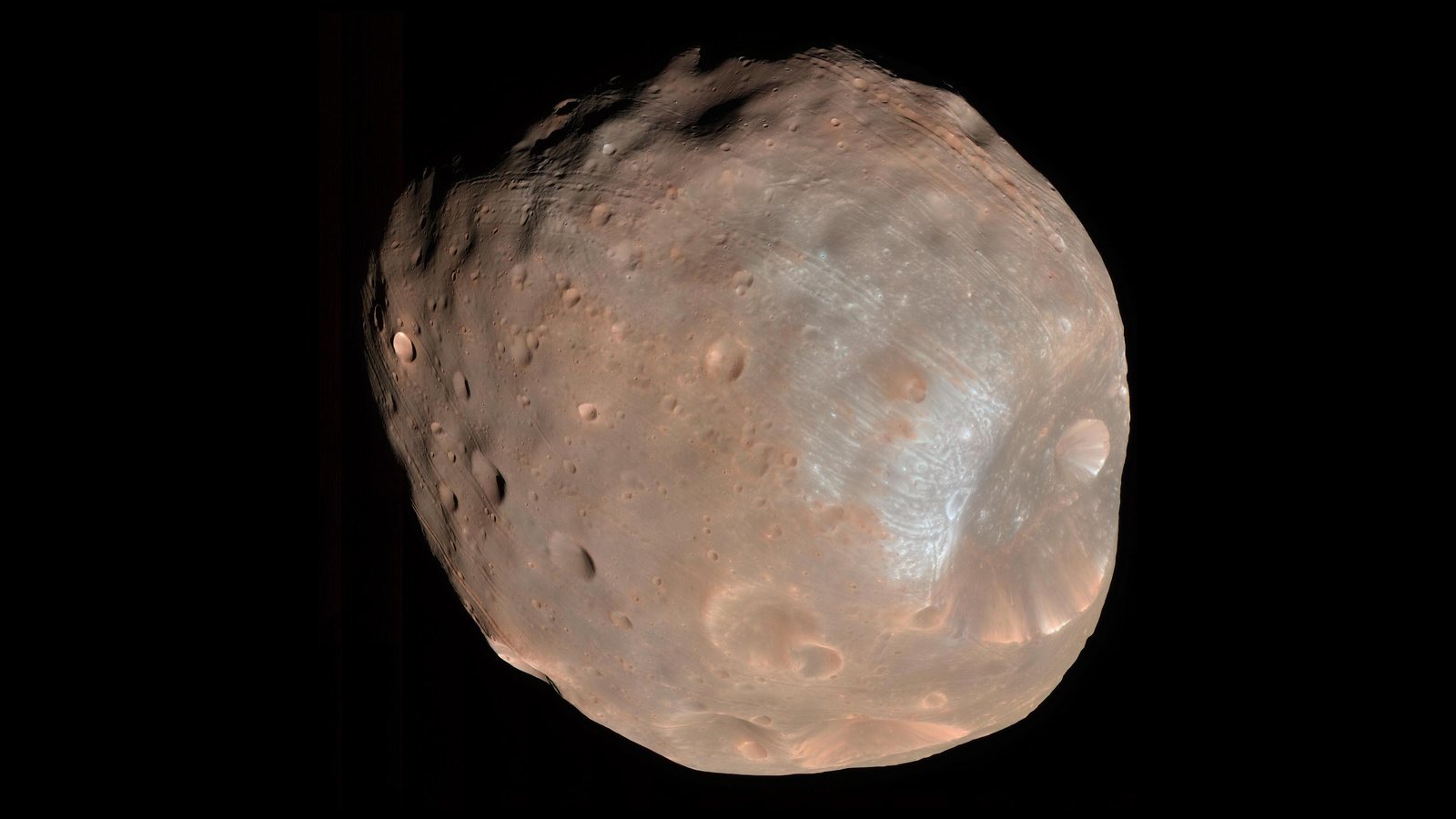
Mars's larger moon Phobos in colour, photographed by the HiRISE camera on NASA's Mars Reconnaissance Orbiter on March 23, 2008, with the large crater Stickney at right

Planet Guide · Mars · Updated for the February 2027 Opposition

Phobos and Deimos: Can a Telescope Show Mars’s Moons?

Mars has two moons, and both are small enough to drive across in under an hour. Phobos skims just 6,000 km above the Martian surface and is slowly spiralling inward. Deimos drifts farther out. A Japanese spacecraft launched in October 2026 is on its way to bring a piece of Phobos back to Earth. And with a large telescope and a few tricks, you can try to glimpse both moons yourself when Mars is closest in February 2027.

~22 kmPhobos, longest axis 27 km
~12 kmDeimos, longest axis 15 km
12 / 13Their magnitudes in Feb 2027
8-inch+Telescope you realistically need
By Telescope Advisor Editorial Team Published: Updated: Reviewed & approved by Juhi Sahni, Senior Editor Editorial Standards
Elena Reyes — Senior Science Editor

Elena Reyes

Senior Science Editor

Covers NASA missions, space science discoveries, and astronomical events for Telescope Advisor. Translates complex astrophysical research into practical insights for backyard observers. Based in the San Francisco Bay Area.

Content reviewed by our editorial team. Research and drafting assisted by AI to ensure unbiased, data-driven analysis. Learn more about our editorial process.

Quick Answer: Phobos and Deimos in Brief

  • • What they are: Mars’s only two moons. Both are dark, potato-shaped bodies: Phobos is about 27 × 22 × 18 km and Deimos about 15 × 12 × 11 km.
  • • Orbits: Phobos circles Mars every 7 hours 39 minutes, about 9,380 km from the planet’s centre. Deimos takes 30 hours 18 minutes, about 23,460 km out.
  • • Origin: still unknown. They are either captured asteroids or debris from a giant impact on Mars. Japan’s MMX mission, launched October 19, 2026 (US time), aims to settle it by returning at least 10 grams of Phobos in 2031.
  • • Can you see them? Yes, but it is hard. Near the February 19, 2027 opposition, Phobos is about magnitude 12 and Deimos about 13, faint but not impossibly so. The problem is Mars’s glare: Phobos never gets more than about 19 arcseconds from the centre of Mars, and Deimos about 48.
  • • What it takes: realistically an 8-inch or larger telescope, steady air, high magnification, and either an occulting bar in the eyepiece or Mars placed just outside the field of view. Deimos, farther from the glare, is usually caught first.

Orbit and size figures are from the NASA Mars fact sheet and NASA Science. Opposition distances, disk sizes, magnitudes and elongations were computed by Telescope Advisor from the JPL DE421 ephemeris with the Skyfield library and cross-checked against EarthSky and hemel.waarnemen.com. Mission details are from NASA, ESA and JAXA releases (sources at the end of this page).
Meet Phobos and Deimos

Asaph Hall found both moons in August 1877 with the 26-inch refractor of the US Naval Observatory in Washington, then the largest refractor in the world. Deimos came first, and Phobos about six days later. Hall named them after the sons of Ares, the Greek counterpart of Mars: Phobos means fear and Deimos means dread.

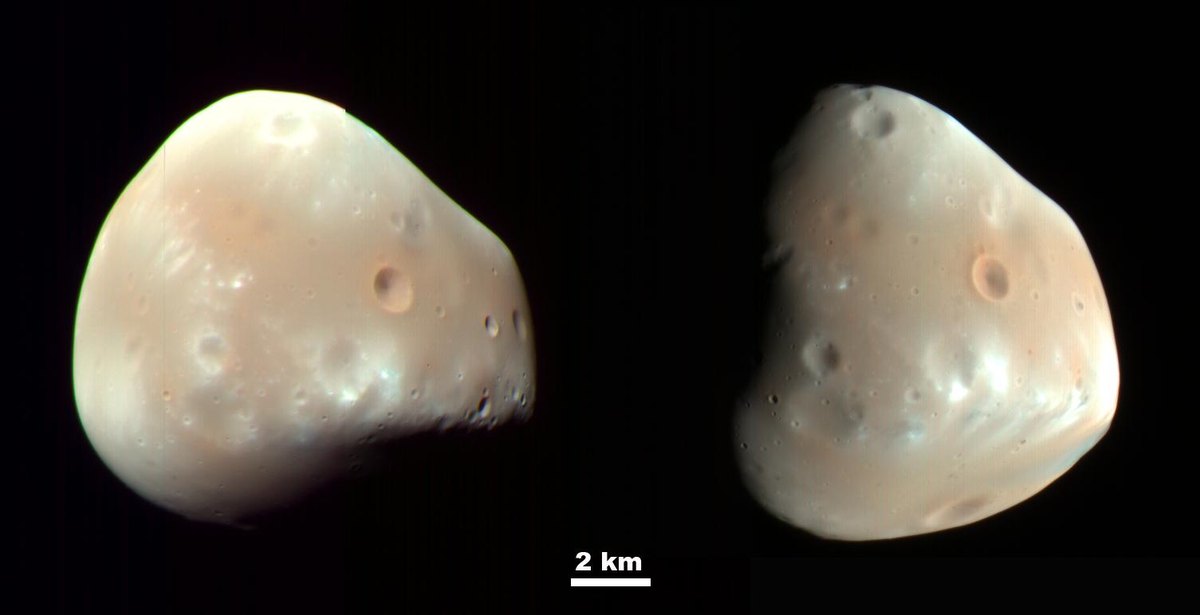
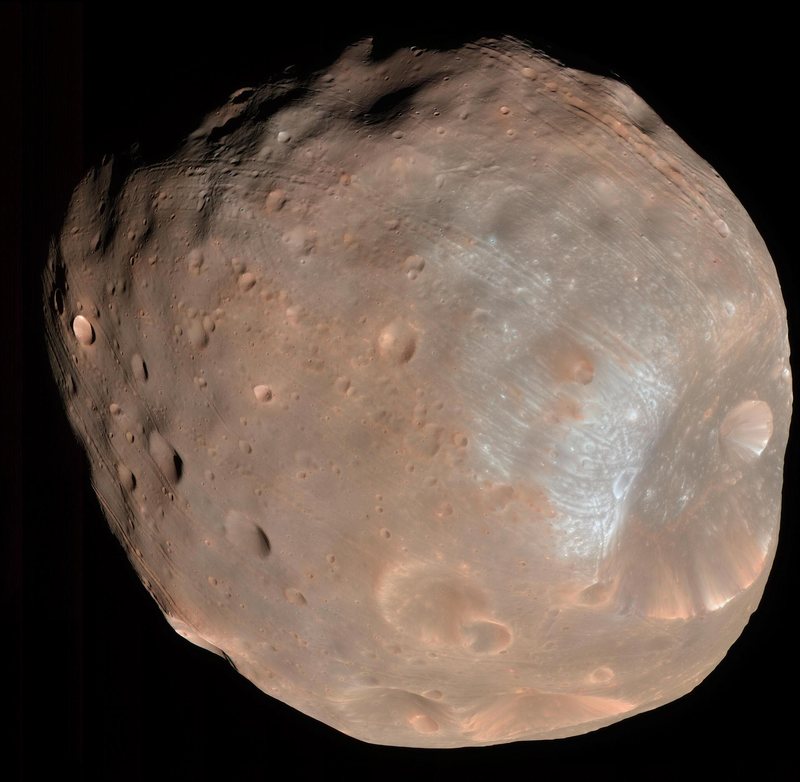
They look nothing like our Moon. Neither is massive enough to pull itself into a sphere, so both are irregular lumps, and both are very dark, reflecting only 7–8% of the sunlight that hits them. Phobos is the larger and stranger of the two. Its surface is scarred by the 9 km crater Stickney and by long parallel grooves. Deimos is smaller and smoother, with a blanket of loose dust softening its craters.

Two colour views of Mars's smaller moon Deimos taken by the HiRISE camera on NASA's Mars Reconnaissance Orbiter in 2009, with a 2 km scale bar
Deimos from NASA’s Mars Reconnaissance Orbiter (HiRISE, 2009). The scale bar is 2 km. Credit: NASA/JPL-Caltech/University of Arizona.
PhobosDeimos
Size27 × 22 × 18 km15 × 12 × 11 km
Distance from Mars’s centre9,378 km (about 6,000 km above the surface)23,459 km (about 20,000 km above the surface)
Orbital period7 h 39 min30 h 18 min
OrbitAlmost circular, close to Mars’s equatorAlmost perfectly circular, close to the equator
Reflectivity (albedo)7%8%
Brightness near the Feb 2027 oppositionabout magnitude 12.1about magnitude 13.2
DiscoveredAugust 1877, Asaph HallAugust 1877, Asaph Hall (a few days earlier)

Where Did Mars’s Moons Come From?

Nobody knows for sure, and that is one of the main reasons to visit them. There are two leading ideas:

1. Captured asteroids

Their dark, lumpy appearance resembles the carbon-rich asteroids of the outer main belt, so Mars may have snared two passing asteroids billions of years ago. The difficulty is that capture usually leaves a moon on a tilted, stretched orbit. Both moons instead follow near-circular paths almost exactly over Mars’s equator.

2. Debris from a giant impact

A large body may have struck Mars early in its history and thrown a disk of material into orbit, from which the moons formed, much as our own Moon is thought to have formed. That would explain the neat, equatorial orbits, and it would mean Phobos contains pieces of ancient Mars.

The two ideas predict different chemistry, so a sample of Phobos in a laboratory should tell them apart. NASA notes that the answer also bears on how the inner planets got their water and organic compounds. That is the job of Japan’s MMX mission, described below.

Phobos Is Falling Toward Mars

Phobos orbits Mars faster than Mars spins, so the tidal bulge it raises on the planet lags behind it and drags it down. NASA puts the rate at about 1.8 metres (6 feet) every hundred years. That sounds tiny, but it adds up. In roughly 30 to 50 million years, Phobos will either crash into Mars or be torn apart by tides and spread into a ring around the planet.

Its long surface grooves may be the first signs of that breakup. A 2015 study from NASA’s Goddard Space Flight Center modelled them as stretch marks from tidal stress on a weak, rubble-pile interior, rather than scars from the Stickney impact. Deimos is in the opposite situation: it orbits more slowly than Mars turns, so it is drifting very gradually outward.

Colour view of Phobos from NASA's Mars Reconnaissance Orbiter showing the large crater Stickney and the moon's parallel grooves
Phobos from about 6,800 km, imaged by HiRISE on NASA’s Mars Reconnaissance Orbiter on March 23, 2008. Stickney crater is at right, and the grooves run across the surface. Credit: NASA/JPL-Caltech/University of Arizona.

What the Moons Look Like From Mars

An astronaut on Mars would see something no Earth sky offers: a moon that comes up in the west and goes down in the east. Phobos completes an orbit in 7 hours 39 minutes, faster than Mars rotates (24 hours 37 minutes), so it overtakes the turning planet. It rises in the west roughly every 11 hours, about twice a Martian day, and crosses the sky in about four hours.

Even so, Phobos would look small, less than half the width of our full Moon, and it is so close to Mars that it never rises at all for observers near the poles. Deimos moves the conventional way, rising in the east, but so slowly that it stays above the horizon for more than two days at a time. It would look like a bright star rather than a disk.

Can You See Phobos and Deimos With a Telescope?

Yes, but they are among the hardest targets in the solar system, and not because they are faint. At magnitude 12 to 13, Phobos and Deimos are about as bright as the faint galaxies a 6-inch telescope shows easily. The problem is where they are. Both moons hug a planet that, near opposition, is roughly 200,000 times brighter than Phobos and more than half a million times brighter than Deimos. Scattered light from Mars floods exactly the patch of sky where the moons sit.

The numbers below are for the February 19, 2027 opposition, when Mars is at its closest for this cycle.

Near the Feb 2027 oppositionPhobosDeimos
Magnitudeabout 12.1about 13.2
Greatest distance from Mars’s centre19″48″
Gap from the edge of the 13.8″ diskabout 12″ (under one Mars width)about 41″ (three Mars widths)
Time between greatest elongationsabout 3.8 hours (alternating east and west)about 15 hours
Time spent near greatest elongationabout 1.5 hours each timeabout 6 hours each time
How far Phobos and Deimos get from Mars in February 2027 To-scale diagram: Mars is a disk 13.8 arcseconds wide. Phobos reaches at most 19 arcseconds from Mars's centre on either side, and Deimos at most 48 arcseconds. Scale: 5.5 pixels per arcsecond Mars 13.8″ Phobos Phobos 19″ 19″ Deimos Deimos 48″ 48″ Greatest elongations on either side of Mars. The orange halo suggests the glare the moons sit in.
To scale for the February 2027 opposition (Mars 13.8″ across). Each moon only reaches these positions briefly. The rest of the time it is closer to Mars, or in front of or behind it.

What different telescopes can realistically do

TelescopePhobos and Deimos?
Binoculars, 70–90 mm refractorsNo. The moons are too faint for the aperture and buried in the glare.
5–6 inch (130–150 mm)Deimos is only a remote possibility, with an occulting bar, excellent seeing and the moon at greatest elongation. Phobos is not realistic.
8 inch (200 mm)Deimos becomes a fair challenge and Phobos a hard one. Most successful visual reports start at this size.
10–14 inch and largerYour best chance for both, on nights of steady air. Larger apertures also make the moons easier to separate from the glare.
Planetary camera on 8 inch or moreOften easier than visual work. With Mars deliberately overexposed, the moons can show up in short exposures.

This guidance draws on Sky & Telescope’s advice that you “need a big telescope” and on observer reports. The moons’ magnitudes alone would put them within reach of a 6-inch telescope. The glare is what raises the bar.

How to Try: Techniques That Work

1. Time it for greatest elongation

Look up when each moon is farthest east or west of Mars. A planetarium program such as Stellarium, or NASA JPL’s Horizons service, shows the moons’ positions for any time. Phobos only stays near greatest elongation for about an hour and a half, so plan the session around it.

2. Hide Mars

Put an occulting bar in the eyepiece, which can be a thin strip of aluminium foil or wire across the field stop. Turn the eyepiece so the bar runs north–south, then slide Mars behind it. The moons sit roughly east or west of the planet at elongation. Or simply move Mars just outside the edge of the field.

3. Use high power

Magnification spreads out Mars’s glare and darkens the background, but leaves the point-like moons as bright as before. Observers report success at 250–350×. A Barlow lens is the cheapest way to get there.

4. Wait for steady air

Turbulent air smears the glare outward and swallows the moons. Observe when Mars is highest, near midnight around opposition, and on nights when the stars barely twinkle. Several attempts over different nights are normal.

5. Start with Deimos

Deimos is fainter, but it gets three times farther from Mars, well out of the worst glare. Most observers catch it first. Once you have it, try for Phobos at its next greatest elongation.

6. Or image them

A planetary camera makes the job easier. Overexpose Mars on purpose, take short exposures, and look for the moons near its position. Spider vanes in a reflector add diffraction spikes from Mars, so rotate the camera to keep the spikes away from the moons.

Best Dates: The February 2027 Opposition

Mars reaches opposition on February 19, 2027, and its closest point to Earth on February 20, at 101.4 million km. It will shine at magnitude −1.2 in Leo and show a disk 13.8″ across. This is Mars’s most distant opposition of the century, so the planet is smaller than in recent years. For moon hunters that is not all bad: Mars is fainter, so there is less glare to fight. Mars also rides high in Leo for northern observers, about 65° up at midnight from latitude 40°N, which means steadier views through less air.

DateEarth–Mars distanceMars diskPhobos / Deimos max distance from Mars
January 20, 2027116.6 million km12.0″17″ / 42″
February 1, 2027107.4 million km13.0″18″ / 45″
February 19–20, 2027101.4 million km13.8″19″ / 48″
March 10, 2027106.7 million km13.1″18″ / 45″
March 20, 2027113.7 million km12.3″17″ / 43″

The useful window is roughly late January to mid-March 2027. Through those weeks the moons stay within a few tenths of a magnitude of their best. One catch: the Moon is full on February 20 and sits only 8–10° from Mars on February 20–21, which brightens the sky right where you are looking. The darker nights fall in the first half of February and the first half of March, around the new Moons of February 6 and March 8.

Planning the rest of your Mars season: see our Mars opposition 2027 guide and how to see Mars with a telescope.

MMX: The Mission to Bring Back a Piece of Phobos

Japan’s space agency JAXA launched Martian Moons eXploration (MMX) on an H3 rocket from Tanegashima Space Center at 3:41 p.m. EDT on October 19, 2026, which was 4:41 a.m. on October 20 in Japan. It is the first mission designed to land on Phobos and return a sample to Earth.

  • • August 2027: arrival at Mars, followed by a survey of both moons from orbit.
  • • No earlier than December 2028: landing on Phobos. Before the main spacecraft touches down, it drops Idefix, a 25 kg four-wheeled rover built by France’s CNES and Germany’s DLR, to explore the surface.
  • • Sample: at least 10 grams of Phobos, gathered with a coring sampler and NASA’s gas-jet P-Sampler mounted on a landing leg.
  • • 2031: the sample capsule returns to Earth. NASA will curate about 15% of the material at Johnson Space Center.

NASA also supplied MEGANE, a gamma-ray and neutron spectrometer built at the Johns Hopkins Applied Physics Laboratory that will map Phobos’s chemical makeup from orbit, plus tracking through the Deep Space Network. ESA provided the deep-space communication equipment and ground-station support. Mission dates beyond launch are current plans and may shift.

Telescopes and Accessories for Hunting Mars’s Moons

Aperture and steady tracking are what count here. These are the scopes and accessories from our planetary guides that suit the challenge:

Sky-Watcher Classic 200P

Sky-Watcher Classic 200P

An 8-inch Dobsonian, the most affordable way to get the aperture this challenge needs. It also gives excellent views of Mars itself at the 2027 opposition.

Celestron NexStar 8SE

Celestron NexStar 8SE

An 8-inch GoTo Schmidt-Cassegrain. Its tracking keeps Mars parked behind an occulting bar while you wait for steady moments, and its closed tube has no spider-vane spikes.

Accessories

Celestron Omni 2x Barlow Lens

Celestron Omni 2x Barlow Lens

Doubles the magnification of your eyepieces to reach the 250x and more that helps darken the glare around Mars.

Comparing more options? See our guides to the best telescopes for viewing planets and the best planetary cameras.

Frequently Asked Questions

What are Phobos and Deimos?

They are the two moons of Mars. Both are small, dark, irregular bodies: Phobos measures about 27 by 22 by 18 km and Deimos about 15 by 12 by 11 km. Asaph Hall discovered them in August 1877 and named them after the sons of Ares, meaning fear and dread.

Can you see Phobos and Deimos with a telescope?

Yes, but it is difficult. Near the February 2027 opposition they are about magnitude 12 and 13, which would be easy in a 6-inch telescope if Mars were not so close. In practice you need about an 8-inch telescope or larger, steady air, high magnification, and a way to hide Mars, such as an occulting bar or placing Mars just outside the field of view.

Which moon of Mars is easier to see?

Deimos is usually easier, even though it is about one magnitude fainter. At greatest elongation it gets about 48 arcseconds from the centre of Mars, roughly three Mars widths from the edge of the disk. Phobos never gets more than about 19 arcseconds from the centre, well inside the glare.

When is the best time to see Mars’s moons?

Around a Mars opposition. The next is February 19, 2027. The best nights are in the first half of February and the first half of March 2027, because the full Moon sits close to Mars on February 20–21. Within a night, look when each moon is at greatest elongation, farthest east or west of Mars, and when Mars is high, near midnight.

Is Phobos going to crash into Mars?

Eventually, yes. Tides are drawing Phobos inward by about 1.8 metres every hundred years. In roughly 30 to 50 million years it will either hit Mars or be torn apart into a ring around the planet.

Where did Phobos and Deimos come from?

That is still debated. They may be asteroids captured by Mars long ago, or they may have formed from debris thrown into orbit by a giant impact on Mars. Japan’s MMX mission aims to answer the question by returning a sample of Phobos to Earth in 2031.

What is the MMX mission?

Martian Moons eXploration (MMX) is a JAXA mission launched on October 19, 2026 (October 20 in Japan). It arrives at Mars in August 2027, will land on Phobos no earlier than December 2028 with the help of the CNES/DLR rover Idefix, and will bring at least 10 grams of Phobos back to Earth in 2031. NASA and ESA are partners.

Sources, Method & Image Credits

Some links in this article are affiliate links. If you buy through them, we may earn a small commission at no extra cost to you. It never changes which products we recommend. See our affiliate disclosure.